Hawaii: Right-of-way and turning — Part 2 Practice Test
Questions in this part include: “Which of these is a condition under which you must not pass?” · “You must not pass when approaching within what distance of any intersection or railroad crossing?”
Independent educational site · not affiliated with any government agency or DMV
Ready? Test yourself
- Instant feedback with an explanation
- Every answer cites its source in the manual
- Your best score is saved on this device
Questions are original and based on the official manual "Hawaii Driver's Manual" (2023), Hawaii Department of Transportation.
All 20 questions in this practice test
Take the test above first, then use this list to study. Tap “Show answer” to see the correct answer and explanation.
Show the questions and answersHide the questions
-
What should you NOT do when you meet a funeral procession?
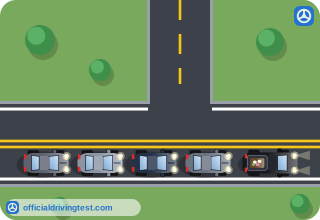
- Drive in the right lane while the whole procession passes you
- Drive your vehicle between the vehicles in the procession
- Stop at an intersection while the procession passes
- Reduce your speed as the procession approaches you
Show answer
Correct answer: Drive your vehicle between the vehicles in the procession
You should not drive your vehicle between the vehicles in a funeral procession.
Source: Hawaii Driver's Manual (2023), page 29 · Open this page in the manual (Manual page 29)
-
Which of these is a condition under which you must not pass?
- On a one-way street with two or more lanes marked for traffic
- On a paved street with two or more lanes marked for traffic in each direction
- On the right shoulder of the highway
- When the vehicle you are passing is about to make a left turn
Show answer
Correct answer: On the right shoulder of the highway
The manual lists passing on the right shoulder of the highway among the no-passing conditions.
Source: Hawaii Driver's Manual (2023), page 30 · Open this page in the manual (Manual page 30)
-
When approaching a hill or curve, you must not pass if there is not what clear distance ahead?
- 200 to 400 feet (61m to 122m)
- 300 to 500 feet (91m to 152m)
- 400 to 600 feet (122m to 183m)
- 700 to 1000 feet (213m to 305m)
Show answer
Correct answer: 700 to 1000 feet (213m to 305m)
Do not pass on approaching a hill or curve where there is not 700 to 1000 feet (213m to 305m) of clear distance ahead.
Source: Hawaii Driver's Manual (2023), page 30 · Open this page in the manual (Manual page 30)
-
In which situation must you not pass?
- When the vehicle ahead is traveling much slower than the posted speed limit
- When the pass cannot be finished without endangering the oncoming vehicle
- When it is daytime and the road is dry
- When you have signaled and checked your mirrors
Show answer
Correct answer: When the pass cannot be finished without endangering the oncoming vehicle
Do not pass when the pass cannot be completed without interfering with the safety of the oncoming vehicle and before the yellow line appears in your traffic lane.
Source: Hawaii Driver's Manual (2023), page 30 · Open this page in the manual (Manual page 30)
-
When you are being passed, what is unlawful?
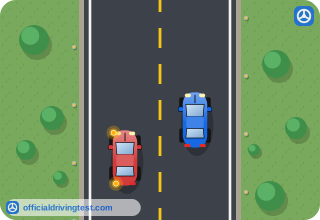
- Slowing down to let the vehicle by
- Staying in your lane
- Increasing your speed
- Moving to the right side of your lane
Show answer
Correct answer: Increasing your speed
When you are being passed, it is unlawful to increase your speed.
Source: Hawaii Driver's Manual (2023), page 30 · Open this page in the manual (Manual page 30)
-
When must you not pass a school bus on the same roadway?
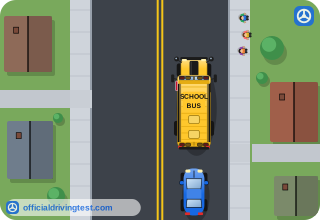
- When it is moving along the road
- When it is parked near a school
- When its flashing lights are operating
- During the morning and afternoon school hours
Show answer
Correct answer: When its flashing lights are operating
Do not pass when there is a school bus on the same roadway when the flashing lights are operating.
Source: Hawaii Driver's Manual (2023), page 31 · Open this page in the manual (Manual page 31)
-
You must not pass when approaching within what distance of any intersection or railroad crossing?
- 50 feet (15m)
- 100 feet (30m)
- 200 feet (60m)
- 500 feet (150m)
Show answer
Correct answer: 100 feet (30m)
Do not pass when approaching within 100 feet (30m) of or when traversing any intersection or railroad crossing.
Source: Hawaii Driver's Manual (2023), page 31 · Open this page in the manual (Manual page 31)
-
You must not pass within 100 feet (30m) of which of these?
- A parking lot entrance on a side street ahead of you
- A gas station next to the road
- A rest area beside the highway
- Any posted narrow bridge, viaduct or tunnel
Show answer
Correct answer: Any posted narrow bridge, viaduct or tunnel
Do not pass when approaching within 100 feet (30m) of any posted narrow bridge, viaduct or tunnel.
Source: Hawaii Driver's Manual (2023), page 31 · Open this page in the manual (Manual page 31)
-
What does the end of a "no passing zone" mean?
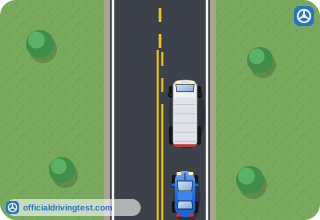
- That it is safe to pass at once
- That passing is now required of you
- Only that there is increased visibility ahead
- That the posted speed limit has been raised ahead
Show answer
Correct answer: Only that there is increased visibility ahead
The end of a no passing zone does not mean it is safe to pass; it means there is increased visibility ahead.
Source: Hawaii Driver's Manual (2023), page 31 · Open this page in the manual (Manual page 31)
-
Your vehicle and another vehicle approach an intersection at the same time. Which vehicle must yield?
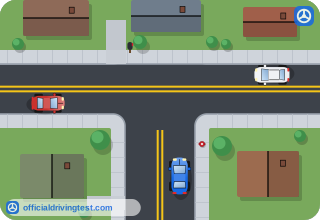
- Yield to the car on your right
- Yield to the car on your left
- The faster vehicle yields
- The vehicle on the right must yield
Show answer
Correct answer: Yield to the car on your right
The manual says to yield to the car on the right when vehicles approach at the same time.
Source: Hawaii Driver's Manual (2023), page 32 · Open this page in the manual (Manual page 32)
-
When you turn left at an intersection, whom must you yield to?
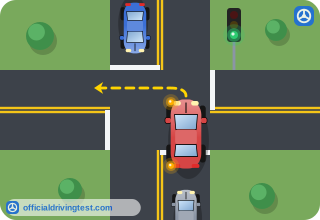
- Only oncoming vehicles that have their headlamps turned on
- Only oncoming vehicles that are turning right
- No one, if you signaled first
- All oncoming traffic that is so close as to be a hazard
Show answer
Correct answer: All oncoming traffic that is so close as to be a hazard
When turning left, you must yield to all oncoming traffic that is so close as to be a hazard.
Source: Hawaii Driver's Manual (2023), page 32 · Open this page in the manual (Manual page 32)
-
You face a yield sign and cross traffic is on the protected route. What must you do?
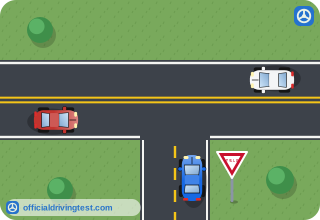
- Speed up to clear the intersection first
- Yield to all traffic on the protected route
- Go first if you arrived first
- Yield only to traffic coming from your right
Show answer
Correct answer: Yield to all traffic on the protected route
The right-of-way diagram says to yield to all traffic on the protected route.
Source: Hawaii Driver's Manual (2023), page 32 · Open this page in the manual (Manual page 32)
-
You face a stop sign and cross traffic is on the protected route. What must you do?
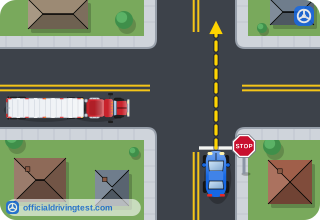
- Slow down and yield only to traffic from your right side
- Stop and yield to all traffic on the protected route
- Stop, then go first if you arrived first
- Stop only if other vehicles are in sight
Show answer
Correct answer: Stop and yield to all traffic on the protected route
The right-of-way diagram says to stop and yield to all traffic on the protected route.
Source: Hawaii Driver's Manual (2023), page 32 · Open this page in the manual (Manual page 32)
-
When the traffic light turns green and you are about to start through the intersection, whom must you yield to?
- Only pedestrians who are in a marked crosswalk nearby
- Only vehicles coming from your right side
- No one, since you have a green light to go
- Pedestrians and cars caught in the intersection
Show answer
Correct answer: Pedestrians and cars caught in the intersection
The manual says to yield to pedestrians and cars caught in the intersection when the light turns green.
Source: Hawaii Driver's Manual (2023), page 32 · Open this page in the manual (Manual page 32)
-
What must you do when entering a public street or road from an alley, driveway or farmyard?
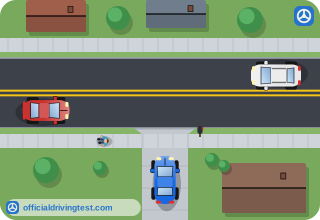
- Stop and yield
- Slow down and yield only to traffic from your left
- Enter first if you are turning right
- Sound your horn and proceed
Show answer
Correct answer: Stop and yield
The manual says to stop and yield when entering any public street or road from an alley, driveway or farmyard.
Source: Hawaii Driver's Manual (2023), page 32 · Open this page in the manual (Manual page 32)
-
Where must the stop be made at a STOP sign?
- Past the crosswalk, at the edge of the intersection
- Wherever you can first see the cross traffic
- In the middle of the crosswalk
- At the “stop line”
Show answer
Correct answer: At the “stop line”
The stop must be made at the “stop line”.
Source: Hawaii Driver's Manual (2023), page 44 · Open this page in the manual (Manual page 44)
-
There is no “stop line” at a STOP sign. Where must you stop?
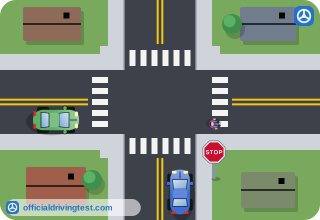
- Just past the crosswalk, where you can see traffic
- Before crossing any marked or unmarked crosswalk
- In the middle of the intersection
- Only after entering the crosswalk if pedestrians are there
Show answer
Correct answer: Before crossing any marked or unmarked crosswalk
If there is no “stop line”, you must stop before crossing any marked or unmarked crosswalk.
Source: Hawaii Driver's Manual (2023), page 44 · Open this page in the manual (Manual page 44)
-
You cannot see other traffic from your first stop at a STOP sign. What should you do?
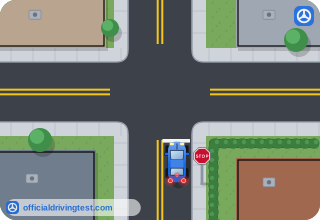
- Wait at the stop line until all traffic has cleared the intersection
- Honk your horn and wait for other drivers to wave you ahead
- Move ahead slowly and stop again where you can see approaching traffic
- Proceed through the intersection at normal speed after you signal
Show answer
Correct answer: Move ahead slowly and stop again where you can see approaching traffic
When you cannot see other traffic from the first stop, you move ahead slowly and stop again where you can see approaching traffic.
Source: Hawaii Driver's Manual (2023), page 44 · Open this page in the manual (Manual page 44)
-
What must you do when a lane use control sign is posted for your traffic lane?
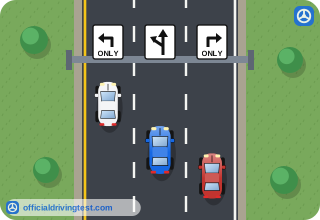
- Treat the arrows as a suggestion unless police are present
- Move your vehicle only in the direction indicated for your lane
- Turn left from any lane if the way is clear
- Use any lane as long as you signal early
Show answer
Correct answer: Move your vehicle only in the direction indicated for your lane
You must move your vehicle only in the direction indicated for your traffic lane.
Source: Hawaii Driver's Manual (2023), page 45 · Open this page in the manual (Manual page 45)
-
Before changing lanes or driving away from the curb, what did the proper procedure always require?
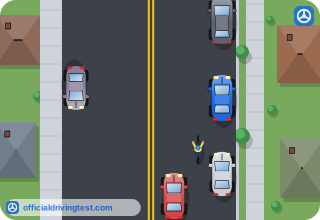
- Check the rear view mirror once before moving over
- Sound the horn to warn nearby drivers
- Turn your head and look behind you for oncoming traffic
- Wait for every following vehicle to pass first
Show answer
Correct answer: Turn your head and look behind you for oncoming traffic
The proper procedure required you to turn your head and look behind you before taking any action; reducing it to the mirror is a “bad” habit.
Source: Hawaii Driver's Manual (2023), page 57 · Open this page in the manual (Manual page 57)