Hawaii: Right-of-way and turning — Part 1 Practice Test
Questions in this part include: “When you are moving slower than other traffic, which lane should you drive in?” · “On a one-way street, when may you pass to the right of another vehicle?”
Independent educational site · not affiliated with any government agency or DMV
Ready? Test yourself
- Instant feedback with an explanation
- Every answer cites its source in the manual
- Your best score is saved on this device
Questions are original and based on the official manual "Hawaii Driver's Manual" (2023), Hawaii Department of Transportation.
All 20 questions in this practice test
Take the test above first, then use this list to study. Tap “Show answer” to see the correct answer and explanation.
Show the questions and answersHide the questions
-
Under the general rule, which part of the roadway must you drive on?
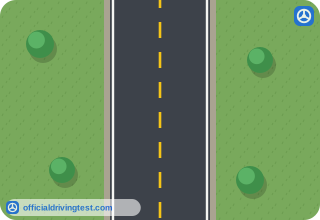
- The right half of the roadway
- The left half of the roadway
- The center of the roadway
- Whichever half has less traffic
Show answer
Correct answer: The right half of the roadway
The manual says you must drive on the right half of the roadway.
Source: Hawaii Driver's Manual (2023), page 26 · Open this page in the manual (Manual page 26)
-
Vehicles going in opposite directions must pass each other on which side?
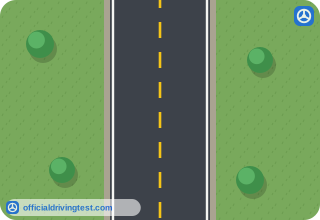
- On the left
- On the side with the wider shoulder
- On the right
- On the side chosen by the faster vehicle
Show answer
Correct answer: On the right
Vehicles going in opposite directions must pass each other on the right.
Source: Hawaii Driver's Manual (2023), page 26 · Open this page in the manual (Manual page 26)
-
On narrow roads, how much of the main traveled portion of the road must you allow vehicles going in the opposite direction?
- At least one-third
- At least one-half
- At least one-quarter
- At least two-thirds
Show answer
Correct answer: At least one-half
You must allow vehicles going in the opposite direction at least one-half of the main traveled portion of the road.
Source: Hawaii Driver's Manual (2023), page 26 · Open this page in the manual (Manual page 26)
-
When you are moving slower than other traffic, which lane should you drive in?
- The center lane
- The extreme left lane
- The lane with the least traffic
- The extreme right lane
Show answer
Correct answer: The extreme right lane
The manual says that when moving slower than other traffic you should drive in the extreme right lane.
Source: Hawaii Driver's Manual (2023), page 26 · Open this page in the manual (Manual page 26)
-
In which situation may you drive on the left half of the roadway?
- When approaching the top of a hill
- When approaching a curve
- When driving on a one-way street or road
- When you are within 100 feet of an intersection
Show answer
Correct answer: When driving on a one-way street or road
Driving on a one-way street or road is one of the situations in which you may drive on the left half of the roadway.
Source: Hawaii Driver's Manual (2023), page 26 · Open this page in the manual (Manual page 26)
-
In which situation must you NOT drive on the left half of the roadway?
- When approaching the top of a hill
- When driving on a one-way street or road
- When overtaking a vehicle on a two-lane road with no oncoming traffic
- When an obstruction blocks the roadway and oncoming vehicles are not using the left half
Show answer
Correct answer: When approaching the top of a hill
You must not drive on the left half of the roadway when approaching the top of a hill or on a curve.
Source: Hawaii Driver's Manual (2023), page 26 · Open this page in the manual (Manual page 26)
-
You must not drive on the left half of the roadway when approaching or passing through an intersection or railroad crossing. Within what distance does this apply?
- Within 50 feet (15m)
- Within 200 feet (61m)
- Within 300 feet (91m)
- Within 100 feet (30.5m)
Show answer
Correct answer: Within 100 feet (30.5m)
The manual prohibits driving on the left half when approaching within 100 feet (30.5m) of or passing through an intersection or railroad crossing.
Source: Hawaii Driver's Manual (2023), page 26 · Open this page in the manual (Manual page 26)
-
On a road with four or more lanes for moving traffic, when may you drive on the left half of the roadway?
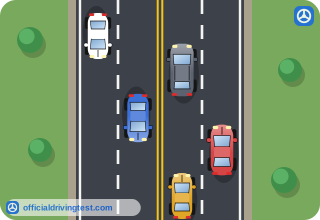
- Whenever you are overtaking a slower vehicle
- Only when signs direct otherwise
- Whenever the left lane is empty
- Whenever you have signaled first
Show answer
Correct answer: Only when signs direct otherwise
You must not drive on the left half of a road with four or more lanes for moving traffic unless otherwise directed by signs.
Source: Hawaii Driver's Manual (2023), page 26 · Open this page in the manual (Manual page 26)
-
Within 100 feet of a bridge or tunnel, you must NOT drive on the left half of the roadway when which condition is true?
- The bridge or tunnel is longer than 100 feet
- You cannot see vehicles coming toward you
- The road surface is wet
- The bridge or tunnel has a toll
Show answer
Correct answer: You cannot see vehicles coming toward you
The rule applies when you approach within 100 feet (30.5m) of a bridge or tunnel and cannot see vehicles coming from the opposite direction.
Source: Hawaii Driver's Manual (2023), page 26 · Open this page in the manual (Manual page 26)
-
In which situation may you pass to the right of another vehicle?
- When the vehicle ahead is slowing to make a right turn
- On a two-lane road with one lane marked for each direction
- When the shoulder of the road is wide enough to hold your whole vehicle
- When the vehicle you are passing is about to make a left turn
Show answer
Correct answer: When the vehicle you are passing is about to make a left turn
You may pass to the right when the vehicle you are passing is about to make a left turn.
Source: Hawaii Driver's Manual (2023), page 26 · Open this page in the manual (Manual page 26)
-
On a paved street or highway, how many lanes marked for traffic in each direction must there be before you may pass to the right of another vehicle?
- Two or more
- One
- Three or more
- Four or more
Show answer
Correct answer: Two or more
You may pass on the right on a paved street or highway with two or more lanes marked for traffic in each direction.
Source: Hawaii Driver's Manual (2023), page 26 · Open this page in the manual (Manual page 26)
-
On a one-way street, when may you pass to the right of another vehicle?
- On any one-way street
- Never, on a one-way street
- When the street has two or more lanes marked for traffic
- Only when the street has three or more lanes marked for traffic
Show answer
Correct answer: When the street has two or more lanes marked for traffic
You may pass on the right on a one-way street with two or more lanes marked for traffic.
Source: Hawaii Driver's Manual (2023), page 26 · Open this page in the manual (Manual page 26)
-
When you pass to the right of a vehicle that is about to make a left turn, what must you NOT do?
- Use your turn signal before you start to pass
- Slow down and stay in the same lane while you are passing
- Pass within a lane that is marked for traffic
- Drive off the main traveled portion of the roadway
Show answer
Correct answer: Drive off the main traveled portion of the roadway
You may pass on the right of a vehicle about to turn left, but you may not drive off the pavement or main traveled portion of the roadway to pass.
Source: Hawaii Driver's Manual (2023), page 26 · Open this page in the manual (Manual page 26)
-
On a one-way roadway, in which direction must you drive?
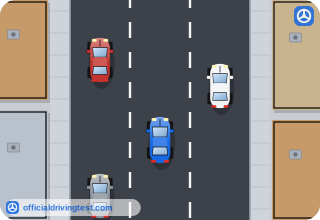
- In either direction whenever no other traffic is present nearby
- Only in the direction indicated by the posted traffic signs
- Toward the nearest oncoming vehicle
- In the direction of the heaviest traffic
Show answer
Correct answer: Only in the direction indicated by the posted traffic signs
You must drive only in the direction indicated by the posted traffic signs.
Source: Hawaii Driver's Manual (2023), page 26 · Open this page in the manual (Manual page 26)
-
On a street or road marked with traffic lanes, what must you do?
- Straddle two lanes for a while when traffic is light
- Change lanes whenever the next lane is moving faster
- Drive entirely within your marked lane and change only when safe
- Stay in one lane only on roads with four or more marked lanes of traffic
Show answer
Correct answer: Drive entirely within your marked lane and change only when safe
You must drive entirely within the marked lane and not change lanes until you have checked that the change can be made safely.
Source: Hawaii Driver's Manual (2023), page 26 · Open this page in the manual (Manual page 26)
-
What must you do about the orders and directions of a police officer?
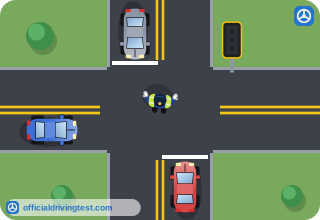
- Obey all lawful orders and directions
- Obey them only when no traffic signal is present
- Obey them only when signs agree with them
- Treat them as advice
Show answer
Correct answer: Obey all lawful orders and directions
You must obey all lawful orders and directions of a police officer.
Source: Hawaii Driver's Manual (2023), page 26 · Open this page in the manual (Manual page 26)
-
When a highway is divided by a barrier or an unpaved space, when may you drive across or through it?
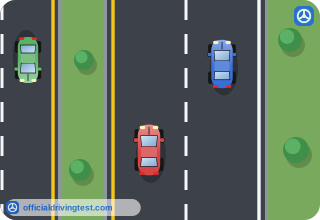
- Whenever there is no oncoming traffic on either side
- Whenever the unpaved space is dry and the ground is level enough to cross
- Only at an opening or paved surface that signs do not prohibit
- Whenever you signal first and check for traffic
Show answer
Correct answer: Only at an opening or paved surface that signs do not prohibit
You must not cross the barrier or space except where an opening or paved surface is provided and signs do not prohibit it.
Source: Hawaii Driver's Manual (2023), page 27 · Open this page in the manual (Manual page 27)
-
What right do funeral processions and convoys have at intersections?
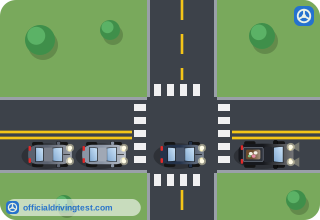
- They must yield at every intersection
- They must stop and wait for a green light
- The right of way
- They have no special right of way
Show answer
Correct answer: The right of way
Funeral processions and convoys have the right of way at intersections.
Source: Hawaii Driver's Manual (2023), page 29 · Open this page in the manual (Manual page 29)
-
How do vehicles in a convoy or funeral procession usually identify themselves?
- By using headlamps
- By flashing their hazard lights
- By sounding their horns at intersections
- By driving with parking lights only
Show answer
Correct answer: By using headlamps
Vehicles in a convoy or procession will usually use headlamps for identification.
Source: Hawaii Driver's Manual (2023), page 29 · Open this page in the manual (Manual page 29)
-
Which vehicles in a funeral procession will usually have a distinctive marking?
- Every vehicle in the procession
- Only the first vehicle
- Only the last vehicle
- The first and last vehicles
Show answer
Correct answer: The first and last vehicles
The first and last vehicles of a procession will usually have a distinctive marking.
Source: Hawaii Driver's Manual (2023), page 29 · Open this page in the manual (Manual page 29)