Hawaii: Railroad crossings Practice Test
Railroad signs and signals and when you must stop before the tracks.
Independent educational site · not affiliated with any government agency or DMV
Ready? Test yourself
- Instant feedback with an explanation
- Every answer cites its source in the manual
- Your best score is saved on this device
Questions are original and based on the official manual "Hawaii Driver's Manual" (2023), Hawaii Department of Transportation.
All 5 questions in this practice test
Take the test above first, then use this list to study. Tap “Show answer” to see the correct answer and explanation.
Show the questions and answersHide the questions
-
When you must stop for a railroad crossing, how close to the nearest rail may you stop?
- Not less than 5 feet (1.5m)
- Not less than 15 feet (4.6m)
- Not less than 30 feet (9m)
- Not less than 50 feet (15m)
Show answer
Correct answer: Not less than 15 feet (4.6m)
You must stop your vehicle not less than 15 feet (4.6m) from the nearest rail in the listed situations.
Source: Hawaii Driver's Manual (2023), page 27 · Open this page in the manual (Manual page 27)
-
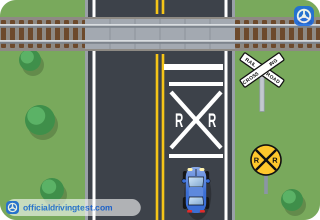
At a railroad crossing, which situation requires you to stop at least 15 feet from the nearest rail?
- The tracks look unused from where you are stopped
- You are driving on a one-way street within sight of the tracks
- A gate is lowered or a flagman signals a train is coming
- The crossing is on a road with a posted speed limit
Show answer
Correct answer: A gate is lowered or a flagman signals a train is coming
A lowered crossing gate or a flagman signaling the approach of a train requires you to stop not less than 15 feet from the nearest rail.
Source: Hawaii Driver's Manual (2023), page 27 · Open this page in the manual (Manual page 27)
-
A train approaching within what distance gives audible warning of its approach, requiring you to stop at least 15 feet from the nearest rail?
- 1,500 feet (460m)
- 500 feet (150m)
- 1,000 feet (305m)
- 2,500 feet (760m)
Show answer
Correct answer: 1,500 feet (460m)
You must stop when a train approaching within 1,500 feet (460m) gives audible warning of its approach.
Source: Hawaii Driver's Manual (2023), page 27 · Open this page in the manual (Manual page 27)
-
When an approaching train is visible, in what case must you stop at least 15 feet from the nearest rail?
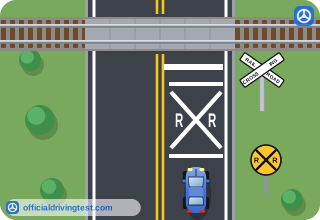
- When it is so close as to constitute a hazard
- Only when it is sounding its horn at the crossing
- Only when a crossing gate is lowered across the road
- Only when a flagman signals you to stop
Show answer
Correct answer: When it is so close as to constitute a hazard
You must stop when the approaching train is visible and so close as to constitute a hazard.
Source: Hawaii Driver's Manual (2023), page 27 · Open this page in the manual (Manual page 27)
-
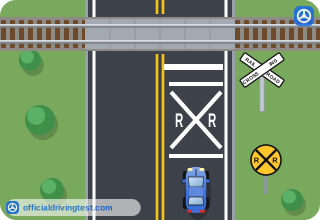
What is the purpose of the solid yellow centerline that extends the entire distance of a railroad crossing marking?
- To show where pedestrians cross
- To guide you around an obstruction
- To mark the edge of the roadway
- To prevent passing
Show answer
Correct answer: To prevent passing
A solid yellow centerline extends the entire distance of the railroad crossing markings to prevent passing.
Source: Hawaii Driver's Manual (2023), page 38 · Open this page in the manual (Manual page 38)