Hawaii: Freeway driving Practice Test
Entering and leaving freeways, merging, lane use and what to do if you miss your exit.
Independent educational site · not affiliated with any government agency or DMV
Ready? Test yourself
- Instant feedback with an explanation
- Every answer cites its source in the manual
- Your best score is saved on this device
Questions are original and based on the official manual "Hawaii Driver's Manual" (2023), Hawaii Department of Transportation.
All 15 questions in this practice test
Take the test above first, then use this list to study. Tap “Show answer” to see the correct answer and explanation.
Show the questions and answersHide the questions
-
Which of these does a freeway NOT have?
- Entrances at planned locations
- Exits at planned locations
- Signs directing you to the correct entrance
- Traffic signals
Show answer
Correct answer: Traffic signals
Freeways have no stop signs, no traffic signals, no railroad crossings, and no entrances or exits except at planned locations.
Source: Hawaii Driver's Manual (2023), page 77 · Open this page in the manual (Manual page 77)
-
When planning a freeway trip with a map, what should you plan exactly?
- Where you will stop to rest on the shoulder
- Where you are going to enter and leave the freeway
- Which lane you will stay in for the whole trip
- How many vehicles you will pass
Show answer
Correct answer: Where you are going to enter and leave the freeway
Under “Use a Map”, the manual says to plan exactly where you are going to enter and leave the freeway.
Source: Hawaii Driver's Manual (2023), page 78 · Open this page in the manual (Manual page 78)
-
Where are service stations located in relation to a freeway?
- On the right lane of the freeway
- In the median
- Off the freeway
- Along the breakdown lane
Show answer
Correct answer: Off the freeway
The manual says to be sure your vehicle is properly equipped, because service stations are located off the freeway.
Source: Hawaii Driver's Manual (2023), page 78 · Open this page in the manual (Manual page 78)
-
If the freeway entrance lane is congested, what should you do?
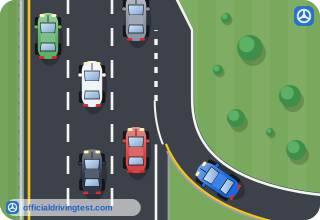
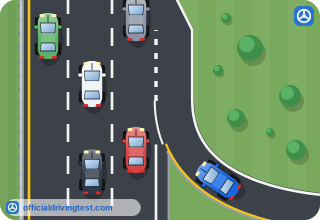
- Slow down or stop near the entrance, not at the end of the entrance lane
- Move slowly to the end of the entrance lane and stop to wait for a gap
- Stop in the freeway near lane
- Use the hazard warning signals and merge
Show answer
Correct answer: Slow down or stop near the entrance, not at the end of the entrance lane
The manual says if the entrance lane is congested, slow down or stop near the entrance and do not move slowly to the end of the entrance lane and stop.
Source: Hawaii Driver's Manual (2023), page 78 · Open this page in the manual (Manual page 78)
-
When the freeway entrance lane is clear, what should you do to merge?
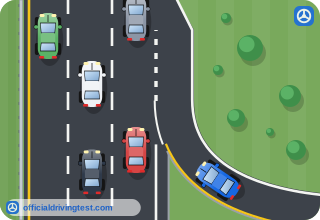
- Stop at the end of the entrance lane and wait for a gap in traffic
- Merge at a speed slower than freeway traffic
- Use the hazard warning signals while merging
- Use your turn signal, then increase speed to match the freeway traffic
Show answer
Correct answer: Use your turn signal, then increase speed to match the freeway traffic
The manual says to signal that you are going to merge, then increase your speed to match that of the freeway traffic.
Source: Hawaii Driver's Manual (2023), page 78 · Open this page in the manual (Manual page 78)
-
Which lanes should through traffic use on a freeway?
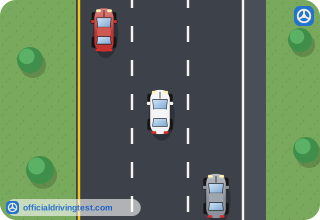
- The right lane only
- The left or center lanes
- The entry or exit lane
- The breakdown lane
Show answer
Correct answer: The left or center lanes
Through traffic should use the left or center lanes and move at or near the posted speed limit.
Source: Hawaii Driver's Manual (2023), page 79 · Open this page in the manual (Manual page 79)
-
Who uses the right lane of a freeway?
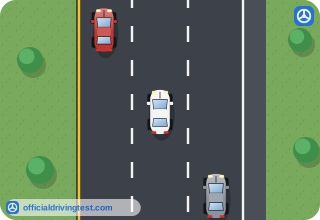
- Through traffic that is moving at or near the posted speed limit
- Vehicles that are passing slower traffic
- Vehicles that are unable to keep up with the through traffic
- Vehicles that wish to stop and rest
Show answer
Correct answer: Vehicles that are unable to keep up with the through traffic
The right lane is used by vehicles that are unable to keep up with the through traffic.
Source: Hawaii Driver's Manual (2023), page 79 · Open this page in the manual (Manual page 79)
-
If you are in the right lane of a freeway, what should you do?
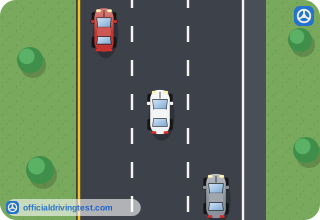
- Allow space for entering vehicles
- Follow the vehicle ahead closely
- Slow to a stop at each entrance
- Stay in the lane without checking your mirrors
Show answer
Correct answer: Allow space for entering vehicles
The manual says if you are in the right lane, allow space for entering vehicles.
Source: Hawaii Driver's Manual (2023), page 79 · Open this page in the manual (Manual page 79)
-
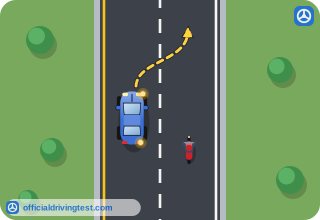
In addition to using your rear-view mirrors and signaling well in advance, what should you do before changing lanes on a freeway?
- Sound your horn
- Turn on the hazard warning signals
- Look back
- Flash your high beams
Show answer
Correct answer: Look back
The manual lists using your rear-view mirrors and looking back before changing lanes.
Source: Hawaii Driver's Manual (2023), page 79 · Open this page in the manual (Manual page 79)
-
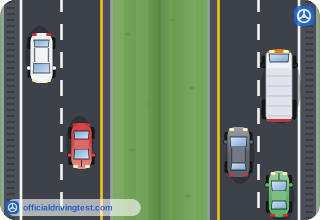
When may you stop on a freeway?
- Whenever traffic is heavy
- Only if it is absolutely unavoidable
- To let a vehicle merge in front of you
- To read a sign you may have missed
Show answer
Correct answer: Only if it is absolutely unavoidable
The manual says never to stop on the freeway unless it is absolutely unavoidable.
Source: Hawaii Driver's Manual (2023), page 79 · Open this page in the manual (Manual page 79)
-
Why should you not follow too closely on a freeway?
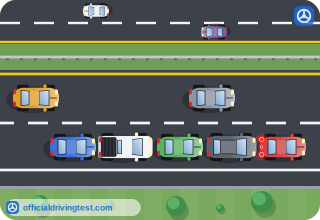
- Following closely is allowed on freeways whenever traffic is moving slowly
- Following closely uses extra fuel in the right lane
- Following closely blocks vehicles that are entering
- Rear end collisions are common on freeways and usually involve several vehicles
Show answer
Correct answer: Rear end collisions are common on freeways and usually involve several vehicles
The manual says rear end collisions are common on freeways and usually involve several vehicles.
Source: Hawaii Driver's Manual (2023), page 79 · Open this page in the manual (Manual page 79)
-
If you must proceed in the opposite direction on a freeway, what should you do?
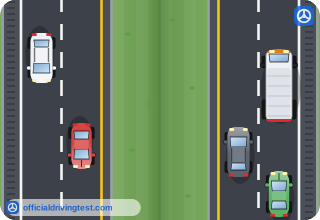
- Turn around at the nearest opening in the center divider when traffic clears
- Stop on the shoulder and wait to make a U-turn
- Go to the next exit, leave the freeway and re-enter in the opposite direction
- Back up along the shoulder to the last exit
Show answer
Correct answer: Go to the next exit, leave the freeway and re-enter in the opposite direction
The manual says never to cross the center divider, turn around or back up on a freeway; go to the next exit and re-enter in the opposite direction.
Source: Hawaii Driver's Manual (2023), page 79 · Open this page in the manual (Manual page 79)
-
In the manual’s freeway lane diagram, which lane is labeled for entering, exiting or slow travel?
- The passing lane next to the median
- The lane between the travel lane and the breakdown lane
- The travel lane next to the passing lane
- The breakdown lane at the far right edge of the road
Show answer
Correct answer: The lane between the travel lane and the breakdown lane
The diagram lists, from the median: passing lane, travel lane, entry, exit or slow travel lane, and breakdown lane.
Source: Hawaii Driver's Manual (2023), page 79 · Open this page in the manual (Manual page 79)
-
You pass the place where you intended to leave the freeway. What should you do?
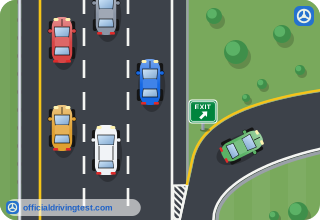
- Continue on to the next exit
- Stop on the shoulder and wait for traffic
- Back up along the shoulder to the exit
- Slow down and turn around at the nearest gap
Show answer
Correct answer: Continue on to the next exit
The manual says not to stop and not to back up if you pass your exit, but to continue on to the next exit.
Source: Hawaii Driver's Manual (2023), page 80 · Open this page in the manual (Manual page 80)
-
What should you use to show that you intend to leave the freeway?
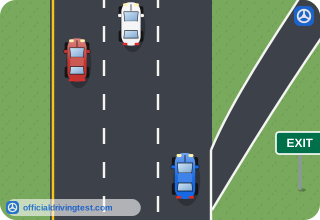
- Your hazard warning lights
- Your turn signal
- Your horn
- Your high-beam headlights
Show answer
Correct answer: Your turn signal
The manual says to use your turn signal to indicate your intention to exit.
Source: Hawaii Driver's Manual (2023), page 80 · Open this page in the manual (Manual page 80)