Hawaii: Emergency vehicles and work zones Practice Test
Yielding to emergency vehicles, construction and work zones, flaggers and arrow panels.
Independent educational site · not affiliated with any government agency or DMV
Ready? Test yourself
- Instant feedback with an explanation
- Every answer cites its source in the manual
- Your best score is saved on this device
Questions are original and based on the official manual "Hawaii Driver's Manual" (2023), Hawaii Department of Transportation.
All 21 questions in this practice test
Take the test above first, then use this list to study. Tap “Show answer” to see the correct answer and explanation.
Show the questions and answersHide the questions
-
According to the definitions, what must a private vehicle designated by ordinance be equipped with to count as an emergency vehicle?
- A yellow or amber flashing light and a warning sound system
- A white or green flashing light and a warning sound system
- A blue or red flashing light and a warning sound system
- A blue or red flashing light but no warning sound system
Show answer
Correct answer: A blue or red flashing light and a warning sound system
The definition of an emergency vehicle includes a private vehicle designated by ordinance and properly equipped with a blue or red flashing light and warning sound system.
Source: Hawaii Driver's Manual (2023), page 8 · Open this page in the manual (Manual page 8)
-
When you hear the warning signal of an emergency vehicle or see its warning lamps, what must you do?
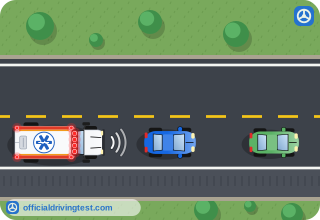
- Provide a clear path for the emergency vehicle and stop
- Speed up to get out of the way of the vehicle
- Brake hard right away, wherever you happen to be on the road
- Keep driving at the same speed in your lane
Show answer
Correct answer: Provide a clear path for the emergency vehicle and stop
You must provide a clear path for the emergency vehicle and stop, without panicking or jamming on the brakes.
Source: Hawaii Driver's Manual (2023), page 29 · Open this page in the manual (Manual page 29)
-
Which warning lamp colors on an emergency vehicle require you to provide a clear path?
- Flashing green or white
- Flashing white or purple
- Flashing red or blue
- Steady blue or green
Show answer
Correct answer: Flashing red or blue
The warning lamps of an emergency vehicle that require a clear path are flashing red or blue.
Source: Hawaii Driver's Manual (2023), page 29 · Open this page in the manual (Manual page 29)
-
If an emergency vehicle is directly behind your vehicle when you are in heavy traffic, what should you do?
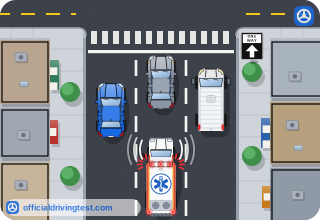
- Stop immediately in the middle of your lane and wait
- Keep moving slowly until you can get out of the way
- Brake hard and stay exactly where you are in traffic
- Speed up to stay well ahead of it until you are clear
Show answer
Correct answer: Keep moving slowly until you can get out of the way
In heavy traffic with an emergency vehicle directly behind you, keep moving slowly until you can get out of the way.
Source: Hawaii Driver's Manual (2023), page 29 · Open this page in the manual (Manual page 29)
-
What should you do when you approach a stopped emergency vehicle with its lights flashing?
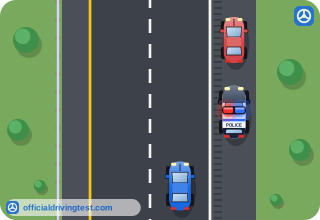
- Maintain your speed and stay in your lane next to it
- Pull in directly behind it and stop as close as you possibly can to it
- Sound your horn and pass it on the right side
- Slow down or stop, and leave an empty lane if possible and safe
Show answer
Correct answer: Slow down or stop, and leave an empty lane if possible and safe
You should slow down or stop as appropriate and move away so an empty traffic lane separates you from the emergency vehicle, if possible and safe to do so.
Source: Hawaii Driver's Manual (2023), page 29 · Open this page in the manual (Manual page 29)
-
What is the basic color of traffic control devices used in construction and maintenance work areas?
- Yellow
- Red
- Green
- Orange
Show answer
Correct answer: Orange
Orange is the basic color for these devices.
Source: Hawaii Driver's Manual (2023), page 49 · Open this page in the manual (Manual page 49)
-
Which of these is among the most commonly used traffic control devices in work areas?
- Rumble strips on the pavement
- Flashing arrow panels
- Speed cameras
- Guardrails
Show answer
Correct answer: Flashing arrow panels
The most commonly used devices are signs, barricades, drums, cones, tubes, flashing arrow panels and flagpersons.
Source: Hawaii Driver's Manual (2023), page 49 · Open this page in the manual (Manual page 49)
-
What are construction and maintenance signs used for?
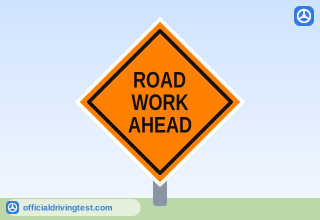
- To show drivers where parking is prohibited in or near work areas
- To give drivers route and location information in or near work areas
- To notify drivers of potentially dangerous conditions in or near work areas
- To tell pedestrians where they may safely cross the road near work areas
Show answer
Correct answer: To notify drivers of potentially dangerous conditions in or near work areas
Construction and maintenance signs notify drivers of unusual or potentially dangerous conditions in or near work areas.
Source: Hawaii Driver's Manual (2023), page 49 · Open this page in the manual (Manual page 49)
-
What shape are most signs in work areas?
- Diamond shaped
- Rectangular
- Triangular
- Octagonal
Show answer
Correct answer: Diamond shaped
Most signs in work areas are diamond shaped, and a few are rectangular.
Source: Hawaii Driver's Manual (2023), page 49 · Open this page in the manual (Manual page 49)
-
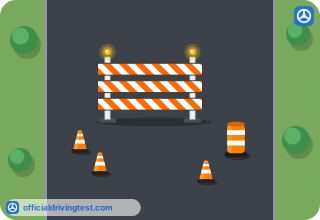
Barricades, vertical panels, drums, cones and tubes are examples of what?
- Regulatory signs
- Channelizing devices
- Lane use control signs
- Warning signs
Show answer
Correct answer: Channelizing devices
These are the most commonly used channelizing devices in highway and street work areas.
Source: Hawaii Driver's Manual (2023), page 50 · Open this page in the manual (Manual page 50)
-
At night, channelizing devices are often equipped with what?
- Reflective orange flags
- Loud warning horns
- Floodlights that shine on the road
- Flashing or steady burn lights
Show answer
Correct answer: Flashing or steady burn lights
At night they are often equipped with flashing or steady burn lights.
Source: Hawaii Driver's Manual (2023), page 50 · Open this page in the manual (Manual page 50)
-
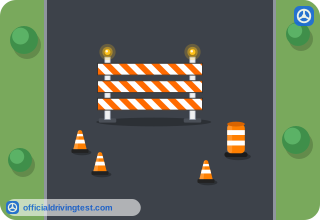
What do the diagonal stripes on a barricade or vertical panel do?
- Guide the driver towards the direction in which traffic is to pass
- Show the speed at which traffic must travel through the area
- Mark the end of the work zone and the end of the detour
- Warn that the road ahead is closed to all traffic and pedestrians
Show answer
Correct answer: Guide the driver towards the direction in which traffic is to pass
The diagonal stripes guide the driver towards the direction to which traffic is to pass.
Source: Hawaii Driver's Manual (2023), page 50 · Open this page in the manual (Manual page 50)
-
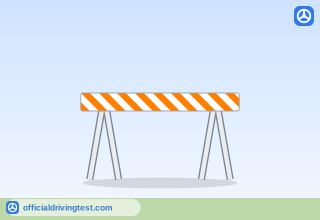
The stripes on a barricade slope downward to the right. Which way should you drive?
- Bear to the left
- Stop and wait
- Bear to the right
- Go straight ahead
Show answer
Correct answer: Bear to the right
Stripes sloping downward to the right mean the driver should bear to the right.
Source: Hawaii Driver's Manual (2023), page 50 · Open this page in the manual (Manual page 50)
-
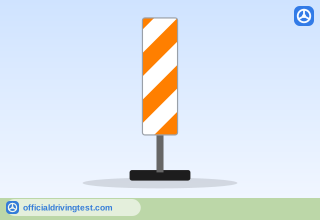
The stripes on a vertical panel slope downward to the left. Which way should you drive?
- Bear to the right
- Stop and wait
- Bear to the left
- Go straight ahead
Show answer
Correct answer: Bear to the left
Stripes sloping downward to the left mean bear to the left.
Source: Hawaii Driver's Manual (2023), page 50 · Open this page in the manual (Manual page 50)
-
What do large flashing or sequencing arrow panels do in work zones?
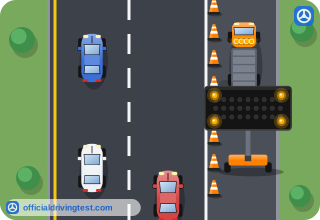
- Guide drivers into certain lanes and show that part of the road ahead is closed
- Tell drivers where the work zone speed limit ends and normal limits resume
- Show drivers where flagpersons and workers are standing
- Warn drivers that a detour has been removed and the road is open
Show answer
Correct answer: Guide drivers into certain lanes and show that part of the road ahead is closed
They guide drivers into certain traffic lanes and inform them that the part of the road or street ahead is closed.
Source: Hawaii Driver's Manual (2023), page 51 · Open this page in the manual (Manual page 51)
-
When may large flashing or sequencing arrow panels be used in work zones?
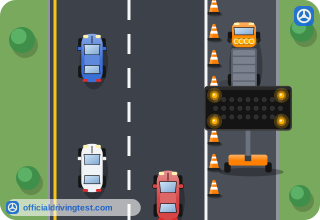
- Only at night
- Only during daylight
- Only when the road is wet
- Both day and night
Show answer
Correct answer: Both day and night
Arrow panels may be used in work zones both day and night.
Source: Hawaii Driver's Manual (2023), page 51 · Open this page in the manual (Manual page 51)
-
What are flagpersons often provided in work zones to do?
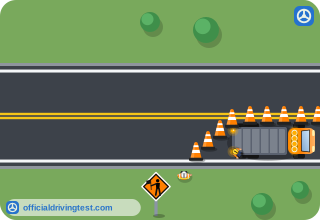
- Write citations to drivers who exceed the speed limit
- Stop, slow or guide traffic safely through the area
- Check vehicles for valid inspection stickers and insurance
- Keep pedestrians out of the roadway
Show answer
Correct answer: Stop, slow or guide traffic safely through the area
Flagpersons are often provided in work zones to stop, slow or guide traffic safely through the areas.
Source: Hawaii Driver's Manual (2023), page 51 · Open this page in the manual (Manual page 51)
-
What do flagpersons wear?
- Orange vests, shirts or jackets
- Red vests, shirts or jackets
- White vests, shirts or jackets
- Blue vests, shirts or jackets
Show answer
Correct answer: Orange vests, shirts or jackets
Flagpersons wear orange vests, shirts or jackets.
Source: Hawaii Driver's Manual (2023), page 51 · Open this page in the manual (Manual page 51)
-
What do flagpersons use to direct traffic through work zones?
- Green flags or yield paddles
- Blue flags or lane paddles
- Red flags or stop/slow paddles
- Whistles and green lanterns
Show answer
Correct answer: Red flags or stop/slow paddles
Flagpersons use red flags or stop/slow paddles to direct traffic through work zones.
Source: Hawaii Driver's Manual (2023), page 51 · Open this page in the manual (Manual page 51)
-
A flagperson in an orange vest holds a red flag straight out across your lane and raises the other hand, palm out. What does the manual show this to mean?
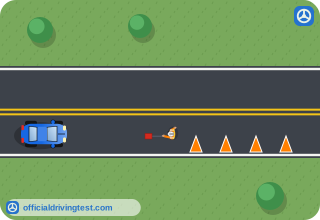
- Traffic proceed
- Traffic stop
- Slow down and pass with care
- Pull to the right and wait
Show answer
Correct answer: Traffic stop
The manual's illustration labels a flag held out with a raised hand as TRAFFIC STOP.
Source: Hawaii Driver's Manual (2023), page 51 · Open this page in the manual (Manual page 51)
-
A flagperson in an orange vest holds up a paddle that reads SLOW. What does the manual show this to mean?
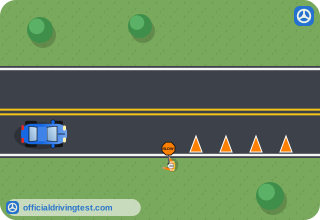
- Traffic stop
- Turn around
- Pull over and wait
- Traffic proceed
Show answer
Correct answer: Traffic proceed
The manual's illustration labels the SLOW paddle as TRAFFIC PROCEED.
Source: Hawaii Driver's Manual (2023), page 51 · Open this page in the manual (Manual page 51)