Hawaii: Emergencies — Part 4 Practice Test
Questions in this part include: “With what does power steering failure usually occur?” · “If you lose power steering, what should you do?”
Independent educational site · not affiliated with any government agency or DMV
Ready? Test yourself
- Instant feedback with an explanation
- Every answer cites its source in the manual
- Your best score is saved on this device
Questions are original and based on the official manual "Hawaii Driver's Manual" (2023), Hawaii Department of Transportation.
All 16 questions in this practice test
Take the test above first, then use this list to study. Tap “Show answer” to see the correct answer and explanation.
Show the questions and answersHide the questions
-
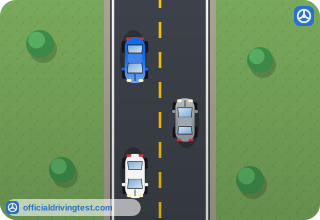
An oncoming vehicle is in your traffic lane. Where should you steer?

- To the left, into the oncoming traffic lane
- Straight ahead, toward the center line
- To the right, out of the lane into a clear area
- Toward the vehicle, to pass it
Show answer
Correct answer: To the right, out of the lane into a clear area
The manual says to steer to the right out of the lane and not to enter the oncoming traffic lane.
Source: Hawaii Driver's Manual (2023), page 82 · Open this page in the manual (Manual page 82)
-
If you must drive off the road to avoid an oncoming vehicle in your lane, what should you avoid?

- Gravel and loose dirt
- Solid objects and pedestrians
- The shoulder or grass beside the road
- Grass and unpaved areas
Show answer
Correct answer: Solid objects and pedestrians
The manual says to drive off the road if necessary and to avoid solid objects and pedestrians.
Source: Hawaii Driver's Manual (2023), page 82 · Open this page in the manual (Manual page 82)
-
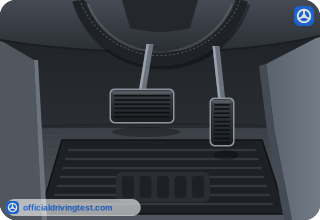
If your accelerator sticks open, what should you do first?
- Turn the steering wheel to the right
- Shift into park
- Pull the parking brake as hard as you can
- Slap the accelerator pedal hard with your foot
Show answer
Correct answer: Slap the accelerator pedal hard with your foot
The manual says to slap the accelerator pedal hard with your foot: quickly press it all the way down and quickly release it.
Source: Hawaii Driver's Manual (2023), page 83 · Open this page in the manual (Manual page 83)
-
When you turn off the ignition because the accelerator is stuck, how far should you move the switch?
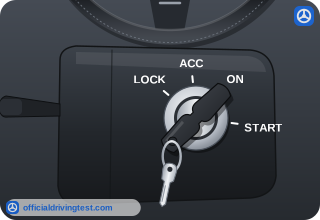
- Only far enough to stop the engine, not lock the wheel
- All the way to the lock position to stop quickly
- Only to the accessory position
- Back and forth several times
Show answer
Correct answer: Only far enough to stop the engine, not lock the wheel
The manual warns against engaging the steering wheel locking mechanism.
Source: Hawaii Driver's Manual (2023), page 83 · Open this page in the manual (Manual page 83)
-
After you have slapped the pedal, turned the ignition off and applied the brakes with a stuck accelerator, what should you do?
- Continue driving to the nearest repair shop
- Turn the ignition back on
- Pull off the roadway into a safe area
- Stop in the traffic lane
Show answer
Correct answer: Pull off the roadway into a safe area
The manual ends the stuck-accelerator steps with pulling off the roadway into a safe area.
Source: Hawaii Driver's Manual (2023), page 83 · Open this page in the manual (Manual page 83)
-
With what does power steering failure usually occur?
- A tire blowout on the front wheels
- Engine failure or loss of the power unit belt
- A stuck accelerator pedal that will not release
- A fire in the engine compartment
Show answer
Correct answer: Engine failure or loss of the power unit belt
The manual says power steering failure usually occurs with engine failure or loss of the belt driving the power unit.
Source: Hawaii Driver's Manual (2023), page 83 · Open this page in the manual (Manual page 83)
-
If you lose power steering, what should you do?
- Turn off the ignition and coast
- Speed up to keep control
- Apply the parking brake with great force
- Reduce speed, drive to a safe area and stop
Show answer
Correct answer: Reduce speed, drive to a safe area and stop
The manual says to reduce speed and drive to a safe area and stop, using additional effort to steer.
Source: Hawaii Driver's Manual (2023), page 83 · Open this page in the manual (Manual page 83)
-
On which road surfaces should you use extra care to avoid skidding?

- Dry concrete surfaces in clear weather
- Wet, slippery or gravel-covered surfaces
- Freshly painted lanes
- Wide, straight roads
Show answer
Correct answer: Wet, slippery or gravel-covered surfaces
The manual says to use extra care on wet, slippery or gravel-covered road surfaces.
Source: Hawaii Driver's Manual (2023), page 83 · Open this page in the manual (Manual page 83)
-
When you encounter a skid or control problem, what should you do?

- Do the exact opposite of what you were doing
- Brake as hard as possible
- Take your hands off the steering wheel
- Stop or reduce what you were doing when it started
Show answer
Correct answer: Stop or reduce what you were doing when it started
The manual says to stop or reduce whatever you were doing when the problem started.
Source: Hawaii Driver's Manual (2023), page 83 · Open this page in the manual (Manual page 83)
-
A skid started when you applied the brakes. What should you do?

- Release the brakes
- Press the brakes harder
- Shift to a lower gear at once
- Apply the parking brake
Show answer
Correct answer: Release the brakes
The manual says to avoid using the brakes and to release them if the skid started when you applied them.
Source: Hawaii Driver's Manual (2023), page 83 · Open this page in the manual (Manual page 83)
-
To steer out of a skid, which way should you turn the steering wheel?

- Opposite to the direction the rear is skidding
- Toward the center line
- In the direction the rear of the vehicle is skidding
- Straight ahead until the vehicle stops
Show answer
Correct answer: In the direction the rear of the vehicle is skidding
The manual says if skidding to the right, turn right, and turn left for a skid to the left.
Source: Hawaii Driver's Manual (2023), page 83 · Open this page in the manual (Manual page 83)
-
What should you do with the accelerator when your vehicle begins to skid?

- Press it harder to pull out of the skid
- Ease off the accelerator
- Hold it steady
- Tap it quickly several times
Show answer
Correct answer: Ease off the accelerator
The manual says easing off the accelerator may stop the skid.
Source: Hawaii Driver's Manual (2023), page 83 · Open this page in the manual (Manual page 83)
-
As a skid stops, what should you do with the steering?

- Turn it fully in the direction of the skid
- Turn it fully away from the skid
- Let go of the wheel
- Turn it to the straight ahead position
Show answer
Correct answer: Turn it to the straight ahead position
The manual says to turn the steering to the straight ahead position as the skid stops.
Source: Hawaii Driver's Manual (2023), page 83 · Open this page in the manual (Manual page 83)
-
What may happen if you overcorrect while steering out of a skid?

- The vehicle may skid in the opposite direction
- The vehicle will stop immediately and safely
- The tires will blow out
- The brakes will fail
Show answer
Correct answer: The vehicle may skid in the opposite direction
The manual says overcorrecting may cause a skid in the opposite direction, so steer gently into the skid again.
Source: Hawaii Driver's Manual (2023), page 83 · Open this page in the manual (Manual page 83)
-
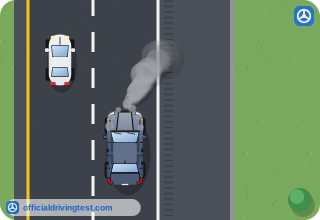
According to the manual, which is a usual cause of vehicle fires?
- A low tire, a loose mirror or a dirty windshield
- A worn wiper blade, a cracked lens or a loose belt
- An overheated engine, an electrical short, or a fuel leak
- A dim headlight, a stuck window or a worn seat cover
Show answer
Correct answer: An overheated engine, an electrical short, or a fuel leak
The manual says fires usually result from an overheated engine, electrical short, fuel leak or oil leak.
Source: Hawaii Driver's Manual (2023), page 84 · Open this page in the manual (Manual page 84)
-
What should you do about any burning odor in your vehicle?
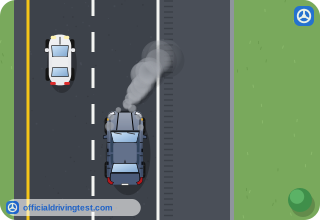
- Ignore it unless smoke appears
- Investigate it immediately
- Wait until your next service check
- Open the windows and keep driving
Show answer
Correct answer: Investigate it immediately
The manual says any burning odor should be immediately investigated.
Source: Hawaii Driver's Manual (2023), page 84 · Open this page in the manual (Manual page 84)