Hawaii: Emergencies — Part 2 Practice Test
Questions in this part include: “What are the basic factors involved in all driving emergencies?”
Independent educational site · not affiliated with any government agency or DMV
Ready? Test yourself
- Instant feedback with an explanation
- Every answer cites its source in the manual
- Your best score is saved on this device
Questions are original and based on the official manual "Hawaii Driver's Manual" (2023), Hawaii Department of Transportation.
All 16 questions in this practice test
Take the test above first, then use this list to study. Tap “Show answer” to see the correct answer and explanation.
Show the questions and answersHide the questions
-
If you must stop on a freeway, where should you stop?
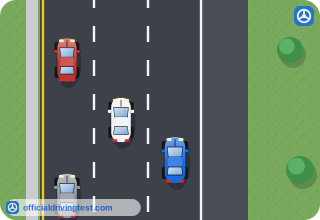
- Drive entirely off the roadway, as far away from traffic as possible
- In the right lane near an exit ramp with the hazard warning signals on
- Just past the nearest exit ramp in the traffic lane
- As close to the center divider as possible
Show answer
Correct answer: Drive entirely off the roadway, as far away from traffic as possible
The manual says if you must stop, drive entirely off the roadway as far away from traffic as possible.
Source: Hawaii Driver's Manual (2023), page 79 · Open this page in the manual (Manual page 79)
-
If you have a problem on a freeway, what should you try to do first?
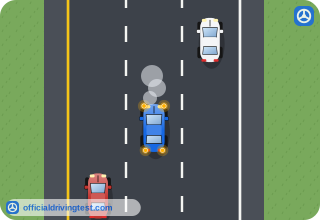
- Stop immediately in the right lane and wait
- Cross the center divider to reach help
- Walk to the nearest service station
- Get off the freeway at the next exit if you can
Show answer
Correct answer: Get off the freeway at the next exit if you can
The manual says to try to get off the freeway at the next exit if you can.
Source: Hawaii Driver's Manual (2023), page 79 · Open this page in the manual (Manual page 79)
-
What should you do if you see another driver in trouble on a freeway?
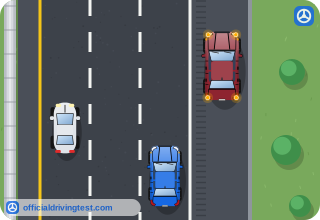
- Stop behind the driver and turn on the hazard warning signals
- Do not stop to assist; report the situation to the proper authorities
- Stop and walk over to help
- Stop to help only if you are in the right lane
Show answer
Correct answer: Do not stop to assist; report the situation to the proper authorities
The manual says not to stop to assist other drivers in trouble but to report the situation to the proper authorities.
Source: Hawaii Driver's Manual (2023), page 79 · Open this page in the manual (Manual page 79)
-
What are the basic factors involved in all driving emergencies?
- Speed, distance and lights
- Horn, mirrors and signals
- Tires, fuel and engine temperature
- Brakes, steering and power
Show answer
Correct answer: Brakes, steering and power
The manual says all driving emergencies involve the use of brakes, steering and power.
Source: Hawaii Driver's Manual (2023), page 80 · Open this page in the manual (Manual page 80)
-
Why should you avoid slamming on the brakes and sliding the wheels in an emergency?
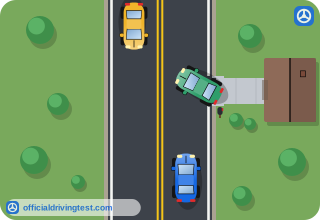
- You cannot control a vehicle when the wheels are sliding
- Sliding wheels will always cause a tire to blow out
- Sliding wheels make the engine stall
- You cannot steer unless the wheels are locked
Show answer
Correct answer: You cannot control a vehicle when the wheels are sliding
The manual states that you cannot control a vehicle when the wheels are sliding.
Source: Hawaii Driver's Manual (2023), page 80 · Open this page in the manual (Manual page 80)
-
What do antilock brakes do for you automatically?
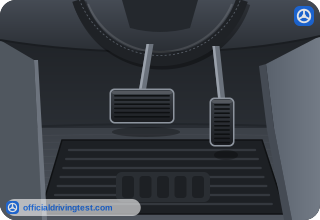
- Steer the vehicle into a less dangerous location by itself
- Release the parking brake in an emergency
- Keep the wheels from sliding when you brake hard
- Reduce your speed without any pedal pressure
Show answer
Correct answer: Keep the wheels from sliding when you brake hard
The manual says to avoid slamming on the brakes and sliding the wheels; antilock brakes do this for you automatically.
Source: Hawaii Driver's Manual (2023), page 80 · Open this page in the manual (Manual page 80)
-
If a wheel slides during hard braking, what should you do?
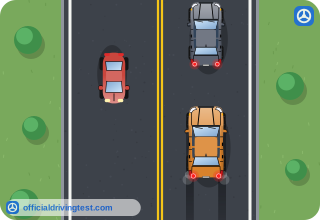
- Hold the brake pedal down until the vehicle stops
- Release the brakes and reapply them when no longer sliding
- Pump the accelerator until the wheel grips
- Turn off the engine and coast to a stop
Show answer
Correct answer: Release the brakes and reapply them when no longer sliding
The manual says to release the brakes and reapply them once the vehicle is no longer sliding or skidding.
Source: Hawaii Driver's Manual (2023), page 80 · Open this page in the manual (Manual page 80)
-
Why should you wear your safety belts in a driving emergency?
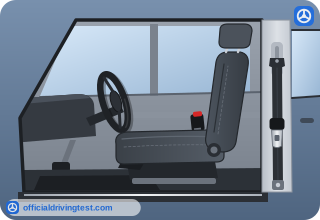
- So the vehicle will stop in a shorter distance
- So you can steer the vehicle using only one hand
- So the airbags will not inflate in a collision
- So you can remain in a position to control your vehicle
Show answer
Correct answer: So you can remain in a position to control your vehicle
The manual says safety belts keep you in a position to control your vehicle.
Source: Hawaii Driver's Manual (2023), page 80 · Open this page in the manual (Manual page 80)
-
After your vehicle strikes another object, what should you do?
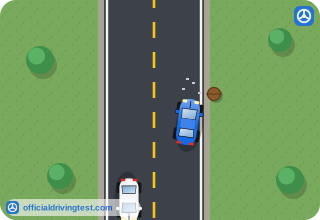
- Continue to try to control your vehicle
- Take your hands off the steering wheel
- Turn off the engine at once
- Remove your safety belt
Show answer
Correct answer: Continue to try to control your vehicle
The manual says to keep trying to control your vehicle even after striking another object.
Source: Hawaii Driver's Manual (2023), page 80 · Open this page in the manual (Manual page 80)
-
According to the manual, what most often causes tire blowouts?
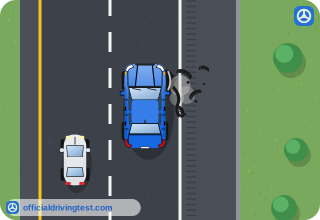
- Driving too often on wet pavement
- Improper tire care and maintenance
- Driving on a freeway
- Carrying too many passengers
Show answer
Correct answer: Improper tire care and maintenance
The manual says blowouts are most often the result of improper tire care and maintenance.
Source: Hawaii Driver's Manual (2023), page 80 · Open this page in the manual (Manual page 80)
-
If a tire blows out, what should you NOT do?
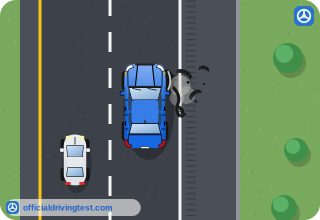
- Grip the steering wheel firmly
- Steer to stay in your traffic lane
- Reduce speed gradually
- Apply the brakes
Show answer
Correct answer: Apply the brakes
The manual says not to apply the brakes in a blowout because the vehicle may become uncontrollable.
Source: Hawaii Driver's Manual (2023), page 81 · Open this page in the manual (Manual page 81)
-
During a tire blowout, how should you handle the steering wheel?
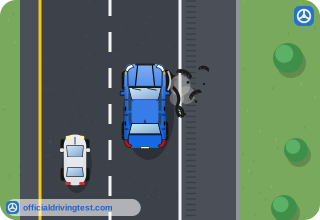
- Grip it firmly and steer to remain in your traffic lane
- Hold it loosely and let the vehicle drift to the shoulder
- Turn it sharply toward the side of the blown tire
- Let go of it until the vehicle slows
Show answer
Correct answer: Grip it firmly and steer to remain in your traffic lane
The manual says to grip the steering wheel firmly and keep the vehicle in your traffic lane, even though the pull may change direction.
Source: Hawaii Driver's Manual (2023), page 81 · Open this page in the manual (Manual page 81)
-
After a tire blowout, once you are moving very slowly, what should you do?
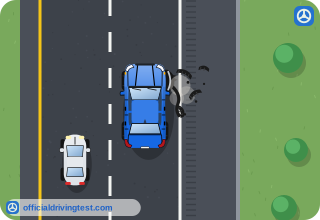
- Stop in the traffic lane and turn on the hazard lights
- Accelerate to reach the next exit
- Apply the brakes lightly and pull off the road into a safe area
- Apply the brakes firmly and stop at once
Show answer
Correct answer: Apply the brakes lightly and pull off the road into a safe area
The manual says to slow gradually without brakes until very slow, then brake lightly and pull off the road into a safe area.
Source: Hawaii Driver's Manual (2023), page 81 · Open this page in the manual (Manual page 81)
-
According to the manual, what can you do with a blown-out tire at a very slow speed?
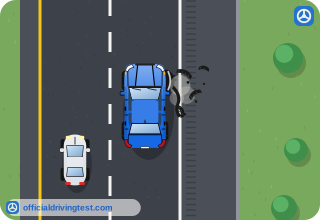
- Drive only a few feet before the rim is damaged
- Drive some distance without damaging the wheel rim
- Drive only on the freeway
- Drive only if the spare tire is also flat
Show answer
Correct answer: Drive some distance without damaging the wheel rim
The manual says you can drive for some distance with a blown-out tire at a very slow speed without damaging the wheel rim.
Source: Hawaii Driver's Manual (2023), page 81 · Open this page in the manual (Manual page 81)
-
If a wheel comes off your vehicle, what corrective procedure should you use?
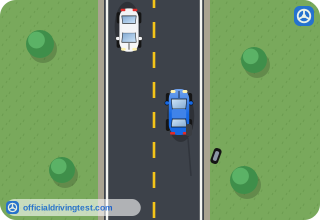
- The same procedure as for a skid
- The same procedure as for a stuck accelerator
- The same procedure as for steering failure
- The same procedure as for a tire blowout
Show answer
Correct answer: The same procedure as for a tire blowout
The manual says a loss of wheel is handled with the same corrective procedure as a tire blowout.
Source: Hawaii Driver's Manual (2023), page 81 · Open this page in the manual (Manual page 81)
-
What is likely to happen when a wheel is lost?
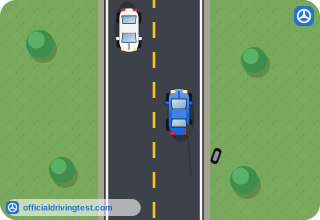
- A total or partial brake failure
- A total loss of engine power
- A stuck accelerator
- A power steering fire
Show answer
Correct answer: A total or partial brake failure
The manual says total or partial brake failure is likely when a wheel is lost.
Source: Hawaii Driver's Manual (2023), page 81 · Open this page in the manual (Manual page 81)