Georgia: Speed & following distance — Part 4 Practice Test
Questions in this part include: “Which condition always calls for an even greater distance between you and the vehicle in front?” · “How do curves compare when roadways are slick because of rain or other hazards?”
Independent educational site · not affiliated with any government agency or DMV
Ready? Test yourself
- Instant feedback with an explanation
- Every answer cites its source in the manual
- Your best score is saved on this device
Questions are original and based on the official manual "Georgia Driver's Manual" (2023-2024), Georgia Department of Driver Services (DDS).
All 19 questions in this practice test
Take the test above first, then use this list to study. Tap “Show answer” to see the correct answer and explanation.
Show the questions and answersHide the questions
-
You pass the same reference point before you finish counting "one-thousand-one, one-thousand-two." What does this mean?
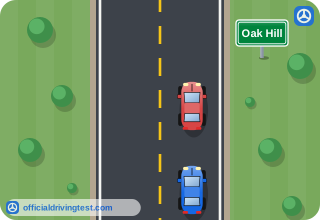
- You have left a safe following distance
- You are driving above the speed limit
- You are following too closely
- You are passing the car too slowly
Show answer
Correct answer: You are following too closely
If you pass the same spot before you are through counting, you are following too closely.
Source: Georgia Driver's Manual (2023-2024), page 40
-
Which condition always calls for an even greater distance between you and the vehicle in front?
- Driving at night
- Driving in the daytime
- Driving on a dry, straight road
- Driving in light traffic
Show answer
Correct answer: Driving at night
The distance should be even greater during inclement weather, construction, heavy traffic, and always at night.
Source: Georgia Driver's Manual (2023-2024), page 40
-
Besides vehicle speed, which of these affects your actual stopping distance?
- Color of the vehicle's paint
- Type of fuel in the tank
- Size of the vehicle's fuel tank
- Type and condition of the pavement
Show answer
Correct answer: Type and condition of the pavement
The type and condition of the pavement is listed as a factor in actual stopping distance.
Source: Georgia Driver's Manual (2023-2024), page 40
-
Which of these is listed as a factor in actual stopping distance?
- Color of the seat fabric
- Chassis (frame) design
- Tint of the windshield
- Number of doors
Show answer
Correct answer: Chassis (frame) design
Chassis (frame) design is one of the factors listed that affect stopping distance.
Source: Georgia Driver's Manual (2023-2024), page 40
-
Which of these is listed as a factor in actual stopping distance, in addition to speed?
- Mental and physical reaction of the driver
- The driver's height and weight
- The number of passengers in the vehicle
- The driver's years of licensed driving
Show answer
Correct answer: Mental and physical reaction of the driver
The driver's mental and physical reaction is listed among the factors that affect stopping distance.
Source: Georgia Driver's Manual (2023-2024), page 40
-
What is a leading factor in serious injury and death as a result of traffic crashes?
- Road width
- Vehicle color
- Speed
- Radio volume
Show answer
Correct answer: Speed
The manual says speed is a leading factor in serious injury and death in traffic crashes.
Source: Georgia Driver's Manual (2023-2024), page 40
-
What happens to the force of impact as your speed increases?
- It stays the same
- It becomes greater
- It becomes smaller
- It depends only on the vehicle's weight
Show answer
Correct answer: It becomes greater
The greater the speed, the greater the force of impact.
Source: Georgia Driver's Manual (2023-2024), page 40
-
What usually marks sharper curves in a roadway?
- A flashing yellow beacon at every curve
- A solid white line across the roadway
- A safe miles-per-hour sign
- A red reflective post on the outside edge
Show answer
Correct answer: A safe miles-per-hour sign
The manual says sharper curves are usually marked with a safe miles-per-hour sign.
Source: Georgia Driver's Manual (2023-2024), page 38
-
How does the speed shown on a curve's advisory sign usually compare with the posted speed limit?
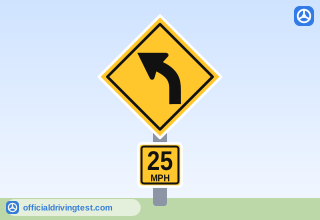
- It is usually greater than the posted speed limit
- It is always exactly equal to the posted speed limit
- It has no connection to the posted limit and can be ignored
- It is usually less than the posted speed limit
Show answer
Correct answer: It is usually less than the posted speed limit
The manual says these advisory signs are usually less than the posted speed limit and show the speed that makes the curve safer.
Source: Georgia Driver's Manual (2023-2024), page 38
-
How do curves compare when roadways are slick because of rain or other hazards?
- They are especially dangerous and need much lower speeds
- They are safe at the same speeds as on a dry road
- They are dangerous only if the curve is marked with a sign
- They are less dangerous because traffic slows on its own
Show answer
Correct answer: They are especially dangerous and need much lower speeds
The manual says slick curves can be especially dangerous and require much lower speeds than when the road is dry.
Source: Georgia Driver's Manual (2023-2024), page 38
-
When should you reduce your speed for a sharp curve marked with an advisory sign?
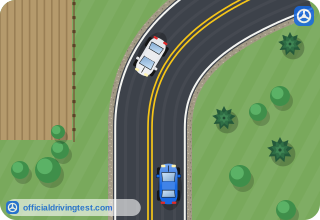
- Once you are halfway through the curve
- Only after you feel the car drifting
- Before entering the curve
- Only if another vehicle is approaching
Show answer
Correct answer: Before entering the curve
The manual says to reduce your speed before entering these curves.
Source: Georgia Driver's Manual (2023-2024), page 39
-
While driving through a curve, you realize you are traveling too fast. What should you do?

- Brake as hard as you can to slow down as quickly as possible
- Ease off the accelerator, brake carefully, and keep steering in the lane
- Steer onto the shoulder and stop until the curve is behind you
- Speed up briefly to gain traction, then slow down after the curve
Show answer
Correct answer: Ease off the accelerator, brake carefully, and keep steering in the lane
The manual says not to brake forcefully, which may cause a skid; take your foot off the accelerator, carefully apply the brake and keep steering in your lane.
Source: Georgia Driver's Manual (2023-2024), page 39
-
As a driver's speed increases, what happens to the risk of serious or fatal pedestrian injuries?
- It increases exponentially
- It increases only slightly
- It stays about the same
- It decreases if the driver brakes
Show answer
Correct answer: It increases exponentially
The manual says the risk of serious or fatal pedestrian injuries increases exponentially with driver speed.
Source: Georgia Driver's Manual (2023-2024), page 42
-
When a pedestrian is struck by a motor vehicle traveling 40 mph, what is the risk of pedestrian death?
- At least 20%
- At least 40%
- At least 80%
- At least 60%
Show answer
Correct answer: At least 80%
The manual states that at 40 mph the risk of pedestrian death is at least 80%.
Source: Georgia Driver's Manual (2023-2024), page 42
-
How much following distance should you allow when following a motorcycle?
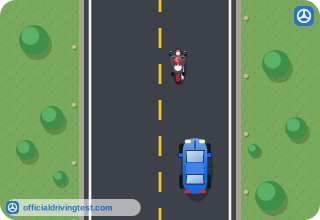
- One or two seconds
- Five or six seconds
- Three or four seconds
- Six or seven seconds
Show answer
Correct answer: Three or four seconds
The manual says to allow three or four seconds so the rider has enough time to maneuver or stop in an emergency.
Source: Georgia Driver's Manual (2023-2024), page 43
-
In dry conditions, how does a motorcycle's stopping ability compare with a car's?
- Motorcycles need more distance to stop than cars
- Motorcycles can stop more quickly than cars
- Motorcycles stop in the same distance as cars
- Motorcycles stop more quickly only with a passenger
Show answer
Correct answer: Motorcycles can stop more quickly than cars
The manual says that in dry conditions motorcycles can stop more quickly than cars.
Source: Georgia Driver's Manual (2023-2024), page 43
-
A fully loaded tractor-trailer traveling 55 mph needs how much distance to stop compared with a car?
- 3 times the distance
- 2 times the distance
- 5 times the distance
- 10 times the distance
Show answer
Correct answer: 3 times the distance
A fully loaded tractor-trailer traveling 55 mph needs 3 times the distance a car needs to stop.
Source: Georgia Driver's Manual (2023-2024), page 44
-
What distance is recommended so that you do not cut off commercial motor vehicles?
- One car length for every 5 miles per hour of speed
- Two car lengths for every 10 miles per hour of speed
- One car length for every 20 miles per hour of speed
- One car length for every 10 miles per hour of speed
Show answer
Correct answer: One car length for every 10 miles per hour of speed
The manual recommends one car length for every 10 miles per hour of speed.
Source: Georgia Driver's Manual (2023-2024), page 45
-
Speed is a factor in what share of all fatal crashes?
- Nearly one-tenth
- Nearly one-half
- Nearly one-third
- Nearly two-thirds
Show answer
Correct answer: Nearly one-third
The manual says speed is a factor in nearly one-third of all fatal crashes.
Source: Georgia Driver's Manual (2023-2024), page 45