Georgia: Speed & following distance — Part 3 Practice Test
Questions in this part include: “How is a conviction for aggressive driving classified?” · “Where should you not stop when driving at night?”
Independent educational site · not affiliated with any government agency or DMV
Ready? Test yourself
- Instant feedback with an explanation
- Every answer cites its source in the manual
- Your best score is saved on this device
Questions are original and based on the official manual "Georgia Driver's Manual" (2023-2024), Georgia Department of Driver Services (DDS).
All 19 questions in this practice test
Take the test above first, then use this list to study. Tap “Show answer” to see the correct answer and explanation.
Show the questions and answersHide the questions
-
How is a conviction for aggressive driving classified?
- A felony offense punishable by a prison term
- A civil infraction with only a fine and no record
- A non-moving violation with no points or penalty
- A misdemeanor of a high and aggravated nature
Show answer
Correct answer: A misdemeanor of a high and aggravated nature
A conviction for aggressive driving is considered a misdemeanor of a high and aggravated nature.
Source: Georgia Driver's Manual (2023-2024), page 23
-
Reckless stunt driving involves operating a vehicle while doing what?
- Driving without a valid license on private property without permission
- Towing a trailer that is wider than the legal limit on a highway
- Drag racing or laying drags in reckless disregard for the safety of persons
- Weaving through traffic at or below the posted speed limit on a highway
Show answer
Correct answer: Drag racing or laying drags in reckless disregard for the safety of persons
The manual defines reckless stunt driving as operating a vehicle while drag racing or laying drags in reckless disregard for the safety of persons.
Source: Georgia Driver's Manual (2023-2024), page 23
-
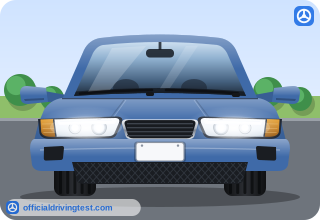
What should you do about your headlights to help ensure safe driving at night?
- Replace the bulbs every month whether or not they work
- Keep the lenses clean and periodically have the aim checked
- Tint the lenses to reduce the glare from other vehicles
- Point them slightly upward so that you can see farther
Show answer
Correct answer: Keep the lenses clean and periodically have the aim checked
The manual says to make sure headlights work properly, keep the lenses clean, and periodically check their aim/alignment.
Source: Georgia Driver's Manual (2023-2024), page 24
-
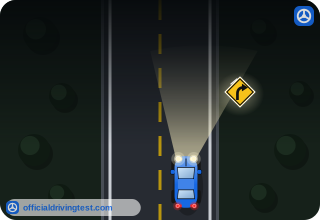
What does it mean not to "overdrive" your headlights at night?
- Not leaving your headlights on for more than two hours at a time while you drive at night
- Not using high-beam headlights when you are traveling faster than 55 mph on a rural highway
- Not driving with headlights that are brighter than those of oncoming vehicles on the road
- Not driving at a speed that requires a stopping time greater than the distance lit by your headlights
Show answer
Correct answer: Not driving at a speed that requires a stopping time greater than the distance lit by your headlights
The manual says not to drive at a speed that requires a stopping time greater than the distance illuminated by your headlights.
Source: Georgia Driver's Manual (2023-2024), page 24
-
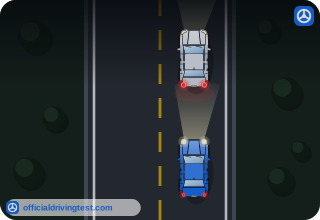
At night, when should you slow down?
- Only when you are driving through a busy urban area with streetlights
- When oncoming traffic is approaching or when you are nearing a curve
- Only on roads that have no edge line or center line marked
- Only when another driver flashes the headlights at you first
Show answer
Correct answer: When oncoming traffic is approaching or when you are nearing a curve
The manual says to slow down when oncoming traffic is approaching or when you are nearing a curve.
Source: Georgia Driver's Manual (2023-2024), page 24
-
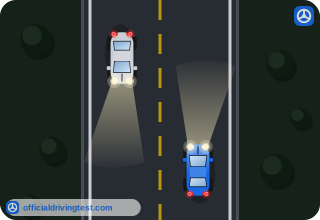
If visibility is greatly reduced at night, what should you use as a guide to maintain your lane?
- The center line, or the edge line if there is no center line
- The taillights of the vehicle ahead of you
- The shoulder of the road on your right
- The edge line, or the center line if there is no edge line
Show answer
Correct answer: The edge line, or the center line if there is no edge line
The manual says to use the edge line as a guide and, if there is none, to use the center line.
Source: Georgia Driver's Manual (2023-2024), page 24
-
Which measures does the manual say can help you avoid drowsiness and inattention when driving at night?
- More frequent stops, more fresh air, and lively radio programs
- Driving faster so that you finish the trip sooner than planned
- Driving longer stretches without stopping for any rest break
- Keeping the cabin warm and the radio turned off during the trip
Show answer
Correct answer: More frequent stops, more fresh air, and lively radio programs
The manual lists more frequent stops, more fresh air, lively radio programs and other measures to avoid drowsiness.
Source: Georgia Driver's Manual (2023-2024), page 24
-
Why should you watch carefully for highway signs at night?
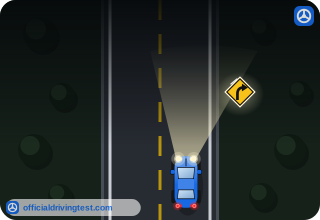
- They are posted lower at night
- Speed limits are reduced at night
- They are harder to see at night
- They are smaller than the signs used in the day
Show answer
Correct answer: They are harder to see at night
The manual says highway signs are harder to see at night.
Source: Georgia Driver's Manual (2023-2024), page 24
-
At night, what should you watch carefully for?
- Only oncoming traffic in the left lane of the roadway ahead
- Only animals crossing the roadway in rural or wooded areas
- Only signs that are posted on the left side of the road
- Pedestrians and vehicles stopped along the edge of the road
Show answer
Correct answer: Pedestrians and vehicles stopped along the edge of the road
The manual says to watch carefully for pedestrians and for vehicles stopped along the edge of the road.
Source: Georgia Driver's Manual (2023-2024), page 24
-
Where should you not stop when driving at night?
- On the roadway
- On the shoulder
- In a parking lot
- In a rest area
Show answer
Correct answer: On the roadway
The manual says not to stop on the roadway when driving at night.
Source: Georgia Driver's Manual (2023-2024), page 24
-
Which is one of the ways the manual lists to help ensure safe driving at night?
- Keep your dome light on
- Tint your windshield
- Keep your windshield clean
- Wear sunglasses
Show answer
Correct answer: Keep your windshield clean
Keeping the windshield clean is one of the night driving suggestions.
Source: Georgia Driver's Manual (2023-2024), page 24
-
Which of these is one of the guidelines for driving in heavy fog?
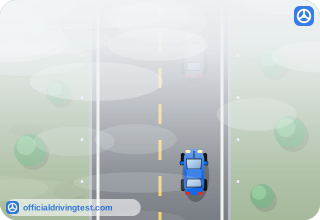
- Use your bright headlights to see farther
- Reduce your driving speed
- Turn on your hazard lights so others see you
- Follow closely behind the taillights ahead
Show answer
Correct answer: Reduce your driving speed
The fog guidelines begin with reducing your driving speed.
Source: Georgia Driver's Manual (2023-2024), page 38
-
While driving in fog, you see headlights or red tail lights ahead. What should you do?
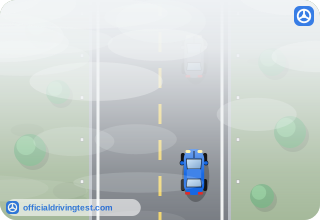
- Reduce your speed even more
- Increase your speed to pass the vehicle
- Switch to your brightest headlights
- Keep the same speed and follow closely
Show answer
Correct answer: Reduce your speed even more
Lights ahead show another vehicle, and fog makes distance harder to judge, so you reduce speed further.
Source: Georgia Driver's Manual (2023-2024), page 38
-
In heavy fog, what should you do with your headlights?
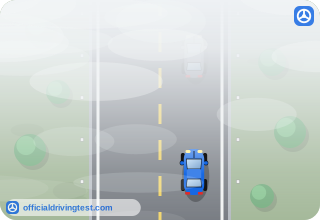
- Use high beams, since they reach farther
- Use only your parking lights
- Dim them, because bright lights cause glare
- Turn them off and use your hazard lights
Show answer
Correct answer: Dim them, because bright lights cause glare
Bright lights produce a glare in heavy fog, making it harder to see than regular headlights do.
Source: Georgia Driver's Manual (2023-2024), page 38
-
What does the manual say about driving with parking or hazard lights on in fog?
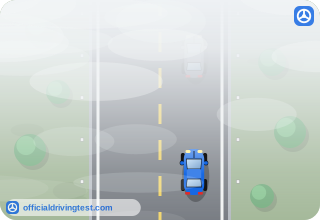
- Turn them on so other drivers can see you
- Do not drive with them on
- Use them only on expressways
- Use them whenever you cannot see the road ahead
Show answer
Correct answer: Do not drive with them on
The fog guidelines say not to drive with parking or hazard lights on.
Source: Georgia Driver's Manual (2023-2024), page 38
-
According to the manual, what causes a rear-end crash?
- Following another vehicle too closely
- Driving slower than the speed limit
- Using turn signals too early
- Braking gently at a traffic light
Show answer
Correct answer: Following another vehicle too closely
The manual states that a rear-end crash is caused by following another vehicle too closely.
Source: Georgia Driver's Manual (2023-2024), page 40
-
When following another vehicle, how much distance must there be between you and it?
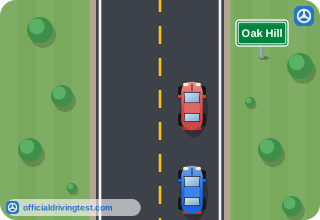
- Enough to pass it safely if it slows down
- Enough for another vehicle to pull in between
- Enough to safely stop if it suddenly slows or stops
- Enough to see its license plate clearly
Show answer
Correct answer: Enough to safely stop if it suddenly slows or stops
There must be enough distance for you to safely stop if the vehicle in front suddenly slows down or stops.
Source: Georgia Driver's Manual (2023-2024), page 40
-
Which method does the manual give to check whether you have enough distance behind the vehicle ahead?
- Compare your speedometer with the car ahead's speed
- Count the time after the car ahead passes a fixed point
- Watch the brake lights of the car two vehicles ahead
- Check that you can see the tires of the car ahead
Show answer
Correct answer: Count the time after the car ahead passes a fixed point
You measure the time between when the vehicle ahead passes a reference point and when you pass the same point.
Source: Georgia Driver's Manual (2023-2024), page 40
-
When the car ahead passes a reference point such as a telephone pole, what do you count?
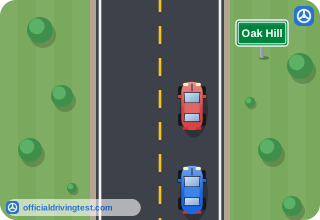
- "one-thousand-one through one-thousand-four"
- "one-thousand-one, one-thousand-two, one-thousand-three"
- "one-thousand-one through one-thousand-five"
- "one-thousand-one, one-thousand-two"
Show answer
Correct answer: "one-thousand-one, one-thousand-two"
The manual says to count "one-thousand-one, one-thousand-two" after the car ahead passes a reference point.
Source: Georgia Driver's Manual (2023-2024), page 40