Georgia: Parking rules Practice Test
Where you may not park, stand or stop, and how to park safely.
Independent educational site · not affiliated with any government agency or DMV
Ready? Test yourself
- Instant feedback with an explanation
- Every answer cites its source in the manual
- Your best score is saved on this device
Questions are original and based on the official manual "Georgia Driver's Manual" (2023-2024), Georgia Department of Driver Services (DDS).
All 31 questions in this practice test
Take the test above first, then use this list to study. Tap “Show answer” to see the correct answer and explanation.
Show the questions and answersHide the questions
-
During parallel parking on the driving test, your car must be no more than how far from the curb?
- 6 inches
- 18 inches
- 12 inches
- 24 inches
Show answer
Correct answer: 18 inches
You must park midway between two standards so your car is not more than 18 inches from the curb.
Source: Georgia Driver's Manual (2023-2024), page 12
-
What are the standard parallel parking dimensions used in the driver's license test?
- 20 feet in length by 8 feet in depth
- 25 feet in length by 12 feet in depth
- 18 feet in length by 10 feet in depth
- 22 feet in length by 10 feet in depth
Show answer
Correct answer: 22 feet in length by 10 feet in depth
The standard dimensions are 22 feet in length by 10 feet in depth.
Source: Georgia Driver's Manual (2023-2024), page 12
-
If your vehicle is disabled, what should you make every practical effort to do?
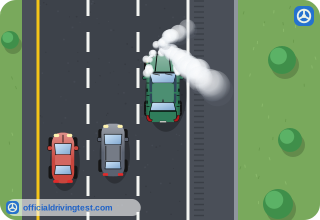
- Park in the far right lane
- Leave it in the passing lane
- Park off the highway
- Park it on a bridge or overpass
Show answer
Correct answer: Park off the highway
A disabled vehicle should be parked off the highway if at all practical, leaving free passage and a clear view of it.
Source: Georgia Driver's Manual (2023-2024), page 20
-
If your vehicle is disabled, free passage and a clear view of your vehicle should be left for how many feet in each direction?
- 100 feet
- 200 feet
- 300 feet
- 500 feet
Show answer
Correct answer: 200 feet
A disabled vehicle should leave free passage and a clear view of it for 200 feet in each direction.
Source: Georgia Driver's Manual (2023-2024), page 20
-
At any time, stopping, standing or parking is not permitted in which of these places?
- In front of a public or private driveway
- Within 15 feet of a fire hydrant
- Within 50 feet of a railroad crossing
- On the street side of any parked vehicle
Show answer
Correct answer: On the street side of any parked vehicle
The manual lists the street side of any parked vehicle among the places where stopping, standing or parking is never permitted.
Source: Georgia Driver's Manual (2023-2024), page 20
-
At any time, stopping, standing or parking is not permitted in which of these places?
- On a sidewalk
- Within 20 feet of a fire station driveway
- Within 30 feet of a stop sign
- Within 20 feet of a crosswalk at an intersection
Show answer
Correct answer: On a sidewalk
A sidewalk is listed among the places where stopping, standing or parking is not permitted at any time.
Source: Georgia Driver's Manual (2023-2024), page 20
-
At any time, stopping, standing or parking is not permitted in which of these places?
- Within 75 feet of the spot across the street from a fire station driveway
- Within 15 feet of a fire hydrant
- Within an intersection
- In front of a public or private driveway
Show answer
Correct answer: Within an intersection
Within an intersection is listed among the places where stopping, standing or parking is not permitted at any time.
Source: Georgia Driver's Manual (2023-2024), page 20
-
At any time, stopping, standing or parking is not permitted in which of these places?
- Within 30 feet of a traffic control signal
- On a crosswalk
- Within 50 feet of a railroad crossing
- Within 15 feet of a fire hydrant
Show answer
Correct answer: On a crosswalk
A crosswalk is listed among the places where stopping, standing or parking is not permitted at any time.
Source: Georgia Driver's Manual (2023-2024), page 20
-
At any time, stopping, standing or parking is not permitted in which of these places?
- Within 20 feet of a fire station driveway
- Within 30 feet of a yield sign
- Within 15 feet of a fire hydrant
- Between a safety zone and the adjacent curb
Show answer
Correct answer: Between a safety zone and the adjacent curb
The space between a safety zone and the adjacent curb is a place where stopping, standing or parking is not permitted at any time.
Source: Georgia Driver's Manual (2023-2024), page 20
-
When is stopping, standing or parking not permitted alongside or opposite a street excavation or obstruction?
- When it would obstruct traffic
- When it is nighttime
- When the excavation is more than 200 feet long
- When the vehicle is a large truck or bus
Show answer
Correct answer: When it would obstruct traffic
Stopping, standing or parking alongside or opposite a street excavation or obstruction is not permitted when it would obstruct traffic.
Source: Georgia Driver's Manual (2023-2024), page 20
-
At any time, stopping, standing or parking is not permitted in which of these places?
- Within 20 feet of a crosswalk at an intersection
- Within 75 feet of the spot across the street from a fire station driveway
- Upon a bridge or overpass, or within a highway tunnel
- In front of a public or private driveway
Show answer
Correct answer: Upon a bridge or overpass, or within a highway tunnel
A bridge, an overpass and a highway tunnel are places where stopping, standing or parking is not permitted at any time.
Source: Georgia Driver's Manual (2023-2024), page 20
-
At any time, stopping, standing or parking is not permitted in which of these places?
- Within 15 feet of a fire hydrant
- On any railroad tracks
- Within 30 feet of a stop sign
- Within 20 feet of a fire station driveway
Show answer
Correct answer: On any railroad tracks
Railroad tracks are listed among the places where stopping, standing or parking is not permitted at any time.
Source: Georgia Driver's Manual (2023-2024), page 20
-
At any time, stopping, standing or parking is not permitted in which of these places?
- Within 50 feet of a railroad crossing
- In front of a public or private driveway
- Within 20 feet of a crosswalk at an intersection
- On a controlled access roadway
Show answer
Correct answer: On a controlled access roadway
A controlled access roadway is listed among the places where stopping, standing or parking is not permitted at any time.
Source: Georgia Driver's Manual (2023-2024), page 20
-
At any time, stopping, standing or parking is not permitted in which of these places?
- Between the roadways of a divided highway, even at crossovers
- Within 30 feet of a stop sign or traffic control signal
- Within 15 feet of a fire hydrant on the street
- In front of a public or private driveway entrance
Show answer
Correct answer: Between the roadways of a divided highway, even at crossovers
The area between roadways on a divided highway, including crossovers, is a place where stopping, standing or parking is not permitted at any time.
Source: Georgia Driver's Manual (2023-2024), page 20
-
At any time, stopping, standing or parking is not permitted in which of these places?
- Within 50 feet of a railroad crossing
- Within 20 feet of a fire station driveway
- At any place marked by a no-parking sign
- Within 30 feet of a yield sign
Show answer
Correct answer: At any place marked by a no-parking sign
Any place marked by a no-parking sign is a place where stopping, standing or parking is not permitted at any time.
Source: Georgia Driver's Manual (2023-2024), page 20
-
Stopping, standing or parking is permitted only momentarily to pick up or drop off passengers within how many feet of a fire hydrant?
- 5 feet
- 15 feet
- 30 feet
- 50 feet
Show answer
Correct answer: 15 feet
Within 15 feet of a fire hydrant, stopping is permitted only momentarily to pick up or drop off passengers.
Source: Georgia Driver's Manual (2023-2024), page 20
-
Stopping, standing or parking is permitted only momentarily to pick up or drop off passengers within how many feet of a crosswalk at an intersection?
- 10 feet
- 30 feet
- 75 feet
- 20 feet
Show answer
Correct answer: 20 feet
Within 20 feet of a crosswalk at an intersection, stopping is permitted only momentarily to pick up or drop off passengers.
Source: Georgia Driver's Manual (2023-2024), page 20
-
Stopping, standing or parking is permitted only momentarily to pick up or drop off passengers within how many feet of a stop sign, yield sign, or traffic control signal?
- 30 feet
- 15 feet
- 50 feet
- 75 feet
Show answer
Correct answer: 30 feet
Within 30 feet of a stop sign, yield sign or traffic control signal, stopping is permitted only momentarily to pick up or drop off passengers.
Source: Georgia Driver's Manual (2023-2024), page 20
-
Stopping, standing or parking is permitted only momentarily to pick up or drop off passengers within how many feet of a fire station driveway?
- 15 feet
- 30 feet
- 20 feet
- 50 feet
Show answer
Correct answer: 20 feet
Within 20 feet of a fire station driveway, stopping is permitted only momentarily to pick up or drop off passengers.
Source: Georgia Driver's Manual (2023-2024), page 20
-
Stopping, standing or parking is permitted only momentarily to pick up or drop off passengers within how many feet of the spot across the street from a fire station driveway?
- 20 feet
- 75 feet
- 30 feet
- 50 feet
Show answer
Correct answer: 75 feet
Within 75 feet of the spot across the street from a fire station driveway, stopping is permitted only momentarily to pick up or drop off passengers.
Source: Georgia Driver's Manual (2023-2024), page 20
-
Stopping, standing or parking is permitted only momentarily to pick up or drop off passengers within how many feet of a railroad crossing?
- 15 feet
- 30 feet
- 100 feet
- 50 feet
Show answer
Correct answer: 50 feet
Within 50 feet of a railroad crossing, stopping is permitted only momentarily to pick up or drop off passengers.
Source: Georgia Driver's Manual (2023-2024), page 20
-
Which place is one where stopping, standing or parking is permitted only momentarily to pick up or drop off passengers?
- In front of a public or private driveway
- On a sidewalk next to a building
- On a marked crosswalk in a street
- Within an intersection of two roads
Show answer
Correct answer: In front of a public or private driveway
In front of a public or private driveway, stopping is permitted only momentarily to pick up or drop off passengers.
Source: Georgia Driver's Manual (2023-2024), page 20
-
When parallel parking, you first drive past the space and stop approximately even with which car?
- The car behind the space you wish to use
- The car parked directly across the street
- The car ahead of the space you wish to use
- Whichever car is closest to the curb
Show answer
Correct answer: The car ahead of the space you wish to use
You drive past the space and stop when you are approximately even with the car ahead of the space you wish to use.
Source: Georgia Driver's Manual (2023-2024), page 20
-
When you stop even with the car ahead of the space to parallel park, about how far should you be from that car, door to door?
- 1 foot
- 2 feet
- 4 feet
- 6 feet
Show answer
Correct answer: 2 feet
You should be approximately 2 feet from the other car, door to door.
Source: Georgia Driver's Manual (2023-2024), page 20
-
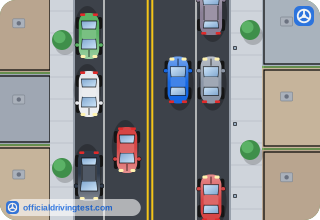
When parallel parking, after you stop even with the car ahead of the space, what do you do first?
- Turn your wheels sharply to the left and back quickly into the space
- Keep your wheels straight and back slowly toward the car behind the space
- Turn your wheels sharply to the right and pull forward to the curb
- Turn your wheels sharply to the right and back slowly toward the car behind the space
Show answer
Correct answer: Turn your wheels sharply to the right and back slowly toward the car behind the space
The first step is to turn the wheels sharply to the right and back slowly toward the car behind the space you wish to use.
Source: Georgia Driver's Manual (2023-2024), page 21
-
When parallel parking, what do you do as your front door passes the back bumper of the car ahead of the space?
- Quickly straighten your wheels and back diagonally into the space
- Turn your wheels sharply to the left and keep backing slowly
- Stop, pull forward and start the whole maneuver over again
- Keep your wheels turned to the right and back in faster
Show answer
Correct answer: Quickly straighten your wheels and back diagonally into the space
As your front door passes the back bumper of the car ahead of the space, you quickly straighten your wheels and back diagonally in a straight line.
Source: Georgia Driver's Manual (2023-2024), page 21
-
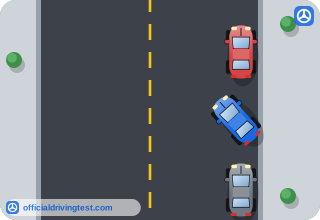
When parallel parking, what do you do when your front bumper is completely clear of the car ahead of you?
- Turn your wheels sharply to the right and back slowly toward the curb
- Straighten your wheels and back up quickly to the car behind you
- Turn your wheels sharply to the left and back slowly toward the car behind you
- Stop, place the car in drive and pull toward the center of the space
Show answer
Correct answer: Turn your wheels sharply to the left and back slowly toward the car behind you
Once your front bumper clears the car ahead, you turn the wheels sharply to the left and back slowly toward the car behind you.
Source: Georgia Driver's Manual (2023-2024), page 21
-
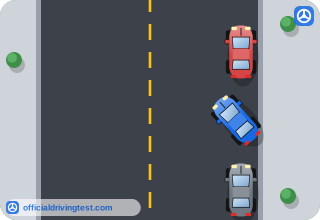
When parallel parking, what do you do at the end of the maneuver, after stopping before you touch the car behind you?
- Place the car in reverse, turn your wheels sharply to the left and back toward the curb
- Place the car in drive, turn your wheels sharply to the right and pull toward the center of the space
- Turn your wheels sharply to the left and pull toward the center of the space
- Place the car in park and leave your wheels turned toward the curb
Show answer
Correct answer: Place the car in drive, turn your wheels sharply to the right and pull toward the center of the space
You stop before contacting the car behind, place the car in drive, turn the wheels sharply right and pull toward the center of the space.
Source: Georgia Driver's Manual (2023-2024), page 21
-
How should you check behind you when backing your vehicle?
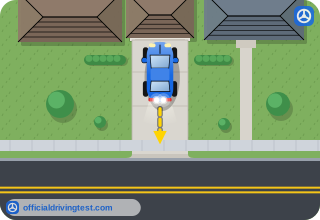
- Look over your right shoulder; do not depend on your mirrors
- Rely mainly on your rearview and side mirrors instead of looking back
- Turn your head and look over your left shoulder only
- Lean out of the window and look along the side of the vehicle
Show answer
Correct answer: Look over your right shoulder; do not depend on your mirrors
The manual says to turn your head and look over your right shoulder while backing and not to depend on your mirrors.
Source: Georgia Driver's Manual (2023-2024), page 21
-
What should the driver of a bus or other large vehicle do while backing?
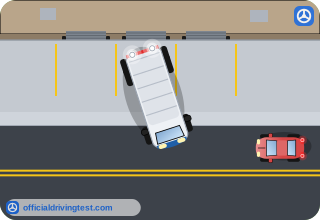
- Use only the driver's-side mirror and back up slowly
- Sound the horn and back up without any helper
- Use all mirrors and a reliable person to observe and direct
- Turn on the hazard lights and rely on the rearview mirror
Show answer
Correct answer: Use all mirrors and a reliable person to observe and direct
The manual says that for buses and large vehicles the driver should use all mirrors and a reliable person to observe and direct while backing.
Source: Georgia Driver's Manual (2023-2024), page 21
-
When may you open the doors of a vehicle on the side on which traffic is moving?
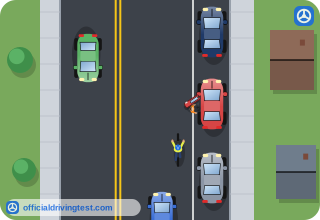
- Whenever the vehicle is stopped with its hazard lights on and the engine off
- Only when it is safe and it will not interfere with other traffic, including bicyclists
- Whenever you have signaled for at least three seconds before you open the door
- Only when a bicyclist has already passed, even if other vehicles are close by
Show answer
Correct answer: Only when it is safe and it will not interfere with other traffic, including bicyclists
Opening a door on the traffic side is prohibited unless it is safe and does not interfere with other traffic, including bicyclists near parked cars.
Source: Georgia Driver's Manual (2023-2024), page 23