Delaware: Speed and following distance — Part 3 Practice Test
Delaware speed limits, adjusting speed to the road and traffic, night driving, and the space around your vehicle. — Part 3
Independent educational site · not affiliated with any government agency or DMV
Ready? Test yourself
- Instant feedback with an explanation
- Every answer cites its source in the manual
- Your best score is saved on this device
Questions are original and based on the official manual "Delaware Driver Manual" (July 2026), Delaware Division of Motor Vehicles (DMV).
All 34 questions in this practice test
Take the test above first, then use this list to study. Tap “Show answer” to see the correct answer and explanation.
Show the questions and answersHide the questions
-
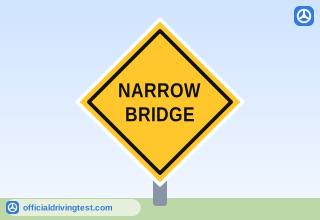
Why may you need to slow down on narrow bridges and tunnels?
- Vehicles are required to stop before entering
- Headlights are not allowed in tunnels
- The speed limit is always 15 mph there
- Vehicles approaching each other are closer together
Show answer
Correct answer: Vehicles approaching each other are closer together
The manual says vehicles approaching each other in narrow bridges and tunnels are closer together.
Source: Delaware Driver Manual (July 2026), page 125 · Open this page in the manual (Manual page 125)
-
What may happen to the number of lanes at a toll plaza?
- It could change both before and after the plaza
- It stays the same before and after the plaza
- It can change only after the plaza
- It can change only before the plaza
Show answer
Correct answer: It could change both before and after the plaza
The manual says the number of lanes could change both before and after the plaza.
Source: Delaware Driver Manual (July 2026), page 125 · Open this page in the manual (Manual page 125)
-
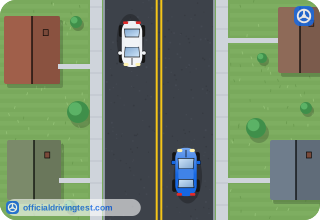
Why should you slow down near schools, playgrounds and residential streets?
- Playgrounds and schools are closed to traffic on most days
- Parked vehicles never block the view in these areas at all
- Children are often present and may cross or run into the street
- Traffic signals are not used on any of these streets
Show answer
Correct answer: Children are often present and may cross or run into the street
The manual says children are often present in these areas, so you should be alert for children crossing, running or riding into the street without looking.
Source: Delaware Driver Manual (July 2026), page 125 · Open this page in the manual (Manual page 125)
-
What does the glare of oncoming headlights cause in your eyes?
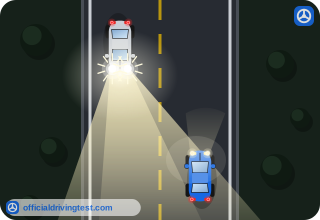
- The pupils contract, and it takes time for them to readjust
- The pupils expand and you see more detail
- The eyes cannot be affected for longer than a second
- The eyes stop seeing color for several minutes
Show answer
Correct answer: The pupils contract, and it takes time for them to readjust
The manual says glare causes the pupils to contract and it takes time to readjust to less intense light, during which you may be driving as though blind.
Source: Delaware Driver Manual (July 2026), page 125 · Open this page in the manual (Manual page 125)
-
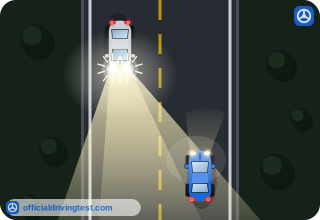
The glare of oncoming headlights greatly increases the difficulty of night driving, especially for which drivers?
- Drivers of large trucks
- Drivers who are new to driving
- Older drivers
- Drivers who wear sunglasses
Show answer
Correct answer: Older drivers
The manual says glare of oncoming headlights is especially difficult for older drivers.
Source: Delaware Driver Manual (July 2026), page 125 · Open this page in the manual (Manual page 125)
-
What is the most important thing to do to make your night driving safer?
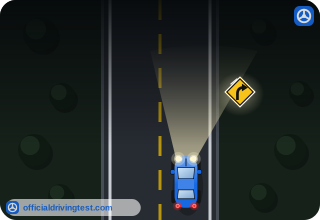
- Drive with your high beams on at all times
- Don’t over drive your headlights
- Keep up with the traffic around you
- Stay in the left lane as much as possible
Show answer
Correct answer: Don’t over drive your headlights
The manual says that most important of all, you should not over drive your headlights.
Source: Delaware Driver Manual (July 2026), page 125 · Open this page in the manual (Manual page 125)
-
When passing vehicles at night, what should you do instead of staring at their headlights?
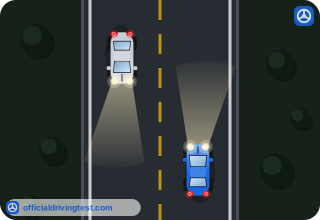
- Close one eye
- Look at the center line only
- Look at the vehicle’s driver
- Use quick glances
Show answer
Correct answer: Use quick glances
The manual says not to stare at the headlights of passing vehicles and to use quick glances instead.
Source: Delaware Driver Manual (July 2026), page 125 · Open this page in the manual (Manual page 125)
-
Which of these is a reason to use quick glances when passing vehicles at night?
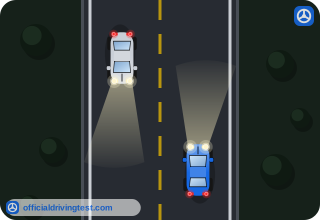
- To be certain of the right edge of the road
- To read the license plates of the vehicles
- To count the passengers in the other vehicles
- To check the speed of the other vehicles
Show answer
Correct answer: To be certain of the right edge of the road
The manual lists being certain of the right edge of the road among the reasons for using quick glances.
Source: Delaware Driver Manual (July 2026), page 125 · Open this page in the manual (Manual page 125)
-
When another driver’s turn signal is flashing, what should you do?
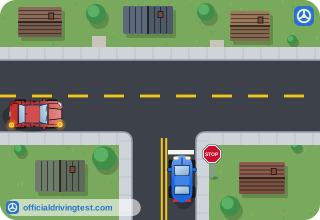
- Assume they will turn and speed up
- Assume they will turn and stay close behind
- Not assume they will turn, and plan for both cases
- Honk to tell them to turn
Show answer
Correct answer: Not assume they will turn, and plan for both cases
The manual says not to assume that a driver with a flashing turn signal will make a turn, and to plan what to do if they do not turn as well as if they do.
Source: Delaware Driver Manual (July 2026), page 126 · Open this page in the manual (Manual page 126)
-
Why should you not assume that every driver will stop at a stop sign or red traffic light?
- Stop signs and red lights are optional during the night hours
- Some drivers deliberately run them and others may be daydreaming
- Only commercial drivers are required to stop at them
- Drivers may stop only when they see you coming first
Show answer
Correct answer: Some drivers deliberately run them and others may be daydreaming
The manual says some drivers deliberately run stop signs and traffic lights, and others may be daydreaming.
Source: Delaware Driver Manual (July 2026), page 126 · Open this page in the manual (Manual page 126)
-
What should you constantly be thinking of as you drive, so you have a plan ready in a sudden emergency?
- The nearest exit
- The speed of the car behind you
- The next place to stop
- An escape route
Show answer
Correct answer: An escape route
The manual says to constantly think of an escape route so you will have a plan of action ready in a sudden emergency.
Source: Delaware Driver Manual (July 2026), page 126 · Open this page in the manual (Manual page 126)
-
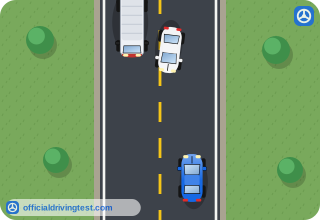
What should you do if you see an approaching vehicle start to pass and you think they may not have room?
- Slow down
- Speed up
- Move onto the shoulder at once
- Flash your high beams and hold your speed
Show answer
Correct answer: Slow down
The manual gives slowing down as the example action when an approaching vehicle starts to pass without enough room.
Source: Delaware Driver Manual (July 2026), page 126 · Open this page in the manual (Manual page 126)
-
With good tires, brakes and dry pavement, about how far can it take to react and stop at 50 mph?
- About 200 feet
- About 300 feet
- About 400 feet
- About 100 feet
Show answer
Correct answer: About 400 feet
The manual says it can take about 400 feet to react and stop at 50 mph, about the length of a city block.
Source: Delaware Driver Manual (July 2026), page 126 · Open this page in the manual (Manual page 126)
-
With good tires, brakes and dry pavement, about how far can it take to stop at 30 mph?
- About 100 feet
- About 200 feet
- About 400 feet
- About 300 feet
Show answer
Correct answer: About 200 feet
The manual says it can take about 200 feet to stop at 30 mph, almost half a city block.
Source: Delaware Driver Manual (July 2026), page 126 · Open this page in the manual (Manual page 126)
-
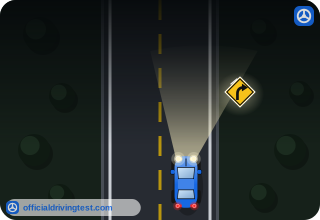
Compared with the daytime, how close must you be to an object to see it at night?
- The same distance
- Farther away
- Twice as far away
- Closer
Show answer
Correct answer: Closer
The manual says you must be closer to an object to see it at night than during the day.
Source: Delaware Driver Manual (July 2026), page 126 · Open this page in the manual (Manual page 126)
-
About how far ahead do your headlights let you see?
- About 350 feet
- About 150 feet
- About 500 feet
- About 700 feet
Show answer
Correct answer: About 350 feet
The manual says your headlights will let you see about 350 feet ahead.
Source: Delaware Driver Manual (July 2026), page 126 · Open this page in the manual (Manual page 126)
-
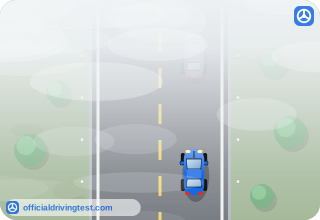
In a very heavy rain, snowstorm or thick fog you cannot see much more than 200 feet ahead. What is the fastest you can safely drive?
- 40 mph
- 50 mph
- 30 mph
- 20 mph
Show answer
Correct answer: 30 mph
The manual says that when you cannot see any farther than 200 feet, you cannot safely drive faster than 30 mph.
Source: Delaware Driver Manual (July 2026), page 126 · Open this page in the manual (Manual page 126)
-
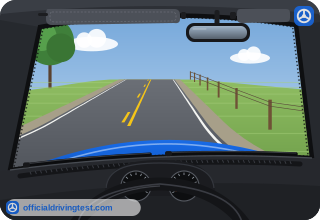
What should you do when you come to a hill or curve where you cannot see over or around it?
- Move toward the center of the road for a better view
- Sound your horn and keep your current speed
- Drive along the middle of the road shoulder
- Adjust your speed so you can stop if necessary
Show answer
Correct answer: Adjust your speed so you can stop if necessary
The manual says to adjust your speed so you can stop if necessary, since a vehicle may be stalled just over the hill or around the curve.
Source: Delaware Driver Manual (July 2026), page 126 · Open this page in the manual (Manual page 126)
-
Why should you give parked vehicles as much room as you safely can?
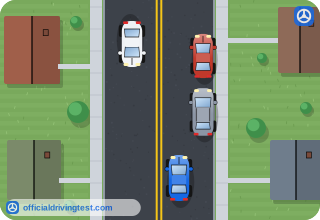
- They may block your view, and people may walk out from between them
- Parked vehicles are always about to pull out into traffic
- Parked vehicles must always be passed on the left side only
- The road surface is always rougher near parked vehicles
Show answer
Correct answer: They may block your view, and people may walk out from between them
The manual says parked vehicles may block your view and people may be ready to get out or walk out from between them.
Source: Delaware Driver Manual (July 2026), page 127 · Open this page in the manual (Manual page 127)
-
Using the “Four-Second Sight Distance Rule,” what do you pick out first?
- A moving vehicle in the next lane over from you
- The vehicle that is following you closely behind
- A stationary object as far ahead as you can clearly see
- A road sign no more than 100 feet away from you
Show answer
Correct answer: A stationary object as far ahead as you can clearly see
The manual says to pick out a stationary object, such as a sign or telephone pole, as far ahead as you can clearly see.
Source: Delaware Driver Manual (July 2026), page 127 · Open this page in the manual (Manual page 127)
-
Using the “Four-Second Sight Distance Rule,” what does it mean if you reach the object before you finish counting “four-one-thousand”?
- You are following the vehicle in front of you too closely
- You are going too fast for your sight distance, so slow down
- You are driving at a safe speed for the conditions ahead
- You should speed up to pass the vehicle in front of you
Show answer
Correct answer: You are going too fast for your sight distance, so slow down
The manual says reaching the object before you finish saying four-one-thousand means you are going too fast for your sight distance.
Source: Delaware Driver Manual (July 2026), page 127 · Open this page in the manual (Manual page 127)
-
Why should you use the four-second sight distance rule at night?
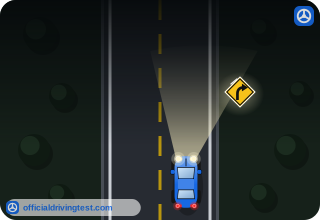
- To find out how far away the next intersection is
- To tell if the vehicle behind you is too close
- To judge when to turn on your high beams
- To make sure you are not over-driving your headlights
Show answer
Correct answer: To make sure you are not over-driving your headlights
The manual says to use the rule at night to make sure you are not over-driving your headlights.
Source: Delaware Driver Manual (July 2026), page 127 · Open this page in the manual (Manual page 127)
-
What are speed limits based on?
- The design of the road and the type of vehicles that use it
- The age and experience of the drivers using the road
- The number of crashes recorded on the road last year
- The weather forecast on the day the sign was posted
Show answer
Correct answer: The design of the road and the type of vehicles that use it
The manual says speed limits are based on the design of the road and the type of vehicles that use them.
Source: Delaware Driver Manual (July 2026), page 127 · Open this page in the manual (Manual page 127)
-
Which of these do speed limits take into account?
- Only the speed of the slowest vehicle on the road
- Only the width of the lane and the type of shoulder
- Things you cannot see, such as side roads and driveways
- The posted limit of the nearest highway or freeway
Show answer
Correct answer: Things you cannot see, such as side roads and driveways
The manual says speed limits take into account things you cannot see, such as side roads and driveways where people may pull out suddenly, and the amount of traffic.
Source: Delaware Driver Manual (July 2026), page 127 · Open this page in the manual (Manual page 127)
-
Speed limits are posted for what kind of conditions?
- Average conditions
- Ideal conditions
- Night conditions
- Wet-road conditions
Show answer
Correct answer: Ideal conditions
The manual says speed limits are posted for ideal conditions, so you must slow down if the road is wet or icy, you cannot see well or traffic is heavy.
Source: Delaware Driver Manual (July 2026), page 127 · Open this page in the manual (Manual page 127)
-
Can you get a ticket for driving too fast during unsafe conditions even if you are under the posted speed limit?
- No
- Only on highways
- Only at night
- Yes
Show answer
Correct answer: Yes
The manual says you can get a ticket for traveling too fast during unsafe conditions even if you are under the posted limit.
Source: Delaware Driver Manual (July 2026), page 127 · Open this page in the manual (Manual page 127)
-
What does the manual compare the space you keep around your vehicle to?
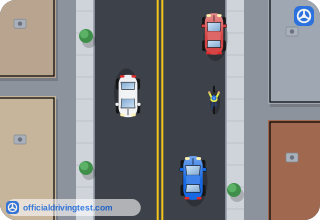
- A safety cushion
- A speed buffer
- A traffic lane
- A warning zone
Show answer
Correct answer: A safety cushion
The manual says the space around you is like a safety cushion: the more you have, the safer you can be.
Source: Delaware Driver Manual (July 2026), page 127 · Open this page in the manual (Manual page 127)
-
What causes rear-end crashes, which are very common?
- Drivers who stop too often at traffic signals or stop signs
- Drivers who change lanes too often on busy roads without signaling
- Drivers following too closely to stop when the vehicle ahead suddenly stops
- Drivers who drive much more slowly than the rest of traffic
Show answer
Correct answer: Drivers following too closely to stop when the vehicle ahead suddenly stops
The manual says rear-end crashes are caused by drivers following too closely to stop before hitting the vehicle ahead when it suddenly stops.
Source: Delaware Driver Manual (July 2026), page 127 · Open this page in the manual (Manual page 127)
-
The “three-second rule” for telling whether you are following too closely works at what speeds?
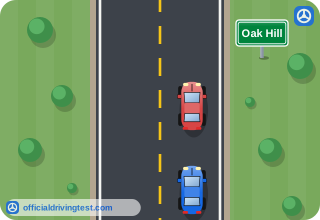
- Only speeds under 30 mph
- Any speed
- Only speeds over 50 mph
- Only on dry roads
Show answer
Correct answer: Any speed
The manual says the three-second rule works at any speed.
Source: Delaware Driver Manual (July 2026), page 127 · Open this page in the manual (Manual page 127)
-
When using the three-second rule, how do you know you are following too closely?
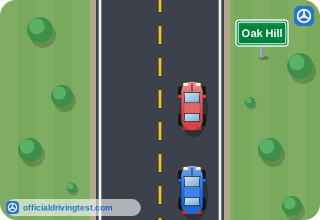
- You pass the mark after you finish counting
- You see the brake lights of the vehicle ahead
- You cannot see the road surface ahead
- You pass the mark before you finish counting
Show answer
Correct answer: You pass the mark before you finish counting
The manual says you are following too closely if you pass the mark before you finish counting.
Source: Delaware Driver Manual (July 2026), page 128 · Open this page in the manual (Manual page 128)
-
If you are following too closely, what should you do?
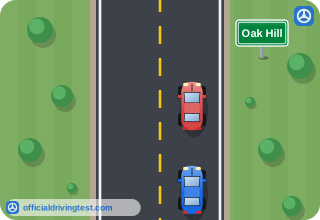
- Drop back, then count at another spot until no closer than three seconds
- Move to the right lane and keep driving at the same speed as before
- Count again at the same spot until you finally pass it safely
- Speed up to pass the vehicle ahead as soon as it is safe
Show answer
Correct answer: Drop back, then count at another spot until no closer than three seconds
The manual says to drop back and count again at another spot, repeating until you follow no closer than three seconds.
Source: Delaware Driver Manual (July 2026), page 128 · Open this page in the manual (Manual page 128)
-
In situations such as slippery roads, you may need to leave how much following distance to be safe?
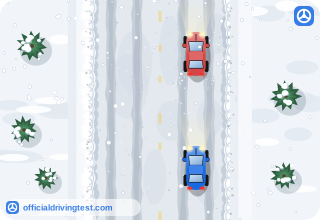
- Two seconds
- Six seconds
- Four seconds
- One second
Show answer
Correct answer: Four seconds
The manual says that in certain situations you may need a four-second following distance to be safe.
Source: Delaware Driver Manual (July 2026), page 128 · Open this page in the manual (Manual page 128)
-
Why must you leave more space in front of you on slippery roads?
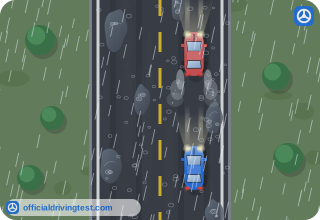
- Your headlights are less effective
- You need more distance to stop your vehicle
- The vehicle ahead will always slow down
- Other drivers cannot see your signals
Show answer
Correct answer: You need more distance to stop your vehicle
The manual says you need more distance to stop on slippery roads, so you must leave more space in front.
Source: Delaware Driver Manual (July 2026), page 128 · Open this page in the manual (Manual page 128)
-
What should you do when the driver behind you wants to pass?
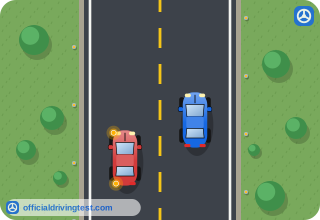
- Speed up to stay ahead of the driver behind you
- Move onto the shoulder and wait for the driver
- Brake sharply to warn the driver behind you
- Slow down to allow room in front of your vehicle
Show answer
Correct answer: Slow down to allow room in front of your vehicle
The manual says slowing down to allow room in front also lets the pass be completed sooner.
Source: Delaware Driver Manual (July 2026), page 128 · Open this page in the manual (Manual page 128)