Delaware: Speed and following distance — Part 1 Practice Test
Delaware speed limits, adjusting speed to the road and traffic, night driving, and the space around your vehicle. — Part 1
Independent educational site · not affiliated with any government agency or DMV
Ready? Test yourself
- Instant feedback with an explanation
- Every answer cites its source in the manual
- Your best score is saved on this device
Questions are original and based on the official manual "Delaware Driver Manual" (July 2026), Delaware Division of Motor Vehicles (DMV).
All 34 questions in this practice test
Take the test above first, then use this list to study. Tap “Show answer” to see the correct answer and explanation.
Show the questions and answersHide the questions
-
What does the general speed restriction require of you on a Delaware highway?
- Driving at the posted speed limit at all times, which is always safe
- Not driving faster than is reasonable under existing conditions
- Driving 10 miles per hour below the posted limit in bad weather
- Driving at the speed of surrounding traffic whatever the posted limit is
Show answer
Correct answer: Not driving faster than is reasonable under existing conditions
You must not drive at a speed greater than is reasonable under existing conditions, so it is not always lawful to drive as fast as the posted limit.
Source: Delaware Driver Manual (July 2026), page 93 · Open this page in the manual (Manual page 93)
-
No matter what the weather, traffic density or your urgency, what must you always control your speed to avoid?
- Being passed by other drivers on the highway
- Arriving later than other drivers do
- Having to use your horn near pedestrians
- Hitting any person, vehicle, or other conveyance
Show answer
Correct answer: Hitting any person, vehicle, or other conveyance
You must always control your speed to avoid hitting any person, vehicle, or other conveyance.
Source: Delaware Driver Manual (July 2026), page 93 · Open this page in the manual (Manual page 93)
-
Delaware traffic laws provide both a general speed restriction and specific speed limits. Which must you obey?
- Only the specific speed limits, because the general restriction is advice
- Only the general restriction, because it replaces posted limits
- Both the general restriction and the specific limits
- Whichever of the two is higher on that road
Show answer
Correct answer: Both the general restriction and the specific limits
The manual says the laws provide both a general speed restriction and specific speed limits, and you must obey both.
Source: Delaware Driver Manual (July 2026), page 93 · Open this page in the manual (Manual page 93)
-
According to the speed table, what is the speed limit in school zones?
- 20 miles per hour
- 15 miles per hour
- 25 miles per hour
- 30 miles per hour
Show answer
Correct answer: 20 miles per hour
The table lists school zones at 20 miles per hour.
Source: Delaware Driver Manual (July 2026), page 93 · Open this page in the manual (Manual page 93)
-
According to the speed table, what is the speed limit in business districts?
- 15 miles per hour
- 20 miles per hour
- 30 miles per hour
- 25 miles per hour
Show answer
Correct answer: 25 miles per hour
The table lists business districts at 25 miles per hour.
Source: Delaware Driver Manual (July 2026), page 93 · Open this page in the manual (Manual page 93)
-
According to the speed table, what is the speed limit in residential districts?
- 20 miles per hour
- 25 miles per hour
- 30 miles per hour
- 35 miles per hour
Show answer
Correct answer: 25 miles per hour
The table lists residential districts at 25 miles per hour.
Source: Delaware Driver Manual (July 2026), page 93 · Open this page in the manual (Manual page 93)
-
According to the speed table, what is the speed limit on two-lane roads?
- 50 miles per hour
- 40 miles per hour
- 45 miles per hour
- 55 miles per hour
Show answer
Correct answer: 50 miles per hour
The table lists two-lane roads at 50 miles per hour.
Source: Delaware Driver Manual (July 2026), page 93 · Open this page in the manual (Manual page 93)
-
According to the speed table, what is the speed limit on divided roads and roads having four or more lanes?
- 45 miles per hour
- 50 miles per hour
- 55 miles per hour
- 65 miles per hour
Show answer
Correct answer: 55 miles per hour
The table lists divided roads and roads having four or more lanes at 55 miles per hour.
Source: Delaware Driver Manual (July 2026), page 93 · Open this page in the manual (Manual page 93)
-
According to the speed table, what is the speed limit on controlled access highways (turnpikes and expressways)?
- 45 miles per hour
- 55 miles per hour
- 50 miles per hour
- 60 miles per hour
Show answer
Correct answer: 55 miles per hour
The table lists controlled access highways (turnpikes and expressways) at 55 miles per hour.
Source: Delaware Driver Manual (July 2026), page 93 · Open this page in the manual (Manual page 93)
-
According to the speed table, what is the speed limit on Route 1 and Interstate 495?
- 55 miles per hour
- 60 miles per hour
- 70 miles per hour
- 65 miles per hour
Show answer
Correct answer: 65 miles per hour
The table lists Route 1 and interstate 495 at 65 miles per hour.
Source: Delaware Driver Manual (July 2026), page 93 · Open this page in the manual (Manual page 93)
-
Under emergency conditions the speed limits may be changed. What must the driver never do?
- Drive below the posted limit
- Use the horn
- Exceed the posted limit
- Stop on the roadway
Show answer
Correct answer: Exceed the posted limit
Under emergency conditions the limits may be changed, but the driver must never exceed the posted limit.
Source: Delaware Driver Manual (July 2026), page 93 · Open this page in the manual (Manual page 93)
-
What may happen when any of the listed speed limits are unsafe for conditions?
- They may be reduced to lower speed limits
- They may be raised for safer passing
- They are replaced by minimum speed limits
- They stay in force until the police change them
Show answer
Correct answer: They may be reduced to lower speed limits
The listed limits may be reduced to lower limits when unsafe for conditions, and signs may show the reduced limit.
Source: Delaware Driver Manual (July 2026), page 94 · Open this page in the manual (Manual page 94)
-
When may you drive so slowly that you impede the normal and reasonable movement of traffic?
- When you are driving in the right lane with your flashers on
- When you are unsure of the route and want to read signs
- When the weather is clear and you are in no hurry
- When necessary for safety or compliance with the law
Show answer
Correct answer: When necessary for safety or compliance with the law
You must not impede normal and reasonable traffic movement by slow driving, except when necessary for safety or compliance with the law.
Source: Delaware Driver Manual (July 2026), page 94 · Open this page in the manual (Manual page 94)
-
When may you disobey a posted minimum speed limit?
- When you are driving a vehicle with a heavy load on board
- When weather or other conditions make it unsafe to obey it
- When there are no other vehicles on the road ahead of you
- When you turn on your hazard flashers and keep right
Show answer
Correct answer: When weather or other conditions make it unsafe to obey it
You must obey posted minimum speed limits except when weather or other conditions make it unsafe to do so.
Source: Delaware Driver Manual (July 2026), page 94 · Open this page in the manual (Manual page 94)
-
What are the two kinds of speed signs described in the manual?
- Speed limit signs and advisory (recommended) speed signs
- Speed limit signs and construction-zone speed signs
- Posted speed signs and school-zone speed signs only
- Maximum speed signs and minimum warning speed signs
Show answer
Correct answer: Speed limit signs and advisory (recommended) speed signs
The manual says there are two speed signs: speed limit signs and advisory (recommended) speed signs.
Source: Delaware Driver Manual (July 2026), page 94 · Open this page in the manual (Manual page 94)
-
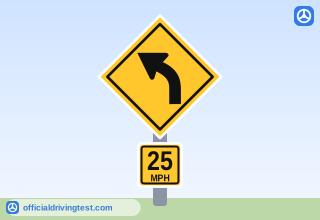
Why are advisory speed signs posted along portions of highways?
- To show the highest speed that is legally allowed on that part of the road
- To show the lowest speed you may drive there without impeding traffic
- To tell you the speed limit changes for the next several miles
- To warn you that conditions may often make it unsafe to drive faster
Show answer
Correct answer: To warn you that conditions may often make it unsafe to drive faster
Advisory speed signs warn that conditions may often make it unsafe to drive faster than the posted advisory speed.
Source: Delaware Driver Manual (July 2026), page 94 · Open this page in the manual (Manual page 94)
-
If you exceed an advisory speed and have a crash, what may be concluded?
- That you violated a minimum speed limit, but you cannot be arrested
- That the advisory speed has no legal effect, so you are not at fault
- That you violated the general speed restriction and could be subject to arrest
- That you violated the specific speed limit and must pay the fine at the scene
Show answer
Correct answer: That you violated the general speed restriction and could be subject to arrest
An advisory speed is not a specific limit, but exceeding it and crashing may be taken as violating the general speed restriction.
Source: Delaware Driver Manual (July 2026), page 94 · Open this page in the manual (Manual page 94)
-
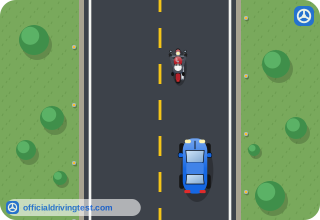
How many seconds should you follow behind a motorcyclist when traveling above 40 mph?
- Two seconds
- Three seconds
- Four seconds
- Six seconds
Show answer
Correct answer: Four seconds
The manual calls for a four second count behind a motorcyclist at speeds above 40 mph.
Source: Delaware Driver Manual (July 2026), page 100 · Open this page in the manual (Manual page 100)
-
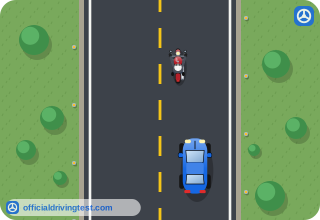
Why should you not follow a motorcyclist too closely?
- It may make the rider's headlight shine into your mirrors
- It may make the rider nervous and distract the rider from the road ahead
- It may cause the rider to accelerate beyond the speed limit
- It may keep the rider from seeing the turn signal of your car
Show answer
Correct answer: It may make the rider nervous and distract the rider from the road ahead
The manual says tailgating a rider can make the rider nervous and take attention away from the road ahead.
Source: Delaware Driver Manual (July 2026), page 100 · Open this page in the manual (Manual page 100)
-
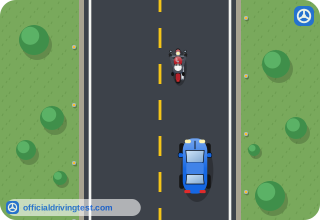
Why do you need to follow a motorcycle at a safe distance, according to the manual?
- Motorcycles cannot use their brakes in the rain
- Motorcycles always travel faster than cars
- Motorcycles have no taillights at night
- Motorcycles can stop quicker
Show answer
Correct answer: Motorcycles can stop quicker
The manual notes that motorcycles can stop quicker, so a safe following distance is needed.
Source: Delaware Driver Manual (July 2026), page 100 · Open this page in the manual (Manual page 100)
-
What should you do with your following distance behind a motorcycle on a slippery or wet road?
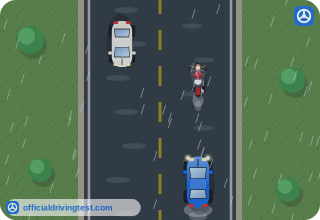
- Increase it
- Keep it the same
- Decrease it slightly
- Move alongside the rider
Show answer
Correct answer: Increase it
The manual tells drivers to increase following distance behind a motorcycle when the road is slippery or wet.
Source: Delaware Driver Manual (July 2026), page 100 · Open this page in the manual (Manual page 100)
-
What should you do with your speed after you pass a truck?
- Slow down right away
- Maintain your speed
- Brake firmly
- Speed up for several seconds
Show answer
Correct answer: Maintain your speed
The manual says to maintain your speed after you pass a truck.
Source: Delaware Driver Manual (July 2026), page 103 · Open this page in the manual (Manual page 103)
-
How many seconds should you leave between your vehicle and a truck you are following?
- At least four seconds
- At least one second
- At least two seconds
- At least three car lengths
Show answer
Correct answer: At least four seconds
The manual says to allow at least four seconds between your vehicle and the truck in its rear blind spot.
Source: Delaware Driver Manual (July 2026), page 103 · Open this page in the manual (Manual page 103)
-
What is the best way not to speed?
- Match your speed to that of the vehicle just ahead of you
- Know how fast you are going; check the speedometer often
- Judge your speed by the engine noise and the feel of the road
- Rely on the flow of traffic rather than the speedometer
Show answer
Correct answer: Know how fast you are going; check the speedometer often
The best way not to speed is to know how fast you are going, so check the speedometer often.
Source: Delaware Driver Manual (July 2026), page 114 · Open this page in the manual (Manual page 114)
-
When is it especially easy to be traveling much faster than you think?
- When you enter a high speed road from a slow local road
- When you drive on a local road for the first time
- When you drive in heavy traffic during rush hour
- When you leave high speed roads for much slower local roads
Show answer
Correct answer: When you leave high speed roads for much slower local roads
People are not good at judging their speed, especially when they leave high speed roads for much slower local roads.
Source: Delaware Driver Manual (July 2026), page 114 · Open this page in the manual (Manual page 114)
-
According to the manual, why are speed limit signs posted?
- For your safety
- To raise funds for road repairs
- To help police issue more tickets
- To reduce noise near homes
Show answer
Correct answer: For your safety
The manual says speed limit signs are there for your safety, so you should follow them.
Source: Delaware Driver Manual (July 2026), page 114 · Open this page in the manual (Manual page 114)
-
What does stopping suddenly usually point to?
- A vehicle with worn brake pads
- A driver who is driving too slowly
- A driver who was not paying attention
- A road with a slippery surface
Show answer
Correct answer: A driver who was not paying attention
Stopping suddenly is dangerous and usually points to a driver who was not paying attention.
Source: Delaware Driver Manual (July 2026), page 114 · Open this page in the manual (Manual page 114)
-
What could happen when you brake quickly?
- You could skid and lose control of your vehicle
- Your tires will always grip the road better
- Your brake lights will flash automatically
- Your engine will stall and the horn will sound
Show answer
Correct answer: You could skid and lose control of your vehicle
When you brake quickly, you could skid and lose control of your vehicle.
Source: Delaware Driver Manual (July 2026), page 114 · Open this page in the manual (Manual page 114)
-
How does braking quickly affect the drivers behind you?
- It gives them extra time to see your brake lights
- It has no effect if your brake lights work
- It is harder for them to stop without hitting you
- It makes them more likely to pass you safely
Show answer
Correct answer: It is harder for them to stop without hitting you
Braking quickly makes it harder for drivers behind you to stop without hitting you.
Source: Delaware Driver Manual (July 2026), page 114 · Open this page in the manual (Manual page 114)
-
What should you do to avoid panic stops?
- Follow closely so you can react to the vehicle ahead
- See events well in advance and slow down or change lanes
- Brake lightly and often so you are always ready to stop
- Wait until the last moment, then brake firmly
Show answer
Correct answer: See events well in advance and slow down or change lanes
Avoid panic stops by seeing events well in advance; slowing down or changing lanes may mean you do not have to stop at all.
Source: Delaware Driver Manual (July 2026), page 114 · Open this page in the manual (Manual page 114)
-
How many seconds ahead of their vehicle do safer drivers tend to look?
- At least 10 seconds
- At least 3 seconds
- At least 5 seconds
- At least 20 seconds
Show answer
Correct answer: At least 10 seconds
Safer drivers tend to look at least 10 seconds ahead, the distance the vehicle will travel in 10 seconds.
Source: Delaware Driver Manual (July 2026), page 116 · Open this page in the manual (Manual page 116)
-
In city traffic, how far ahead should you try to look?
- At least four blocks
- A quarter of a mile
- At least one block
- About 500 feet
Show answer
Correct answer: At least one block
In the city, 10 seconds is about one block, so you should try to look at least one block ahead.
Source: Delaware Driver Manual (July 2026), page 116 · Open this page in the manual (Manual page 116)
-
How can you figure out how many seconds ahead you are looking?
- Pick a moving vehicle ahead and count the seconds until it turns
- Count the seconds until the traffic light ahead changes color
- Count the seconds from seeing a sign to being able to read it
- Pick a non-moving object ahead and count until you reach it
Show answer
Correct answer: Pick a non-moving object ahead and count until you reach it
You find a non-moving object about as far ahead as you are looking and count seconds until you reach it.
Source: Delaware Driver Manual (July 2026), page 116 · Open this page in the manual (Manual page 116)
-
How does looking well down the road help your steering?
- You can take curves at a higher speed
- You can hold the wheel with one hand
- You need to check your mirrors less often
- You steer straighter with less weaving
Show answer
Correct answer: You steer straighter with less weaving
Looking well down the road helps you steer straighter with less weaving.
Source: Delaware Driver Manual (July 2026), page 116 · Open this page in the manual (Manual page 116)