Delaware: Signals and vehicle controls — Part 5 Practice Test
Required and prohibited vehicle equipment, headlights, checking your vehicle, steering, braking, scanning, turn signals and hand signals. — Part 5
Independent educational site · not affiliated with any government agency or DMV
Ready? Test yourself
- Instant feedback with an explanation
- Every answer cites its source in the manual
- Your best score is saved on this device
Questions are original and based on the official manual "Delaware Driver Manual" (July 2026), Delaware Division of Motor Vehicles (DMV).
All 38 questions in this practice test
Take the test above first, then use this list to study. Tap “Show answer” to see the correct answer and explanation.
Show the questions and answersHide the questions
-
When should you use your low beams?
- Only when no other vehicles are on the road at night
- Only when approaching a hill crest at night
- Only on unfamiliar roads or in construction areas
- When following another vehicle or in heavy traffic
Show answer
Correct answer: When following another vehicle or in heavy traffic
The manual says to use low beams when following another vehicle or when in heavy traffic.
Source: Delaware Driver Manual (July 2026), page 119 · Open this page in the manual (Manual page 119)
-
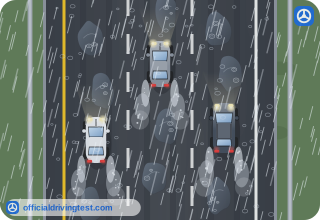
Which beams should you use in fog or when it is snowing or raining hard?
- High beams
- Parking lights only
- Alternating high and low beams
- Low beams
Show answer
Correct answer: Low beams
Light from high beams reflects back, causing glare, so use low beams in fog, snow, or hard rain.
Source: Delaware Driver Manual (July 2026), page 119 · Open this page in the manual (Manual page 119)
-
In Delaware, when must you turn on your lights?
- Only from sunset to sunrise, whatever the weather
- In rain, mist, and snow, and any time your wipers are on
- Only in heavy rain, and only on highways
- Only in snow or fog, but not in rain or mist
Show answer
Correct answer: In rain, mist, and snow, and any time your wipers are on
The manual says you must turn on your lights in rain, mist, and snow, and at any time you have your wipers on, and it is the law in Delaware.
Source: Delaware Driver Manual (July 2026), page 119 · Open this page in the manual (Manual page 119)
-
What are parking lights for?
- Driving in fog
- Driving at dusk
- Parking only
- Driving in heavy rain
Show answer
Correct answer: Parking only
You must not drive at any time with only your parking lights on, because parking lights are for parking only.
Source: Delaware Driver Manual (July 2026), page 119 · Open this page in the manual (Manual page 119)
-
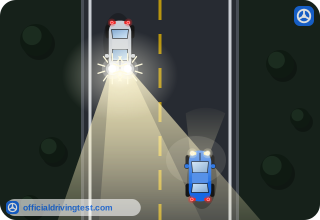
A vehicle comes toward you with its high beams on. What should you do?
- Flash your headlights quickly a couple of times
- Turn on your hazard lights and slow down
- Sound your horn until the driver dims
- Turn on your own high beams to match
Show answer
Correct answer: Flash your headlights quickly a couple of times
The manual says to flash your headlights quickly a couple of times.
Source: Delaware Driver Manual (July 2026), page 119 · Open this page in the manual (Manual page 119)
-
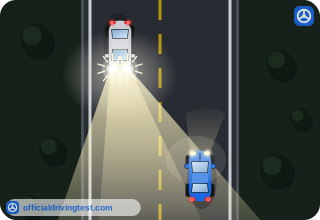
If an oncoming driver fails to dim the lights, where should you look?
- Directly at the oncoming headlights
- Toward the center line of the road
- Toward the right side of the road
- Toward the left edge of the road
Show answer
Correct answer: Toward the right side of the road
Looking toward the right side of the road keeps you from being blinded and lets you see the edge of the road to stay on course.
Source: Delaware Driver Manual (July 2026), page 119 · Open this page in the manual (Manual page 119)
-
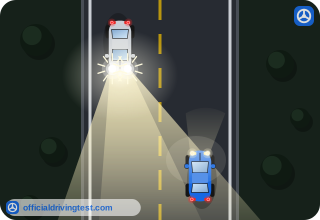
Why should you not keep your bright lights on to “get back” at an oncoming driver?
- Both of you may be blinded
- Your headlights will burn out sooner
- It is only allowed on unlit roads
- It will drain your battery faster
Show answer
Correct answer: Both of you may be blinded
If you keep your bright lights on, both of you may be blinded.
Source: Delaware Driver Manual (July 2026), page 119 · Open this page in the manual (Manual page 119)
-
In Delaware, what must you do when you turn on your windshield wipers?
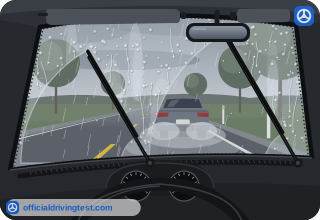
- Turn on your headlights
- Turn on your hazard flashers
- Turn on your parking lights only
- Roll down your windows
Show answer
Correct answer: Turn on your headlights
The manual says that if you turn on your wipers you turn on your headlights, and that this is the law in Delaware.
Source: Delaware Driver Manual (July 2026), page 120 · Open this page in the manual (Manual page 120)
-
When are parking lights meant to be used?
- At dusk, while driving slowly
- In light rain, to save the headlights
- Only on parked vehicles
- When driving in fog
Show answer
Correct answer: Only on parked vehicles
Whenever you are driving and lights are needed you use your headlights, because parking lights are for parked vehicles only.
Source: Delaware Driver Manual (July 2026), page 120 · Open this page in the manual (Manual page 120)
-
Why should you turn on your headlights when driving away from a rising or setting sun?
- The sun makes your dashboard hard to read
- Drivers coming toward you may have trouble seeing your vehicle
- Your own headlights are needed to see the road ahead
- Parking lights do not work in sunlight
Show answer
Correct answer: Drivers coming toward you may have trouble seeing your vehicle
The manual says drivers coming toward you may have trouble seeing your vehicle, and your headlights help them see you.
Source: Delaware Driver Manual (July 2026), page 120 · Open this page in the manual (Manual page 120)
-
What does the manual say about turning on your headlights a little early as it begins to get dark?
- It wastes battery power and should be avoided
- It can blind other drivers
- It is not allowed before full darkness
- It helps other drivers see you
Show answer
Correct answer: It helps other drivers see you
Turning headlights on a little early still helps other drivers see you.
Source: Delaware Driver Manual (July 2026), page 120 · Open this page in the manual (Manual page 120)
-
What can you do with your headlights to alert other road users that you are there?
- Flick them
- Switch to parking lights
- Leave them off until it is dark
- Turn them off and on slowly for ten seconds
Show answer
Correct answer: Flick them
The manual says to flick your headlights if needed to alert other road users you are there.
Source: Delaware Driver Manual (July 2026), page 120 · Open this page in the manual (Manual page 120)
-
How should you use your horn when there is no immediate danger?
- Sound a long blast
- Sound three short blasts
- Give it a light tap
- Hold it down until the other driver reacts
Show answer
Correct answer: Give it a light tap
With no immediate danger, a light tap on the horn should be all you need.
Source: Delaware Driver Manual (July 2026), page 120 · Open this page in the manual (Manual page 120)
-
When should you give your horn a light tap?
- When a driver ahead is driving slower than you want
- At a place where you cannot see ahead, such as a sharp curve
- When you want to greet a friend on the sidewalk
- When the traffic light has just turned green
Show answer
Correct answer: At a place where you cannot see ahead, such as a sharp curve
A light tap is advised at places where you cannot see ahead, such as a steep hill, sharp curve or narrow alley exit.
Source: Delaware Driver Manual (July 2026), page 120 · Open this page in the manual (Manual page 120)
-
Which of these is a time to give your horn a light tap?
- You want a driver in front of you to speed up and move
- You are driving near a blind pedestrian on a sidewalk
- You want to tell another driver about a mistake made
- You are passing a driver who starts to turn into your lane
Show answer
Correct answer: You are passing a driver who starts to turn into your lane
The manual lists passing a driver who starts to turn into your lane as a time for a light tap on the horn.
Source: Delaware Driver Manual (July 2026), page 120 · Open this page in the manual (Manual page 120)
-
Which situation calls for a light tap on the horn?
- A person on foot or on a bike seems to move into your lane
- A driver behind you is following too closely
- You are waiting at a red light and it is taking long
- You are about to start your engine in a driveway
Show answer
Correct answer: A person on foot or on a bike seems to move into your lane
A light tap is recommended when a person on foot or on a bike seems to be moving into your lane.
Source: Delaware Driver Manual (July 2026), page 120 · Open this page in the manual (Manual page 120)
-
When should you sound a sharp blast on your horn?
- A driver is not paying attention to your vehicle ahead
- You are coming to a steep hill that you cannot see over
- A child or older person is about to enter the street
- You are passing a driver who is signaling a turn ahead
Show answer
Correct answer: A child or older person is about to enter the street
If there is danger, such as a child or older person about to enter the street, the manual says not to be afraid to sound a sharp blast.
Source: Delaware Driver Manual (July 2026), page 120 · Open this page in the manual (Manual page 120)
-
Which situation calls for a sharp blast on your horn?
- You are exiting a narrow alley slowly
- You have lost control and are moving toward someone
- You are passing a vehicle on a two-lane road
- Another driver does not see you from far away
Show answer
Correct answer: You have lost control and are moving toward someone
A sharp blast is for danger, including when you have lost control of your vehicle and are moving towards someone.
Source: Delaware Driver Manual (July 2026), page 120 · Open this page in the manual (Manual page 120)
-
Around whom should you not use your horn?
- Bicyclists riding ahead
- Children at a crosswalk
- Drivers who are slow to move
- Blind pedestrians
Show answer
Correct answer: Blind pedestrians
Around blind pedestrians is listed among the occasions when you should not use your horn.
Source: Delaware Driver Manual (July 2026), page 120 · Open this page in the manual (Manual page 120)
-
Which of these is a time when you should NOT use your horn?
- To encourage someone to drive faster or get out of the way
- When another vehicle is in danger of hitting you
- When a driver may have trouble seeing you
- When you cannot see what is ahead at a sharp curve
Show answer
Correct answer: To encourage someone to drive faster or get out of the way
Encouraging someone to drive faster or get out of the way is listed among the times not to use your horn.
Source: Delaware Driver Manual (July 2026), page 120 · Open this page in the manual (Manual page 120)
-
Which of these is listed as a time when you should not use your horn?
- Warning a child about to run into the street
- Alerting a driver who is not paying attention
- Greeting a friend
- Warning a person about to walk into your lane
Show answer
Correct answer: Greeting a friend
The manual lists greeting a friend among the occasions when you should not use your horn.
Source: Delaware Driver Manual (July 2026), page 120 · Open this page in the manual (Manual page 120)
-
When should you use your turn signals?
- Only when other vehicles are nearby on the road
- Only when turning at an intersection with a light
- Before changing lanes, turning, merging, or parking
- Only after you have already started the turn itself
Show answer
Correct answer: Before changing lanes, turning, merging, or parking
The manual says to use turn signals before you change lanes, turn right or left, merge into traffic, or park.
Source: Delaware Driver Manual (July 2026), page 122 · Open this page in the manual (Manual page 122)
-
What does the manual say about signaling a change of direction when you do not see anyone else around?
- It is not needed when no one is in sight
- Signal anyway, since someone could be missed
- It is needed only on highways
- Use a horn tap instead of a signal
Show answer
Correct answer: Signal anyway, since someone could be missed
You should get into the habit of signaling every time, because it is easy to miss someone who needs to know.
Source: Delaware Driver Manual (July 2026), page 122 · Open this page in the manual (Manual page 122)
-
The manual says to try to signal at least how long before you make your move?
- One second
- Five seconds
- Ten seconds
- Three seconds
Show answer
Correct answer: Three seconds
The manual says to try and signal at least three seconds before you make your move.
Source: Delaware Driver Manual (July 2026), page 122 · Open this page in the manual (Manual page 122)
-
If there are streets, driveways, or entrances between you and where you want to turn, when should you signal?
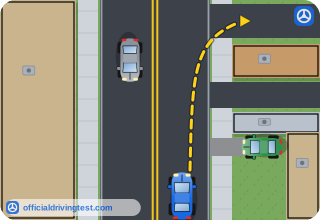
- As early as possible, before reaching them
- While you are in the first of them
- After you have passed them
- Only when you reach the turn itself
Show answer
Correct answer: After you have passed them
Be careful not to signal too early; wait until you have passed such streets, driveways or entrances.
Source: Delaware Driver Manual (July 2026), page 122 · Open this page in the manual (Manual page 122)
-
Why should you wait to signal your turn if another vehicle is about to enter the street between you and your turn?
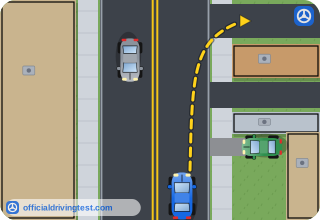
- Your signal may not be visible in daylight
- The other driver may think you will turn where they are
- The other driver would be required to stop for you
- Your turn signal may stay on by itself
Show answer
Correct answer: The other driver may think you will turn where they are
An early signal may make the other driver think you will turn where they are, and they might pull into your path.
Source: Delaware Driver Manual (July 2026), page 122 · Open this page in the manual (Manual page 122)
-
What should you check after you have made a turn or lane change?
- That your hazard flashers are on
- That your brake lights are lit
- That your headlights are on high beam
- That your turn signal is off
Show answer
Correct answer: That your turn signal is off
After small turns the signals may not turn off by themselves, so you should make sure yours is off.
Source: Delaware Driver Manual (July 2026), page 122 · Open this page in the manual (Manual page 122)
-
What may happen if you leave your turn signal on after completing a turn?
- Others might think you plan to turn again
- Other drivers will think you are slowing down
- The signal will click off by itself
- Your brake lights will stop working
Show answer
Correct answer: Others might think you plan to turn again
If you do not turn off a signal that has not clicked off, others might think you plan to turn again.
Source: Delaware Driver Manual (July 2026), page 122 · Open this page in the manual (Manual page 122)
-
If you are going to stop or slow down at a place where another driver does not expect it, what should you do?
- Sound your horn once to warn the drivers behind
- Flash your headlights twice at the drivers behind
- Tap the brake pedal three or four times quickly
- Turn on your emergency flashers and keep going
Show answer
Correct answer: Tap the brake pedal three or four times quickly
Tapping the brake pedal three or four times quickly lets those behind you know you are about to slow down.
Source: Delaware Driver Manual (July 2026), page 122 · Open this page in the manual (Manual page 122)
-
What do your brake lights tell other people?
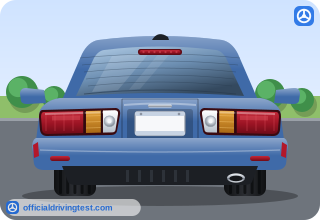
- That you are about to turn
- That you are slowing down
- That you are parked
- That you are changing lanes
Show answer
Correct answer: That you are slowing down
The manual says your brake lights let people know that you are slowing down.
Source: Delaware Driver Manual (July 2026), page 122 · Open this page in the manual (Manual page 122)
-
You should signal that you are slowing down in which situation?
- When driving at a steady speed on a clear, open road
- When passing a vehicle on a multilane road ahead
- When traffic ahead is moving at about your speed
- To turn off a roadway with no separate turn or exit lanes
Show answer
Correct answer: To turn off a roadway with no separate turn or exit lanes
Slowing down to turn off a roadway without separate turn or exit lanes is one of the times to signal.
Source: Delaware Driver Manual (July 2026), page 122 · Open this page in the manual (Manual page 122)
-
Which is a time to signal that you are slowing down?
- To avoid something in the road or stopped traffic that a driver behind you cannot see
- When a driver ahead is signaling a turn
- When the roadway has separate turn lanes and you are in the middle lane
- When you are speeding up to merge
Show answer
Correct answer: To avoid something in the road or stopped traffic that a driver behind you cannot see
The manual lists avoiding something in the road, or stopped or slowing traffic that a driver behind cannot see, as a time to signal.
Source: Delaware Driver Manual (July 2026), page 122 · Open this page in the manual (Manual page 122)
-
How far should you signal when traveling at a high speed?
- The same distance as at low speeds
- A shorter distance, since you pass it faster
- A much greater distance than usual
- Only until you start to move over
Show answer
Correct answer: A much greater distance than usual
At high speed you should signal for a much greater distance (longer time interval).
Source: Delaware Driver Manual (July 2026), page 122 · Open this page in the manual (Manual page 122)
-
When is signaling for a much greater distance particularly important?
- When turning onto a quiet residential street
- When changing lanes on express highways
- When parking at a curb beside a building
- When backing out of a driveway into a street
Show answer
Correct answer: When changing lanes on express highways
The manual says it is particularly important when changing lanes on all express highways such as the interstate system.
Source: Delaware Driver Manual (July 2026), page 122 · Open this page in the manual (Manual page 122)
-
A driver sticks the left arm straight out of the window, level with the shoulder. What does this hand signal mean?
- Stop or slow down
- Right turn
- Left turn
- Pull over to park
Show answer
Correct answer: Left turn
The manual’s hand-signal picture shows the arm held straight out to the side for a left turn.
Source: Delaware Driver Manual (July 2026), page 122 · Open this page in the manual (Manual page 122)
-
A driver holds the left arm out of the window with the forearm bent upward. What does this hand signal mean?
- Right turn
- Left turn
- Stop or slow down
- Pass me on the left
Show answer
Correct answer: Right turn
The manual’s hand-signal picture shows the arm bent upward at the elbow for a right turn.
Source: Delaware Driver Manual (July 2026), page 122 · Open this page in the manual (Manual page 122)
-
A driver holds the left arm out of the window with the forearm pointing down. What does this hand signal mean?
- Left turn
- Right turn
- Pass me on the right
- Stop or slow down
Show answer
Correct answer: Stop or slow down
The manual’s hand-signal picture shows the arm bent downward for stop or slow.
Source: Delaware Driver Manual (July 2026), page 122 · Open this page in the manual (Manual page 122)
-
What happens if you turn the ignition to the "lock" position while the vehicle is still in motion?
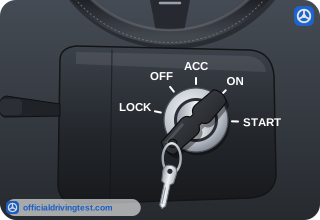
- The steering locks and you lose control of the vehicle
- The engine turns off but the steering stays normal
- The brakes lock on all four wheels
- The headlights and emergency flashers come on
Show answer
Correct answer: The steering locks and you lose control of the vehicle
The manual warns that turning the ignition to lock while moving causes the steering to lock.
Source: Delaware Driver Manual (July 2026), page 136 · Open this page in the manual (Manual page 136)