Delaware: Signals and vehicle controls — Part 2 Practice Test
Required and prohibited vehicle equipment, headlights, checking your vehicle, steering, braking, scanning, turn signals and hand signals. — Part 2
Independent educational site · not affiliated with any government agency or DMV
Ready? Test yourself
- Instant feedback with an explanation
- Every answer cites its source in the manual
- Your best score is saved on this device
Questions are original and based on the official manual "Delaware Driver Manual" (July 2026), Delaware Division of Motor Vehicles (DMV).
All 39 questions in this practice test
Take the test above first, then use this list to study. Tap “Show answer” to see the correct answer and explanation.
Show the questions and answersHide the questions
-
What does Delaware law say about using a muffler cut-out?
- It is allowed on highways in daytime
- It is allowed with a DMV waiver
- It is prohibited
- It is allowed below 25 mph
Show answer
Correct answer: It is prohibited
It is prohibited to use a muffler cut-out.
Source: Delaware Driver Manual (July 2026), page 62 · Open this page in the manual (Manual page 62)
-
Which device may an ordinary vehicle NOT be equipped with?
- A horn in good working order
- A siren, exhaust or compression whistle
- A rear vision mirror inside the car
- A windshield wiper on the driver side
Show answer
Correct answer: A siren, exhaust or compression whistle
No ordinary vehicle shall be equipped with any siren, exhaust, or compression whistle.
Source: Delaware Driver Manual (July 2026), page 62 · Open this page in the manual (Manual page 62)
-
How many vehicles may a motor vehicle tow, with the exception that a tractor and semi-trailer may tow one other vehicle?
- Two vehicles
- Three vehicles
- Any number if brakes are fitted
- A single vehicle
Show answer
Correct answer: A single vehicle
No motor vehicle shall tow more than a single vehicle (a tractor and semi-trailer may tow one other vehicle).
Source: Delaware Driver Manual (July 2026), page 62 · Open this page in the manual (Manual page 62)
-
The draw bar or other connection between a towing vehicle and the vehicle it tows must be no more than what length?
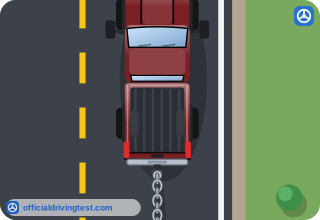
- 15 feet
- 6 feet
- 10 feet
- 25 feet
Show answer
Correct answer: 15 feet
The connection between two vehicles, one of which is towing the other, must be no more than 15 feet long.
Source: Delaware Driver Manual (July 2026), page 62 · Open this page in the manual (Manual page 62)
-
If a chain, rope or cable is used to tow a vehicle, what must be attached to it?
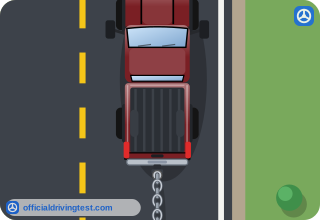
- A white flag at least 6 inches square
- A red light visible from 500 feet
- A red flag at least 12 inches square
- A reflector of four square inches
Show answer
Correct answer: A red flag at least 12 inches square
A red flag at least 12 inches square must be attached to a chain, rope or cable used for towing.
Source: Delaware Driver Manual (July 2026), page 62 · Open this page in the manual (Manual page 62)
-
Window tint may not be installed over which of these?
- The rear window
- The side mirrors
- The steering wheel cover
- Lights or the license plate
Show answer
Correct answer: Lights or the license plate
Tint material may not be installed over any lights or the vehicle's license plate.
Source: Delaware Driver Manual (July 2026), page 62 · Open this page in the manual (Manual page 62)
-
What must a vehicle with tint installed have?
- Outside mirrors on both the right and left sides
- A tint certificate sticker on the windshield
- Two rear vision mirrors inside the vehicle
- A DMV inspection of the tint every year
Show answer
Correct answer: Outside mirrors on both the right and left sides
Vehicles with tint installed must have outside mirrors on both the right and left sides of the vehicle.
Source: Delaware Driver Manual (July 2026), page 62 · Open this page in the manual (Manual page 62)
-
A vehicle with aftermarket tint to the immediate right or left of the driver must have what?
- A tint waiver kept at home with the title
- A DMV window sticker on the windshield
- A valid approved waiver kept in the vehicle
- A letter from the tint installer
Show answer
Correct answer: A valid approved waiver kept in the vehicle
Such vehicles must have an approved valid tint waiver, and it must be kept inside the vehicle at all times.
Source: Delaware Driver Manual (July 2026), page 62 · Open this page in the manual (Manual page 62)
-
Delaware law requires headlights (not parking lights) to be on when driving at which time?
- Only after 9 p.m.
- After sunset or before sunrise
- Only from midnight to sunrise
- Only when other vehicles have theirs on
Show answer
Correct answer: After sunset or before sunrise
Headlights must be on when driving after sunset or before sunrise.
Source: Delaware Driver Manual (July 2026), page 62 · Open this page in the manual (Manual page 62)
-
Headlights must be on any other time you cannot see beyond what distance?

- 200 feet
- 500 feet
- 100 feet
- 1000 feet
Show answer
Correct answer: 1000 feet
Headlights must be on any other time you cannot see beyond 1000 feet.
Source: Delaware Driver Manual (July 2026), page 62 · Open this page in the manual (Manual page 62)
-
Under the manual’s "Using Headlights" rules, when must your headlights be on?
- Use your windshield wipers
- Drive on a two-lane road
- Drive in a work zone
- Follow a large truck
Show answer
Correct answer: Use your windshield wipers
Headlights must be on any time you use your windshield wipers.
Source: Delaware Driver Manual (July 2026), page 62 · Open this page in the manual (Manual page 62)
-
Delaware law requires switching to low beams how far before meeting another vehicle?
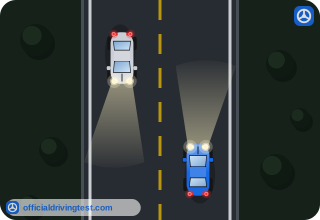
- 100 feet
- 200 feet
- 500 feet
- 350 feet
Show answer
Correct answer: 500 feet
Switch to low beams 500 feet before meeting another vehicle or when within 200 feet of a vehicle you are following.
Source: Delaware Driver Manual (July 2026), page 62 · Open this page in the manual (Manual page 62)
-
You must switch to low beams when within what distance of the vehicle you are following?
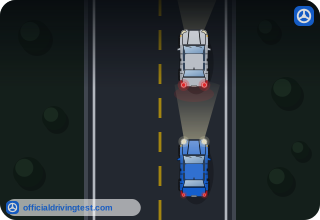
- 100 feet
- 200 feet
- 350 feet
- 500 feet
Show answer
Correct answer: 200 feet
Low beams are required when within 200 feet of the vehicle you are following.
Source: Delaware Driver Manual (July 2026), page 62 · Open this page in the manual (Manual page 62)
-
Which of these lights are listed among those that must be clean, in working order and properly aimed at inspection?
- Stop lights, turn signals, license plate light, parking lights and headlights
- Headlights, stop lights, turn signals and parking lights, but not the license plate light
- Only the headlights and the parking lights
- Only the stop lights and the turn signals
Show answer
Correct answer: Stop lights, turn signals, license plate light, parking lights and headlights
The inspection list includes stop lights, turn signals, license plate light, parking lights, and headlights.
Source: Delaware Driver Manual (July 2026), page 64 · Open this page in the manual (Manual page 64)
-
What kind of brake check is given to all vehicles presented for inspection?
- A visual check of the brake pedal
- A road test on public streets
- A performance brake test
- A check of the parking brake only
Show answer
Correct answer: A performance brake test
A performance brake test is given to all vehicles presented for inspection.
Source: Delaware Driver Manual (July 2026), page 64 · Open this page in the manual (Manual page 64)
-
What is required of mirrors at inspection?
- They must be tinted against glare
- They must be clean and unbroken
- They must be on both front doors
- They must be at least 10 inches wide
Show answer
Correct answer: They must be clean and unbroken
The inspection list says mirrors must be clean and unbroken.
Source: Delaware Driver Manual (July 2026), page 64 · Open this page in the manual (Manual page 64)
-
What is required of windshield wipers at inspection?
- They must have two speeds and a rain sensor fitted by the maker
- They must be replaced before every inspection
- They must clear at least half the windshield
- They must be fully operative, with the rubber blades in good condition
Show answer
Correct answer: They must be fully operative, with the rubber blades in good condition
Windshield wipers must be fully operative, which means the rubber blades must be in good condition.
Source: Delaware Driver Manual (July 2026), page 64 · Open this page in the manual (Manual page 64)
-
What must the hood and trunk latches do at inspection?
- Hold the hood and trunk fully closed
- Open from the driver's seat only
- Lock with a separate key
- Release when the engine is running
Show answer
Correct answer: Hold the hood and trunk fully closed
Hood and trunk latches must hold the hood and trunk fully closed.
Source: Delaware Driver Manual (July 2026), page 64 · Open this page in the manual (Manual page 64)
-
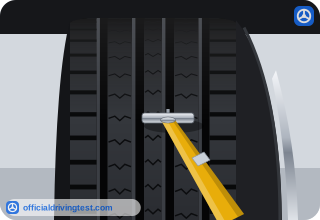
What is the minimum tire tread depth at inspection, measured in two adjacent treads?
- 1/32 inch
- 4/32 inch
- 2/32 inch
- 6/32 inch
Show answer
Correct answer: 2/32 inch
Tread depth must be at least 2/32 inch measured in two adjacent treads.
Source: Delaware Driver Manual (July 2026), page 64 · Open this page in the manual (Manual page 64)
-
Which tire condition is listed as not allowed at inspection?
- A spare of a different size
- Fabric showing
- Plastic valve caps
- Uneven wear on the sidewall label
Show answer
Correct answer: Fabric showing
Tires must have no bulges, no fabric showing, no bald areas, and no cuts.
Source: Delaware Driver Manual (July 2026), page 64 · Open this page in the manual (Manual page 64)
-
What must the muffler do?
- Make the exhaust louder at highway speed
- Be replaced every two years
- Be made of stainless steel
- Effectively reduce the sound of engine exhaust
Show answer
Correct answer: Effectively reduce the sound of engine exhaust
The muffler must effectively reduce the sound of engine exhaust, with no leaks in the exhaust system.
Source: Delaware Driver Manual (July 2026), page 64 · Open this page in the manual (Manual page 64)
-
When must a catalytic converter be installed on a vehicle?
- If the vehicle was originally equipped with one by the manufacturer
- Only on vehicles built after 1996 and weighing under 8,000 lbs
- Only on diesel-powered vehicles
- Only after a failed emissions test
Show answer
Correct answer: If the vehicle was originally equipped with one by the manufacturer
A catalytic converter must be installed if originally equipped by the manufacturer.
Source: Delaware Driver Manual (July 2026), page 64 · Open this page in the manual (Manual page 64)
-
Which of these must NOT be visible on a vehicle presented for inspection?
- Dust and dirt on the dashboard and seats
- Mud on the lower body
- Gasoline, oil, or coolant leaks
- Scratches on the paint
Show answer
Correct answer: Gasoline, oil, or coolant leaks
There must be no visible gasoline, oil, or coolant leaks.
Source: Delaware Driver Manual (July 2026), page 64 · Open this page in the manual (Manual page 64)
-
What must be true of door handles at inspection?
- They must be chrome plated and at least four inches long
- They must be present and in working condition
- They must lock from outside only
- They must be replaced yearly
Show answer
Correct answer: They must be present and in working condition
Door handles or equivalent must be present and in working condition.
Source: Delaware Driver Manual (July 2026), page 64 · Open this page in the manual (Manual page 64)
-
What must be true of the horn at inspection?
- It must sound louder than 100 decibels
- It must play two tones
- It must work only with the key on
- It must be in operating condition
Show answer
Correct answer: It must be in operating condition
The inspection list says the horn must be in operating condition.
Source: Delaware Driver Manual (July 2026), page 64 · Open this page in the manual (Manual page 64)
-
What is the maximum bumper height on passenger cars, measured from the ground to the bottom of the bumper?
- 22 inches
- 16 inches
- 28 inches
- 30 inches
Show answer
Correct answer: 22 inches
Bumper height on passenger cars must not exceed 22 inches from the ground to the bottom of the bumper.
Source: Delaware Driver Manual (July 2026), page 65 · Open this page in the manual (Manual page 65)
-
What is the maximum distance allowed between the vehicle body and the vehicle frame rail?
- One inch
- Five inches
- Three inches
- Eight inches
Show answer
Correct answer: Three inches
The maximum distance between the vehicle body and vehicle frame rail may not exceed three inches.
Source: Delaware Driver Manual (July 2026), page 65 · Open this page in the manual (Manual page 65)
-
How high may an air scoop mounted on a vehicle hood be?
- No more than one inch
- No more than six inches
- No more than ten inches
- No more than three inches
Show answer
Correct answer: No more than three inches
No air scoops may be mounted on a vehicle hood that exceed three inches.
Source: Delaware Driver Manual (July 2026), page 65 · Open this page in the manual (Manual page 65)
-
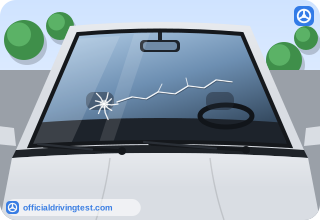
A windshield crack longer than what length is a mandatory failure item at inspection?
- Over five inches
- Over two inches
- Over eight inches
- Over ten inches
Show answer
Correct answer: Over five inches
Cracks over five inches are mandatory failure items.
Source: Delaware Driver Manual (July 2026), page 65 · Open this page in the manual (Manual page 65)
-
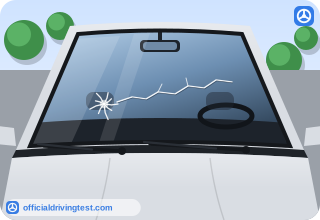
A star chip in the windshield larger than what size is a mandatory failure item at inspection?
- Over a quarter inch
- Over two inches
- Over one inch
- Over three inches
Show answer
Correct answer: Over one inch
Star chips over one inch are mandatory failure items.
Source: Delaware Driver Manual (July 2026), page 65 · Open this page in the manual (Manual page 65)
-
What is the minimum height of visibility of a windshield?
- 4 inches
- 10 inches
- 15 inches
- 20 inches
Show answer
Correct answer: 10 inches
The manual gives the minimum height of visibility of a windshield as 10 inches.
Source: Delaware Driver Manual (July 2026), page 65 · Open this page in the manual (Manual page 65)
-
Which vehicles will be tested for exhaust emissions?
- Only vehicles older than 1968
- Only vehicles from 1996 on
- Only diesel-powered vehicles
- All vehicles from 1968 to 1995
Show answer
Correct answer: All vehicles from 1968 to 1995
All vehicles 1968 to 1995 are tested for exhaust emissions.
Source: Delaware Driver Manual (July 2026), page 65 · Open this page in the manual (Manual page 65)
-
When they are inspected for emissions, what test do 1996 and newer gas-powered vehicles of less than 8,000 lbs receive?
- The Onboard Diagnostic Test (OBD-II)
- A visual smoke check at the inspection lane
- A tailpipe exhaust test only
- A tailpipe smoke test by a private mechanic
Show answer
Correct answer: The Onboard Diagnostic Test (OBD-II)
1996 and newer gas-powered vehicles less than 8,000 lbs receive the Onboard Diagnostic Test (OBD-II).
Source: Delaware Driver Manual (July 2026), page 65 · Open this page in the manual (Manual page 65)
-
Which vehicles between 8,501 and 14,000 GVWR are tested using the Onboard Diagnostic Test (OBD-II)?
- Only vehicles from 1968 to 1995
- Only gas-powered vehicles from 1996
- 2008 and newer vehicles, gas or diesel powered
- Only trailers and recreational vehicles
Show answer
Correct answer: 2008 and newer vehicles, gas or diesel powered
2008 and newer gas or diesel vehicles between 8,501 and 14,000 GVWR get the OBD-II test.
Source: Delaware Driver Manual (July 2026), page 65 · Open this page in the manual (Manual page 65)
-
When does Delaware law require drivers to signal by hand or turn signals?
- Only when turning left at an intersection
- Only when other vehicles are nearby
- When they intend to stop, turn, or change lanes
- Only when changing lanes on a freeway
Show answer
Correct answer: When they intend to stop, turn, or change lanes
Delaware law requires signaling by hand or turn signals when intending to stop, turn, or change lanes.
Source: Delaware Driver Manual (July 2026), page 81 · Open this page in the manual (Manual page 81)
-
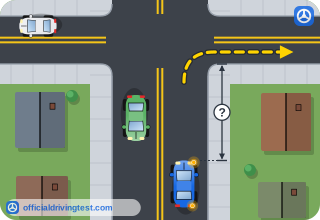
How far before your intended action must you signal?
- 50 feet
- 300 feet
- 100 feet
- 500 feet
Show answer
Correct answer: 300 feet
The manual says you must signal 300 feet prior to your intended action.
Source: Delaware Driver Manual (July 2026), page 81 · Open this page in the manual (Manual page 81)
-
What equipment must a moped or triped have, according to the manual?
- Front and rear lights and a bell or device audible at 100 feet
- A front light only and a horn that is audible at 50 feet
- A rear-view mirror and a siren audible at 200 feet
- Wheel reflectors and a horn audible at 500 feet at night
Show answer
Correct answer: Front and rear lights and a bell or device audible at 100 feet
Mopeds and tripeds need lights front and rear and a bell or device audible at least 100 feet.
Source: Delaware Driver Manual (July 2026), page 101 · Open this page in the manual (Manual page 101)
-
Who is responsible for making sure the vehicle being driven is safe to operate?
- The driver of the vehicle
- The Delaware Division of Motor Vehicles
- The company that built the car
- The shop that last repaired it
Show answer
Correct answer: The driver of the vehicle
The manual says it is the duty of drivers to make certain the vehicles they drive are safe to operate.
Source: Delaware Driver Manual (July 2026), page 105 · Open this page in the manual (Manual page 105)
-
What does the manual give as the best way to prolong the life of your car and save on fuel?
- Drive it only on the highway
- Let the engine idle before every trip
- Use it as little as possible
- Park it in the sun between trips
Show answer
Correct answer: Use it as little as possible
The manual states that using the car as little as possible is the best way to prolong its life and save fuel.
Source: Delaware Driver Manual (July 2026), page 105 · Open this page in the manual (Manual page 105)