Delaware: Seat belts and child safety — Part 2 Practice Test
Questions in this part include: “What does it mean that the child seatbelt law is a primary enforcement law?” · “For a child aged 1 to 3 years, how long do the NHTSA and the AAP recommend a rear-facing car seat?”
Independent educational site · not affiliated with any government agency or DMV
Ready? Test yourself
- Instant feedback with an explanation
- Every answer cites its source in the manual
- Your best score is saved on this device
Questions are original and based on the official manual "Delaware Driver Manual" (July 2026), Delaware Division of Motor Vehicles (DMV).
All 17 questions in this practice test
Take the test above first, then use this list to study. Tap “Show answer” to see the correct answer and explanation.
Show the questions and answersHide the questions
-
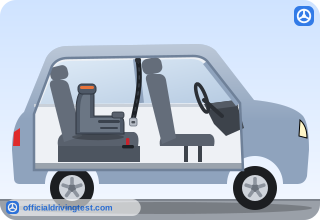
How long must a child in a belt positioning booster seat remain in it under Delaware law?
- Until they reach their eighth birthday, regardless of their height or weight
- Until they are tall enough to see over the front seat headrest
- Until they weigh 60 pounds, regardless of the manufacturer's limits
- Until reaching the height or weight maximum listed by the booster seat manufacturer
Show answer
Correct answer: Until reaching the height or weight maximum listed by the booster seat manufacturer
The law keeps children in a booster seat until the height or weight maximum listed by the booster seat manufacturer.
Source: Delaware Driver Manual (July 2026), page 109 · Open this page in the manual (Manual page 109)
-
A child who has outgrown a belt positioning booster seat must wear a properly secured seatbelt in all seating positions until what age?
- 16
- 12
- 14
- 18
Show answer
Correct answer: 16
The manual says such a child who has not yet reached the age of 16 must wear a properly secured seatbelt in all seating positions.
Source: Delaware Driver Manual (July 2026), page 109 · Open this page in the manual (Manual page 109)
-
What does it mean that the child seatbelt law is a primary enforcement law?
- Officers can only issue a ticket if the vehicle is stopped for another reason
- Officers can issue only a warning the first time they see it
- Officers can pull a vehicle over if they see an unrestrained child inside
- The child's parents must attend a safety class after a ticket
Show answer
Correct answer: Officers can pull a vehicle over if they see an unrestrained child inside
The manual says primary enforcement means officers can pull a vehicle over if they see an unrestrained child inside.
Source: Delaware Driver Manual (July 2026), page 109 · Open this page in the manual (Manual page 109)
-
Which child should not occupy the front passenger seat of a vehicle?
- A child under age 8 or under 4'9"
- A child under age 12 or under 5'5"
- A child under age 14 or under 5'8"
- A child under age 6 or under 4'0"
Show answer
Correct answer: A child under age 12 or under 5'5"
The manual says a child under age 12 or under 5'5" should not occupy the front passenger seat.
Source: Delaware Driver Manual (July 2026), page 109 · Open this page in the manual (Manual page 109)
-
What do the NHTSA and the AAP recommend for a child under the age of 1?
- Ride in a forward-facing car seat with a harness
- Ride in a belt positioning booster seat
- Ride on an adult's lap in the back seat
- Always ride in a rear-facing car seat
Show answer
Correct answer: Always ride in a rear-facing car seat
The manual says children under the age of 1 should always ride in a rear-facing car seat.
Source: Delaware Driver Manual (July 2026), page 109 · Open this page in the manual (Manual page 109)
-
How can infant-only car seats be used?
- Only rear-facing
- Only forward-facing
- Rear- or forward-facing
- Only as a booster
Show answer
Correct answer: Only rear-facing
The manual says infant-only seats can only be used rear-facing.
Source: Delaware Driver Manual (July 2026), page 109 · Open this page in the manual (Manual page 109)
-
Why can convertible and all-in-one car seats keep a child rear-facing for longer?
- They are installed in the front passenger seat instead of the back
- They switch to a belt positioning booster after the first year
- They typically have higher height and weight limits for rear-facing mode
- They have a built-in harness that works only when facing forward
Show answer
Correct answer: They typically have higher height and weight limits for rear-facing mode
The manual says these seats typically have higher rear-facing height and weight limits.
Source: Delaware Driver Manual (July 2026), page 109 · Open this page in the manual (Manual page 109)
-
For a child aged 1 to 3 years, how long do the NHTSA and the AAP recommend a rear-facing car seat?
- Until the child's second birthday, whatever the seat's limits
- Until the top height or weight limit for rear-facing mode
- Only until the child can sit up without any help
- Until the child learns to walk without any help
Show answer
Correct answer: Until the top height or weight limit for rear-facing mode
The manual says the child should remain rear-facing until reaching the seat manufacturer's top rear-facing height or weight limit.
Source: Delaware Driver Manual (July 2026), page 109 · Open this page in the manual (Manual page 109)
-
Once a child outgrows the rear-facing car seat, what is the child ready to travel in?
- A belt positioning booster seat
- An adult lap belt in the back seat
- A rear-facing infant-only seat
- A forward-facing car seat with a harness
Show answer
Correct answer: A forward-facing car seat with a harness
The manual says once the rear-facing seat is outgrown, the child is ready for a forward-facing car seat with a harness.
Source: Delaware Driver Manual (July 2026), page 109 · Open this page in the manual (Manual page 109)
-
When is it time for a child to travel in a booster seat?
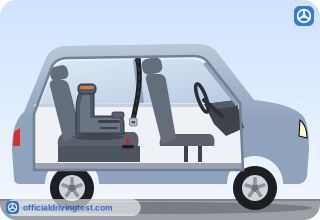
- When they outgrow their forward-facing car seat with a harness
- Once they can sit upright in the seat without any support
- Once they learn how to unbuckle the harness themselves
- Once they are tall enough to see out of the window
Show answer
Correct answer: When they outgrow their forward-facing car seat with a harness
The manual says that once a child outgrows a forward-facing car seat with a harness, it is time for a booster seat.
Source: Delaware Driver Manual (July 2026), page 110 · Open this page in the manual (Manual page 110)
-
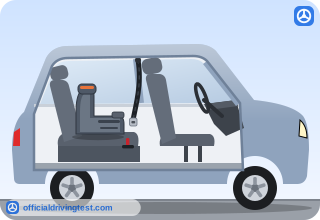
According to the NHTSA and AAP recommendations in the manual, how long should an 8- to 12-year-old child stay in a booster seat?
- Until the child can buckle the seat belt without any help
- Until the child's feet can rest flat on the floor mat
- Until the child is big enough to fit the adult seat belt properly
- Until the child asks to sit in the front passenger seat
Show answer
Correct answer: Until the child is big enough to fit the adult seat belt properly
The manual says NHTSA and the AAP recommend keeping 8- to 12-year-olds in a booster seat until they are big enough to fit the adult seat belt properly.
Source: Delaware Driver Manual (July 2026), page 110 · Open this page in the manual (Manual page 110)
-
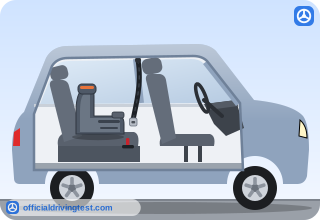
For an adult seat belt to fit a child properly, where must the lap belt lie?
- Snugly across the stomach, not the thighs
- Snugly across the upper thighs, not the stomach
- Loosely across the hips with a little slack
- Across the lower abdomen, above the hip bones
Show answer
Correct answer: Snugly across the upper thighs, not the stomach
A properly fitting lap belt lies snugly across the upper thighs, not the stomach.
Source: Delaware Driver Manual (July 2026), page 110 · Open this page in the manual (Manual page 110)
-
How should the shoulder belt lie on a child who is using the adult seat belt?
- Across the neck so that the belt stays in place
- Under the arm that is closest to the door
- Behind the child's back and across the lap only
- Snug across the shoulder and chest, not the neck or face
Show answer
Correct answer: Snug across the shoulder and chest, not the neck or face
The shoulder belt should lie snug across the shoulder and chest and must not cross the neck or face.
Source: Delaware Driver Manual (July 2026), page 110 · Open this page in the manual (Manual page 110)
-
Where should an 8- to 12-year-old child ride, according to the manual?
- In the front seat, once the child is in a booster seat
- In the front seat, as long as the air bag is working
- In whichever seat the driver can watch the child from
- In the back seat, because it is safer there
Show answer
Correct answer: In the back seat, because it is safer there
The manual says a child in this age group should still ride in the back seat because it is safer there.
Source: Delaware Driver Manual (July 2026), page 110 · Open this page in the manual (Manual page 110)
-
According to the manual, which car seat is the best one?
- The most expensive seat sold at a juvenile product store
- The one that fits the child and vehicle and is used correctly
- The newest model released by a major manufacturer
- The largest seat that will fit in the back of the vehicle
Show answer
Correct answer: The one that fits the child and vehicle and is used correctly
The best car seat fits your child, fits your vehicle, and can be used correctly every time.
Source: Delaware Driver Manual (July 2026), page 110 · Open this page in the manual (Manual page 110)
-
Where must a rear-facing car seat never be installed?
- Directly behind the driver's seat
- In the center of the back seat
- In front of an active frontal air bag
- Next to a rear passenger window
Show answer
Correct answer: In front of an active frontal air bag
The manual says never to install a rear-facing car seat in front of an active frontal air bag.
Source: Delaware Driver Manual (July 2026), page 110 · Open this page in the manual (Manual page 110)
-
How can you tell that a car seat's harness straps fit snugly?
- You cannot pinch any excess webbing at the child's collarbone
- You can slide your whole hand between the strap and chest
- You can pinch about an inch of webbing at the collarbone
- The straps lie loosely against the child's shoulders
Show answer
Correct answer: You cannot pinch any excess webbing at the child's collarbone
Harness straps are snug when you cannot pinch excess webbing between your fingers at the child's collarbone.
Source: Delaware Driver Manual (July 2026), page 110 · Open this page in the manual (Manual page 110)