Delaware: Right-of-way and turning — Part 5 Practice Test
Questions in this part include: “Before you begin a right turn, what must you check for?” · “When is it especially important to look left and right at a signal-controlled intersection?”
Independent educational site · not affiliated with any government agency or DMV
Ready? Test yourself
- Instant feedback with an explanation
- Every answer cites its source in the manual
- Your best score is saved on this device
Questions are original and based on the official manual "Delaware Driver Manual" (July 2026), Delaware Division of Motor Vehicles (DMV).
All 18 questions in this practice test
Take the test above first, then use this list to study. Tap “Show answer” to see the correct answer and explanation.
Show the questions and answersHide the questions
-
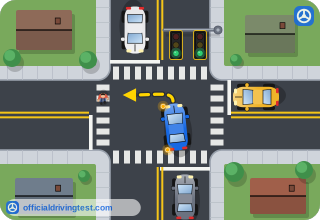
What is the last thing you should do before you turn left across oncoming traffic?
- Flash your headlights at the oncoming drivers
- Look one more time in the direction of oncoming traffic
- Check only the street you are turning onto
- Speed up to cross before oncoming traffic arrives
Show answer
Correct answer: Look one more time in the direction of oncoming traffic
The manual says to look one more time in the direction of oncoming traffic before you turn.
Source: Delaware Driver Manual (July 2026), page 117 · Open this page in the manual (Manual page 117)
-
Before you begin a right turn, what must you check for?
- Parked vehicles along the street you will enter
- Traffic lights facing the street you will enter
- The speed limit of the street you will enter
- Pedestrians crossing where you will be turning
Show answer
Correct answer: Pedestrians crossing where you will be turning
You must not begin your turn without checking for pedestrians crossing where you will be turning.
Source: Delaware Driver Manual (July 2026), page 117 · Open this page in the manual (Manual page 117)
-
Before turning right, you must make sure there is no traffic approaching from your left and no oncoming traffic doing what?
- Stopped at the red light
- Passing a parked vehicle
- Slowing to look for parking
- Turning left into your path
Show answer
Correct answer: Turning left into your path
Before turning right, make sure there is no traffic approaching from your left and no oncoming traffic turning left into your path.
Source: Delaware Driver Manual (July 2026), page 117 · Open this page in the manual (Manual page 117)
-
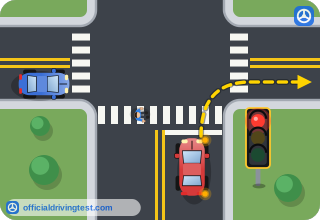
When may you turn right on a red light?
- Only when a green arrow is also lit
- Unless it is prohibited
- Only when a police officer waves you on
- Never, a red light always means wait
Show answer
Correct answer: Unless it is prohibited
The manual says you may turn right on red unless prohibited.
Source: Delaware Driver Manual (July 2026), page 117 · Open this page in the manual (Manual page 117)
-
Which left turn may you make unless it is prohibited?
- From a two-way street across a double yellow line
- From a bike lane directly across a crosswalk
- From a one-way street onto another one-way street
- From a one-way street into oncoming lanes
Show answer
Correct answer: From a one-way street onto another one-way street
The manual says you may turn left from a one-way street onto another one-way street unless prohibited.
Source: Delaware Driver Manual (July 2026), page 117 · Open this page in the manual (Manual page 117)
-
At an intersection, why should you look left and right even if other traffic has a red light or a stop sign?
- Some drivers do not obey traffic signals or signs
- Traffic signals often change without warning
- Stop signs only apply to the first vehicle
- Red lights only apply to vehicles going straight
Show answer
Correct answer: Some drivers do not obey traffic signals or signs
The manual warns that some drivers do not obey traffic signals or signs, so you cannot rely on them alone.
Source: Delaware Driver Manual (July 2026), page 117 · Open this page in the manual (Manual page 117)
-
When is it especially important to look left and right at a signal-controlled intersection?
- Only after the light has been green for a long time
- Only when the light is red
- Just after the light has turned green
- Only when the light is flashing
Show answer
Correct answer: Just after the light has turned green
Just after the light turns green is when cross-street drivers are most likely to hurry through before the light changes to red.
Source: Delaware Driver Manual (July 2026), page 117 · Open this page in the manual (Manual page 117)
-
If you were stopped and your view of a cross street is blocked, what should you do?
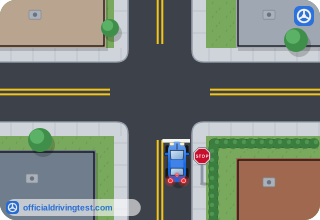
- Edge forward slowly until you can see
- Honk your horn and drive through quickly
- Back up to get a better view
- Wait for the vehicle behind you to pass
Show answer
Correct answer: Edge forward slowly until you can see
The manual says to edge forward slowly until you can see.
Source: Delaware Driver Manual (July 2026), page 117 · Open this page in the manual (Manual page 117)
-
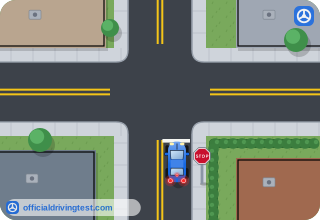
Why does edging forward slowly help when your view of a cross street is blocked?
- It gives you a longer view of the traffic signal ahead of you
- It lets crossing drivers know that you plan to turn right
- It warns drivers behind you that you are about to back up
- Crossing drivers can see the front of your vehicle first
Show answer
Correct answer: Crossing drivers can see the front of your vehicle first
Crossing drivers can see the front of your vehicle before you can see them, which gives them a chance to slow down and warn you.
Source: Delaware Driver Manual (July 2026), page 117 · Open this page in the manual (Manual page 117)
-
Where is it very important to look to the sides because of activity along the road?
- Near playgrounds and school yards
- On a long, empty rural highway
- On a freeway with no entrances
- Inside a tunnel with a single lane
Show answer
Correct answer: Near playgrounds and school yards
The manual says to look to the sides near shopping centers and parking lots, construction areas, busy sidewalks, and playgrounds and school yards.
Source: Delaware Driver Manual (July 2026), page 117 · Open this page in the manual (Manual page 117)
-
How should you cross several lanes of traffic?
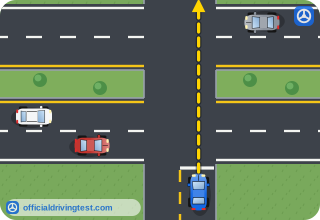
- Take them one lane at a time
- Wait until every lane is clear, then cross all at once
- Cross as fast as possible in one move
- Stop on the line between lanes and check again
Show answer
Correct answer: Take them one lane at a time
Like taking stairs one step at a time, it is safest and easiest to cross one lane at a time.
Source: Delaware Driver Manual (July 2026), page 130 · Open this page in the manual (Manual page 130)
-
When you enter traffic, what do you need enough space to do?
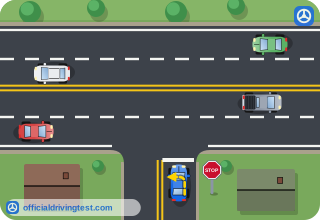
- Stop and check mirrors
- Honk and wait
- Turn and get up to speed
- Signal and coast
Show answer
Correct answer: Turn and get up to speed
When you enter traffic, you need enough space to turn and get up to speed.
Source: Delaware Driver Manual (July 2026), page 130 · Open this page in the manual (Manual page 130)
-
When is stopping halfway across a road safe while you cross traffic?
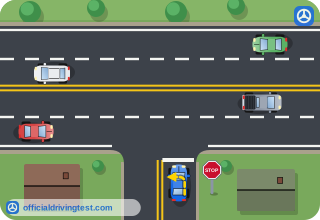
- When your turn signal has been on for a while
- Only if a median is large enough for your vehicle
- When no vehicles are visible in either direction
- When traffic in the other lanes is moving slowly
Show answer
Correct answer: Only if a median is large enough for your vehicle
Stopping halfway across is only safe when there is a median divider large enough for your vehicle.
Source: Delaware Driver Manual (July 2026), page 130 · Open this page in the manual (Manual page 130)
-
Before turning left, what should you make sure of?
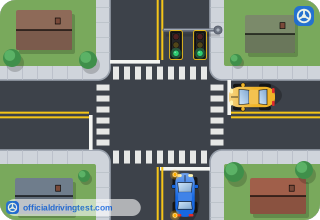
- Oncoming drivers have their headlights on
- Your vehicle is already halfway into the oncoming lane
- The traffic light has been green for a long time
- No vehicles or pedestrians block your path
Show answer
Correct answer: No vehicles or pedestrians block your path
You do not want to be stuck across a lane with oncoming vehicles while waiting for your path to clear.
Source: Delaware Driver Manual (July 2026), page 131 · Open this page in the manual (Manual page 131)
-
You have a green light but vehicles are blocking your way through the intersection. What should you do?
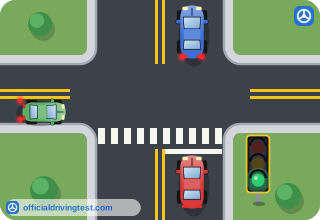
- Wait; do not start across the intersection
- Enter and wait in the middle for the path to clear
- Enter the intersection and sound your horn
- Go around the vehicles using the opposite lane
Show answer
Correct answer: Wait; do not start across the intersection
Even with a green light, do not start across the intersection if vehicles block your way.
Source: Delaware Driver Manual (July 2026), page 131 · Open this page in the manual (Manual page 131)
-
What can happen if you are caught in the intersection when the light changes to red?
- Your license is automatically suspended
- You must pay to repair the traffic signal
- You can get a ticket
- You must report the incident to the DMV
Show answer
Correct answer: You can get a ticket
You will block other traffic and can get a ticket for blocking an intersection.
Source: Delaware Driver Manual (July 2026), page 131 · Open this page in the manual (Manual page 131)
-
An approaching vehicle has its turn signal on. When should you go?
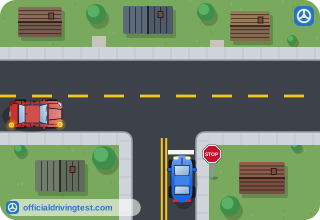
- As soon as you see the signal start flashing
- When the driver actually starts to turn and it is safe
- Once the approaching vehicle begins to slow down
- After the driver gives you a hand wave to go
Show answer
Correct answer: When the driver actually starts to turn and it is safe
The driver may turn later or may have forgotten to cancel the signal, so wait until the other driver actually starts to turn.
Source: Delaware Driver Manual (July 2026), page 131 · Open this page in the manual (Manual page 131)
-
Which vehicles' turn signals often do not cancel by themselves?
- Large trucks
- School buses
- Delivery vans
- Motorcycles
Show answer
Correct answer: Motorcycles
The manual notes that motorcycle signals often do not cancel by themselves.
Source: Delaware Driver Manual (July 2026), page 131 · Open this page in the manual (Manual page 131)