Delaware: Right-of-way and turning — Part 4 Practice Test
Questions in this part include: “According to the manual, what must you do regardless of the circumstances?” · “What must drivers overtaking a vehicle traveling in the same direction do?”
Independent educational site · not affiliated with any government agency or DMV
Ready? Test yourself
- Instant feedback with an explanation
- Every answer cites its source in the manual
- Your best score is saved on this device
Questions are original and based on the official manual "Delaware Driver Manual" (July 2026), Delaware Division of Motor Vehicles (DMV).
All 18 questions in this practice test
Take the test above first, then use this list to study. Tap “Show answer” to see the correct answer and explanation.
Show the questions and answersHide the questions
-
How should drivers treat a median crossing?
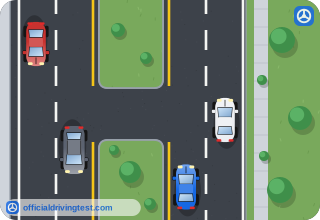
- As a parking area, stopping before you cross it every time
- As a shoulder, driving across at whatever angle you choose
- Like a roadway, staying to the right of the opening at all times
- As a sidewalk, yielding to everyone who is crossing it
Show answer
Correct answer: Like a roadway, staying to the right of the opening at all times
The manual says to treat the median like a roadway and stay to the right of the opening.
Source: Delaware Driver Manual (July 2026), page 88 · Open this page in the manual (Manual page 88)
-
According to the manual, what must you do regardless of the circumstances?
- Maintain your speed whenever you have the right-of-way at an intersection
- Do everything you can to prevent striking a pedestrian or another vehicle
- Insist on taking the right-of-way at every intersection you reach
- Sound your horn whenever other drivers or pedestrians approach you
Show answer
Correct answer: Do everything you can to prevent striking a pedestrian or another vehicle
The manual says you must do everything you can to prevent striking a pedestrian or another vehicle, regardless of the circumstances.
Source: Delaware Driver Manual (July 2026), page 88 · Open this page in the manual (Manual page 88)
-
At an intersection, who must drivers turning left yield to?
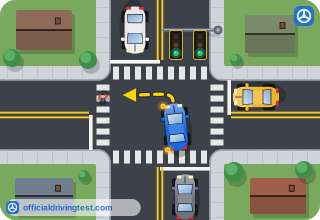
- Vehicles behind them
- Vehicles turning right from the same direction
- No one, if they signaled first
- Oncoming vehicles going straight ahead
Show answer
Correct answer: Oncoming vehicles going straight ahead
The manual says drivers turning left must yield to oncoming vehicles going straight ahead.
Source: Delaware Driver Manual (July 2026), page 88 · Open this page in the manual (Manual page 88)
-
Who must yield when a driver enters a traffic circle or rotary?
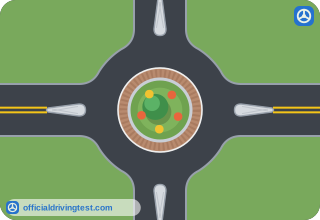
- The driver entering must yield to drivers already in the circle
- Drivers already in the circle must yield to the driver entering
- The larger vehicle always goes first
- The driver on the left always goes first
Show answer
Correct answer: The driver entering must yield to drivers already in the circle
The manual says drivers entering a traffic circle or rotary must yield to drivers already in the circle.
Source: Delaware Driver Manual (July 2026), page 88 · Open this page in the manual (Manual page 88)
-
At an intersection with no stop sign, yield sign, or traffic signal, to whom should drivers yield?
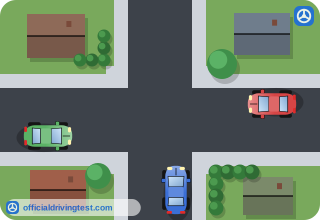
- Vehicles coming from the left
- Vehicles going straight only
- Vehicles coming from the right
- The vehicle that is moving faster
Show answer
Correct answer: Vehicles coming from the right
The manual says drivers should yield to vehicles coming from the right, though yielding to all vehicles is safest.
Source: Delaware Driver Manual (July 2026), page 88 · Open this page in the manual (Manual page 88)
-
At a 4-way stop, who goes first?
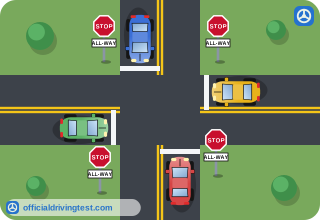
- The driver on the left, after a complete stop
- The driver who arrives first, after a complete stop
- The driver going straight ahead before the others
- The driver in the largest vehicle on the road
Show answer
Correct answer: The driver who arrives first, after a complete stop
The manual says that at a 4-way stop the driver reaching the intersection first goes first, after coming to a complete stop.
Source: Delaware Driver Manual (July 2026), page 88 · Open this page in the manual (Manual page 88)
-
At a 4-way stop, which vehicle goes first if more than one vehicle arrives at the same time?
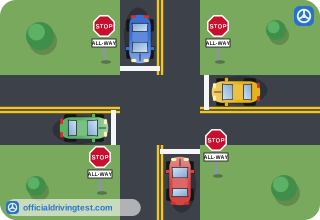
- The vehicle on the left
- The vehicle going straight
- The vehicle that is turning
- The vehicle on the right
Show answer
Correct answer: The vehicle on the right
The manual says that if more than one vehicle arrives at the same time, the vehicle on the right goes first.
Source: Delaware Driver Manual (July 2026), page 88 · Open this page in the manual (Manual page 88)
-
What must drivers entering a road from a driveway, alley, or roadside do?
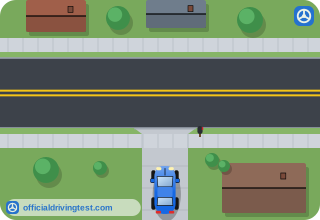
- Yield to vehicles already on the main road
- Enter first because they are signaling
- Sound the horn and then enter
- Yield only to vehicles coming from the left
Show answer
Correct answer: Yield to vehicles already on the main road
The manual says drivers entering from a driveway, alley, or roadside must yield to vehicles already on the main road.
Source: Delaware Driver Manual (July 2026), page 88 · Open this page in the manual (Manual page 88)
-
What must drivers entering a road from a turn only lane do, if necessary?
- Proceed without slowing
- Sound the horn and merge
- Yield, including stopping
- Merge ahead of the main road traffic
Show answer
Correct answer: Yield, including stopping
The manual says drivers entering from turn only lanes must yield, including stopping if necessary.
Source: Delaware Driver Manual (July 2026), page 88 · Open this page in the manual (Manual page 88)
-
When may drivers enter an intersection?
- Whenever the light turns green, even if traffic is backed up
- Only if they can get through it without having to stop
- Whenever there is room to stop in the middle
- Whenever they are the first in line
Show answer
Correct answer: Only if they can get through it without having to stop
The manual says drivers may not enter an intersection unless they can get through without stopping, so they do not block it.
Source: Delaware Driver Manual (July 2026), page 89 · Open this page in the manual (Manual page 89)
-
What must drivers overtaking a vehicle traveling in the same direction do?
- Pass without yielding as long as they are traveling faster
- Sound the horn and move ahead of the other vehicle quickly
- Yield only if the other vehicle is using its turn signal
- Yield to that vehicle, even if it slows down or comes to a stop
Show answer
Correct answer: Yield to that vehicle, even if it slows down or comes to a stop
The manual says drivers overtaking a vehicle in the same direction must yield to it, even if it slows or stops.
Source: Delaware Driver Manual (July 2026), page 89 · Open this page in the manual (Manual page 89)
-
At which places is it especially important to look to the sides for vehicles or pedestrians that may cross or enter your path?
- Intersections and railroad crossings
- Long straight highways and tunnels
- Freeway on-ramps and rest areas
- Hills and curves with no side roads
Show answer
Correct answer: Intersections and railroad crossings
The manual says looking to the sides is especially important at intersections and railroad crossings.
Source: Delaware Driver Manual (July 2026), page 117 · Open this page in the manual (Manual page 117)
-
How does the manual define intersections?
- Only places where two named streets meet
- Only places controlled by traffic signals or signs
- Any place where traffic merges or crosses
- Only places where a road crosses railroad tracks
Show answer
Correct answer: Any place where traffic merges or crosses
Intersections are any place where traffic merges or crosses.
Source: Delaware Driver Manual (July 2026), page 117 · Open this page in the manual (Manual page 117)
-
Which of these is an intersection, according to the manual?
- A shopping center or parking lot entrance
- A stretch of road with no side streets
- A bridge with no ramps
- A tunnel with a single lane
Show answer
Correct answer: A shopping center or parking lot entrance
The manual lists cross streets, side streets, driveways, and shopping center or parking lot entrances as intersections.
Source: Delaware Driver Manual (July 2026), page 117 · Open this page in the manual (Manual page 117)
-
If you are stopped at an intersection, when should you look to both the left and right?
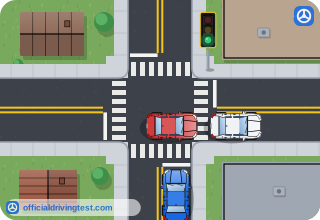
- Only once, right after you stop
- Only if you cannot see the signal
- Only after you have started moving into the intersection
- Just before you start moving
Show answer
Correct answer: Just before you start moving
If stopped, you look to both the left and right just before you start moving.
Source: Delaware Driver Manual (July 2026), page 117 · Open this page in the manual (Manual page 117)
-
Why should you look across an intersection before you start to move through it?
- So you can speed up before the light changes
- So you will not block it if you have to stop
- So you know which lane other drivers will use
- So you can drive through without signaling
Show answer
Correct answer: So you will not block it if you have to stop
You look to make sure the path is clear all the way through so you will not block the intersection if you have to stop.
Source: Delaware Driver Manual (July 2026), page 117 · Open this page in the manual (Manual page 117)
-
What should you look for before you turn left across oncoming traffic?
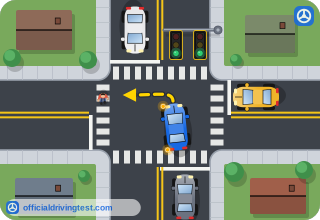
- A safe gap in the traffic
- A vehicle that will wave you through
- A red light for the oncoming lanes
- A stopped vehicle to follow across
Show answer
Correct answer: A safe gap in the traffic
Before turning left across oncoming traffic you look for a safe gap in the traffic.
Source: Delaware Driver Manual (July 2026), page 117 · Open this page in the manual (Manual page 117)
-
Why should you look at the street you are turning left onto?
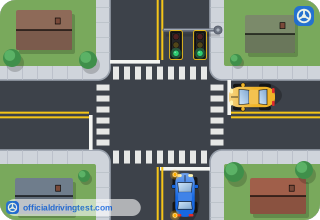
- To read the street name before you commit to the turn
- To see whether a parking space is open
- To avoid being stranded in the path of oncoming traffic
- To confirm that the street has more than one lane
Show answer
Correct answer: To avoid being stranded in the path of oncoming traffic
You check that no vehicles or pedestrians are in your path so you are not left stranded in the path of oncoming traffic.
Source: Delaware Driver Manual (July 2026), page 117 · Open this page in the manual (Manual page 117)