Delaware: Right-of-way and turning — Part 1 Practice Test
Questions in this part include: “What is a three-point turn?” · “According to the overtaking law quoted in the manual, on which side shall vehicles overtake other vehicles?”
Independent educational site · not affiliated with any government agency or DMV
Ready? Test yourself
- Instant feedback with an explanation
- Every answer cites its source in the manual
- Your best score is saved on this device
Questions are original and based on the official manual "Delaware Driver Manual" (July 2026), Delaware Division of Motor Vehicles (DMV).
All 19 questions in this practice test
Take the test above first, then use this list to study. Tap “Show answer” to see the correct answer and explanation.
Show the questions and answersHide the questions
-
What is a three-point turn?
- A maneuver to turn right at an intersection with a signal
- A maneuver to back a vehicle into a parking space
- A maneuver to merge from a ramp to a highway
- A maneuver to turn a vehicle 180 degrees on a narrow street
Show answer
Correct answer: A maneuver to turn a vehicle 180 degrees on a narrow street
The manual defines a three-point turn as a maneuver to turn a vehicle 180 degrees on a narrow street (sometimes called a turnabout).
Source: Delaware Driver Manual (July 2026), page 13 · Open this page in the manual (Manual page 13)
-
How does the manual describe the first step of a three-point turn?
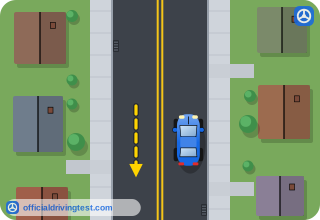
- Turning sharply to the left almost to the curb
- Backing sharply to the right almost to the curb
- Turning sharply to the right to the center of the street
- Stopping in the center of the street and backing straight
Show answer
Correct answer: Turning sharply to the left almost to the curb
The manual says the turn is accomplished by turning sharply to the left almost to the curb, backing to the right almost to the other curb, and then turning to the right side of the roadway in the opposite direction.
Source: Delaware Driver Manual (July 2026), page 13 · Open this page in the manual (Manual page 13)
-
According to the Delaware Driver Manual, what do motor vehicle laws describe regarding the right-of-way?
- Who is to yield the right-of-way
- Which vehicles may ignore traffic signals
- Which driver always has the right-of-way
- Which roads have the right-of-way
Show answer
Correct answer: Who is to yield the right-of-way
The manual says the laws do not give anyone the right-of-way; they describe who must yield it.
Source: Delaware Driver Manual (July 2026), page 69 · Open this page in the manual (Manual page 69)
-
You can prevent a crash by yielding the right-of-way, even though another driver was supposed to yield to you. What does the manual say about yielding?
- It is only required if the other driver is a pedestrian
- It is not advised, because you have the right of way
- It is of course the right thing to do
- It is allowed only on roads without signals
Show answer
Correct answer: It is of course the right thing to do
The manual states that yielding to prevent a crash is the right thing to do, regardless of who was supposed to yield.
Source: Delaware Driver Manual (July 2026), page 69 · Open this page in the manual (Manual page 69)
-
When may you turn right at a steady red light?
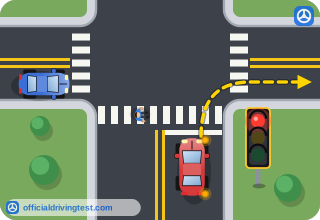
- Only if no other vehicle is in sight, without stopping
- Only when a police officer waves you through the intersection
- Never, because a red light always means no turns are allowed
- After a full stop, unless a sign or a steady red arrow prohibits it
Show answer
Correct answer: After a full stop, unless a sign or a steady red arrow prohibits it
Right turns on red are permissible after a full stop, except when a posted sign or a steady red arrow prohibits them.
Source: Delaware Driver Manual (July 2026), page 69 · Open this page in the manual (Manual page 69)
-
Under what condition is a left turn on red permissible after a full stop?
- From a one-way street to another one-way street
- From a two-way street to another two-way street
- From any street onto a one-way street
- From a one-way street onto any two-way street
Show answer
Correct answer: From a one-way street to another one-way street
The manual allows left turns on red after a full stop only from a one-way street to another one-way street, unless prohibited.
Source: Delaware Driver Manual (July 2026), page 69 · Open this page in the manual (Manual page 69)
-
At a steady green light, when may you go straight ahead or turn?
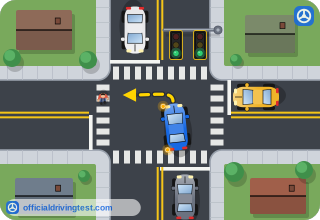
- When safe, unless a sign or signal prohibits it
- Only straight ahead, and never turn in any case
- Only after waiting a few seconds
- Only when no pedestrians are in the area
Show answer
Correct answer: When safe, unless a sign or signal prohibits it
The manual allows you to enter and go straight or turn when safe unless a sign or additional signal prohibits the turn.
Source: Delaware Driver Manual (July 2026), page 70 · Open this page in the manual (Manual page 70)
-
Where must you make a complete stop at a stop sign?
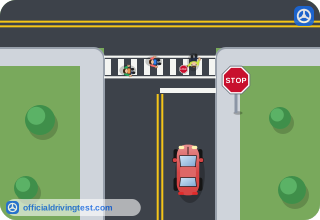
- Just past the crosswalk, at the very edge of the intersection so you can see
- At the stop line; if none, at the crosswalk; if none, before entering the intersection
- At the stop line only; if there is none, slow down and roll through the intersection
- Anywhere before the sign, at the spot from which you can see cross traffic best
Show answer
Correct answer: At the stop line; if none, at the crosswalk; if none, before entering the intersection
You stop at the stop line, or if there is none at the crosswalk, or if none before entering the intersection.
Source: Delaware Driver Manual (July 2026), page 74 · Open this page in the manual (Manual page 74)
-
After stopping at a stop sign, what must you do before starting?
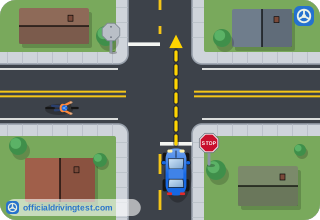
- Sound your horn to warn other vehicles and pedestrians that you are starting
- Wait for every other vehicle to finish crossing and leave the intersection
- Proceed at once, since you have already made your complete stop at the line
- Yield the right-of-way to any vehicle or pedestrian in or approaching the intersection
Show answer
Correct answer: Yield the right-of-way to any vehicle or pedestrian in or approaching the intersection
Before starting you must yield to any vehicle or pedestrian in or approaching the intersection.
Source: Delaware Driver Manual (July 2026), page 74 · Open this page in the manual (Manual page 74)
-
When you start up from a stop sign, which vehicles does the manual say to look carefully for because they are less visible?
- Bicycles, mopeds, and motorcycles
- Delivery vans and box trucks
- School buses and transit buses
- Farm tractors and horse-drawn vehicles
Show answer
Correct answer: Bicycles, mopeds, and motorcycles
The manual tells you to look for less visible vehicles such as bicycles, mopeds and motorcycles before starting from a stop sign.
Source: Delaware Driver Manual (July 2026), page 74 · Open this page in the manual (Manual page 74)
-
A red and white sign shaped like a point-down triangle has no other sign of its shape on the highway. What must you do when you come to it?
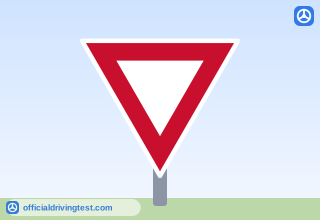
- Make a complete stop every time, whether or not anyone is approaching
- Speed up so you can clear the intersection before traffic arrives
- Yield the right-of-way to any vehicle or pedestrian, stopping if necessary
- Stop only if a pedestrian is already in the crosswalk ahead of you
Show answer
Correct answer: Yield the right-of-way to any vehicle or pedestrian, stopping if necessary
You yield to any vehicle or pedestrian in or approaching the intersection, stopping if necessary.
Source: Delaware Driver Manual (July 2026), page 74 · Open this page in the manual (Manual page 74)
-
After you have yielded at a yield sign to a vehicle or pedestrian, when may you proceed?
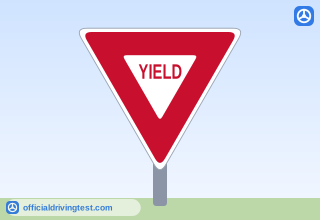
- As soon as the other vehicle or pedestrian has passed you
- Only when the movement can be made in safety
- As soon as you have slowed down and looked left and right
- Whenever the vehicle behind you signals for you to go
Show answer
Correct answer: Only when the movement can be made in safety
Having yielded, you shall not proceed until the movement can be made in safety.
Source: Delaware Driver Manual (July 2026), page 74 · Open this page in the manual (Manual page 74)
-
What should you do as you approach a yield sign?
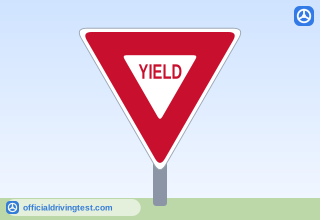
- Maintain your speed and let the cross traffic and pedestrians yield to you
- Come to a complete stop at the stop line every time, even if the way is clear
- Stay in your lane and sound your horn as you enter the intersection
- Slow down, look left and right, and yield to crossing traffic and pedestrians
Show answer
Correct answer: Slow down, look left and right, and yield to crossing traffic and pedestrians
The manual says to slow down, look left and right, and yield to pedestrians and vehicles performing lawful maneuvers or crossing.
Source: Delaware Driver Manual (July 2026), page 74 · Open this page in the manual (Manual page 74)
-
According to the overtaking law quoted in the manual, on which side shall vehicles overtake other vehicles?
- On the left, when at a safe distance
- On either side, whenever the lane is clear
- Only in a marked passing lane
- On the shoulder, when traffic is slow
Show answer
Correct answer: On the left, when at a safe distance
Delaware law states vehicles shall overtake others on the left only when at a safe distance.
Source: Delaware Driver Manual (July 2026), page 81 · Open this page in the manual (Manual page 81)
-
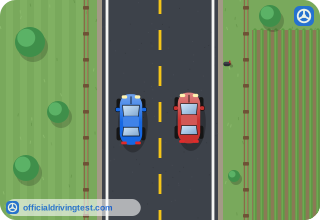
When may you return to the right after overtaking another vehicle?
- As soon as your front bumper passes
- When the other driver signals
- When you are safely clear
- After you have counted to three
Show answer
Correct answer: When you are safely clear
Delaware law says a vehicle shall return to the right only when safely clear.
Source: Delaware Driver Manual (July 2026), page 81 · Open this page in the manual (Manual page 81)
-
What must the driver of a vehicle being overtaken do?
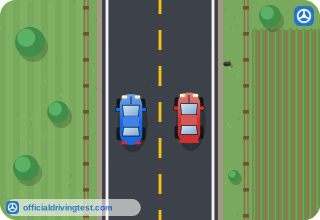
- Give way to the right and not increase speed until fully overtaken
- Give way to the left and speed up until fully overtaken
- Hold the lane and maintain speed while being passed
- Slow down to a stop so the other driver can pass
Show answer
Correct answer: Give way to the right and not increase speed until fully overtaken
Vehicles being overtaken shall give way to the right and not increase their speed until fully overtaken.
Source: Delaware Driver Manual (July 2026), page 81 · Open this page in the manual (Manual page 81)
-
In which direction does traffic move around a roundabout’s central island?
- Clockwise
- Counterclockwise
- Toward the left side of the road
- In whichever direction is shortest
Show answer
Correct answer: Counterclockwise
The manual says a roundabout moves traffic counterclockwise around a central island.
Source: Delaware Driver Manual (July 2026), page 85 · Open this page in the manual (Manual page 85)
-
When you turn left at a roundabout, how far around it do you go before you exit?
- Halfway around
- One quarter of the way around
- All the way around, back to its entry
- Three-quarters of the way around
Show answer
Correct answer: Three-quarters of the way around
The manual’s roundabout diagram says a left-turning vehicle yields to traffic in the roundabout, goes 3/4 around and completes its turn.
Source: Delaware Driver Manual (July 2026), page 85 · Open this page in the manual (Manual page 85)
-
How do you make a U-turn at a roundabout?
- Stay to the right and go around to exit on the road you entered from
- Turn left in front of the central island and exit right away
- Go straight through and turn around outside the roundabout
- Stop in the roundabout and wait for traffic to clear first
Show answer
Correct answer: Stay to the right and go around to exit on the road you entered from
The manual’s roundabout diagram says a U-turning vehicle yields, stays to the right, continues around and exits on the same road it entered from.
Source: Delaware Driver Manual (July 2026), page 85 · Open this page in the manual (Manual page 85)