Delaware: Railroad crossings Practice Test
Highway-rail crossing signs and signals, the emergency notification system, and crossing the tracks safely.
Independent educational site · not affiliated with any government agency or DMV
Ready? Test yourself
- Instant feedback with an explanation
- Every answer cites its source in the manual
- Your best score is saved on this device
Questions are original and based on the official manual "Delaware Driver Manual" (July 2026), Delaware Division of Motor Vehicles (DMV).
All 31 questions in this practice test
Take the test above first, then use this list to study. Tap “Show answer” to see the correct answer and explanation.
Show the questions and answersHide the questions
-
What is a highway-rail intersection?
- The area where two highways meet at a traffic signal or sign
- A crossing that is used only by trains and railroad workers
- The area common to highways and railroad tracks that intersect or cross
- A safety zone set aside beside the railroad tracks
Show answer
Correct answer: The area common to highways and railroad tracks that intersect or cross
The manual defines a highway-rail intersection as the area common to one or more highways intersecting with, or crossing, one or more railroad tracks.
Source: Delaware Driver Manual (July 2026), page 12 · Open this page in the manual (Manual page 12)
-
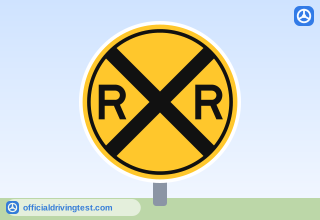
A round yellow sign with a black X and the letters R R is used as what?
- A warning that a school zone or school crossing is approaching
- A sign that trains always have the right-of-way at a crossing ahead
- A sign that the railroad crossing ahead has no gate or signal
- An advance warning that you are approaching a highway-rail intersection
Show answer
Correct answer: An advance warning that you are approaching a highway-rail intersection
The round black on yellow sign is an advance warning of a highway-rail intersection.
Source: Delaware Driver Manual (July 2026), page 75 · Open this page in the manual (Manual page 75)
-
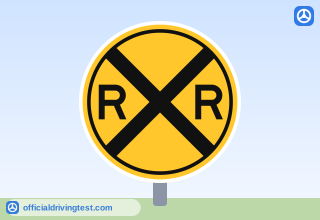
When you come to the round advance warning sign for a highway-rail intersection at night, what does the manual tell you to take care to avoid?
- Driving into the side of a train
- Driving with your low beams on
- Stopping before the crossing gates
- Crossing without hazard flashers on
Show answer
Correct answer: Driving into the side of a train
At night you are told to use particular caution to avoid driving into the side of a train.
Source: Delaware Driver Manual (July 2026), page 75 · Open this page in the manual (Manual page 75)
-
What is the Emergency Notification System (ENS) number at a grade crossing used for?
- Reporting a vehicle that has been parked illegally
- Asking the railroad when the next train will arrive
- Contacting the railroad to report problems at the crossing
- Requesting a tow truck for a stalled vehicle
Show answer
Correct answer: Contacting the railroad to report problems at the crossing
Every grade crossing has an emergency dispatch number for contacting the railroad to report problems.
Source: Delaware Driver Manual (July 2026), page 83 · Open this page in the manual (Manual page 83)
-
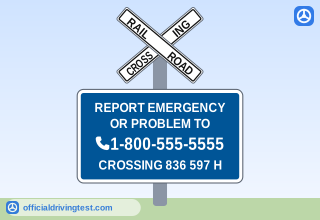
Where is the ENS number typically located at a railroad crossing?
- On a red sign at the nearest road intersection
- On a blue sign on the crossbuck or near the crossing
- On the pavement just before the railroad stop bar
- On the flashing warning lights over the roadway
Show answer
Correct answer: On a blue sign on the crossbuck or near the crossing
The manual says the ENS number is typically on a blue sign on the crossbuck or in the vicinity of the crossing.
Source: Delaware Driver Manual (July 2026), page 83 · Open this page in the manual (Manual page 83)
-
What does the DOT number on the blue sign at a railroad crossing identify?
- The number of train tracks at the crossing
- The speed limit for trains at the crossing
- The railroad company that owns the tracks
- The physical location of the crossing
Show answer
Correct answer: The physical location of the crossing
The DOT number identifies the physical location of the grade crossing so emergency crews or railroad personnel can respond.
Source: Delaware Driver Manual (July 2026), page 83 · Open this page in the manual (Manual page 83)
-
Why does the ENS dispatcher need the DOT number of a crossing?
- To tell trains coming in that direction to stop or slow down
- To close the road to every vehicle for the whole day
- To bill the driver for delaying the train
- To record which drivers used the crossing that day
Show answer
Correct answer: To tell trains coming in that direction to stop or slow down
The DOT number tells the dispatcher exactly where the crossing is so trains can be told to stop or slow down.
Source: Delaware Driver Manual (July 2026), page 83 · Open this page in the manual (Manual page 83)
-
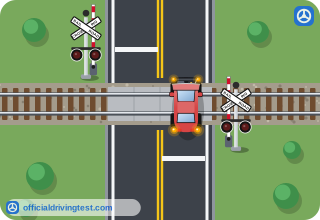
Something is blocking the tracks at a railroad crossing. What does the manual call the best and most efficient way to contact the railroad?
- Flashing your headlights at the next train
- Calling the local DMV office
- Using the Emergency Notification System (ENS)
- Waiting for the crossing gate to lower
Show answer
Correct answer: Using the Emergency Notification System (ENS)
The manual says utilizing the ENS is the best and most efficient way to contact the railroads about a problem or a blockage.
Source: Delaware Driver Manual (July 2026), page 83 · Open this page in the manual (Manual page 83)
-
What should you never try to do at a railroad crossing?
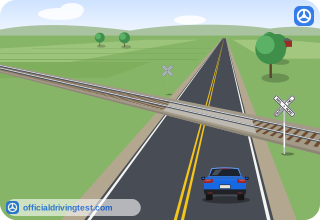
- Stop at the crossing before the stop line
- Beat a train across the tracks
- Look both ways before crossing
- Slow down when you see the warning sign
Show answer
Correct answer: Beat a train across the tracks
The manual says never try to beat a train across the tracks.
Source: Delaware Driver Manual (July 2026), page 83 · Open this page in the manual (Manual page 83)
-
When should you not start to cross a railroad crossing?
- When the road surface on the tracks is wet or covered with snow
- When another vehicle has just crossed the tracks ahead of you
- When you are driving in a lower gear than you usually drive in
- When there is no room for your vehicle on the far side of the tracks
Show answer
Correct answer: When there is no room for your vehicle on the far side of the tracks
The manual says never start to cross if there is not room for your vehicle on the far side or if you would have to stop on the tracks.
Source: Delaware Driver Manual (July 2026), page 83 · Open this page in the manual (Manual page 83)
-
Why is it wise not to shift gears while crossing railroad tracks?
- You might stall
- The tracks could damage the gear shift
- The crossing gate could lower on your vehicle
- Shifting gears is illegal near a crossing
Show answer
Correct answer: You might stall
The manual says not shifting gears on the tracks is wise just in case you might stall.
Source: Delaware Driver Manual (July 2026), page 83 · Open this page in the manual (Manual page 83)
-
A round yellow warning sign has an “X” symbol and black “RR” letters. What is it called?
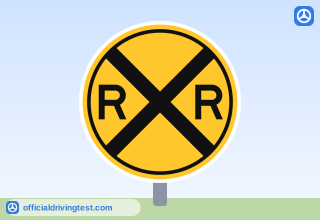
- The Stop Ahead Sign
- The Crossbuck Sign
- The Advance Warning Sign
- The Yield Warning Sign
Show answer
Correct answer: The Advance Warning Sign
The manual says a round yellow sign with an X and black RR letters placed before a crossing is the Advance Warning Sign.
Source: Delaware Driver Manual (July 2026), page 84 · Open this page in the manual (Manual page 84)
-
Which markings usually appear on the pavement in advance of a highway–rail intersection?
- A solid double yellow line and the word “TRAIN”
- An “X” symbol with the letters “RR” and a stop bar
- A white arrow pointing toward the tracks
- Diagonal white stripes with the letters “STOP”
Show answer
Correct answer: An “X” symbol with the letters “RR” and a stop bar
The manual says the advance pavement markings usually include an X symbol with RR and a stop bar.
Source: Delaware Driver Manual (July 2026), page 84 · Open this page in the manual (Manual page 84)
-
A white, X-shaped sign with Railroad Crossing on it is at a railroad crossing. It has the same meaning as which sign?
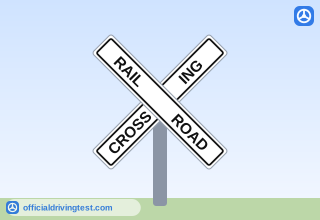
- A Stop sign
- A Do Not Enter sign
- A Merge sign
- A Yield sign
Show answer
Correct answer: A Yield sign
The manual says this crossbuck has the same meaning as a Yield sign, so you must yield to crossing trains.
Source: Delaware Driver Manual (July 2026), page 84 · Open this page in the manual (Manual page 84)
-
What must you do when the side-by-side lights at a railroad crossing are flashing?
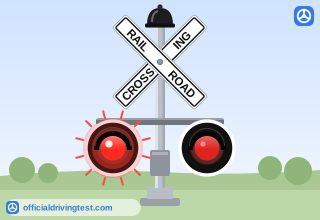
- Stop
- Slow down and cross if no train is visible
- Stop only if the gate is lowered
- Cross quickly before the train arrives
Show answer
Correct answer: Stop
The manual says that when the lights are flashing, you must stop.
Source: Delaware Driver Manual (July 2026), page 84 · Open this page in the manual (Manual page 84)
-
A crossing gate has lowered at a railroad crossing. What does the manual say about it?
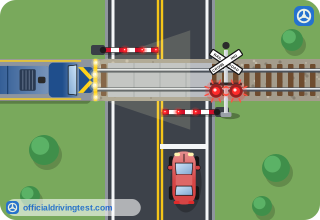
- You may drive around it if you can see no train
- You may drive around it if you slow down to 10 mph
- Do not drive around the gate
- You may drive around it if you stopped first
Show answer
Correct answer: Do not drive around the gate
The manual says a crossing gate lowers when a train is coming and you must not drive around it.
Source: Delaware Driver Manual (July 2026), page 84 · Open this page in the manual (Manual page 84)
-
A bell is sounding at a railroad crossing. When may you cross?
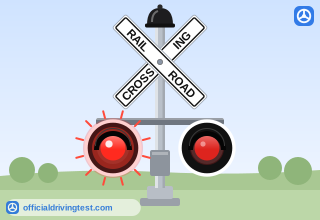
- As soon as the lights stop flashing
- Not until the bell has stopped
- Whenever the road ahead is clear
- After you have slowed down to a crawl
Show answer
Correct answer: Not until the bell has stopped
The manual says some crossings have a bell that sounds, and you must not cross until it has stopped.
Source: Delaware Driver Manual (July 2026), page 84 · Open this page in the manual (Manual page 84)
-
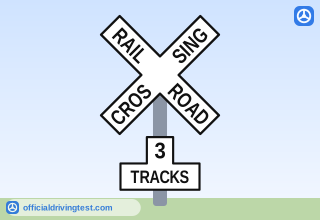
What does a sign showing the number of tracks at a railroad crossing warn you about?
- A train will cross the road within the next minute or so
- The railroad has set a speed limit for all trains there
- The crossing is closed to heavy vehicles and large trucks
- There is more than one track and maybe more than one train
Show answer
Correct answer: There is more than one track and maybe more than one train
The manual says number-of-tracks signs warn that there is more than one track and possibly more than one train.
Source: Delaware Driver Manual (July 2026), page 84 · Open this page in the manual (Manual page 84)
-
You come to a railroad crossing that has no number-of-tracks sign. What is important to do?
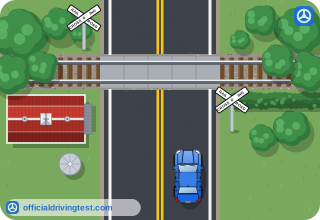
- Check for more than one track before crossing
- Assume that there is only one track at the crossing
- Stop for ten seconds and then cross the tracks
- Follow the vehicle ahead of you across the tracks
Show answer
Correct answer: Check for more than one track before crossing
The manual says that without a number-of-tracks sign you must always check for more than one track before crossing.
Source: Delaware Driver Manual (July 2026), page 84 · Open this page in the manual (Manual page 84)
-
As you approach any railroad crossing, what should you do?
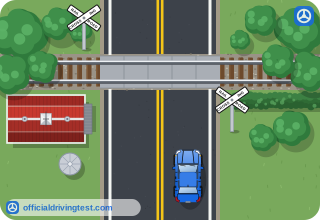
- Speed up to cross before a train arrives
- Keep your speed and watch only for flashing lights
- Slow down and look up and down the tracks
- Move to the far left of your lane
Show answer
Correct answer: Slow down and look up and down the tracks
You should slow down and look up and down the tracks to make sure a train is not coming.
Source: Delaware Driver Manual (July 2026), page 118 · Open this page in the manual (Manual page 118)
-
You have never seen a train at a certain railroad crossing. What should you do?
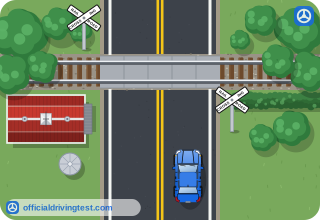
- Assume that no train will come
- Always expect a train
- Cross without slowing down
- Look only if the gates are down
Show answer
Correct answer: Always expect a train
The manual says not to assume that a train is not coming, even if you have never seen one there. Always expect a train.
Source: Delaware Driver Manual (July 2026), page 118 · Open this page in the manual (Manual page 118)
-
Before you cross railroad tracks, what must you make sure of?
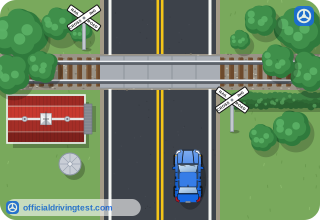
- Your hazard lights are on
- Your vehicle is in the lane closest to the right side
- No other vehicle is driving behind you
- There is room for your vehicle on the far side
Show answer
Correct answer: There is room for your vehicle on the far side
You must make sure there is room for your vehicle on the far side so you do not block the crossing.
Source: Delaware Driver Manual (July 2026), page 118 · Open this page in the manual (Manual page 118)
-
Why should you wait until a passing train is well down the track at a crossing with more than one track?
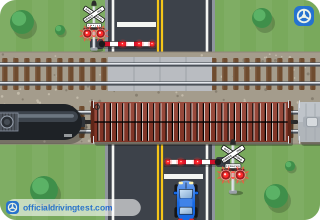
- The crossing gates may not lift for several minutes
- The train may reverse direction after it passes
- The tracks may be slippery right after a train
- Another train may be hidden by the one that just passed
Show answer
Correct answer: Another train may be hidden by the one that just passed
Another train may be hidden by the one that just passed.
Source: Delaware Driver Manual (July 2026), page 118 · Open this page in the manual (Manual page 118)
-
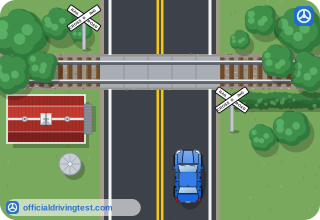
At a railroad crossing, what do you need to make sure of before you cross?
- That the crossing gates are painted red and white stripes
- That there are no trains coming and that you have room to cross
- That the vehicle behind you has stopped as well as you
- That you are driving faster than the other vehicles nearby
Show answer
Correct answer: That there are no trains coming and that you have room to cross
The manual says to make sure there are no trains coming and that you have room to cross, and not to block the crossing.
Source: Delaware Driver Manual (July 2026), page 125 · Open this page in the manual (Manual page 125)
-
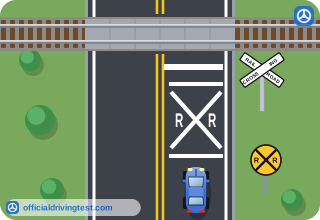
Why may you need to slow down at some railroad crossings?
- The tracks are always icy
- The rails give off a bright glare
- Crossing gates block most of the road
- Some crossings are bumpy
Show answer
Correct answer: Some crossings are bumpy
The manual says some crossings are bumpy, so you need to slow down to cross safely.
Source: Delaware Driver Manual (July 2026), page 125 · Open this page in the manual (Manual page 125)
-
When approaching railroad crossings, which vehicles require you to leave extra room because they must stop?
- Transit buses, school buses, and vehicles carrying hazardous materials
- Passenger cars, pickup trucks and small sport utility vehicles
- Motorcycles, mopeds, bicycles and other two-wheeled vehicles
- Mail trucks, delivery vans and other commercial vehicles
Show answer
Correct answer: Transit buses, school buses, and vehicles carrying hazardous materials
The manual says to leave extra room for vehicles required to stop at crossings, including transit buses, school buses and vehicles carrying hazardous materials.
Source: Delaware Driver Manual (July 2026), page 128 · Open this page in the manual (Manual page 128)
-
When you cross railroad tracks, what must you make sure of?
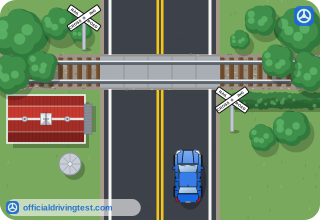
- You will not have to stop on the tracks
- Your hazard lights are turned on first
- The train’s horn can be heard clearly
- You have shifted into a lower gear
Show answer
Correct answer: You will not have to stop on the tracks
Before crossing, make sure you can cross without having to stop on the tracks.
Source: Delaware Driver Manual (July 2026), page 131 · Open this page in the manual (Manual page 131)
-
If there is a railroad grade crossing ahead, what does the manual say about passing?
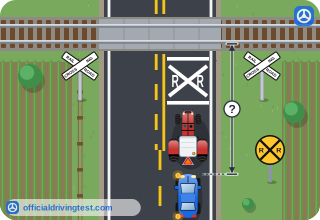
- Do not pass
- Pass quickly before you reach the crossing
- Pass only if no train is in sight
- Pass only if the crossing has gates
Show answer
Correct answer: Do not pass
The manual says not to pass if there is a railroad grade crossing ahead.
Source: Delaware Driver Manual (July 2026), page 132 · Open this page in the manual (Manual page 132)
-
What does the manual say about driving around lowered gates or trying to beat a train?
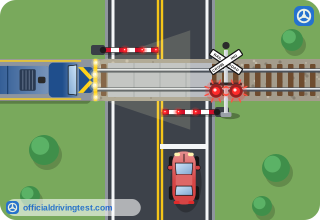
- It is allowed if the train is far away
- It is allowed if you sound your horn
- It is safe if you slow down first
- It can be fatal
Show answer
Correct answer: It can be fatal
The manual warns that driving around lowered gates or trying to beat the train can be fatal.
Source: Delaware Driver Manual (July 2026), page 135 · Open this page in the manual (Manual page 135)
-
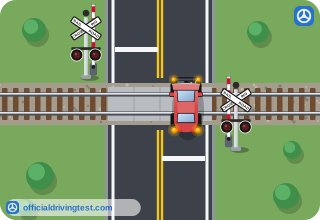
If your vehicle stalls on railroad tracks and you are not sure whether a train is coming, what should you do?
- Stay in the vehicle and keep trying to start it
- Stay in the vehicle and sound the horn
- Leave the engine running and wait
- Get out and move away from your vehicle
Show answer
Correct answer: Get out and move away from your vehicle
The manual says to get out and move away if the vehicle does not start or you are unsure about a train.
Source: Delaware Driver Manual (July 2026), page 138 · Open this page in the manual (Manual page 138)
-
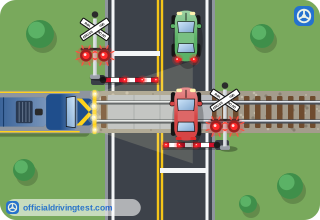
If your vehicle stalls on tracks and a train is coming, in which direction should you run?
- In the same direction the train is traveling
- In the general direction the train is coming from
- Straight along the tracks ahead of the train
- Back to the vehicle to retrieve your belongings
Show answer
Correct answer: In the general direction the train is coming from
The manual says to run in the general direction the train is coming from so collision debris will not hit you.
Source: Delaware Driver Manual (July 2026), page 138 · Open this page in the manual (Manual page 138)