Delaware: Parking rules — Part 1 Practice Test
Questions in this part include: “When you park and leave your vehicle on a highway or street, what must you do?” · “If your car has a manual transmission, which gear should you leave it in when parked and headed downhill?”
Independent educational site · not affiliated with any government agency or DMV
Ready? Test yourself
- Instant feedback with an explanation
- Every answer cites its source in the manual
- Your best score is saved on this device
Questions are original and based on the official manual "Delaware Driver Manual" (July 2026), Delaware Division of Motor Vehicles (DMV).
All 22 questions in this practice test
Take the test above first, then use this list to study. Tap “Show answer” to see the correct answer and explanation.
Show the questions and answersHide the questions
-
When you park and leave your vehicle on a highway or street, what must you do?
- Stop the engine, lock the ignition, remove the key, and set the brakes
- Stop the engine and set the brakes, but leave the key in the ignition
- Turn on your parking lights and set the brakes, leaving the engine idling
- Lock the doors and raise the windows, which are the only legal requirements
Show answer
Correct answer: Stop the engine, lock the ignition, remove the key, and set the brakes
The manual says you must stop the engine, lock the ignition, remove the key, and set the brakes.
Source: Delaware Driver Manual (July 2026), page 91 · Open this page in the manual (Manual page 91)
-
What does the manual say is advisable when you park and leave your vehicle?
- Leave the windows slightly open
- Leave the key with the car for emergencies
- Raise the windows and lock the doors
- Leave your hazard lights on
Show answer
Correct answer: Raise the windows and lock the doors
The manual calls it advisable to raise the windows and lock the doors.
Source: Delaware Driver Manual (July 2026), page 91 · Open this page in the manual (Manual page 91)
-
How close to the curb must you park when parallel parking on a two-way highway?
- Within 6 inches
- Within 12 inches
- Within 18 inches
- Within 24 inches
Show answer
Correct answer: Within 12 inches
On a two-way highway you must park parallel to and within 12 inches of the curb or edge of the highway.
Source: Delaware Driver Manual (July 2026), page 91 · Open this page in the manual (Manual page 91)
-
While you prepare to parallel park, a car behind you is following too closely. What should you do?
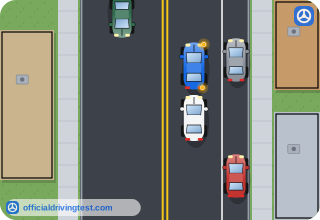
- Stop suddenly and back into the space quickly
- Stop and sound your horn to warn the driver behind you
- Pull into the space nose first so you can leave faster
- Continue driving and find another space
Show answer
Correct answer: Continue driving and find another space
Stopping suddenly with a car behind you may result in a rear-end collision, so you continue and find another space.
Source: Delaware Driver Manual (July 2026), page 91 · Open this page in the manual (Manual page 91)
-
In the first step of parallel parking, where do you stop your vehicle?
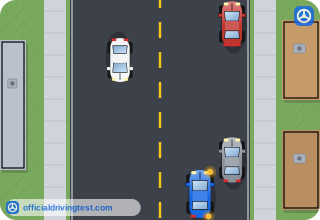
- Several feet behind the vehicle in front of the space
- Directly behind the vehicle ahead, with your bumper almost touching it
- Even with the back of the vehicle in front of the space
- Even with the front of the vehicle behind the space
Show answer
Correct answer: Even with the back of the vehicle in front of the space
You signal and stop with the back end of your vehicle even with the back of the vehicle in front of the place you want to park.
Source: Delaware Driver Manual (July 2026), page 91 · Open this page in the manual (Manual page 91)
-
In parallel parking, how do you begin backing into the space after you stop?
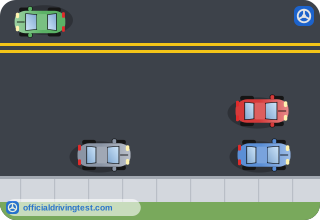
- Slowly, with the steering wheel turned to the right
- Quickly, with the steering wheel turned to the left
- Slowly, with the steering wheel turned to the left
- Slowly, with the wheels kept straight
Show answer
Correct answer: Slowly, with the steering wheel turned to the right
You back slowly, turning the steering wheel to the right to aim the back of your car toward the front of the car behind.
Source: Delaware Driver Manual (July 2026), page 91 · Open this page in the manual (Manual page 91)
-
In parallel parking, what do you do as the front of your car clears the back of the car in front of you?
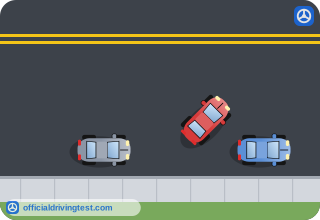
- Turn your wheels sharply to the right and back faster
- Straighten your wheels and pull forward into the space
- Stop, put the car in park, and turn off the engine
- Turn your wheels sharply to the left and keep backing slowly
Show answer
Correct answer: Turn your wheels sharply to the left and keep backing slowly
Once the front of your car clears, you turn your wheels sharply to the left and keep backing slowly until you almost touch the car behind.
Source: Delaware Driver Manual (July 2026), page 91 · Open this page in the manual (Manual page 91)
-
After backing into the space, how do you finish parallel parking?
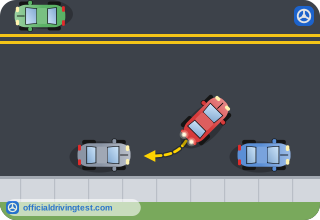
- Turn your wheels toward the curb and back up until you touch the car behind
- Straighten your wheels and pull forward to center the car in the space
- Leave your wheels turned left and stop where you are
- Back up once more with the wheels straight until you touch the car behind
Show answer
Correct answer: Straighten your wheels and pull forward to center the car in the space
The last move is to straighten your wheels and pull forward to center the car, then put it in park, set the brake and turn off the engine.
Source: Delaware Driver Manual (July 2026), page 91 · Open this page in the manual (Manual page 91)
-
What does the law say about leaving keys in a vehicle?
- It is against the law to leave keys in a running, unattended vehicle
- It is legal to leave keys in a running vehicle if the parking lights are on
- It is legal to leave keys in a running vehicle if the doors are locked
- It is legal to leave keys in a running vehicle for up to five minutes
Show answer
Correct answer: It is against the law to leave keys in a running, unattended vehicle
Leaving keys in a running, unattended vehicle is against the law.
Source: Delaware Driver Manual (July 2026), page 91 · Open this page in the manual (Manual page 91)
-
How do you park by the left-hand curb on a one-way street?
- Park only at the right-hand curb, because left-hand parking is never allowed
- Use the same steps with no changes, turning the wheel right and then left
- Follow the same steps as at the right-hand curb, but reverse right and left
- Drive forward into the space and stop within 12 inches of the curb
Show answer
Correct answer: Follow the same steps as at the right-hand curb, but reverse right and left
For left-hand curb parking on a one-way street you follow the same directions but reverse right and left.
Source: Delaware Driver Manual (July 2026), page 91 · Open this page in the manual (Manual page 91)
-
If your car has a manual transmission, which gear should you leave it in when parked and headed uphill?
- Reverse
- Low gear
- Neutral
- Second gear
Show answer
Correct answer: Low gear
A manual transmission car parked headed uphill is left in low gear.
Source: Delaware Driver Manual (July 2026), page 91 · Open this page in the manual (Manual page 91)
-
If your car has a manual transmission, which gear should you leave it in when parked and headed downhill?
- Low gear
- Neutral
- Second gear
- Reverse
Show answer
Correct answer: Reverse
A manual transmission car parked headed downhill is left in reverse.
Source: Delaware Driver Manual (July 2026), page 91 · Open this page in the manual (Manual page 91)
-
What does leaving a manual transmission car in low gear (uphill) or reverse (downhill) help prevent?
- Damage to the clutch or transmission while the engine is off
- The vehicle being towed away by the police
- A crash if your emergency or parking brake should fail
- Theft of the vehicle while you are away
Show answer
Correct answer: A crash if your emergency or parking brake should fail
The manual says this helps prevent a crash if the emergency or parking brake should fail.
Source: Delaware Driver Manual (July 2026), page 91 · Open this page in the manual (Manual page 91)
-
How do you leave a parallel parking space?
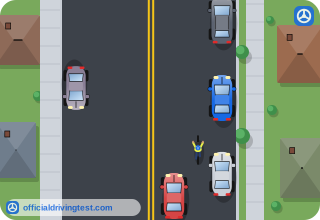
- Signal, watch for traffic, and turn your steering wheel toward the open lane
- Turn your steering wheel toward the curb and back up before easing out
- Signal, then accelerate quickly into the open lane before traffic approaches
- Turn on your hazard lights and pull out without checking traffic
Show answer
Correct answer: Signal, watch for traffic, and turn your steering wheel toward the open lane
You signal your move, watch for traffic and turn the steering wheel toward the open lane, easing your way out.
Source: Delaware Driver Manual (July 2026), page 91 · Open this page in the manual (Manual page 91)
-
Besides a handicapped license plate on the rear of the vehicle, what lets you legally park in a space designated for Handicapped Parking?
- A handicapped parking ID card kept in the glove compartment
- A note from a doctor placed on the dashboard
- A handicapped sticker on the driver-side window
- A handicapped parking ID card hanging from the rearview mirror
Show answer
Correct answer: A handicapped parking ID card hanging from the rearview mirror
The manual allows a handicapped license plate on the rear or a handicapped parking ID card displayed hanging from the rearview mirror.
Source: Delaware Driver Manual (July 2026), page 91 · Open this page in the manual (Manual page 91)
-
When you park on the shoulder or side of a highway, when must you turn on your parking lights or 4-way flashers?
- Only when it is raining or snowing, day or night, on a road with no street lights
- From sunset to sunrise, or when light is insufficient to see persons or objects 1000 feet away
- From one hour after sunset until one hour before sunrise, or whenever it is raining
- Whenever you park for longer than 15 minutes, day or night, on any shoulder
Show answer
Correct answer: From sunset to sunrise, or when light is insufficient to see persons or objects 1000 feet away
Parking lights (or 4-way flashers) are required from sunset to sunrise or when light is insufficient to see persons or objects 1000 feet away.
Source: Delaware Driver Manual (July 2026), page 91 · Open this page in the manual (Manual page 91)
-
What does the manual say about flashing the turn signal lights of a parked vehicle?
- They shall not be flashed on one side only of a parked vehicle
- They must be flashed on the traffic side only when parked at night
- They must be flashed on both sides only when parked on a hill
- They may be flashed on one side to show you will soon pull out
Show answer
Correct answer: They shall not be flashed on one side only of a parked vehicle
Turn signal lights shall not be flashed on one side only of a parked vehicle.
Source: Delaware Driver Manual (July 2026), page 91 · Open this page in the manual (Manual page 91)
-
When may you park on the paved or traveled part of a highway outside of a business or residence?
- When you stay in the vehicle with the engine running
- For up to five minutes with your flashers on
- Only when your vehicle is disabled and cannot be moved
- When the shoulder is too narrow for your vehicle
Show answer
Correct answer: Only when your vehicle is disabled and cannot be moved
You must never park on the paved or traveled part of a highway outside a business or residence unless the vehicle is disabled and cannot be moved; then pull off to the right as far as possible.
Source: Delaware Driver Manual (July 2026), page 92 · Open this page in the manual (Manual page 92)
-
When parking headed downhill, which way must you turn your front wheels?
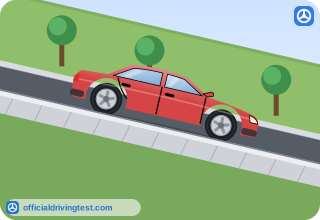
- Away from the curb or edge of the road
- Toward the curb or edge of the road
- Straight ahead, with the wheels centered
- Toward the center of the road or lane
Show answer
Correct answer: Toward the curb or edge of the road
Headed downhill, you must turn your front wheels toward the curb or edge of the road.
Source: Delaware Driver Manual (July 2026), page 92 · Open this page in the manual (Manual page 92)
-
When parking headed uphill next to a curb, how must you turn your front wheels?
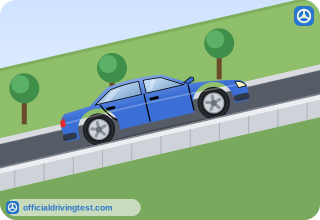
- Toward the curb, with the front wheels pointing at the curb
- Straight ahead, with the tires kept several inches away from the curb so you can pull out easily
- Toward the edge of the highway, with the wheels well clear of the curb
- Away from the curb, and bring the near-side front wheel into contact with the curb
Show answer
Correct answer: Away from the curb, and bring the near-side front wheel into contact with the curb
Headed uphill with a curb, you turn your front wheels away from the curb and bring the near-side front wheel into contact with it.
Source: Delaware Driver Manual (July 2026), page 92 · Open this page in the manual (Manual page 92)
-
When parking headed uphill where there is no curb, which way must you turn your front wheels?
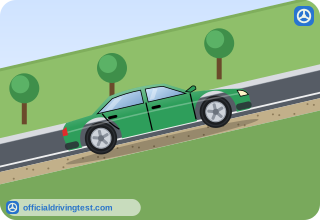
- Away from the edge of the highway
- Straight ahead
- Toward the edge of the highway
- Toward the center of the road
Show answer
Correct answer: Toward the edge of the highway
Headed uphill with no curb, you must turn your front wheels toward the edge of the highway.
Source: Delaware Driver Manual (July 2026), page 92 · Open this page in the manual (Manual page 92)
-
In addition to turning your wheels, what is it wise to do when you park on a hill?
- Leave your vehicle in gear
- Leave the engine running
- Leave the windows down
- Turn on your emergency flashers
Show answer
Correct answer: Leave your vehicle in gear
The manual says it is also wise to leave your vehicle in gear when parking on a hill.
Source: Delaware Driver Manual (July 2026), page 92 · Open this page in the manual (Manual page 92)