Delaware: Emergencies — Part 1 Practice Test
Questions in this part include: “What do Anti-Lock Brake Systems (ABS) prevent in emergency or slippery conditions?” · “According to the manual, what greatly reduces the chance that your vehicle will have a problem?”
Independent educational site · not affiliated with any government agency or DMV
Ready? Test yourself
- Instant feedback with an explanation
- Every answer cites its source in the manual
- Your best score is saved on this device
Questions are original and based on the official manual "Delaware Driver Manual" (July 2026), Delaware Division of Motor Vehicles (DMV).
All 17 questions in this practice test
Take the test above first, then use this list to study. Tap “Show answer” to see the correct answer and explanation.
Show the questions and answersHide the questions
-
What do Anti-Lock Brake Systems (ABS) prevent in emergency or slippery conditions?
- Wheels locking and the vehicle skidding
- The engine from stalling while braking hard
- The driver from having to steer around hazards
- The brakes from overheating on long downhill roads
Show answer
Correct answer: Wheels locking and the vehicle skidding
ABS prevents vehicles from locking their wheels and skidding in emergency or slippery conditions.
Source: Delaware Driver Manual (July 2026), page 115 · Open this page in the manual (Manual page 115)
-
Your vehicle has ABS and you must stop in an emergency. What should you do?
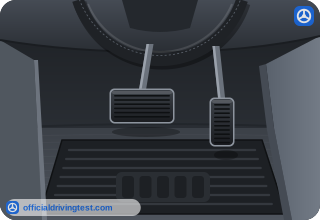
- Pump the brake pedal gently and keep the wheels straight
- Brake lightly and steer only after the vehicle has stopped
- Brake as hard as possible and, if necessary, steer to avoid crashing
- Brake gently so the vehicle slows down gradually
Show answer
Correct answer: Brake as hard as possible and, if necessary, steer to avoid crashing
With ABS the wheels do not lock, so you can brake as hard as possible and still steer to avoid a crash.
Source: Delaware Driver Manual (July 2026), page 115 · Open this page in the manual (Manual page 115)
-
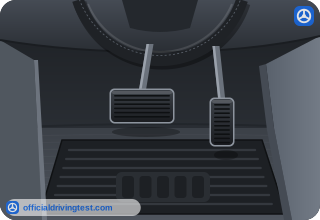
Your vehicle does not have ABS and you must stop in an emergency. What should you do?
- Brake as hard as possible and steer to avoid crashing
- Brake as hard as possible without locking the wheels
- Brake gently so the vehicle slows down gradually
- Lock the wheels so the vehicle stops sooner
Show answer
Correct answer: Brake as hard as possible without locking the wheels
Without ABS you should brake as hard as possible without locking the wheels.
Source: Delaware Driver Manual (July 2026), page 115 · Open this page in the manual (Manual page 115)
-
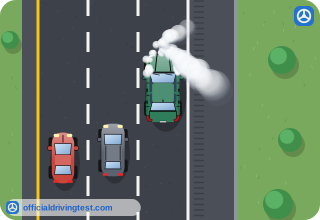
If your vehicle breaks down on a highway, what should you do first if at all possible?
- Stay in the traffic lane and wave for help
- Get it off the road and away from traffic
- Stand behind the vehicle in the roadway
- Try to change a tire where you stopped
Show answer
Correct answer: Get it off the road and away from traffic
The manual's first step is to get the vehicle off the road and away from traffic if at all possible.
Source: Delaware Driver Manual (July 2026), page 121 · Open this page in the manual (Manual page 121)
-
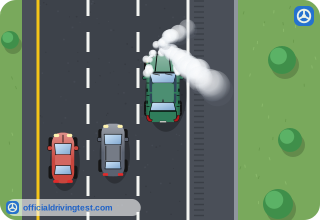
What should you turn on to show other drivers you are having vehicle trouble?
- Your high beams
- Your parking lights only
- Your turn signal
- Your emergency flashers
Show answer
Correct answer: Your emergency flashers
The manual says to turn on your emergency flashers to show you are having trouble.
Source: Delaware Driver Manual (July 2026), page 121 · Open this page in the manual (Manual page 121)
-
If you cannot get your disabled vehicle off the roadway, where should you try to stop?
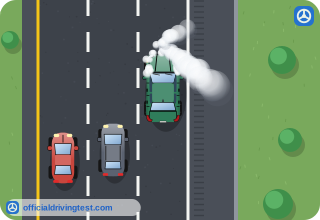
- Where other drivers have a clear view of your vehicle
- Just over a hill so it is out of the way
- Just around a curve, away from fast traffic
- In the middle lane where it is easier to be seen
Show answer
Correct answer: Where other drivers have a clear view of your vehicle
You should try to stop where other drivers have a clear view, and not just over a hill or around a curve.
Source: Delaware Driver Manual (July 2026), page 121 · Open this page in the manual (Manual page 121)
-
Why should you place emergency flares behind your disabled vehicle?
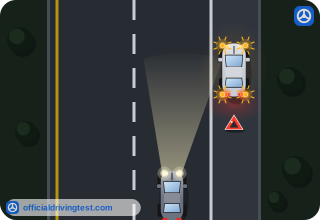
- Your vehicle will not be towed
- You can leave the vehicle unattended
- Other drivers can change lanes if needed
- It shows the vehicle is legally parked
Show answer
Correct answer: Other drivers can change lanes if needed
Flares behind the vehicle warn other road users so they can change lanes if necessary.
Source: Delaware Driver Manual (July 2026), page 121 · Open this page in the manual (Manual page 121)
-
If you have no emergency flares or warning devices, what does the manual say you can do?
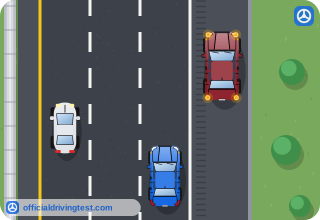
- Stand in the lane behind your vehicle
- Stand safely beside the road and wave traffic around your vehicle
- Sit inside the vehicle with the doors locked and the lights off
- Walk along the roadway to find the next exit
Show answer
Correct answer: Stand safely beside the road and wave traffic around your vehicle
Without flares you should stand safely at the side of the road and wave traffic around your vehicle, using a white cloth if you have one.
Source: Delaware Driver Manual (July 2026), page 121 · Open this page in the manual (Manual page 121)
-
When should you not try to change a tire on a disabled vehicle?
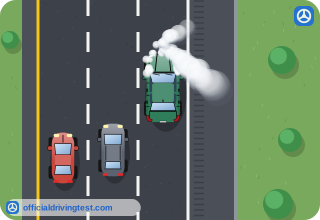
- When the tire to be changed is on the passenger side
- When the vehicle is stopped on level ground
- When you have a white cloth with you
- When you would have to be in a traffic lane
Show answer
Correct answer: When you would have to be in a traffic lane
The manual says never to stand in the roadway and not to change a tire if you would have to be in a traffic lane.
Source: Delaware Driver Manual (July 2026), page 121 · Open this page in the manual (Manual page 121)
-
What can you do to signal an emergency when your vehicle is disabled?
- Lift the hood or tie a white cloth to the antenna
- Open all the doors and the trunk of your vehicle
- Park crosswise behind the vehicle in the roadway
- Remove the license plate and place it on the road
Show answer
Correct answer: Lift the hood or tie a white cloth to the antenna
Lifting the hood or tying a white cloth to the antenna, side mirror or door handle signals an emergency.
Source: Delaware Driver Manual (July 2026), page 121 · Open this page in the manual (Manual page 121)
-
If available, what should you use to notify authorities that a vehicle has broken down?
- The vehicle's horn
- A flashlight pointed at traffic
- A 2-way radio or telephone
- The emergency flashers alone
Show answer
Correct answer: A 2-way radio or telephone
The manual says to use your 2-way radio or telephone, if available, to notify authorities.
Source: Delaware Driver Manual (July 2026), page 121 · Open this page in the manual (Manual page 121)
-
What should you do in a very heavy downpour if you cannot see well enough to drive?
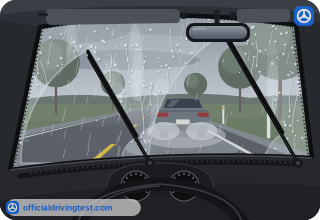
- Turn on your hazard lights and keep driving at a slow speed
- Pull off the road in a safe place and wait until the rain clears
- Stop in the traffic lane so you do not leave the roadway
- Follow the taillights of the vehicle ahead of you closely
Show answer
Correct answer: Pull off the road in a safe place and wait until the rain clears
The manual says to pull off the road in a safe place and wait until the rain clears.
Source: Delaware Driver Manual (July 2026), page 126 · Open this page in the manual (Manual page 126)
-
According to the manual, what greatly reduces the chance that your vehicle will have a problem?
- Replacing all four tires on your vehicle every year
- Driving only on roads that are well paved and dry
- Following the maintenance schedule in the owner manual
- Washing the vehicle inside and out every week
Show answer
Correct answer: Following the maintenance schedule in the owner manual
The manual says following the recommended maintenance schedule greatly reduces the chance of a vehicle problem.
Source: Delaware Driver Manual (July 2026), page 136 · Open this page in the manual (Manual page 136)
-
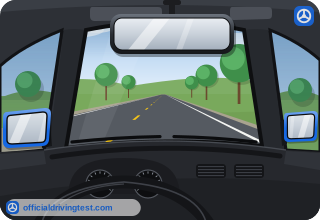
If your brakes stop working, what should you do first?
- Turn off the engine immediately
- Pull the parking brake all the way at once
- Shift into reverse
- Pump the brake pedal several times
Show answer
Correct answer: Pump the brake pedal several times
The manual lists pumping the brake pedal several times first, as it often builds up enough pressure to stop.
Source: Delaware Driver Manual (July 2026), page 136 · Open this page in the manual (Manual page 136)
-
If pumping the brake pedal does not work, how should you use the parking brake?
- Pull it as hard and as fast as you possibly can
- Pull the handle slowly so the rear wheels do not lock
- Apply it only after the vehicle has come to a stop
- Hold it halfway up while you shift into reverse
Show answer
Correct answer: Pull the handle slowly so the rear wheels do not lock
The manual says to pull the parking brake handle slowly so the rear wheels do not lock and cause a skid.
Source: Delaware Driver Manual (July 2026), page 136 · Open this page in the manual (Manual page 136)
-
If your brakes fail and the parking brake does not work, what should you do next?
- Shift to lower gears and look for a safe place to stop
- Turn off the ignition and coast until you stop
- Steer into the oncoming lane to scrub off speed
- Keep driving until you reach a repair shop
Show answer
Correct answer: Shift to lower gears and look for a safe place to stop
The manual says to shift to lower gears and look for a safe place to slow to a stop.
Source: Delaware Driver Manual (July 2026), page 136 · Open this page in the manual (Manual page 136)
-
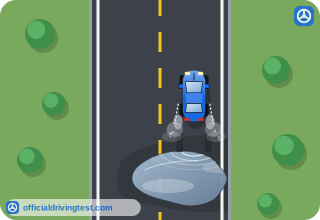
What should you do after driving through deep water?
- Check your tire pressure before you move on
- Stop the engine and wait for ten minutes
- Test your brakes, since they may pull to one side
- Switch on the windshield wipers and the defroster
Show answer
Correct answer: Test your brakes, since they may pull to one side
The manual says to test your brakes after deep water because they may pull to one side or not hold.
Source: Delaware Driver Manual (July 2026), page 136 · Open this page in the manual (Manual page 136)