Delaware: Distracted driving and fitness — Part 2 Practice Test
Questions in this part include: “For how long at most should you take your eyes off the road at any one time?” · “How often should you take breaks on a long trip?”
Independent educational site · not affiliated with any government agency or DMV
Ready? Test yourself
- Instant feedback with an explanation
- Every answer cites its source in the manual
- Your best score is saved on this device
Questions are original and based on the official manual "Delaware Driver Manual" (July 2026), Delaware Division of Motor Vehicles (DMV).
All 22 questions in this practice test
Take the test above first, then use this list to study. Tap “Show answer” to see the correct answer and explanation.
Show the questions and answersHide the questions
-
For how long at most should you take your eyes off the road at any one time?
- Up to ten seconds
- No more than a few seconds
- Up to half a minute
- As long as the road ahead is clear
Show answer
Correct answer: No more than a few seconds
The manual says not to take your eyes off the road for more than a few seconds at any one time.
Source: Delaware Driver Manual (July 2026), page 115 · Open this page in the manual (Manual page 115)
-
If you need to look at a map, what should you do?
- Glance at it only on straight, empty roads
- Hold it at the top of the steering wheel
- Pull safely off the road before you look at it
- Look at it quickly at low speed with hazard lights on
Show answer
Correct answer: Pull safely off the road before you look at it
The manual says to pull safely off the road before you try to look at a map.
Source: Delaware Driver Manual (July 2026), page 115 · Open this page in the manual (Manual page 115)
-
In many crashes with motorcycles, bicycles, and pedestrians, what did drivers report?
- They looked but did not see them
- They were blinded by oncoming high beams
- The other road users ran a red light
- They had been following too closely
Show answer
Correct answer: They looked but did not see them
Drivers in many such crashes reported that they looked but did not see the motorcycle, bicycle, or pedestrian.
Source: Delaware Driver Manual (July 2026), page 116 · Open this page in the manual (Manual page 116)
-
What does the manual say about talking on a phone or radio with “hands free” equipment while driving?
- It is safe because both hands stay on the wheel
- It is safe as long as you drive slowly
- It still takes your attention away from driving
- It is harmless once you are used to it
Show answer
Correct answer: It still takes your attention away from driving
Even with hands free equipment, conversing on a phone or radio takes your attention away from driving.
Source: Delaware Driver Manual (July 2026), page 116 · Open this page in the manual (Manual page 116)
-
Why is it illegal in Delaware to drive with head or earphones that cover or go in both ears?
- It makes it hard to hear emergency horns or sirens
- It blocks the driver's view of the side mirrors
- It interferes with the vehicle's electronic systems
- It makes drivers pay less attention to the speed limit
Show answer
Correct answer: It makes it hard to hear emergency horns or sirens
Such headphones make it hard to hear emergency horns or sirens.
Source: Delaware Driver Manual (July 2026), page 116 · Open this page in the manual (Manual page 116)
-
What should you do when you pass a crash or other roadside activity?
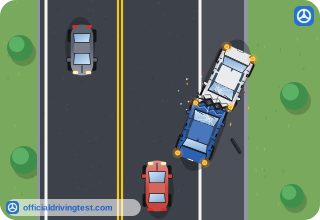
- Slow down so you can see whether anyone needs help
- Slow to a crawl and glance at the scene once
- Stop on the shoulder to watch until traffic clears
- Keep your eyes on the road and get past it safely
Show answer
Correct answer: Keep your eyes on the road and get past it safely
The manual says to keep your eyes on the road and get past roadside activities as soon and as safely as you can.
Source: Delaware Driver Manual (July 2026), page 116 · Open this page in the manual (Manual page 116)
-
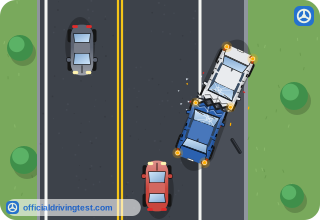
Why is it dangerous to slow down just to look at a crash (rubbernecking)?
- You could miss a turn and end up on a different road
- You could run into a vehicle ahead that has slowed or stopped
- Other drivers could think you are about to turn left
- Your headlights could shine into other drivers' eyes
Show answer
Correct answer: You could run into a vehicle ahead that has slowed or stopped
If you take your eyes off the road to look at something, you could run into a vehicle ahead that has slowed or stopped.
Source: Delaware Driver Manual (July 2026), page 116 · Open this page in the manual (Manual page 116)
-
Whenever there is a lot of activity along the side of the road, what is there a good chance of?
- The speed limit will be lowered
- Someone will cross or enter the road
- Other drivers will pull onto the shoulder
- Vehicles will stop to let you pass
Show answer
Correct answer: Someone will cross or enter the road
With a lot of activity along the roadside, there is a good chance that someone will cross or enter the road.
Source: Delaware Driver Manual (July 2026), page 117 · Open this page in the manual (Manual page 117)
-
How does being tired affect your decisions?
- It takes more time and you do not always decide well
- You decide faster but with less care
- Decisions are not affected, only your eyesight
- You decide better because you focus harder
Show answer
Correct answer: It takes more time and you do not always decide well
When tired, it takes you more time to make decisions and you do not always make good ones.
Source: Delaware Driver Manual (July 2026), page 134 · Open this page in the manual (Manual page 134)
-
What should you try to do before leaving on a long trip?
- Eat a large meal for energy
- Leave late at night when traffic is light
- Get a normal night’s sleep before leaving
- Plan to drive straight through without breaks
Show answer
Correct answer: Get a normal night’s sleep before leaving
To avoid getting tired on a long trip, try to get a normal night's sleep before you leave.
Source: Delaware Driver Manual (July 2026), page 134 · Open this page in the manual (Manual page 134)
-
You are already tired before a planned trip. What does the manual say to do?
- Leave as planned and rest if you feel sleepy
- Do not leave; plan to leave when you are rested
- Leave as planned and drink coffee on the way
- Leave only after eating a large meal
Show answer
Correct answer: Do not leave; plan to leave when you are rested
Do not leave on a trip if you are already tired; plan your trips so you can leave when rested.
Source: Delaware Driver Manual (July 2026), page 134 · Open this page in the manual (Manual page 134)
-
Why should you not eat a large meal before you leave on a long trip?
- Some people get sleepy after they eat a big meal
- Large meals make it hard to see at night
- Eating before driving is against the law
- Food in the stomach makes you drive too fast
Show answer
Correct answer: Some people get sleepy after they eat a big meal
The manual advises eating lightly because some people get sleepy after a big meal.
Source: Delaware Driver Manual (July 2026), page 134 · Open this page in the manual (Manual page 134)
-
How often should you take breaks on a long trip?
- Every three hours, or when the tank is low
- Every two hours, or when you need to
- Every hour or so, or when you need to
- Only after six hours of continuous driving
Show answer
Correct answer: Every hour or so, or when you need to
The manual says to stop every hour or so or when you need to.
Source: Delaware Driver Manual (July 2026), page 134 · Open this page in the manual (Manual page 134)
-
Why should you try not to drive late at night when you are normally asleep?
- Police stop more drivers late at night than by day
- Your body thinks it is time to sleep and will try to
- Speed limits are lower during late-night hours
- Other drivers cannot see your headlights well
Show answer
Correct answer: Your body thinks it is time to sleep and will try to
Your body thinks it is time to go to sleep and will try to do so.
Source: Delaware Driver Manual (July 2026), page 134 · Open this page in the manual (Manual page 134)
-
If you are sleepy, what does the manual say is better than taking a chance you can stay awake?
- Open the windows and turn up the radio
- Drive faster to reach your stop sooner
- Slow down and keep to the right lane
- Stop and sleep for a few hours
Show answer
Correct answer: Stop and sleep for a few hours
Never drive if you are sleepy; it is better to stop and sleep for a few hours.
Source: Delaware Driver Manual (July 2026), page 134 · Open this page in the manual (Manual page 134)
-
If you are not feeling well and need to go somewhere, what does the manual say to do?
- Drive slowly and avoid the highway
- Let someone else drive
- Drive only during daylight hours
- Open the windows and keep driving
Show answer
Correct answer: Let someone else drive
The manual says that if you are not feeling well you should let someone else drive.
Source: Delaware Driver Manual (July 2026), page 135 · Open this page in the manual (Manual page 135)
-
When should diabetics who take insulin not drive, according to the manual?
- Whenever it is raining or the road is wet at all
- Any time within one hour after eating a full meal
- When there is any chance of an insulin reaction or blackout
- Only when driving more than 50 miles from your home
Show answer
Correct answer: When there is any chance of an insulin reaction or blackout
The manual says insulin users should not drive when an insulin reaction, blackout, convulsion, or shock is possible.
Source: Delaware Driver Manual (July 2026), page 135 · Open this page in the manual (Manual page 135)
-
What does the manual say may be a good idea while your doctor is adjusting your insulin dosage?
- Having someone else drive for you
- Driving only short trips close to home
- Keeping a snack in your glove box
- Driving only with the windows open
Show answer
Correct answer: Having someone else drive for you
The manual suggests having someone else drive while your doctor adjusts your insulin dosage.
Source: Delaware Driver Manual (July 2026), page 135 · Open this page in the manual (Manual page 135)
-
Why does the manual say people with diabetes should have their eyes checked regularly?
- For possible color blindness and dry eyes only
- To renew their license every single year
- To qualify for a special restricted license
- For possible night blindness or vision problems
Show answer
Correct answer: For possible night blindness or vision problems
The manual says diabetics should have regular eye checks for possible night blindness or other vision problems.
Source: Delaware Driver Manual (July 2026), page 135 · Open this page in the manual (Manual page 135)
-
If you are being treated by a doctor for a heart condition, what does the manual say to ask?
- If you need to take a brand-new road test
- If it could affect your ability to drive safely
- If you must carry a doctor's note at all times
- If you should drive only at night from now on
Show answer
Correct answer: If it could affect your ability to drive safely
The manual advises asking the doctor whether a heart condition could affect your ability to drive safely.
Source: Delaware Driver Manual (July 2026), page 135 · Open this page in the manual (Manual page 135)
-
If you are angry or excited, what does the manual say you should do?
- Give yourself time to cool off and stay off the road
- Drive carefully with the windows down until calm
- Keep driving to a quiet area until you feel better
- Turn on the radio and drive slowly until calm
Show answer
Correct answer: Give yourself time to cool off and stay off the road
The manual says to cool off and stay off the road until you have calmed down.
Source: Delaware Driver Manual (July 2026), page 135 · Open this page in the manual (Manual page 135)
-
If you are worried or upset about something, what does the manual suggest?
- Driving faster so that you can arrive sooner than planned
- Taking one hand off the wheel to relax your arm
- Keeping your mind on your driving and listening to the radio
- Stopping on the shoulder of the road for a few minutes
Show answer
Correct answer: Keeping your mind on your driving and listening to the radio
The manual says to keep your mind on driving, and that some have found listening to the radio helps.
Source: Delaware Driver Manual (July 2026), page 135 · Open this page in the manual (Manual page 135)