Connecticut: Speed and following distance — Part 6 Practice Test
Questions in this part include: “Speed limits are posted for what kind of conditions?” · “According to the manual, stopping suddenly usually points to what?”
Independent educational site · not affiliated with any government agency or DMV
Ready? Test yourself
- Instant feedback with an explanation
- Every answer cites its source in the manual
- Your best score is saved on this device
Questions are original and based on the official manual "Connecticut Driver's Manual" (Revised March 2023), Connecticut Department of Motor Vehicles (DMV).
All 18 questions in this practice test
Take the test above first, then use this list to study. Tap “Show answer” to see the correct answer and explanation.
Show the questions and answersHide the questions
-
Speed limits are posted for what kind of conditions?
- Ideal conditions
- Heavy traffic
- Wet or icy roads
- Poor visibility
Show answer
Correct answer: Ideal conditions
The manual says limits are posted for ideal conditions, so you must slow down when the road is wet or icy, you cannot see well, or traffic is heavy.
Source: Connecticut Driver's Manual (Revised March 2023), page 36 · Open this page in the manual (Manual page 36)
-
If you drive exactly the posted speed limit, what can still happen when conditions are bad?
- You cannot be ticketed as long as you stay at the posted limit
- You can be ticketed only if you pass another vehicle on the road
- You can get a ticket for traveling too fast for road conditions
- You can be ticketed only when you are inside a school zone area
Show answer
Correct answer: You can get a ticket for traveling too fast for road conditions
Speed must fit road conditions, so even the posted limit can be too fast.
Source: Connecticut Driver's Manual (Revised March 2023), page 36 · Open this page in the manual (Manual page 36)
-
What does the manual say is the best way to prevent speeding?
- Match the speed of the vehicle that is ahead of you on the road
- Know how fast you are going by checking the speedometer often
- Judge your speed by how the road feels to you as you drive
- Stay in the left lane so that you are able to pass others
Show answer
Correct answer: Know how fast you are going by checking the speedometer often
Knowing your speed, by checking the speedometer often, is the manual's best way to prevent speeding.
Source: Connecticut Driver's Manual (Revised March 2023), page 36 · Open this page in the manual (Manual page 36)
-
When is it especially easy to be traveling much faster than you think?
- When you drive at night on a well-lit highway for a long time
- When you follow a slower truck for a long distance on a road
- When you begin driving on a wet road after a long rainstorm
- When you leave high-speed roads and are driving on local roads
Show answer
Correct answer: When you leave high-speed roads and are driving on local roads
People misjudge speed most when going from high-speed roads to local roads.
Source: Connecticut Driver's Manual (Revised March 2023), page 36 · Open this page in the manual (Manual page 36)
-
Compared with the distance it takes to stop at 30 mph, how much distance does stopping at 60 mph take?
- Exactly twice the distance
- About one and a half times the distance
- The same distance if the brakes are good
- Over three times the distance
Show answer
Correct answer: Over three times the distance
The manual says stopping at 60 mph takes over three times the distance needed at 30 mph.
Source: Connecticut Driver's Manual (Revised March 2023), page 36 · Open this page in the manual (Manual page 36)
-
Why can driving much slower than other vehicles be as bad as speeding?
- It uses more fuel and wears out your tires much faster than usual
- It makes vehicles bunch up behind you and causes other traffic to pass you
- It makes your brake lights harder for other drivers to see at night
- It gives pedestrians more time to cross the road in front of you
Show answer
Correct answer: It makes vehicles bunch up behind you and causes other traffic to pass you
Driving much slower than traffic bunches up vehicles and makes others pass.
Source: Connecticut Driver's Manual (Revised March 2023), page 36 · Open this page in the manual (Manual page 36)
-
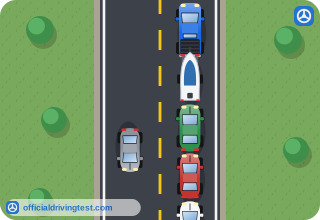
What should you do if vehicles are piled up behind you because you are driving slowly?
- Speed up to a little above the posted limit
- Stop in your lane and wave the drivers around you
- Pull over when it is safe to do so and let them pass
- Turn on your hazard lights and keep the same speed
Show answer
Correct answer: Pull over when it is safe to do so and let them pass
The manual tells you to pull over when safe and let the vehicles pass.
Source: Connecticut Driver's Manual (Revised March 2023), page 36 · Open this page in the manual (Manual page 36)
-
According to the manual, stopping suddenly usually points to what?
- A driver who was not paying attention
- A driver with a defective vehicle
- A driver who is new to the road
- A driver who is going too slowly
Show answer
Correct answer: A driver who was not paying attention
Sudden stops usually point to a driver who was not paying attention.
Source: Connecticut Driver's Manual (Revised March 2023), page 36 · Open this page in the manual (Manual page 36)
-
What could happen when you brake quickly?
- Your brakes will cool down faster
- You could skid and lose control of your vehicle
- Drivers behind you will find it easier to stop
- Your tires will grip the road better than usual
Show answer
Correct answer: You could skid and lose control of your vehicle
Quick braking can cause a skid and loss of control, and it makes it harder for drivers behind you to stop.
Source: Connecticut Driver's Manual (Revised March 2023), page 36 · Open this page in the manual (Manual page 36)
-
Where must you come to a complete stop?
- Only where a police officer is standing
- Only when other vehicles are approaching
- Only at a stop sign that is on a four-way stop
- At a stop sign or stop line
Show answer
Correct answer: At a stop sign or stop line
The manual says you must come to a complete stop at a stop sign or stop line.
Source: Connecticut Driver's Manual (Revised March 2023), page 36 · Open this page in the manual (Manual page 36)
-
If the pavement is dry and you have good tires and brakes, about how many feet can it take to react and stop at 50 mph?
- 400 feet
- 200 feet
- 300 feet
- 600 feet
Show answer
Correct answer: 400 feet
At 50 mph it can take about 400 feet, about the length of a city block.
Source: Connecticut Driver's Manual (Revised March 2023), page 36 · Open this page in the manual (Manual page 36)
-
If the pavement is dry and you have good tires and brakes, about how many feet can it take to stop at 30 mph?
- 100 feet
- 300 feet
- 200 feet
- 400 feet
Show answer
Correct answer: 200 feet
At 30 mph it can take about 200 feet, almost half a city block.
Source: Connecticut Driver's Manual (Revised March 2023), page 36 · Open this page in the manual (Manual page 36)
-
If you cannot see 400 feet ahead, what does that mean?
- You may not be driving safely at 30 mph
- You must stop and wait until the road clears
- You may not be driving safely at 50 mph
- You should switch on your high beams
Show answer
Correct answer: You may not be driving safely at 50 mph
With less than 400 feet of sight distance, 50 mph may be too fast to stop in time.
Source: Connecticut Driver's Manual (Revised March 2023), page 36 · Open this page in the manual (Manual page 36)
-
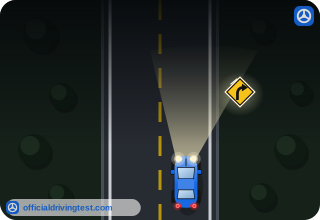
According to the manual, how far ahead do high beam headlights let you see at night?
- About 200 feet
- About 600 feet
- About 400 feet
- About 1,000 feet
Show answer
Correct answer: About 400 feet
The manual says high beams let you see about 400 feet ahead, and you should be able to stop within that distance.
Source: Connecticut Driver's Manual (Revised March 2023), page 38 · Open this page in the manual (Manual page 38)
-
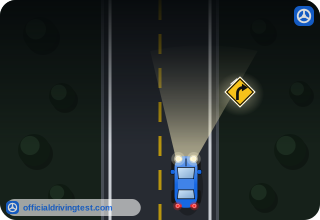
At night, you should drive at a speed that lets you stop within the distance your high beams show. About what speed is that?
- About 35 mph
- About 50 mph
- About 65 mph
- About 25 mph
Show answer
Correct answer: About 50 mph
Because high beams show about 400 feet ahead, the manual says to drive at about 50 mph so you can stop within that distance.
Source: Connecticut Driver's Manual (Revised March 2023), page 38 · Open this page in the manual (Manual page 38)
-
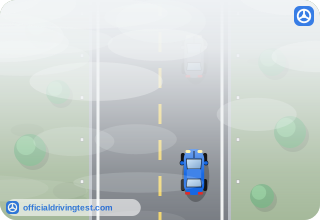
In a very heavy rain, snowstorm, or thick fog, about how far ahead may you be able to see?
- About 400 feet
- About 600 feet
- About 1,000 feet
- About 200 feet
Show answer
Correct answer: About 200 feet
The manual says that in very heavy rain, snowstorm, or thick fog you may not see much more than 200 feet ahead.
Source: Connecticut Driver's Manual (Revised March 2023), page 38 · Open this page in the manual (Manual page 38)
-
What should you do when you come to a hill or curve where you cannot see over or around it?
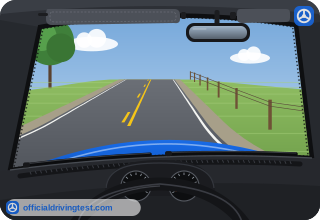
- Sound a sharp blast on your horn
- Speed up to clear the hill or curve quickly
- Adjust your speed so you can stop if necessary
- Move onto the shoulder
Show answer
Correct answer: Adjust your speed so you can stop if necessary
A vehicle may be stalled just over a hill or around a curve, so you must be able to stop.
Source: Connecticut Driver's Manual (Revised March 2023), page 38 · Open this page in the manual (Manual page 38)
-
According to the manual, when do skids happen?
- Only on roads covered with snow or ice
- Only when a driver brakes too softly
- Only at night
- When a driver travels too fast for conditions
Show answer
Correct answer: When a driver travels too fast for conditions
The manual says skids happen when a driver travels too fast for conditions.
Source: Connecticut Driver's Manual (Revised March 2023), page 40 · Open this page in the manual (Manual page 40)