Connecticut: Speed and following distance — Part 5 Practice Test
Questions in this part include: “In Connecticut, when are studded tires permitted?” · “On cold, wet days, which spots can be icy because they freeze first and dry out last?”
Independent educational site · not affiliated with any government agency or DMV
Ready? Test yourself
- Instant feedback with an explanation
- Every answer cites its source in the manual
- Your best score is saved on this device
Questions are original and based on the official manual "Connecticut Driver's Manual" (Revised March 2023), Connecticut Department of Motor Vehicles (DMV).
All 18 questions in this practice test
Take the test above first, then use this list to study. Tap “Show answer” to see the correct answer and explanation.
Show the questions and answersHide the questions
-
What happens if you go too fast in a curve?

- The tires grip better as the vehicle speeds up
- The steering gets lighter and easier to control
- The vehicle straightens and leaves the curve safely
- The tires cannot grip the road and the vehicle skids
Show answer
Correct answer: The tires cannot grip the road and the vehicle skids
The manual says that if you go too fast in a curve, the tires will not be able to grip the road and the vehicle will skid.
Source: Connecticut Driver's Manual (Revised March 2023), page 25 · Open this page in the manual (Manual page 25)
-
When should you slow down for a curve?
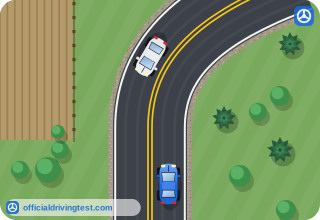
- Before entering it, so you need not brake in it
- Halfway through it, by braking firmly and steadily
- Only after the vehicle begins to skid in it
- At the end of it, by coasting out of it
Show answer
Correct answer: Before entering it, so you need not brake in it
The manual says to slow down before you enter the curve so you do not have to brake in the curve.
Source: Connecticut Driver's Manual (Revised March 2023), page 25 · Open this page in the manual (Manual page 25)
-
When should you slow down for rain, snow, or sleet?
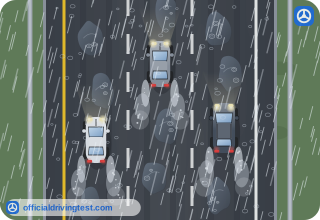
- Only once the road is completely covered
- At the first sign of it
- After your tires begin to slide
- When the temperature drops below freezing
Show answer
Correct answer: At the first sign of it
The manual says to slow down at the first sign of rain, snow, or sleet because they make the roadway slippery.
Source: Connecticut Driver's Manual (Revised March 2023), page 25 · Open this page in the manual (Manual page 25)
-
By about how much should you reduce your speed on a wet road?
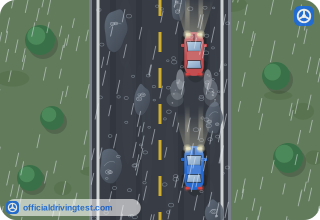
- 5 mph
- 20 mph
- 25 mph
- 10 mph
Show answer
Correct answer: 10 mph
The manual says to reduce your speed by about 10 mph on a wet road.
Source: Connecticut Driver's Manual (Revised March 2023), page 25 · Open this page in the manual (Manual page 25)
-
On packed snow, how much should you reduce your speed?

- Cut it in half
- Reduce it by about 10 mph
- Reduce it by about one third
- Reduce it by about 5 mph
Show answer
Correct answer: Cut it in half
The manual says to cut your speed in half on packed snow.
Source: Connecticut Driver's Manual (Revised March 2023), page 25 · Open this page in the manual (Manual page 25)
-
What should you use when the road has snow on it?

- Tires inflated below normal pressure
- Wider tires with extra tread
- Snow tires or chains
- Summer tires with extra air
Show answer
Correct answer: Snow tires or chains
The manual says to use snow tires or chains when the road has snow on it.
Source: Connecticut Driver's Manual (Revised March 2023), page 25 · Open this page in the manual (Manual page 25)
-
How slowly must you drive on ice?
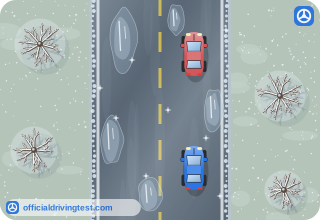
- Cut your speed in half
- Slow to a crawl
- Reduce your speed by about 10 mph
- Stay below 35 mph
Show answer
Correct answer: Slow to a crawl
The manual says that on ice you must slow to a crawl, and that it is very dangerous to drive on ice.
Source: Connecticut Driver's Manual (Revised March 2023), page 25 · Open this page in the manual (Manual page 25)
-
In Connecticut, when are studded tires permitted?
- October 1st through March 31st
- December 1st through March 15th
- November 1st through May 15th
- November 15th through April 30th
Show answer
Correct answer: November 15th through April 30th
The manual says studded tires are permitted in Connecticut from November 15th through April 30th.
Source: Connecticut Driver's Manual (Revised March 2023), page 25 · Open this page in the manual (Manual page 25)
-
On cold, wet days, which spots can be icy because they freeze first and dry out last?
- Shady spots
- Sunny spots
- Open straight stretches
- Spots under street lights
Show answer
Correct answer: Shady spots
The manual says shady spots can be icy on cold, wet days because they freeze first and dry out last.
Source: Connecticut Driver's Manual (Revised March 2023), page 25 · Open this page in the manual (Manual page 25)
-
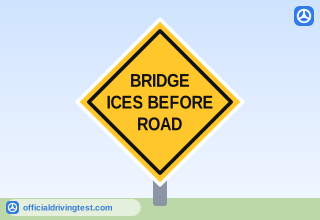
Why can the pavement on a bridge be icy even when other pavement is not?
- Bridges are built with a smoother surface than other roads
- Bridge pavement is never treated for winter weather
- Bridges have no earth underneath to insulate them from the cold
- Bridges sit lower than the roads around them and collect water
Show answer
Correct answer: Bridges have no earth underneath to insulate them from the cold
The manual says bridges lack earth underneath to insulate them, so they can be colder and icier than other roadways.
Source: Connecticut Driver's Manual (Revised March 2023), page 25 · Open this page in the manual (Manual page 25)
-
When is ice more slippery?

- Well below freezing, when it is hardest
- Around the freezing point, when it becomes wet
- Only while snow is actively falling
- Only after the sun has gone down
Show answer
Correct answer: Around the freezing point, when it becomes wet
The manual says ice that becomes wet near the freezing point is more slippery than ice well below freezing.
Source: Connecticut Driver's Manual (Revised March 2023), page 25 · Open this page in the manual (Manual page 25)
-
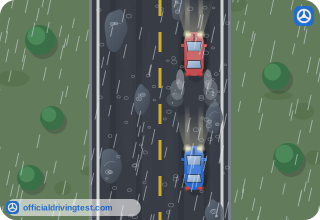
Why can pavement be more slippery in the first few minutes of rain on a hot day?
- The hot rain freezes on contact with the pavement
- The tires soften and cannot grip the road well
- The rain washes loose gravel onto the roadway
- Heat brings the oil in the asphalt to the surface
Show answer
Correct answer: Heat brings the oil in the asphalt to the surface
The manual says heat causes the oil in the asphalt to come to the surface, so the road is more slippery until the oil is washed off.
Source: Connecticut Driver's Manual (Revised March 2023), page 25 · Open this page in the manual (Manual page 25)
-
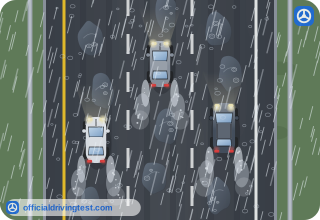
On a wet road, up to about what speed do most tires have good traction?
- 35 mph
- 25 mph
- 45 mph
- 55 mph
Show answer
Correct answer: 35 mph
The manual says most tires have good traction on a wet road up to about 35 mph.
Source: Connecticut Driver's Manual (Revised March 2023), page 25 · Open this page in the manual (Manual page 25)
-
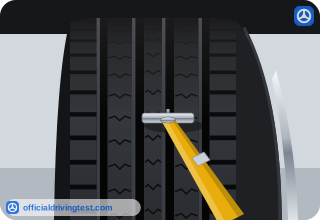
How do bald or badly worn tires behave on a wet road?
- They lose traction only above 55 mph
- They lose traction at much lower speeds
- They behave like tires in good condition
- They keep traction up to about 35 mph
Show answer
Correct answer: They lose traction at much lower speeds
The manual says bald or badly worn tires lose traction at much lower speeds.
Source: Connecticut Driver's Manual (Revised March 2023), page 25 · Open this page in the manual (Manual page 25)
-
What is the best way to keep from hydroplaning?
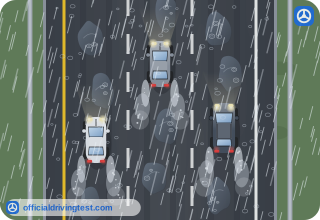
- Speed up slightly to push through the water
- Pump the brakes while you are driving
- Steer in short, quick movements
- Slow down in the rain or when the road is wet
Show answer
Correct answer: Slow down in the rain or when the road is wet
The manual says the best way to keep from hydroplaning is to slow down in the rain or when the road is wet.
Source: Connecticut Driver's Manual (Revised March 2023), page 25 · Open this page in the manual (Manual page 25)
-
What does the manual say to maintain to avoid the trouble caused by tailgating?
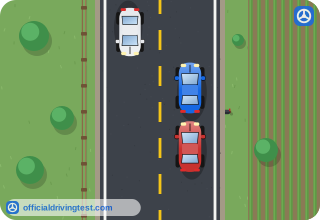
- Constant eye contact with the driver ahead
- A position close behind slower vehicles
- A safe distance from the vehicle in front of you
- The speed of the vehicle behind you
Show answer
Correct answer: A safe distance from the vehicle in front of you
The manual says to maintain a safe distance from the vehicle in front of you.
Source: Connecticut Driver's Manual (Revised March 2023), page 26 · Open this page in the manual (Manual page 26)
-
Which rule does the manual say to use at night so you are not “over-driving” your headlights?
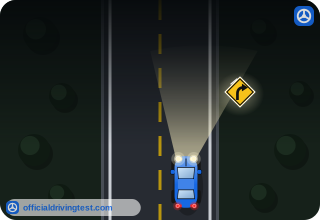
- The “ten-second scanning rule”
- The “six-second reaction rule”
- The “four-second sight-distance rule”
- The “eight-second stopping rule”
Show answer
Correct answer: The “four-second sight-distance rule”
The manual says to use the “four-second sight-distance rule” at night to avoid over-driving your headlights.
Source: Connecticut Driver's Manual (Revised March 2023), page 26 · Open this page in the manual (Manual page 26)
-
What following distance does the manual say to keep behind a distracted driver?
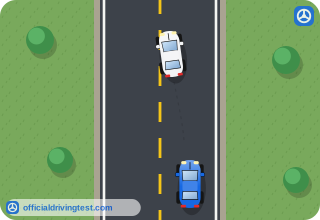
- 1 to 2 seconds
- 3 to 4 seconds
- 5 to 6 seconds
- Half a second
Show answer
Correct answer: 3 to 4 seconds
The manual says to give a distracted driver plenty of room and maintain a safe following distance of 3 to 4 seconds.
Source: Connecticut Driver's Manual (Revised March 2023), page 27 · Open this page in the manual (Manual page 27)