Connecticut: Speed and following distance — Part 4 Practice Test
Questions in this part include: “On a two-lane road, where is it generally safest to drive?” · “At a speed of 55 mph, about how long do you need to pass another vehicle?”
Independent educational site · not affiliated with any government agency or DMV
Ready? Test yourself
- Instant feedback with an explanation
- Every answer cites its source in the manual
- Your best score is saved on this device
Questions are original and based on the official manual "Connecticut Driver's Manual" (Revised March 2023), Connecticut Department of Motor Vehicles (DMV).
All 18 questions in this practice test
Take the test above first, then use this list to study. Tap “Show answer” to see the correct answer and explanation.
Show the questions and answersHide the questions
-
On a two-lane road, where is it generally safest to drive?
- In the center of your lane
- Close to the centerline
- Along the right edge of the road
- On the shoulder when it is clear
Show answer
Correct answer: In the center of your lane
The manual says to keep space from oncoming vehicles without crowding the centerline, and it is safest in the center of your lane.
Source: Connecticut Driver's Manual (Revised March 2023), page 22 · Open this page in the manual (Manual page 22)
-
On a roadway with two or more lanes, what should you do to make room for entering vehicles?
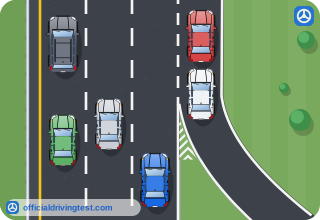
- Speed up to pass the entering vehicles
- Move over a lane if no one is next to you
- Stay in your lane and brake
- Move into the lane with the least space
Show answer
Correct answer: Move over a lane if no one is next to you
The manual says to move over a lane if there is no one next to you.
Source: Connecticut Driver's Manual (Revised March 2023), page 22 · Open this page in the manual (Manual page 22)
-
Why keep extra space between your vehicle and parked cars?
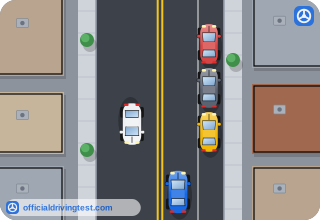
- Parked cars always have their doors wide open to traffic
- Parked cars can block the view of your turn signals ahead
- Parked cars lower the speed limit on residential streets
- Someone could step out or a parked vehicle could pull out
Show answer
Correct answer: Someone could step out or a parked vehicle could pull out
The manual says someone could step out from a parked vehicle or between vehicles, or a parked vehicle could pull out.
Source: Connecticut Driver's Manual (Revised March 2023), page 22 · Open this page in the manual (Manual page 22)
-
What does it mean to “split the difference” between two hazards?
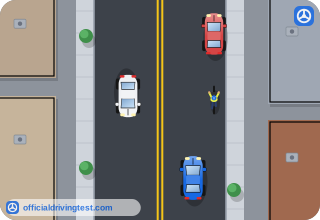
- Steer a middle course between them
- Drive faster to get past them
- Stop until both of them are gone
- Move toward the hazard farther away
Show answer
Correct answer: Steer a middle course between them
The manual says to steer a middle course, giving more space to the more dangerous side.
Source: Connecticut Driver's Manual (Revised March 2023), page 22 · Open this page in the manual (Manual page 22)
-
What should you do if you are driving slightly to the rear and on either side of another vehicle?
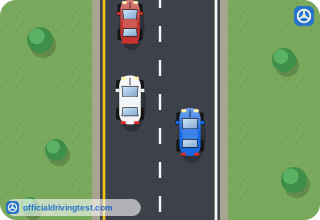
- Stay in that spot and keep watching the other driver
- Move closer to the other vehicle so it sees you
- Flash your lights and hold your position beside it
- Speed up or drop back so the other driver can see you
Show answer
Correct answer: Speed up or drop back so the other driver can see you
The manual says you will be in their blind spot, so speed up or drop back.
Source: Connecticut Driver's Manual (Revised March 2023), page 22 · Open this page in the manual (Manual page 22)
-
When passing another vehicle, how should you get through the other driver's blind spot?
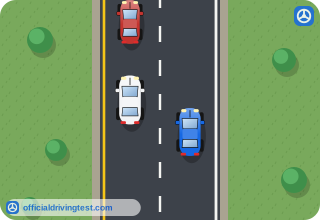
- As slowly as possible
- As quickly as you can
- By staying beside it for a while
- By matching its speed
Show answer
Correct answer: As quickly as you can
The manual says the longer you stay there, the longer you are in danger of the driver turning toward you.
Source: Connecticut Driver's Manual (Revised March 2023), page 22 · Open this page in the manual (Manual page 22)
-
Wherever people or traffic gather, what should you do?
- Lower your speed to have time to react
- Keep your speed to match other drivers
- Use your horn to clear a path
- Stay in the left lane
Show answer
Correct answer: Lower your speed to have time to react
The manual says room to maneuver is limited, so lower your speed to have time to react.
Source: Connecticut Driver's Manual (Revised March 2023), page 22 · Open this page in the manual (Manual page 22)
-
Why may you need to slow down at toll plazas?
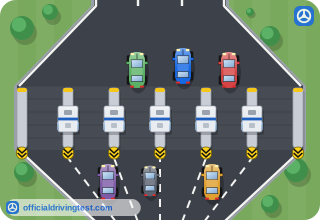
- Vehicles always have to stop there for several minutes
- Vehicles change lanes and stop and start; lanes can change
- The speed limit usually increases once you reach the plaza
- Toll plazas always have only one lane for all vehicles
Show answer
Correct answer: Vehicles change lanes and stop and start; lanes can change
The manual says vehicles are changing lanes, preparing to stop and speeding up again, and the lane count could change.
Source: Connecticut Driver's Manual (Revised March 2023), page 22 · Open this page in the manual (Manual page 22)
-
Why may you need to slow down on narrow bridges and in tunnels?
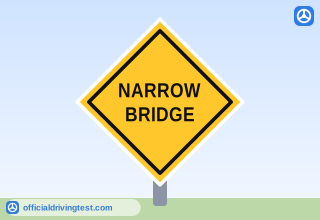
- The road surface is always icy in these locations
- Vehicles must come to a complete stop at the entrance
- Passing other vehicles is required in these places
- Vehicles approaching each other are closer together
Show answer
Correct answer: Vehicles approaching each other are closer together
The manual says vehicles approaching each other are closer together on narrow bridges and tunnels.
Source: Connecticut Driver's Manual (Revised March 2023), page 22 · Open this page in the manual (Manual page 22)
-
At a speed of 55 mph, about how long do you need to pass another vehicle?
- About 3 seconds
- About 5 seconds
- About 20 seconds
- About 10 seconds
Show answer
Correct answer: About 10 seconds
At 55 mph you need about 10 seconds to pass, so you need a 10-second opening in oncoming traffic.
Source: Connecticut Driver's Manual (Revised March 2023), page 23 · Open this page in the manual (Manual page 23)
-
At 55 mph, how far do you travel in 10 seconds?
- Over 800 feet
- About 200 feet
- About 400 feet
- Over 2,000 feet
Show answer
Correct answer: Over 800 feet
At 55 mph you will travel over 800 feet in 10 seconds, and so will an oncoming vehicle.
Source: Connecticut Driver's Manual (Revised March 2023), page 23 · Open this page in the manual (Manual page 23)
-
How far ahead should you be able to see on hills and curves?
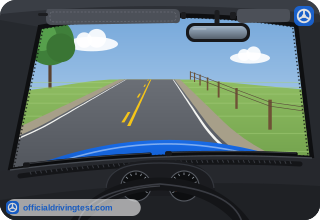
- At least 100 feet
- At least one-tenth of a mile
- At least one full mile
- At least one-third of a mile
Show answer
Correct answer: At least one-third of a mile
The manual says you have to be able to see at least one-third of a mile ahead.
Source: Connecticut Driver's Manual (Revised March 2023), page 24 · Open this page in the manual (Manual page 24)
-
When a curve or hill blocks your view, what should you assume?
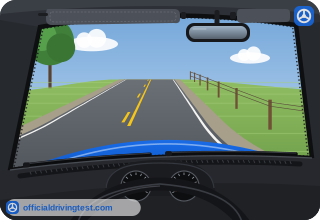
- An oncoming vehicle is just out of sight
- The road ahead is empty of traffic
- The speed limit is lower ahead
- Other drivers will move aside for you
Show answer
Correct answer: An oncoming vehicle is just out of sight
The manual says to assume an oncoming vehicle is just out of sight and to treat a curve or hill as an oncoming vehicle.
Source: Connecticut Driver's Manual (Revised March 2023), page 24 · Open this page in the manual (Manual page 24)
-
When should you not start to pass in relation to a hill or curve?
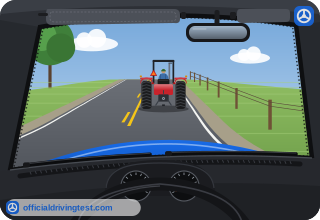
- When you are within 100 feet of it
- When you are within one mile of it
- When within one-third of a mile of it
- Only when you are on the hill itself
Show answer
Correct answer: When within one-third of a mile of it
You should treat a curve or hill as an oncoming vehicle, so do not start to pass within one-third of a mile of it.
Source: Connecticut Driver's Manual (Revised March 2023), page 24 · Open this page in the manual (Manual page 24)
-
Why should you check your mirrors when going down hills or mountains?
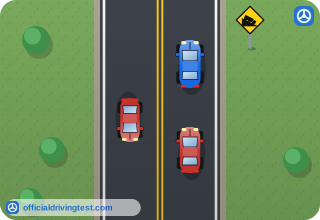
- Mirrors show the road signs that are far ahead of you
- Vehicles speed up downhill; trucks and buses may be too fast
- Vehicles in front always slow down on steep hills
- Other drivers must signal before going down hills
Show answer
Correct answer: Vehicles speed up downhill; trucks and buses may be too fast
The manual says to be alert for large trucks and buses that may be going too fast on a steep grade.
Source: Connecticut Driver's Manual (Revised March 2023), page 24 · Open this page in the manual (Manual page 24)
-
According to the manual, through what is your vehicle’s only contact with the road?
- The tires
- The suspension
- The steering wheel
- The brake pads
Show answer
Correct answer: The tires
The manual says the only contact the vehicle has with the road is through the tires.
Source: Connecticut Driver's Manual (Revised March 2023), page 25 · Open this page in the manual (Manual page 25)
-
Where does the manual tell you to look for the correct tire pressure?
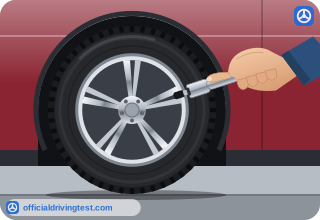
- At any DMV office
- On the tire’s tread wear bars
- In the vehicle owner’s manual
- On the speedometer
Show answer
Correct answer: In the vehicle owner’s manual
The manual says to see the vehicle owner’s manual for correct tire pressure.
Source: Connecticut Driver's Manual (Revised March 2023), page 25 · Open this page in the manual (Manual page 25)
-
How does driving on gravel or dirt differ from driving on concrete or asphalt?
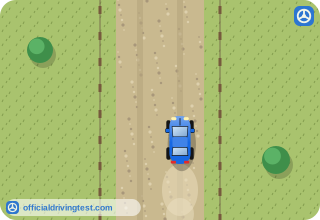
- You have more traction because the loose surface grips the tires
- You have less traction and skid more easily when turning
- Stopping takes less distance because the surface is soft
- Traction is the same, so no change in speed is needed
Show answer
Correct answer: You have less traction and skid more easily when turning
The manual says traction is lower on gravel or dirt, stopping takes much longer and it is easier to skid when turning, so you must slow down.
Source: Connecticut Driver's Manual (Revised March 2023), page 25 · Open this page in the manual (Manual page 25)