Connecticut: Speed and following distance — Part 3 Practice Test
Questions in this part include: “With the three-second rule, how close may you follow the vehicle ahead?” · “Where should you try to stop to pick up or let off passengers?”
Independent educational site · not affiliated with any government agency or DMV
Ready? Test yourself
- Instant feedback with an explanation
- Every answer cites its source in the manual
- Your best score is saved on this device
Questions are original and based on the official manual "Connecticut Driver's Manual" (Revised March 2023), Connecticut Department of Motor Vehicles (DMV).
All 19 questions in this practice test
Take the test above first, then use this list to study. Tap “Show answer” to see the correct answer and explanation.
Show the questions and answersHide the questions
-
The three-second rule shows that you are following too closely. What do you do next?
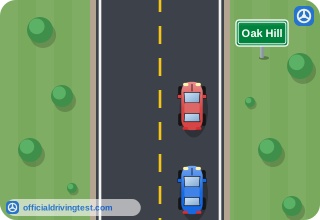
- Speed up to pass the vehicle ahead
- Drop back and count again at another spot
- Keep your distance and stop counting
- Move onto the shoulder and stop
Show answer
Correct answer: Drop back and count again at another spot
The manual says to drop back and count again at another spot to check the new following distance.
Source: Connecticut Driver's Manual (Revised March 2023), page 21 · Open this page in the manual (Manual page 21)
-
With the three-second rule, how close may you follow the vehicle ahead?
- No closer than one second
- No closer than two seconds
- No closer than three seconds
- No closer than ten seconds
Show answer
Correct answer: No closer than three seconds
The manual says to repeat until you are following no closer than three seconds.
Source: Connecticut Driver's Manual (Revised March 2023), page 21 · Open this page in the manual (Manual page 21)
-
In the manual, how many seconds of following distance may you need in some situations, such as on slippery roads?
- Four seconds
- Two seconds
- Six seconds
- Eight seconds
Show answer
Correct answer: Four seconds
The manual says that in certain situations you may need a four-second following distance to be safe.
Source: Connecticut Driver's Manual (Revised March 2023), page 21 · Open this page in the manual (Manual page 21)
-
Why must you leave more space in front of you on slippery roads?
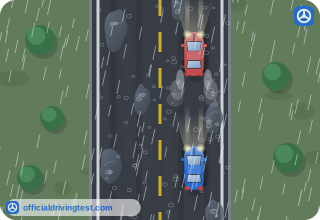
- Slippery roads make vehicles slower to start
- You need more distance to stop your vehicle
- Other drivers will pass you more often
- Your headlights shine less far ahead
Show answer
Correct answer: You need more distance to stop your vehicle
The manual says you need more distance to stop on slippery roads, so you must leave more space in front.
Source: Connecticut Driver's Manual (Revised March 2023), page 21 · Open this page in the manual (Manual page 21)
-
A car behind you wants to pass. To keep a space cushion, what should you do?
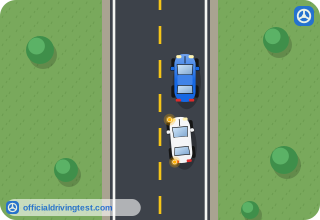
- Speed up to stay ahead of the driver
- Move to the center of the road
- Brake hard to signal the driver to stay back
- Slow down to allow room in front of your vehicle
Show answer
Correct answer: Slow down to allow room in front of your vehicle
The manual says slowing down allows room in front of you and lets the pass be completed sooner.
Source: Connecticut Driver's Manual (Revised March 2023), page 21 · Open this page in the manual (Manual page 21)
-
You are being followed closely. What should you do?
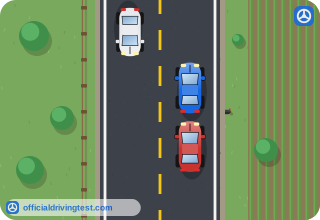
- Speed up to increase the gap between you and the other car
- Pull to the right and allow the vehicle behind you to pass
- Brake quickly to warn the other driver to back off
- Move to the left lane and slow down until it passes
Show answer
Correct answer: Pull to the right and allow the vehicle behind you to pass
The manual says to pull to the right and let the vehicle behind you pass.
Source: Connecticut Driver's Manual (Revised March 2023), page 21 · Open this page in the manual (Manual page 21)
-
Why do you need a longer following distance when pulling a trailer?
- A trailer blocks your rearview mirror
- A trailer reduces your turning radius
- Trailers must stay below the speed of traffic
- The extra weight increases your stopping distance
Show answer
Correct answer: The extra weight increases your stopping distance
The manual says the extra weight increases your stopping distance.
Source: Connecticut Driver's Manual (Revised March 2023), page 21 · Open this page in the manual (Manual page 21)
-
What should you do when it is hard to see ahead because of darkness or bad weather?
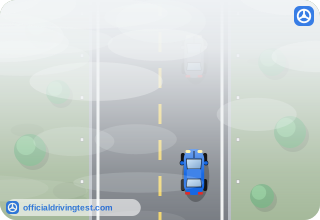
- Follow closely to use the lights ahead
- Keep your following distance the same
- Drive in the center of the road
- Increase your following distance
Show answer
Correct answer: Increase your following distance
The manual says low visibility calls for a longer following distance.
Source: Connecticut Driver's Manual (Revised March 2023), page 21 · Open this page in the manual (Manual page 21)
-
Why leave extra space behind a vehicle stopped on a hill or incline?
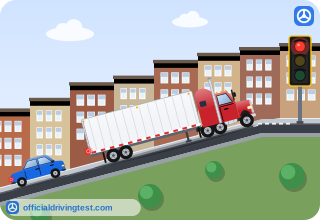
- It may roll back when it starts up
- Its brake lights may not work uphill
- It may be waiting for a train
- It must make a turn at the top
Show answer
Correct answer: It may roll back when it starts up
The manual says the vehicle ahead may roll back when it starts up.
Source: Connecticut Driver's Manual (Revised March 2023), page 21 · Open this page in the manual (Manual page 21)
-
How can you help keep the driver behind you at a safe distance?
- Drive in the center of the road and never change lanes at all
- Keep a steady speed and signal in advance when you slow down or turn
- Tap your brakes often to warn the driver behind you of danger
- Flash your headlights at the driver behind you every so often
Show answer
Correct answer: Keep a steady speed and signal in advance when you slow down or turn
The manual says a steady speed and early signals help keep the driver behind at a safe distance.
Source: Connecticut Driver's Manual (Revised March 2023), page 22 · Open this page in the manual (Manual page 22)
-
Where should you try to stop to pick up or let off passengers?
- In the nearest travel lane
- Next to the center line
- At the next intersection
- In a safe place out of traffic
Show answer
Correct answer: In a safe place out of traffic
The manual says to try to find a safe place out of traffic to stop.
Source: Connecticut Driver's Manual (Revised March 2023), page 22 · Open this page in the manual (Manual page 22)
-
You have to drive so slowly that you slow down other vehicles. What should you do?
- Speed up until you are well ahead of all of them
- Stay in the lane and signal for them to go around
- Pull to the side of the road when safe and let them pass
- Stop in the lane to let them go around you
Show answer
Correct answer: Pull to the side of the road when safe and let them pass
The manual says to pull to the side when it is safe and let them pass.
Source: Connecticut Driver's Manual (Revised March 2023), page 22 · Open this page in the manual (Manual page 22)
-
What areas on some two-lane roads can you use to let faster traffic pass?
- Turnout areas
- Rest stops
- Median strips
- Weigh stations
Show answer
Correct answer: Turnout areas
The manual says some two-lane roads have turnout areas, and others have passing lanes.
Source: Connecticut Driver's Manual (Revised March 2023), page 22 · Open this page in the manual (Manual page 22)
-
When should you always check behind your vehicle?
- Only when you plan to pass
- Only on roads with several lanes
- Whenever you slow down or stop
- Only when you hear a horn
Show answer
Correct answer: Whenever you slow down or stop
The manual says to always check behind whenever you slow down or stop.
Source: Connecticut Driver's Manual (Revised March 2023), page 22 · Open this page in the manual (Manual page 22)
-
Where is checking behind most important when you slow down?
- On roads that have a wide shoulder next to the travel lanes
- Where drivers would not expect it, such as driveways or parking spaces
- At long straight sections of highway with clear visibility
- In rural areas where there is hardly any other traffic around
Show answer
Correct answer: Where drivers would not expect it, such as driveways or parking spaces
The manual names private driveways and parking spaces, where following drivers do not expect you to slow.
Source: Connecticut Driver's Manual (Revised March 2023), page 22 · Open this page in the manual (Manual page 22)
-
You are being tailgated and there is a right lane. What should you do?
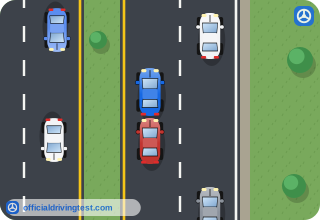
- Move over to the left
- Slow down quickly
- Speed up and stay ahead
- Move over to the right
Show answer
Correct answer: Move over to the right
The manual says that if there is a right lane, you should move over to the right.
Source: Connecticut Driver's Manual (Revised March 2023), page 22 · Open this page in the manual (Manual page 22)
-
You are being tailgated and there is no right lane. What does the manual advise?
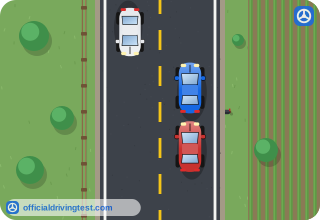
- Brake hard to make the tailgater back off from your vehicle
- Move onto the shoulder at once and wait for it to pass
- Speed up to leave the tailgater far behind your vehicle
- Wait until the road ahead is clear, then reduce speed slowly
Show answer
Correct answer: Wait until the road ahead is clear, then reduce speed slowly
The manual says to wait until the road ahead is clear, then reduce speed slowly so the tailgater drives around you.
Source: Connecticut Driver's Manual (Revised March 2023), page 22 · Open this page in the manual (Manual page 22)
-
Why should you never slow down quickly to discourage a tailgater?
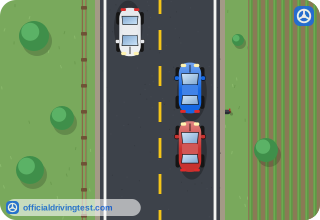
- It makes your brake lights flash for the other driver
- It increases your risk of being hit from behind
- It is a traffic violation for the vehicle following you
- It always makes the tailgater speed up and pass you
Show answer
Correct answer: It increases your risk of being hit from behind
The manual says slowing quickly increases your risk of being hit from behind.
Source: Connecticut Driver's Manual (Revised March 2023), page 22 · Open this page in the manual (Manual page 22)
-
On a multi-lane road, what should you do about driving next to other vehicles?
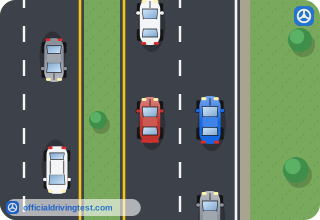
- Stay beside them so that you can keep pace with traffic
- Drive next to them because it saves fuel on long trips
- Avoid it, and move ahead of or drop behind the other vehicle
- Stay next to a truck, since trucks make the road safer
Show answer
Correct answer: Avoid it, and move ahead of or drop behind the other vehicle
The manual says someone may crowd your lane or pull into you, so move ahead of or drop behind the other vehicle.
Source: Connecticut Driver's Manual (Revised March 2023), page 22 · Open this page in the manual (Manual page 22)