Connecticut: Speed and following distance — Part 2 Practice Test
Questions in this part include: “What is the shortest time interval at which you should ever follow a truck?” · “How much time does the manual say speeding saves?”
Independent educational site · not affiliated with any government agency or DMV
Ready? Test yourself
- Instant feedback with an explanation
- Every answer cites its source in the manual
- Your best score is saved on this device
Questions are original and based on the official manual "Connecticut Driver's Manual" (Revised March 2023), Connecticut Department of Motor Vehicles (DMV).
All 19 questions in this practice test
Take the test above first, then use this list to study. Tap “Show answer” to see the correct answer and explanation.
Show the questions and answersHide the questions
-
What is the shortest time interval at which you should ever follow a truck?
- Three seconds
- One second
- Two seconds
- Five seconds
Show answer
Correct answer: Three seconds
The manual says never to follow a truck at a time interval of less than three seconds.
Source: Connecticut Driver's Manual (Revised March 2023), page 20 · Open this page in the manual (Manual page 20)
-
After the rear of a truck passes a landmark, you pass the same landmark before finishing counting “three-one-thousand.” What does this mean?
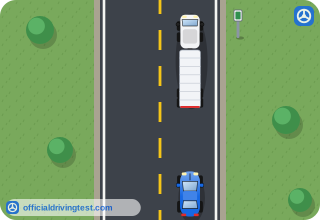
- You are following at the recommended interval
- You are following too far behind
- You are following the truck too closely
- You should change lanes right away
Show answer
Correct answer: You are following the truck too closely
Passing the point before finishing the count means you are following the truck too closely.
Source: Connecticut Driver's Manual (Revised March 2023), page 20 · Open this page in the manual (Manual page 20)
-
When do you begin counting to check your following distance behind a truck?
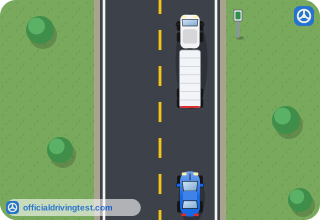
- When the front of the truck passes the landmark
- When the rear of the truck passes a landmark
- When the truck’s brake lights come on
- When your own vehicle passes the landmark
Show answer
Correct answer: When the rear of the truck passes a landmark
You pick a landmark on the side of the road and start counting when the rear of the truck passes it.
Source: Connecticut Driver's Manual (Revised March 2023), page 20 · Open this page in the manual (Manual page 20)
-
Why are you “driving blind” if you follow a truck closely?
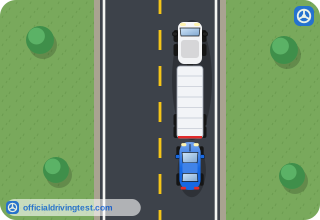
- Its tires throw up dust and water that cover your headlights
- The truck’s headlights shine into your mirrors and blind you
- Its driver can see you, but you cannot see its brake lights
- You can’t see around it and its driver can’t see you in the mirrors
Show answer
Correct answer: You can’t see around it and its driver can’t see you in the mirrors
If you follow a truck closely, you can’t see around it and the truck driver can’t see you in the mirrors.
Source: Connecticut Driver's Manual (Revised March 2023), page 20 · Open this page in the manual (Manual page 20)
-
What may happen if you edge out to the left to see whether there is room to pass a truck you are following closely?
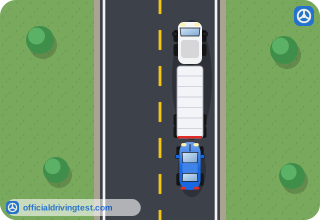
- You may find yourself face-to-face with an oncoming vehicle
- The truck driver will move to the right to let you pass
- You will always have a clear view of the road beyond the truck
- The truck’s wind will pull you safely past it
Show answer
Correct answer: You may find yourself face-to-face with an oncoming vehicle
Edging out may put you face-to-face with an oncoming vehicle that you could have seen had you followed at a safe distance.
Source: Connecticut Driver's Manual (Revised March 2023), page 20 · Open this page in the manual (Manual page 20)
-
What hazard might you hit if you follow a truck too closely, one the truck has safely passed over?
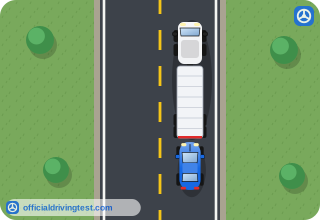
- Ice on the road
- A traffic cone
- A pothole or debris
- A stopped vehicle
Show answer
Correct answer: A pothole or debris
You may hit a pothole or debris that the truck has safely passed over.
Source: Connecticut Driver's Manual (Revised March 2023), page 20 · Open this page in the manual (Manual page 20)
-
What is the benefit of keeping more distance between yourself and other road users?
- Faster travel time
- A wider travel lane
- Better headlight range
- More time to react
Show answer
Correct answer: More time to react
The more distance you keep, the more time you have to react; the space acts like a safety cushion.
Source: Connecticut Driver's Manual (Revised March 2023), page 20 · Open this page in the manual (Manual page 20)
-
How large an opening do you need any time you want to merge with other traffic?
- About one second
- About two seconds
- About six seconds
- About four seconds
Show answer
Correct answer: About four seconds
Any time you merge with other traffic you need an opening of about four seconds.
Source: Connecticut Driver's Manual (Revised March 2023), page 20 · Open this page in the manual (Manual page 20)
-
If you move into the middle of a four-second opening, what following distance do you and the vehicle behind you each have?
- Two seconds
- One second
- Three seconds
- Four seconds
Show answer
Correct answer: Two seconds
In the middle of a four-second opening, you and the vehicle behind you each have a two-second following distance.
Source: Connecticut Driver's Manual (Revised March 2023), page 20 · Open this page in the manual (Manual page 20)
-
When do you need an opening of about four seconds?
- When you are driving straight in your lane at a steady speed
- When you are stopped at a red light in your lane
- When your lane merges with another travel lane
- When you are slowing down behind a stopped car
Show answer
Correct answer: When your lane merges with another travel lane
A four-second opening is needed when you change lanes or enter a roadway and when your lane merges with another travel lane.
Source: Connecticut Driver's Manual (Revised March 2023), page 20 · Open this page in the manual (Manual page 20)
-
Why should you not try to merge into an opening that is too small?
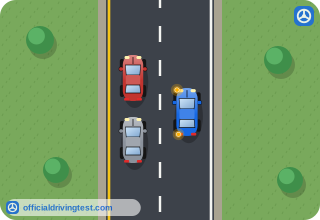
- Other drivers are required to stop for a small opening
- A small opening can quickly become even smaller
- Other drivers cannot see you in a small opening
- You will have to speed up to the limit to use it
Show answer
Correct answer: A small opening can quickly become even smaller
A small opening can quickly become even smaller, so enter one that gives you a big enough space cushion.
Source: Connecticut Driver's Manual (Revised March 2023), page 20 · Open this page in the manual (Manual page 20)
-
How much time does the manual say speeding saves?
- No more than a few minutes an hour
- About half an hour for every hour
- An hour or more on a long trip
- Several minutes for every mile driven
Show answer
Correct answer: No more than a few minutes an hour
The manual says speeding does not save more than a few minutes an hour.
Source: Connecticut Driver's Manual (Revised March 2023), page 21 · Open this page in the manual (Manual page 21)
-
According to the manual, when do crashes involving two or more vehicles often happen?
- When all drivers travel at the same speed in one direction
- When drivers keep a large gap behind the car ahead of them
- When drivers go faster or slower than other vehicles on the road
- When drivers always stay in the right-hand lane on the road
Show answer
Correct answer: When drivers go faster or slower than other vehicles on the road
The manual says such crashes often happen when drivers go faster or slower than the other vehicles.
Source: Connecticut Driver's Manual (Revised March 2023), page 21 · Open this page in the manual (Manual page 21)
-
What happens if you drive faster than the traffic around you?
- You will reach every exit ramp before the other drivers do
- You will have to keep passing others, and each pass risks a collision
- You will be able to avoid passing any other vehicles on the road
- You will no longer need to watch for oncoming vehicles ahead
Show answer
Correct answer: You will have to keep passing others, and each pass risks a collision
Going faster than traffic means you keep passing others, and each pass is a chance for a collision.
Source: Connecticut Driver's Manual (Revised March 2023), page 21 · Open this page in the manual (Manual page 21)
-
On a road that has exit ramps, when should you slow down to leave the road?
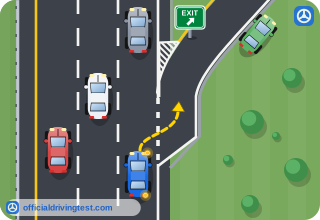
- As soon as you see the exit sign
- A half mile before the exit
- When you first put on your turn signal
- Only once you have moved onto the exit ramp
Show answer
Correct answer: Only once you have moved onto the exit ramp
The manual says to keep up with traffic and not slow down until you move onto the exit ramp.
Source: Connecticut Driver's Manual (Revised March 2023), page 21 · Open this page in the manual (Manual page 21)
-
You turn from a high-speed, two-lane roadway with traffic following you. What does the manual advise?
- Begin slowing gradually well ahead of the turn to warn the drivers behind
- Coast to a stop before reaching the turn and then proceed slowly
- Stay in the center of the road until you are ready to make the turn
- Do not slow down too early; tap your brakes and reduce speed quickly but safely
Show answer
Correct answer: Do not slow down too early; tap your brakes and reduce speed quickly but safely
The manual says to try not to slow down too early and to tap your brakes and reduce speed quickly but safely.
Source: Connecticut Driver's Manual (Revised March 2023), page 21 · Open this page in the manual (Manual page 21)
-
What causes rear-end crashes, which are very common?
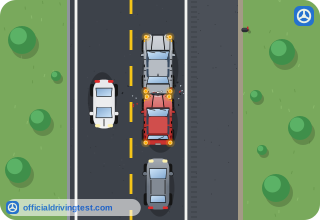
- Drivers who slow down too early before reaching an exit ramp on the road
- Drivers following too closely to stop when the vehicle ahead suddenly stops
- Drivers leaving too much room between them and the vehicle in front
- Drivers who use their turn signals too early before a lane change
Show answer
Correct answer: Drivers following too closely to stop when the vehicle ahead suddenly stops
The manual says drivers who follow too closely cannot stop before hitting the vehicle ahead.
Source: Connecticut Driver's Manual (Revised March 2023), page 21 · Open this page in the manual (Manual page 21)
-
What is the first step of the three-second rule?
- Look at your speedometer and write down your current speed
- Count the seconds before the vehicle ahead puts on its brakes
- Measure the gap between the two vehicles in car lengths ahead
- Watch for the rear of the vehicle ahead to pass a sign or pole
Show answer
Correct answer: Watch for the rear of the vehicle ahead to pass a sign or pole
The manual says to watch for when the rear of the vehicle ahead passes a stationary point such as a sign or pole.
Source: Connecticut Driver's Manual (Revised March 2023), page 21 · Open this page in the manual (Manual page 21)
-
How do you know you are following too closely using the three-second rule?
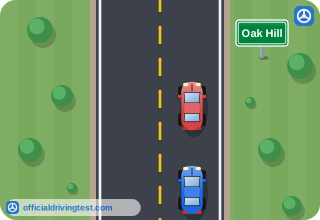
- You pass the mark after counting to five
- The vehicle ahead is not visible
- The vehicle ahead passes the mark before you count
- You pass the mark before you finish counting
Show answer
Correct answer: You pass the mark before you finish counting
The manual says you are following too closely if you pass the mark before you finish counting.
Source: Connecticut Driver's Manual (Revised March 2023), page 21 · Open this page in the manual (Manual page 21)