Connecticut: Speed and following distance — Part 1 Practice Test
Questions in this part include: “During the road test, what kind of "space cushion" should you maintain around your vehicle?” · “Why does making driving changes early help the drivers behind you?”
Independent educational site · not affiliated with any government agency or DMV
Ready? Test yourself
- Instant feedback with an explanation
- Every answer cites its source in the manual
- Your best score is saved on this device
Questions are original and based on the official manual "Connecticut Driver's Manual" (Revised March 2023), Connecticut Department of Motor Vehicles (DMV).
All 19 questions in this practice test
Take the test above first, then use this list to study. Tap “Show answer” to see the correct answer and explanation.
Show the questions and answersHide the questions
-
During the road test, what kind of "space cushion" should you maintain around your vehicle?
- A fixed space of one car length, whatever the speed or road
- The smallest gap that still lets traffic keep moving smoothly
- One suited to the existing speed, road and traffic conditions
- A larger gap only when another vehicle is behind you
Show answer
Correct answer: One suited to the existing speed, road and traffic conditions
The space cushion should be appropriate for the existing speed, road, and traffic conditions.
Source: Connecticut Driver's Manual (Revised March 2023), page 7 · Open this page in the manual (Manual page 7)
-
To be a good driver and know what is happening around your vehicle, which directions must you look?
- Only ahead and behind
- Only ahead and to the sides
- Only straight ahead
- Ahead, to the sides, and behind
Show answer
Correct answer: Ahead, to the sides, and behind
The manual says you must look ahead, to the sides, and behind your vehicle.
Source: Connecticut Driver's Manual (Revised March 2023), page 14 · Open this page in the manual (Manual page 14)
-
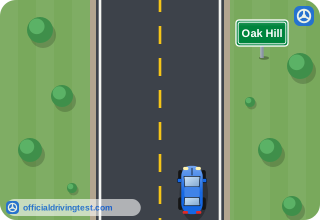
Safer drivers tend to look at least how many seconds ahead of their vehicles?
- 12 seconds
- 3 seconds
- 5 seconds
- 20 seconds
Show answer
Correct answer: 12 seconds
The manual says safer drivers tend to look at least 12 seconds ahead.
Source: Connecticut Driver's Manual (Revised March 2023), page 14 · Open this page in the manual (Manual page 14)
-
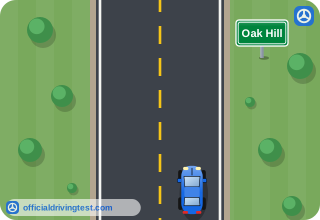
In the city, about how far ahead is 12 seconds?
- About four city blocks
- About a quarter of a mile
- About one block
- About half a block
Show answer
Correct answer: About one block
In the city, 12 seconds is about one block.
Source: Connecticut Driver's Manual (Revised March 2023), page 14 · Open this page in the manual (Manual page 14)
-
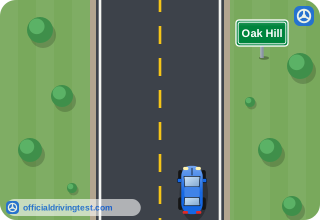
On the highway, about how far ahead is 12 seconds?
- About one city block
- About four city blocks, or a quarter of a mile
- About two city blocks, or an eighth of a mile
- About eight city blocks, or half a mile
Show answer
Correct answer: About four city blocks, or a quarter of a mile
On the highway, 12 seconds is about four city blocks, or a quarter of a mile.
Source: Connecticut Driver's Manual (Revised March 2023), page 14 · Open this page in the manual (Manual page 14)
-
To figure how far ahead you are looking, what kind of object should you find near the road?
- A moving vehicle ahead of you, such as a truck
- A car that is passing you
- The vehicle directly in front of you
- A non-moving object, such as a sign or a telephone pole
Show answer
Correct answer: A non-moving object, such as a sign or a telephone pole
The manual says to find a non-moving object (a sign, a telephone pole, etc.) about as far ahead as you are looking.
Source: Connecticut Driver's Manual (Revised March 2023), page 14 · Open this page in the manual (Manual page 14)
-
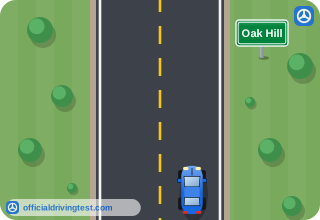
You count “one-one-thousand, two-one-thousand” until you reach the object. What does the number you counted tell you?
- How many seconds ahead you were looking
- How fast the vehicle ahead is traveling
- How long your stopping distance is
- How many seconds until the signal changes
Show answer
Correct answer: How many seconds ahead you were looking
The number of seconds you counted is the number of seconds ahead that you were looking.
Source: Connecticut Driver's Manual (Revised March 2023), page 14 · Open this page in the manual (Manual page 14)
-
Why does looking well ahead help you save fuel?
- You can drive in a higher gear on every road
- You can coast with the engine off
- You avoid unnecessary braking and quick stops
- You can avoid using the headlights
Show answer
Correct answer: You avoid unnecessary braking and quick stops
The manual says drivers who look ahead avoid unnecessary braking, which leads to lower miles-per-gallon.
Source: Connecticut Driver's Manual (Revised March 2023), page 14 · Open this page in the manual (Manual page 14)
-
Looking well down the road helps you steer in what way?
- With more frequent corrections
- More straightly with less weaving
- With greater speed
- With less need to check mirrors
Show answer
Correct answer: More straightly with less weaving
The manual says looking well down the road helps you steer more straightly with less weaving.
Source: Connecticut Driver's Manual (Revised March 2023), page 14 · Open this page in the manual (Manual page 14)
-
Why does making driving changes early help the drivers behind you?
- It lets them follow more closely
- It lets them pass you sooner
- It removes their need to scan ahead
- It gives them more time to react
Show answer
Correct answer: It gives them more time to react
Making changes early gives drivers behind you more time to react.
Source: Connecticut Driver's Manual (Revised March 2023), page 14 · Open this page in the manual (Manual page 14)
-
When is it especially important to look to the sides?
- At intersections and railroad crossings
- On long straight highways with no traffic
- While parked in a driveway
- On roads with no side streets
Show answer
Correct answer: At intersections and railroad crossings
The manual says looking to the sides is especially important at intersections and railroad crossings, or while changing lanes.
Source: Connecticut Driver's Manual (Revised March 2023), page 14 · Open this page in the manual (Manual page 14)
-
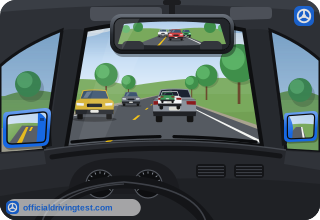
When do you need to check the traffic behind you more often?
- When traffic is light
- When driving on a straight road
- When traffic is heavy
- When driving at night
Show answer
Correct answer: When traffic is heavy
The manual says you need to check more often when traffic is heavy.
Source: Connecticut Driver's Manual (Revised March 2023), page 14 · Open this page in the manual (Manual page 14)
-
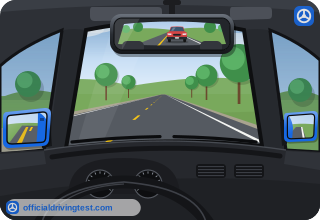
Checking behind you is the only way to know what?
- If a vehicle ahead is about to turn at the corner
- If someone is following too closely or coming up too fast
- If the road ahead is slippery or covered with ice
- If a traffic signal ahead is about to change
Show answer
Correct answer: If someone is following too closely or coming up too fast
Checking behind is the only way you will know if someone is following too closely or coming up too fast.
Source: Connecticut Driver's Manual (Revised March 2023), page 14 · Open this page in the manual (Manual page 14)
-
In which situation is it very important to look for vehicles behind you?
- When driving on a flat, empty road
- When parked with the engine off
- When stopped at a red light with no one around
- When driving down a long or steep hill
Show answer
Correct answer: When driving down a long or steep hill
The manual says it is very important to look behind when you change lanes, slow down, back up or drive down a long or steep hill.
Source: Connecticut Driver's Manual (Revised March 2023), page 14 · Open this page in the manual (Manual page 14)
-
In which situation should you always increase your following distance?
- On dry roads in full daylight
- In areas of poor illumination
- On roads you know very well
- When traffic is light and slow
Show answer
Correct answer: In areas of poor illumination
The manual says to always increase your following distance when road or weather conditions are bad, in areas of poor illumination, and in unfamiliar areas.
Source: Connecticut Driver's Manual (Revised March 2023), page 18 · Open this page in the manual (Manual page 18)
-
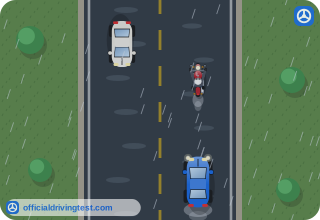
How much following distance should you allow behind a motorcyclist in wet conditions?
- 1 to 2 seconds at most
- 2 to 3 seconds at most
- One car length per 10 mph
- 3 to 4 seconds or more
Show answer
Correct answer: 3 to 4 seconds or more
When following a motorcyclist, allow a 3 to 4 second following distance or more in wet conditions.
Source: Connecticut Driver's Manual (Revised March 2023), page 18 · Open this page in the manual (Manual page 18)
-
To be sure you are not driving too fast for conditions, at what speed should you drive?
- At the speed of the traffic around you
- At the posted speed limit at all times
- At a speed where you can always safely stop
- At a speed that matches the vehicle ahead
Show answer
Correct answer: At a speed where you can always safely stop
The manual says to drive at a speed where you can always safely stop.
Source: Connecticut Driver's Manual (Revised March 2023), page 18 · Open this page in the manual (Manual page 18)
-
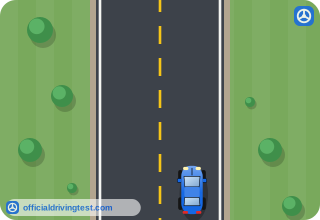
What does it mean if you reach a stationary object ahead before you finish counting “four-one-thousand”?
- You are following the vehicle ahead too closely
- You are going too fast for your sight-distance
- You are driving at a safe speed
- You should speed up to keep pace
Show answer
Correct answer: You are going too fast for your sight-distance
Under the four-second sight-distance rule, reaching the object before you finish counting means you need to slow down because you are going too fast for your sight-distance.
Source: Connecticut Driver's Manual (Revised March 2023), page 18 · Open this page in the manual (Manual page 18)
-
What do you pick out when you use the four-second sight-distance rule?
- A moving vehicle as far ahead as you can see
- A landmark exactly four seconds ahead of you
- The bumper of the car directly in front of you
- A stationary object as far ahead as you clearly see
Show answer
Correct answer: A stationary object as far ahead as you clearly see
You pick out a stationary object, such as a sign or a telephone pole, as far ahead as you can clearly see and then count “one-one-thousand” through “four-one-thousand.”
Source: Connecticut Driver's Manual (Revised March 2023), page 18 · Open this page in the manual (Manual page 18)