Connecticut: Signals and vehicle controls — Part 4 Practice Test
Questions in this part include: “If your vehicle has an anti-theft alarm, what should you learn to do?” · “If you turn your headlights on a little early when it begins to get dark, what does it do?”
Independent educational site · not affiliated with any government agency or DMV
Ready? Test yourself
- Instant feedback with an explanation
- Every answer cites its source in the manual
- Your best score is saved on this device
Questions are original and based on the official manual "Connecticut Driver's Manual" (Revised March 2023), Connecticut Department of Motor Vehicles (DMV).
All 19 questions in this practice test
Take the test above first, then use this list to study. Tap “Show answer” to see the correct answer and explanation.
Show the questions and answersHide the questions
-
What should you do with your headlights for oncoming traffic?
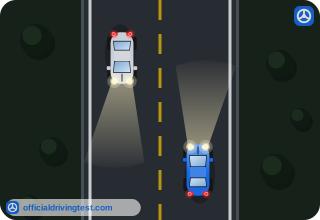
- Switch to high beam
- Flash them
- Turn them off
- Dim them
Show answer
Correct answer: Dim them
The manual says to dim your lights for oncoming traffic.
Source: Connecticut Driver's Manual (Revised March 2023), page 26 · Open this page in the manual (Manual page 26)
-
An oncoming driver uses high beams. What does the manual say about your response?
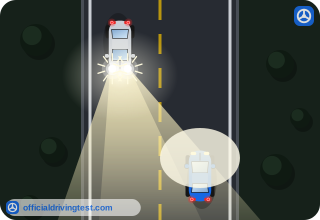
- Do not retaliate with your own high beams
- Keep your high beams on until the other driver dims
- Switch to high beam so you can see past the glare
- Turn your headlights off until the vehicle passes
Show answer
Correct answer: Do not retaliate with your own high beams
The manual says not to retaliate to oncoming high beams with your own to “teach them a lesson.”
Source: Connecticut Driver's Manual (Revised March 2023), page 26 · Open this page in the manual (Manual page 26)
-
If your vehicle has an anti-theft alarm, what should you learn to do?
- Set it to sound louder
- Arm it from a distance
- Turn it off quickly
- Switch it to silent mode
Show answer
Correct answer: Turn it off quickly
The manual says to learn how to turn an anti-theft alarm off quickly.
Source: Connecticut Driver's Manual (Revised March 2023), page 26 · Open this page in the manual (Manual page 26)
-
When buying an anti-theft alarm, which kind should you select?
- One that keeps sounding until it is reset
- One that turns off after a short period
- One with the loudest siren available
- One that sounds only when the horn is pressed
Show answer
Correct answer: One that turns off after a short period
The manual says to select an alarm that turns off after a short period of time.
Source: Connecticut Driver's Manual (Revised March 2023), page 26 · Open this page in the manual (Manual page 26)
-
When should you use your right turn signal in a roundabout?
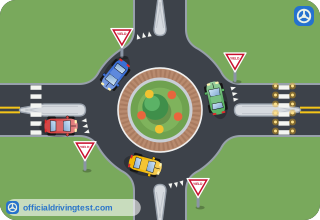
- When you are about to reach your intended exit point
- As you first enter the roundabout
- Never, because you are only driving in a circle
- Only when you pass the first exit
Show answer
Correct answer: When you are about to reach your intended exit point
Signal right as you are about to reach your exit point.
Source: Connecticut Driver's Manual (Revised March 2023), page 37 · Open this page in the manual (Manual page 37)
-
Under Connecticut law, what must you do when you turn on your windshield wipers?
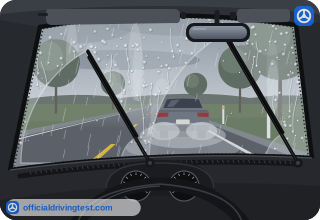
- Turn on your headlights too
- Turn on your high beams
- Turn on your hazard flashers
- Slow down to 25 mph
Show answer
Correct answer: Turn on your headlights too
The manual says that if you turn on your wipers, you must turn on your headlights, and it adds “It’s the law.”
Source: Connecticut Driver's Manual (Revised March 2023), page 38 · Open this page in the manual (Manual page 38)
-
When are parking lights meant to be used?
- When it begins to get dark
- When driving in light fog
- Only on parked vehicles
- When following another vehicle
Show answer
Correct answer: Only on parked vehicles
The manual says parking lights are for parked vehicles only, and you should never drive with only your parking lights on.
Source: Connecticut Driver's Manual (Revised March 2023), page 38 · Open this page in the manual (Manual page 38)
-
Why does the manual tell you to turn on your headlights when driving away from a rising or setting sun?
- The sun may make your own dashboard lights hard to read
- Drivers coming toward you may have trouble seeing your vehicle
- Your low beams are needed to see the road ahead of you
- Oncoming drivers must be warned to dim their high beams
Show answer
Correct answer: Drivers coming toward you may have trouble seeing your vehicle
Headlights help oncoming drivers see your vehicle when the sun is low behind you.
Source: Connecticut Driver's Manual (Revised March 2023), page 38 · Open this page in the manual (Manual page 38)
-
If you turn your headlights on a little early when it begins to get dark, what does it do?
- It saves energy for the battery
- It lets you use your high beams earlier
- It makes your parking lights unnecessary
- It helps other drivers see you
Show answer
Correct answer: It helps other drivers see you
The manual says that even if you turn them on a little early, you will help other drivers see you.
Source: Connecticut Driver's Manual (Revised March 2023), page 38 · Open this page in the manual (Manual page 38)
-
While driving, what does the manual say you can do with your headlights, if necessary, to tell other road users you are there?
- Flash your high beams
- Turn on your parking lights only
- Turn on your interior dome light
- Tap your brake pedal four times
Show answer
Correct answer: Flash your high beams
The manual says that if necessary you should flash your high beams to tell other road users you are there.
Source: Connecticut Driver's Manual (Revised March 2023), page 38 · Open this page in the manual (Manual page 38)
-
How much farther do high beams let you see than low beams?
- One and a half times as far
- Three times as far
- Twice as far
- The same distance, but brighter
Show answer
Correct answer: Twice as far
The manual states that high beams let you see twice as far as low beams.
Source: Connecticut Driver's Manual (Revised March 2023), page 38 · Open this page in the manual (Manual page 38)
-
About how close to an oncoming vehicle should you dim your high beams?
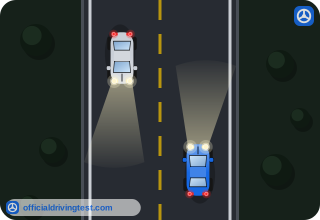
- About two blocks
- About half a block
- About one mile
- About one block
Show answer
Correct answer: About one block
The manual tells you to dim high beams whenever you come within about a one-block distance of an oncoming vehicle.
Source: Connecticut Driver's Manual (Revised March 2023), page 38 · Open this page in the manual (Manual page 38)
-
Which headlight setting should you use when following another vehicle or when in heavy traffic?
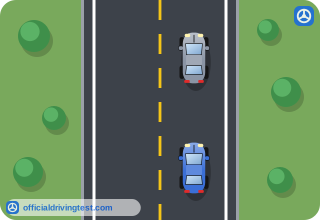
- Low beams
- High beams
- Parking lights only
- Fog lights only
Show answer
Correct answer: Low beams
The manual says to use your low beams when following another vehicle or when in heavy traffic.
Source: Connecticut Driver's Manual (Revised March 2023), page 38 · Open this page in the manual (Manual page 38)
-
Why should you use low beams instead of high beams in fog or when it is snowing or raining hard?
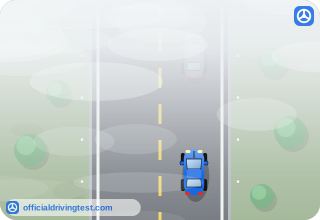
- Low beams light the road twice as far
- High beams drain the battery in wet weather
- High beam light reflects back and causes glare
- Low beams are required whenever wipers are off
Show answer
Correct answer: High beam light reflects back and causes glare
Light from high beams reflects back, causing glare and making it harder to see ahead.
Source: Connecticut Driver's Manual (Revised March 2023), page 38 · Open this page in the manual (Manual page 38)
-
A vehicle comes toward you with its high beams on. What should you do first?
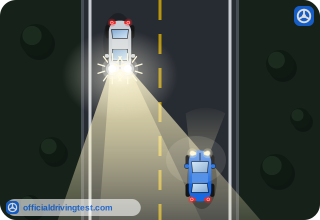
- Keep your high beams on until it dims
- Flash your headlights a couple of times
- Sound a sharp blast on your horn
- Slow down and stop on the shoulder
Show answer
Correct answer: Flash your headlights a couple of times
The manual says to flash your headlights quickly a couple of times to signal the other driver to dim.
Source: Connecticut Driver's Manual (Revised March 2023), page 38 · Open this page in the manual (Manual page 38)
-
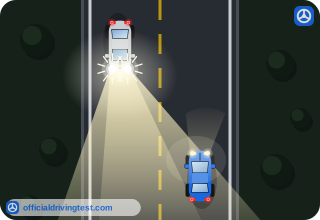
An oncoming driver fails to dim high beams after you flash your headlights. Where should you look?
- Toward the center line
- Directly at the oncoming headlights
- Down at your dashboard
- Toward the right side of the road
Show answer
Correct answer: Toward the right side of the road
Looking toward the right side of the road keeps you from being blinded and lets you see the edge of the road to stay on course.
Source: Connecticut Driver's Manual (Revised March 2023), page 38 · Open this page in the manual (Manual page 38)
-
Why should you not try to “get back” at another driver by keeping your bright lights on?
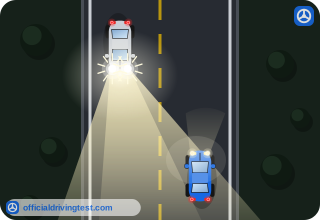
- Both of you may be blinded
- It is illegal to use high beams at night
- It will make the other driver turn off their lights
- It will damage your headlights
Show answer
Correct answer: Both of you may be blinded
The manual warns that if you keep your bright lights on to get back at another driver, both of you may be blinded.
Source: Connecticut Driver's Manual (Revised March 2023), page 38 · Open this page in the manual (Manual page 38)
-
If there is no immediate danger, how should you use your horn?
- Sound a sharp blast
- Give it a light tap
- Hold it down for several seconds
- Not use it at all
Show answer
Correct answer: Give it a light tap
The manual says that if there is no immediate danger, a light tap on the horn should be all you need.
Source: Connecticut Driver's Manual (Revised March 2023), page 38 · Open this page in the manual (Manual page 38)
-
When should you give your horn a light tap?
- A child is about to run into the street
- You have lost control and are moving toward someone
- Another vehicle is in danger of hitting you
- A person on foot or on a bike moves into your lane
Show answer
Correct answer: A person on foot or on a bike moves into your lane
A light tap is for a person on foot or on a bike who appears to be moving into your lane of travel.
Source: Connecticut Driver's Manual (Revised March 2023), page 38 · Open this page in the manual (Manual page 38)