Connecticut: Signals and vehicle controls — Part 3 Practice Test
Questions in this part include: “In some vehicles with a manual transmission, what must you do to start them?” · “After you have finished a lane change, what should you do with your signal?”
Independent educational site · not affiliated with any government agency or DMV
Ready? Test yourself
- Instant feedback with an explanation
- Every answer cites its source in the manual
- Your best score is saved on this device
Questions are original and based on the official manual "Connecticut Driver's Manual" (Revised March 2023), Connecticut Department of Motor Vehicles (DMV).
All 19 questions in this practice test
Take the test above first, then use this list to study. Tap “Show answer” to see the correct answer and explanation.
Show the questions and answersHide the questions
-
In some vehicles with a manual transmission, what must you do to start them?
- Press the accelerator fully
- Depress the clutch
- Release the parking brake
- Turn on the headlights
Show answer
Correct answer: Depress the clutch
The manual says that in some vehicles the clutch must be depressed to start.
Source: Connecticut Driver's Manual (Revised March 2023), page 14 · Open this page in the manual (Manual page 14)
-
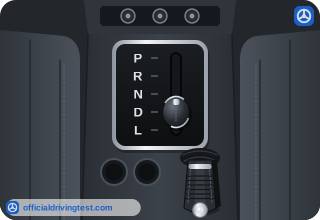
For a vehicle with an automatic transmission, where must the shift selector be to start it?
- Neutral
- Drive
- Low
- Park
Show answer
Correct answer: Park
The manual says you must put the shift selector in “park”.
Source: Connecticut Driver's Manual (Revised March 2023), page 14 · Open this page in the manual (Manual page 14)
-
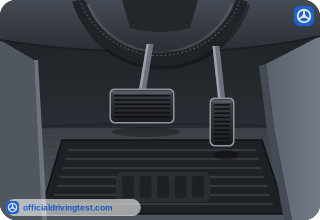
How should you accelerate?
- Gradually and smoothly
- Quickly at first, then gradually
- As fast as the engine allows
- In short, hard bursts
Show answer
Correct answer: Gradually and smoothly
The manual says to accelerate gradually and smoothly.
Source: Connecticut Driver's Manual (Revised March 2023), page 14 · Open this page in the manual (Manual page 14)
-
On slippery surfaces, what can trying to start too fast cause?

- The tires to gain extra grip on the surface
- The brakes to lock automatically
- The drive wheels to spin and the vehicle to slide
- The steering wheel to lock
Show answer
Correct answer: The drive wheels to spin and the vehicle to slide
Starting too fast can make the drive wheels spin and the vehicle slide, especially on slippery surfaces.
Source: Connecticut Driver's Manual (Revised March 2023), page 14 · Open this page in the manual (Manual page 14)
-
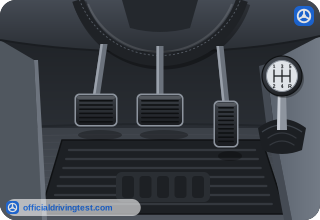
In a manual-shift vehicle, why should you practice using the clutch and accelerator together?
- So the parking brake can be used less often
- So the engine does not over accelerate or stall
- So the vehicle can be started while in gear
- So the brakes are not needed on hills
Show answer
Correct answer: So the engine does not over accelerate or stall
The manual says to practice so the engine does not over accelerate or stall when shifting between gears.
Source: Connecticut Driver's Manual (Revised March 2023), page 14 · Open this page in the manual (Manual page 14)
-
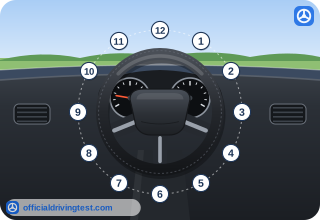
Where should your hands be placed on the steering wheel?
- Both hands at the top of the wheel between 11 and 1 o’clock
- Left hand between 6 and 8 o’clock, right hand between 4 and 6 o’clock
- Left hand between 10 and 12 o’clock, right hand between 12 and 2 o’clock
- Left hand between 8 and 10 o’clock, right hand between 2 and 4 o’clock
Show answer
Correct answer: Left hand between 8 and 10 o’clock, right hand between 2 and 4 o’clock
The manual gives left hand between 8 and 10 o’clock and right hand between 2 and 4 o’clock, on opposite sides of the wheel.
Source: Connecticut Driver's Manual (Revised March 2023), page 14 · Open this page in the manual (Manual page 14)
-
On high-speed roads, what does the recommended hand position on the steering wheel allow you to do?
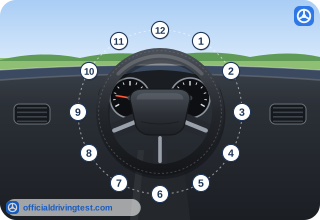
- Make turns without taking your hands from the wheel
- Steer with one hand while resting the other
- Turn the wheel without looking at the road
- Brake without using your foot
Show answer
Correct answer: Make turns without taking your hands from the wheel
The manual says this position allows turns on high-speed roads without taking your hands from the wheel.
Source: Connecticut Driver's Manual (Revised March 2023), page 14 · Open this page in the manual (Manual page 14)
-
Which technique should you use to turn the steering wheel when turning sharp corners?
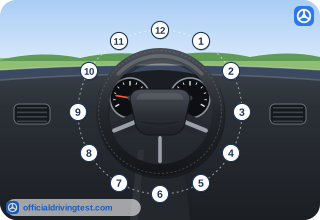
- Palm-to-palm turning
- One-handed turning
- Hand-over-hand
- Letting the wheel slide through your fingers
Show answer
Correct answer: Hand-over-hand
The manual says to use the "hand-over-hand" technique for sharp corners.
Source: Connecticut Driver's Manual (Revised March 2023), page 14 · Open this page in the manual (Manual page 14)
-
What does the manual say about letting the steering wheel slip through your fingers to straighten it after a turn?
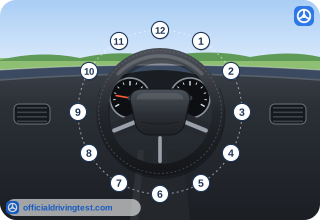
- It is the best way to straighten the wheel
- It could be dangerous
- It is allowed only on highways
- It saves effort on slow turns
Show answer
Correct answer: It could be dangerous
You should straighten the wheel by hand; letting it slip through your fingers could be dangerous.
Source: Connecticut Driver's Manual (Revised March 2023), page 14 · Open this page in the manual (Manual page 14)
-
In the Push/Pull steering method, which way should the driver’s knuckles face?
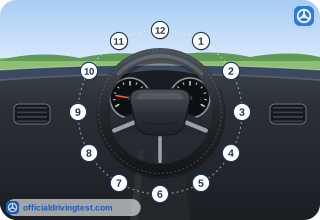
- Inward
- Upward
- Downward
- Outward
Show answer
Correct answer: Outward
The manual says knuckles should be facing outward in the Push/Pull method.
Source: Connecticut Driver's Manual (Revised March 2023), page 14 · Open this page in the manual (Manual page 14)
-
In the Push/Pull method, to which position do you first push one hand, letting the wheel slide through the other hand?
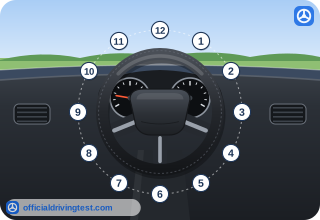
- 12 o’clock
- 3 o’clock
- 6 o’clock
- 9 o’clock
Show answer
Correct answer: 12 o’clock
The manual says to push one hand to the 12 o’clock position.
Source: Connecticut Driver's Manual (Revised March 2023), page 14 · Open this page in the manual (Manual page 14)
-
In the Push/Pull method, after pushing a hand to 12 o’clock, where do you bring that hand before pulling down?
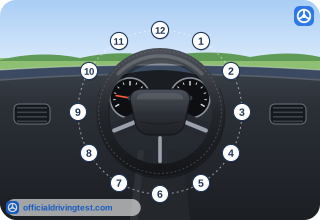
- To the 3 or 9 o’clock position
- To the 4 or 8 o’clock position
- To the 1 or 11 o’clock position
- To the 6 o’clock position
Show answer
Correct answer: To the 1 or 11 o’clock position
The manual says to bring that hand to the 1 or 11 o’clock position and then pull down.
Source: Connecticut Driver's Manual (Revised March 2023), page 14 · Open this page in the manual (Manual page 14)
-
When the Push/Pull method is done correctly, what do the two hands do?
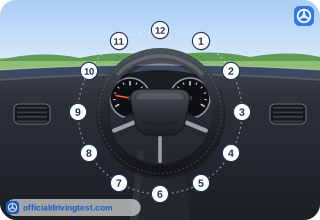
- Cross at the top of the wheel each time
- Never cross and stay on the wheel at all times
- Leave the wheel briefly between pushes
- Stay at 8 and 4 o’clock without moving
Show answer
Correct answer: Never cross and stay on the wheel at all times
Done correctly, the two hands will never cross and will remain on the wheel at all times.
Source: Connecticut Driver's Manual (Revised March 2023), page 14 · Open this page in the manual (Manual page 14)
-
When must you use your headlights?
- Only when it is raining outside
- At night and when it is hard to see
- Only after midnight until dawn
- Only on roads without street lights
Show answer
Correct answer: At night and when it is hard to see
The manual says you must use your headlights at night and at other times when it’s hard to see.
Source: Connecticut Driver's Manual (Revised March 2023), page 24 · Open this page in the manual (Manual page 24)
-
Before you switch lanes, what does the manual say you must not fail to do?
- Sound your horn
- Signal your intention first
- Flash your headlights
- Turn on your hazard lights
Show answer
Correct answer: Signal your intention first
The manual says not to switch lanes without first signaling your intention, and not to cut someone off.
Source: Connecticut Driver's Manual (Revised March 2023), page 26 · Open this page in the manual (Manual page 26)
-
After you have finished a lane change, what should you do with your signal?
- Leave it on for several seconds
- Flash it once more
- Leave it on until the next turn
- Turn it off
Show answer
Correct answer: Turn it off
The manual says to turn your signal off after you have made the maneuver.
Source: Connecticut Driver's Manual (Revised March 2023), page 26 · Open this page in the manual (Manual page 26)
-
To get someone’s attention in a non-emergency situation, how should you use your horn?
- Sound it in two long blasts
- Hold it down until they respond
- Tap it lightly
- Sound it three times in a row
Show answer
Correct answer: Tap it lightly
The manual says to use the horn sparingly and, in a non-emergency, to tap it lightly.
Source: Connecticut Driver's Manual (Revised March 2023), page 26 · Open this page in the manual (Manual page 26)
-
What does the manual say about your horn when the light turns green?
- Tap it once to let the driver ahead know it has turned green
- Do not blow it at the driver ahead as soon as it turns green
- Sound it twice if the driver ahead has not moved
- Hold it briefly so that the driver ahead moves
Show answer
Correct answer: Do not blow it at the driver ahead as soon as it turns green
The manual says not to blow your horn at the driver in front of you the second the light turns green, because a stressed-out motorist may be set off.
Source: Connecticut Driver's Manual (Revised March 2023), page 26 · Open this page in the manual (Manual page 26)
-
Why does the manual say to think twice before using your horn to say “hello” to a pedestrian?
- Pedestrians may mistake the sound for an emergency
- Using the horn near pedestrians is against state law
- The horn may startle drivers in the next lane
- The driver ahead may think you are honking at them
Show answer
Correct answer: The driver ahead may think you are honking at them
The manual says the driver in front of you may think you are honking at him or her.
Source: Connecticut Driver's Manual (Revised March 2023), page 26 · Open this page in the manual (Manual page 26)