Connecticut: Sharing the road — Part 4 Practice Test
Bicyclists, motorcycles, large trucks and their No-Zones, buses, horses and other road users. — Part 4
Independent educational site · not affiliated with any government agency or DMV
Ready? Test yourself
- Instant feedback with an explanation
- Every answer cites its source in the manual
- Your best score is saved on this device
Questions are original and based on the official manual "Connecticut Driver's Manual" (Revised March 2023), Connecticut Department of Motor Vehicles (DMV).
All 31 questions in this practice test
Take the test above first, then use this list to study. Tap “Show answer” to see the correct answer and explanation.
Show the questions and answersHide the questions
-
Where is the chance of a motorcycle falling greatest?
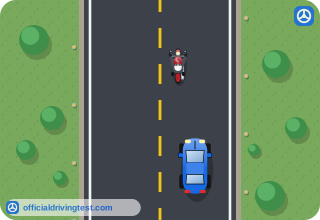
- On dry, smooth pavement in good daylight and clear weather
- On freshly painted road markings in the center of the lane
- On metal surfaces such as bridges, gratings and railroad tracks
- On straight roads that have little or no other traffic
Show answer
Correct answer: On metal surfaces such as bridges, gratings and railroad tracks
The manual lists wet and icy roads, gravel roads, and metal surfaces such as bridges, gratings and tracks.
Source: Connecticut Driver's Manual (Revised March 2023), page 21 · Open this page in the manual (Manual page 21)
-
Why should you drop back when following a truck, bus or van?
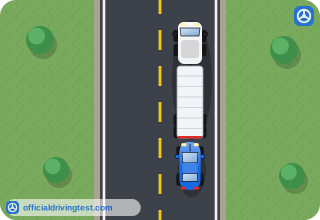
- The driver may stop suddenly without knowing you are there
- Large vehicles always travel more slowly than other traffic
- Their exhaust makes it hard for you to breathe safely
- Their drivers expect you to stay as close behind as possible
Show answer
Correct answer: The driver may stop suddenly without knowing you are there
The manual says drivers of such vehicles may not see you directly behind them and could stop suddenly.
Source: Connecticut Driver's Manual (Revised March 2023), page 21 · Open this page in the manual (Manual page 21)
-
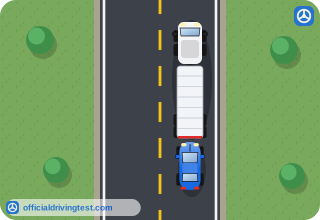
Besides the driver not seeing you, what does falling back behind a large vehicle give you?
- Better fuel economy overall
- A louder horn signal for others
- More room to see ahead
- A faster way to pass the truck
Show answer
Correct answer: More room to see ahead
The manual says large vehicles block your view ahead and falling back gives you more room to see.
Source: Connecticut Driver's Manual (Revised March 2023), page 21 · Open this page in the manual (Manual page 21)
-
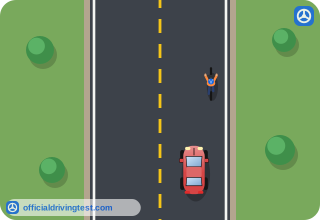
If you want to pass a pedestrian or bicyclist, what should you do?
- Sound your horn close to them so they move to the edge
- Pass on the shoulder as soon as you come up behind them
- Wait until it is safe to pass in the adjoining lane
- Squeeze past within the same lane when no cars are coming
Show answer
Correct answer: Wait until it is safe to pass in the adjoining lane
The manual says not to share a lane with a pedestrian or bicyclist and to pass in the adjoining lane when safe.
Source: Connecticut Driver's Manual (Revised March 2023), page 22 · Open this page in the manual (Manual page 22)
-
An oncoming vehicle is a tractor-trailer. How should you split the difference?
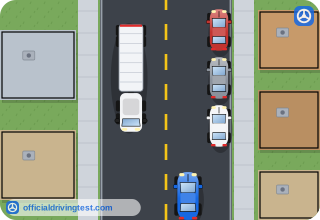
- Leave a little more room on the parked car side
- Move closer to the centerline
- Leave a little more room on the side the truck will pass
- Drive directly in line with the truck
Show answer
Correct answer: Leave a little more room on the side the truck will pass
The manual says to leave a little more room on the side that the truck will pass.
Source: Connecticut Driver's Manual (Revised March 2023), page 22 · Open this page in the manual (Manual page 22)
-
You are overtaking a bicycle and an oncoming vehicle is approaching. What should you do?
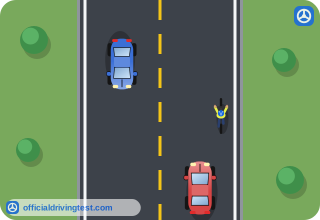
- Pass the bicycle at once before the vehicle arrives
- Slow down and let the oncoming vehicle pass first
- Pass the bicycle while next to the oncoming vehicle
- Speed up and use your horn to warn both of them
Show answer
Correct answer: Slow down and let the oncoming vehicle pass first
The manual says to take hazards one at a time: let the oncoming vehicle pass first so you can give extra room to the bicycle.
Source: Connecticut Driver's Manual (Revised March 2023), page 22 · Open this page in the manual (Manual page 22)
-
Why should you never stay alongside a large vehicle such as a truck or bus?
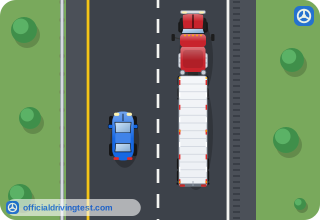
- It always changes lanes without giving any warning
- Its driver can always see you in the side mirrors
- It has large blind spots and its driver may not see you
- It always takes up more than one full lane of traffic
Show answer
Correct answer: It has large blind spots and its driver may not see you
The manual says these vehicles have large blind spots and it is hard for their drivers to see you.
Source: Connecticut Driver's Manual (Revised March 2023), page 22 · Open this page in the manual (Manual page 22)
-
How much space must you allow between your vehicle and a bicycle when you pass it?
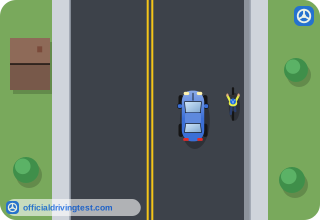
- 3 feet
- 1 foot
- 2 feet
- 5 feet
Show answer
Correct answer: 3 feet
The manual says you must allow 3 feet between your vehicle and a bicycle when passing a bicycle.
Source: Connecticut Driver's Manual (Revised March 2023), page 23 · Open this page in the manual (Manual page 23)
-
What should you never do right after you pass a bicyclist?
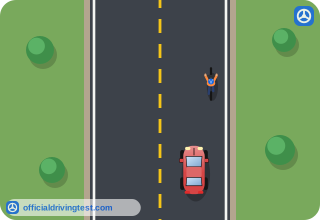
- Signal
- Turn right
- Slow down
- Check your mirrors
Show answer
Correct answer: Turn right
The manual says never to turn right immediately after passing a bicyclist.
Source: Connecticut Driver's Manual (Revised March 2023), page 24 · Open this page in the manual (Manual page 24)
-
When you turn and a bicycle is present, how should you treat it?
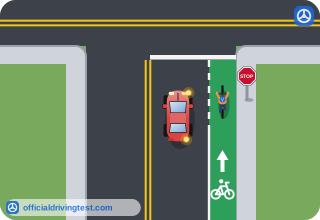
- Sound your horn so it moves aside
- Pass it before turning, since it is slower
- Treat it as a pedestrian
- Yield to it as you would to any other road vehicle
Show answer
Correct answer: Yield to it as you would to any other road vehicle
The manual says to yield to bicycles when turning as you would to any other road vehicle.
Source: Connecticut Driver's Manual (Revised March 2023), page 24 · Open this page in the manual (Manual page 24)
-
Which of these people may enter your path without knowing you are there?
- A driver who has just checked mirrors and signaled
- A pedestrian waiting at a crosswalk who is looking at you
- A driver stopped behind you with clear windows
- A driver whose windows are covered with snow or ice
Show answer
Correct answer: A driver whose windows are covered with snow or ice
The manual lists drivers with covered or steamed-up windows among those who could have trouble seeing you.
Source: Connecticut Driver's Manual (Revised March 2023), page 24 · Open this page in the manual (Manual page 24)
-
Which of these people could have trouble seeing you?
- Pedestrians with umbrellas in front of their faces
- Pedestrians who are standing still on the sidewalk
- Drivers who have just passed you in traffic
- Pedestrians who are looking directly at you
Show answer
Correct answer: Pedestrians with umbrellas in front of their faces
The manual lists pedestrians with umbrellas in front of their faces or hats pulled down as people who may not see you.
Source: Connecticut Driver's Manual (Revised March 2023), page 24 · Open this page in the manual (Manual page 24)
-
What does the manual say about parked vehicles?
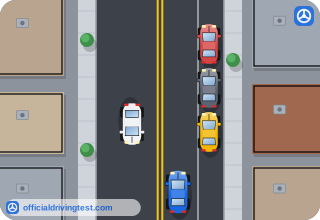
- Pass them as closely as possible
- Sound your horn when passing them
- Give them as much room as you can
- Stay in the center of the road beside them
Show answer
Correct answer: Give them as much room as you can
People may get out of a vehicle or walk out from between parked vehicles, so give parked vehicles as much room as you can.
Source: Connecticut Driver's Manual (Revised March 2023), page 24 · Open this page in the manual (Manual page 24)
-
Aggressive driving can evolve into violent behavior known as what?
- Road fatigue
- Highway hypnosis
- Road tension
- Road rage
Show answer
Correct answer: Road rage
The manual says aggressive driving can evolve into violent behavior known as “road rage.”
Source: Connecticut Driver's Manual (Revised March 2023), page 25 · Open this page in the manual (Manual page 25)
-
Which statement about aggressive driving does the manual make?
- It can occur sometimes without the driver even knowing it
- It happens only when the driver intends to be hostile
- It affects only the driver who behaves aggressively
- It is limited to new drivers with little experience
Show answer
Correct answer: It can occur sometimes without the driver even knowing it
The manual says aggressive driving can occur without the driver knowing it, yet it affects others on the road.
Source: Connecticut Driver's Manual (Revised March 2023), page 25 · Open this page in the manual (Manual page 25)
-
Which responsibility does the manual name as one that comes with the privilege of driving?
- Showing assertiveness
- Defending your space
- Self-control
- Teaching other drivers lessons
Show answer
Correct answer: Self-control
The manual says driving is a privilege with responsibilities, and one of them is self-control.
Source: Connecticut Driver's Manual (Revised March 2023), page 25 · Open this page in the manual (Manual page 25)
-
Which of these does the manual give as a reason for the increase in aggressive driving and road rage?
- Lower speed limits on most highways
- Increased traffic congestion on roads
- More courtesy among drivers
- Better training of new drivers
Show answer
Correct answer: Increased traffic congestion on roads
The manual lists increased traffic congestion on roads among the reasons for more incidents.
Source: Connecticut Driver's Manual (Revised March 2023), page 25 · Open this page in the manual (Manual page 25)
-
Which of these does the manual give as a reason for the increase in aggressive driving incidents?
- More older drivers who react slowly in traffic
- Fewer drivers who use their horns
- Wider lanes that invite higher speeds
- More youths drive but lack maturity when tense
Show answer
Correct answer: More youths drive but lack maturity when tense
The manual lists more youths operating vehicles without the maturity to drive responsibly in tense situations as a reason.
Source: Connecticut Driver's Manual (Revised March 2023), page 25 · Open this page in the manual (Manual page 25)
-
What does a sense of “territory” lead some drivers to presume?
- That they own the space around their vehicles
- That other drivers must always yield to them
- That the lane belongs to whoever got there first
- That the shoulder is reserved for their use
Show answer
Correct answer: That they own the space around their vehicles
The manual says a sense of territory leads people to presume they own the space around themselves and their vehicles.
Source: Connecticut Driver's Manual (Revised March 2023), page 26 · Open this page in the manual (Manual page 26)
-
As vehicles have become safer to drive, what false sense does the manual say some drivers have?
- That traffic laws no longer apply to newer vehicles
- That they need less distance to stop at any speed
- That they are immune from danger, even at high speeds
- That insurance covers any careless driving
Show answer
Correct answer: That they are immune from danger, even at high speeds
The manual lists a sense that everyone is immune from danger in safer vehicles, even at high speeds, as a reason for aggressive driving.
Source: Connecticut Driver's Manual (Revised March 2023), page 26 · Open this page in the manual (Manual page 26)
-
What false sense can a vehicle’s ease of operation give drivers, according to the manual?
- That the vehicle can never break down
- That they control all aspects of the vehicle
- That other drivers can see them clearly
- That their stopping distance is always short
Show answer
Correct answer: That they control all aspects of the vehicle
The manual says ease of operation gives drivers the false sense that they control all aspects of the vehicle, even while driving carelessly.
Source: Connecticut Driver's Manual (Revised March 2023), page 26 · Open this page in the manual (Manual page 26)
-
Another driver’s aggressive driving makes you feel like retaliating. What does the manual say is best?
- Stay close behind the driver to read the license plate
- Flash your headlights to warn the driver
- Pull alongside and ask the driver to stop
- Leave punishment to the police and report it on arrival
Show answer
Correct answer: Leave punishment to the police and report it on arrival
The manual says it is best to leave punishment to the police and to call them to report aggressive driving when you arrive at your destination.
Source: Connecticut Driver's Manual (Revised March 2023), page 26 · Open this page in the manual (Manual page 26)
-
Another driver is racing and wants to pass you. What does the manual advise?
- Let the driver pass; driving is not a contest
- Speed up so the racing driver cannot get ahead
- Block the passing lane to slow the driver down
- Stay close behind and match the driver’s speed
Show answer
Correct answer: Let the driver pass; driving is not a contest
The manual says not to compete on the road, that driving is not a contest, and to let others who are racing pass you.
Source: Connecticut Driver's Manual (Revised March 2023), page 26 · Open this page in the manual (Manual page 26)
-
If a driver, bicyclist, or other road user does something that angers you, what does the manual say to do?
- Use your horn so the other user understands
- Move close behind the other user to show it
- Talk to your passengers about it
- Signal the other user to pull over and talk
Show answer
Correct answer: Talk to your passengers about it
The manual says to talk to your passengers about it instead of using your vehicle as a weapon to retaliate.
Source: Connecticut Driver's Manual (Revised March 2023), page 26 · Open this page in the manual (Manual page 26)
-
What does the manual suggest if you get angry easily and are not in the best frame of mind to drive?
- Take the shortest route and avoid every stop
- Postpone the trip or let someone else drive
- Use your horn to release the tension
- Drive faster so the trip is over sooner
Show answer
Correct answer: Postpone the trip or let someone else drive
The manual suggests postponing the trip until you feel better, or having a friend drive or calling a taxi.
Source: Connecticut Driver's Manual (Revised March 2023), page 26 · Open this page in the manual (Manual page 26)
-
Why does the manual suggest giving an aggressive driver the benefit of the doubt?
- The driver likely has a medical emergency
- The driver probably cannot see your vehicle
- The driver probably has the right of way
- It is likely a mistake from fatigue or inattention
Show answer
Correct answer: It is likely a mistake from fatigue or inattention
The manual says the driver likely made a mistake from fatigue or from failing to pay attention rather than setting out to cause you a problem.
Source: Connecticut Driver's Manual (Revised March 2023), page 26 · Open this page in the manual (Manual page 26)
-
What does the manual say obscene gestures toward other drivers have led to?
- People being shot, stabbed and beaten
- Higher insurance costs for all drivers
- Required anger-management classes
- Lost licenses for the drivers involved
Show answer
Correct answer: People being shot, stabbed and beaten
The manual says obscene gestures have gotten people shot, stabbed and beaten.
Source: Connecticut Driver's Manual (Revised March 2023), page 26 · Open this page in the manual (Manual page 26)
-
What should you do if you pull a trailer or drive a cumbersome vehicle that impedes traffic?
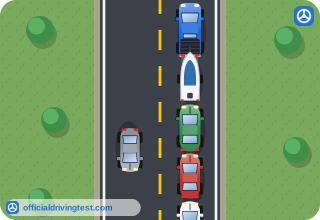
- Stay in the left lane so others pass on the right
- Turn on your hazard flashers and keep going
- Keep driving; the traffic behind must wait
- Pull over when you can, so others can pass
Show answer
Correct answer: Pull over when you can, so others can pass
The manual says to pull over when you have the opportunity so that the motorists behind you can pass.
Source: Connecticut Driver's Manual (Revised March 2023), page 26 · Open this page in the manual (Manual page 26)
-
What does the manual say about blocking the road while talking to a pedestrian on the sidewalk?
- Do not do it; it has resulted in violence from angry motorists
- It is acceptable if you turn on your hazard flashers
- It is acceptable for less than one minute
- It is acceptable when no vehicle is behind you
Show answer
Correct answer: Do not do it; it has resulted in violence from angry motorists
The manual says not to block the road to talk to a pedestrian, a behavior that has resulted in violence from angry motorists.
Source: Connecticut Driver's Manual (Revised March 2023), page 26 · Open this page in the manual (Manual page 26)
-
Why does the manual say not to make eye contact with a hostile motorist who tries to pick a fight?
- It can be seen as a sign that you will yield
- It can be seen as a polite signal to cooperate
- It can be seen as an apology that calms the driver
- It can be seen as a challenge to the other driver
Show answer
Correct answer: It can be seen as a challenge to the other driver
The manual says eye contact can be seen as a challenging gesture and can incite the other driver to violence.
Source: Connecticut Driver's Manual (Revised March 2023), page 26 · Open this page in the manual (Manual page 26)
-
If a motorist pursues you, where does the manual say to drive?
- A police station or other well-lit public place
- Home, where you can lock the doors quickly
- A quiet side street away from traffic
- An empty parking lot where you can talk
Show answer
Correct answer: A police station or other well-lit public place
The manual says not to go home but to drive to a police station, convenience store, or other public, well-lit location where you can get help.
Source: Connecticut Driver's Manual (Revised March 2023), page 26 · Open this page in the manual (Manual page 26)