Connecticut: Sharing the road — Part 2 Practice Test
Bicyclists, motorcycles, large trucks and their No-Zones, buses, horses and other road users. — Part 2
Independent educational site · not affiliated with any government agency or DMV
Ready? Test yourself
- Instant feedback with an explanation
- Every answer cites its source in the manual
- Your best score is saved on this device
Questions are original and based on the official manual "Connecticut Driver's Manual" (Revised March 2023), Connecticut Department of Motor Vehicles (DMV).
All 31 questions in this practice test
Take the test above first, then use this list to study. Tap “Show answer” to see the correct answer and explanation.
Show the questions and answersHide the questions
-
How many motorcycles may share one traffic lane?
- Two
- One
- Three
- Four
Show answer
Correct answer: Two
The manual says two motorcycles may share a lane.
Source: Connecticut Driver's Manual (Revised March 2023), page 18 · Open this page in the manual (Manual page 18)
-
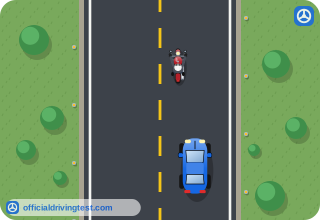
What should you not do when a motorcycle is ahead of you in the same lane?
- Dim your headlights
- Signal before you change lanes
- Pass it within that same lane
- Check your blind spot
Show answer
Correct answer: Pass it within that same lane
The manual says not to pass a motorcycle in the same lane, because the motorcycle needs space to react to other traffic.
Source: Connecticut Driver's Manual (Revised March 2023), page 18 · Open this page in the manual (Manual page 18)
-
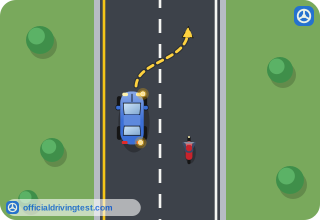
How should you check for motorcycles before entering or leaving a lane of traffic and at intersections?
- Check your rear-view mirror only, without turning
- Check mirrors and blind spots, turning your head
- Listen for engine noise before you move
- Look only at the traffic directly ahead of you
Show answer
Correct answer: Check mirrors and blind spots, turning your head
Always make a visual check for motorcycles by checking mirrors and blind spots by turning your head and looking.
Source: Connecticut Driver's Manual (Revised March 2023), page 18 · Open this page in the manual (Manual page 18)
-
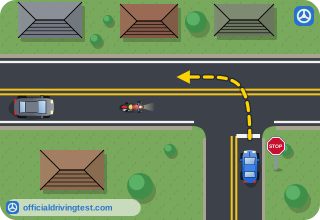
Why can it be difficult to judge the speed and distance of an approaching motorcycle?
- It has a much smaller profile than a motor vehicle
- It always travels faster than other traffic
- It does not use a headlight in daylight
- It always rides in the center of the lane
Show answer
Correct answer: It has a much smaller profile than a motor vehicle
Motorcycles have a much smaller profile than motor vehicles, which can make it more difficult to judge the speed and distance as they approach.
Source: Connecticut Driver's Manual (Revised March 2023), page 18 · Open this page in the manual (Manual page 18)
-
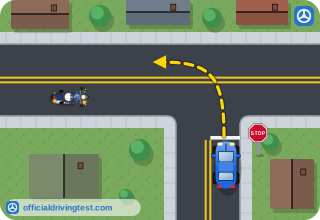
Why should you not assume that a motorcycle is turning when its turn signal is flashing?
- Motorcycles are not allowed to signal at night
- Motorcycle signals flash faster than car signals
- The signal may not self-cancel and may have been left on
- The signal always flashes for ten seconds
Show answer
Correct answer: The signal may not self-cancel and may have been left on
Motorcycle turn signals may not self-cancel, so the rider may have forgotten to turn them off.
Source: Connecticut Driver's Manual (Revised March 2023), page 18 · Open this page in the manual (Manual page 18)
-
Why is it important to leave enough space for a motorcyclist to maneuver?
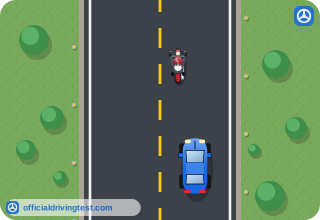
- Motorcycles cannot stop quickly
- Motorcycle headlights are dim
- Motorcyclists must pass on the left
- Motorcycles may not have turn signals
Show answer
Correct answer: Motorcycles may not have turn signals
The manual notes that motorcycles may not have turn signals, so you must leave enough space for the motorcyclist to maneuver.
Source: Connecticut Driver's Manual (Revised March 2023), page 18 · Open this page in the manual (Manual page 18)
-
What does signaling before you change lanes or merge allow a motorcyclist to do?
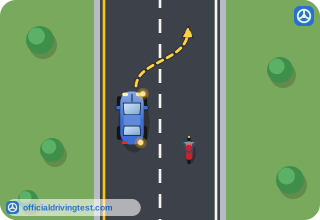
- Anticipate traffic flow and find a safe lane position
- Pass you on the right without slowing down
- Know your exact speed before you merge into traffic
- Turn off the motorcycle's turn signals right away
Show answer
Correct answer: Anticipate traffic flow and find a safe lane position
Signaling your intentions before changing lanes or merging lets the motorcyclist anticipate traffic flow and find a safe lane position.
Source: Connecticut Driver's Manual (Revised March 2023), page 18 · Open this page in the manual (Manual page 18)
-
What should you be prepared for a motorcyclist to do to avoid hazards such as potholes, gravel or wet surfaces?
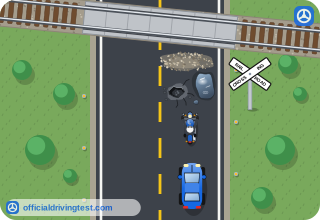
- Pull over and let traffic pass
- Move to the shoulder immediately
- Make sudden changes in lanes or speed
- Ride on the sidewalk
Show answer
Correct answer: Make sudden changes in lanes or speed
Be prepared for motorcyclists to make sudden changes in lanes or speed to avoid hazards, and allow room for them to maneuver.
Source: Connecticut Driver's Manual (Revised March 2023), page 18 · Open this page in the manual (Manual page 18)
-
What should you do with your headlights when approaching a motorcycle?
- Dim them
- Switch to high beams so you are seen
- Turn them off
- Flash them repeatedly
Show answer
Correct answer: Dim them
Always dim your headlights when approaching a motorcycle, because the blinding effect of high beams can be far more dangerous to a motorcyclist.
Source: Connecticut Driver's Manual (Revised March 2023), page 18 · Open this page in the manual (Manual page 18)
-
What should you do when a motorcycle is passing your vehicle?
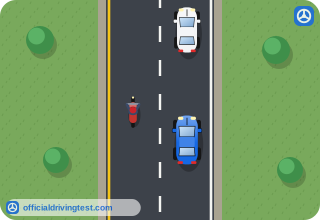
- Speed up slightly to keep pace
- Move over into the next lane at once
- Maintain your lane position and speed
- Brake firmly to let the rider by
Show answer
Correct answer: Maintain your lane position and speed
When a motorcycle is passing, maintain your lane position and speed and never speed up or interfere with its ability to pass safely.
Source: Connecticut Driver's Manual (Revised March 2023), page 18 · Open this page in the manual (Manual page 18)
-
Where should you watch for large trucks and small underpowered cars that lose speed?
- On flat open highways in daylight
- On steep grades or entering traffic
- At traffic signals and stop signs
- Only in school zones and parking lots
Show answer
Correct answer: On steep grades or entering traffic
These vehicles can lose speed on long or steep hills, and it takes them longer to get up to speed when they enter traffic.
Source: Connecticut Driver's Manual (Revised March 2023), page 18 · Open this page in the manual (Manual page 18)
-
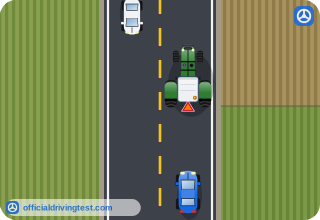
Why is it important to spot slow moving vehicles early?
- You can sound your horn to warn them
- You can move closer and follow them tightly
- You can ask them to pull over
- You have time to change lanes or slow down safely
Show answer
Correct answer: You have time to change lanes or slow down safely
If you spot slow moving vehicles early, you have time to change lanes or slow down safely, since slowing suddenly can cause a crash.
Source: Connecticut Driver's Manual (Revised March 2023), page 18 · Open this page in the manual (Manual page 18)
-
What must drivers do for a bus traveling in the same direction that appropriately signals?
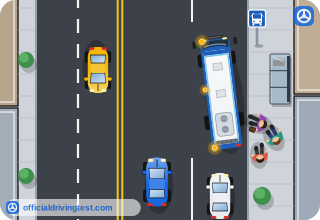
- Yield the right of way
- Pass it on the right
- Speed up and pass it
- Stay three seconds behind it
Show answer
Correct answer: Yield the right of way
Drivers are required to yield the right of way to a bus traveling in the same direction when the bus appropriately signals.
Source: Connecticut Driver's Manual (Revised March 2023), page 18 · Open this page in the manual (Manual page 18)
-
How fast do farm tractors, animal-drawn vehicles and roadway maintenance vehicles usually go?
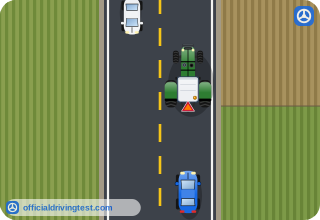
- 35 mph or less
- 15 mph or less
- 25 mph or less
- 45 mph or less
Show answer
Correct answer: 25 mph or less
The manual says these vehicles usually go 25 mph or less.
Source: Connecticut Driver's Manual (Revised March 2023), page 18 · Open this page in the manual (Manual page 18)
-
What decal should farm tractors, animal-drawn vehicles and roadway maintenance vehicles have on the back?
- A red diamond
- An orange triangle
- A yellow circle
- A white square
Show answer
Correct answer: An orange triangle
These vehicles should have a slow-moving decal, an orange triangle, on the back.
Source: Connecticut Driver's Manual (Revised March 2023), page 18 · Open this page in the manual (Manual page 18)
-
How far from an ice cream truck displaying flashing lights and an extended stop signal arm must you stop?
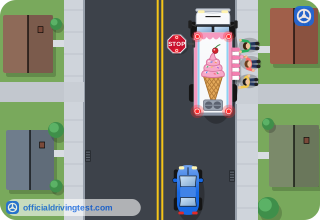
- At least 10 feet
- At least 5 feet
- At least 20 feet
- At least 25 feet
Show answer
Correct answer: At least 10 feet
Drivers must stop their vehicles at least 10 feet from the front or back of the truck.
Source: Connecticut Driver's Manual (Revised March 2023), page 18 · Open this page in the manual (Manual page 18)
-
After stopping for an ice cream truck, how fast may you proceed past it?
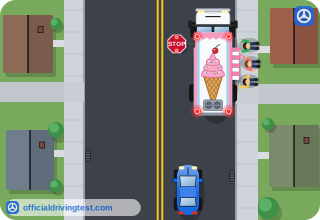
- Up to 10 mph
- Up to 15 mph
- Up to 5 mph
- Up to 25 mph
Show answer
Correct answer: Up to 5 mph
After stopping, you may proceed past the truck at a reasonable speed, up to 5 mph.
Source: Connecticut Driver's Manual (Revised March 2023), page 18 · Open this page in the manual (Manual page 18)
-
After stopping for an ice cream truck, whom must you yield the right-of-way to?
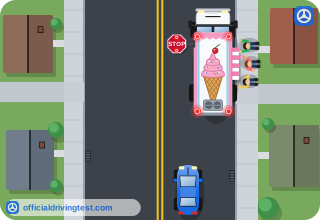
- Only children under 12 who are crossing the road
- Any pedestrian crossing to or from the truck
- Only vehicles that are leaving the truck's lane
- Nobody, if the truck driver waves you on past
Show answer
Correct answer: Any pedestrian crossing to or from the truck
You must yield the right-of-way to any pedestrian crossing the road to or from the truck.
Source: Connecticut Driver's Manual (Revised March 2023), page 18 · Open this page in the manual (Manual page 18)
-
When are drivers not required to stop for an ice cream truck?
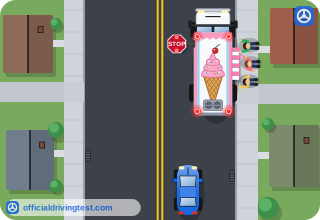
- When it is traveling in the opposite direction
- When no pedestrians are near the truck
- When it is more than 20 feet away
- When a safety island or barrier separates the lanes
Show answer
Correct answer: When a safety island or barrier separates the lanes
Drivers need not stop when the ice cream truck is in another lane separated by a safety island or physical barrier.
Source: Connecticut Driver's Manual (Revised March 2023), page 18 · Open this page in the manual (Manual page 18)
-
How must horseback riders ride on the road?
- Single file near the right curb or road edge
- Two abreast near the center of the lane
- On the left side facing oncoming traffic
- In whichever lane they prefer to use
Show answer
Correct answer: Single file near the right curb or road edge
Horseback riders must ride single file near the right curb or road edge, or on a usable right shoulder, lane or path.
Source: Connecticut Driver's Manual (Revised March 2023), page 18 · Open this page in the manual (Manual page 18)
-
What must you do when you approach a horse on a public highway?
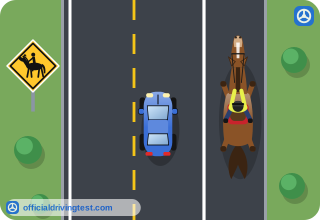
- Pass quickly to avoid frightening it
- Sound your horn to warn the rider
- Reduce your speed, or stop if necessary
- Flash your headlights at the rider
Show answer
Correct answer: Reduce your speed, or stop if necessary
You must reduce your speed (or stop, if necessary) to avoid striking, endangering or frightening a horse.
Source: Connecticut Driver's Manual (Revised March 2023), page 18 · Open this page in the manual (Manual page 18)
-
How must you drive when approaching a horse being ridden or led along a road?
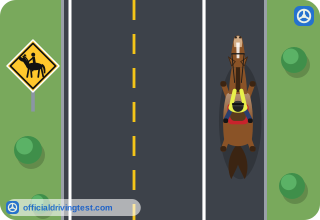
- At the speed limit, passing as close as possible
- At a reasonable speed and a reasonable distance away
- Quickly, to get past before it reacts
- Slowly, directly behind the horse until it stops
Show answer
Correct answer: At a reasonable speed and a reasonable distance away
The law requires due care: drive at a reasonable speed and at a reasonable distance away from the horse.
Source: Connecticut Driver's Manual (Revised March 2023), page 18 · Open this page in the manual (Manual page 18)
-
What is illegal when approaching or passing a horse?
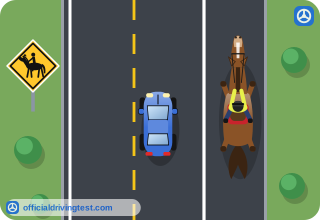
- Passing the horse in the same lane
- Slowing to a reasonable speed
- Stopping to let the rider pass
- Sounding your horn or making loud noises
Show answer
Correct answer: Sounding your horn or making loud noises
It is illegal to sound your horn or cause loud or unusual noises when approaching or passing a horse.
Source: Connecticut Driver's Manual (Revised March 2023), page 18 · Open this page in the manual (Manual page 18)
-
What are No-Zones around trucks, tractor-trailers, buses and RVs?
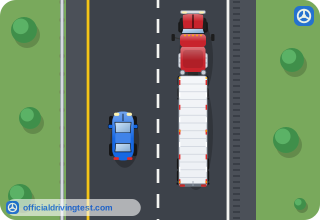
- Lanes on the highway where only trucks, buses and RVs are allowed to travel
- Areas where trucks, buses and RVs are not allowed to stop or park
- Danger areas around these vehicles where crashes are more likely to occur
- Marked zones where drivers may not pass a truck, bus or RV by law
Show answer
Correct answer: Danger areas around these vehicles where crashes are more likely to occur
No-Zones are the danger areas around these vehicles where crashes are more likely to occur.
Source: Connecticut Driver's Manual (Revised March 2023), page 19 · Open this page in the manual (Manual page 19)
-
What do the No-Zones on the side, front and rear of a large truck also include?
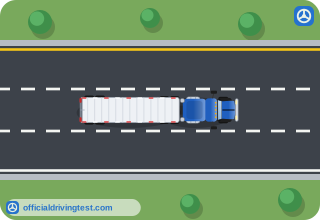
- Areas where your car can be seen best in the truck’s mirrors
- Blind spots where your car disappears from the driver’s view
- Spots where the truck driver is required to yield to your car
- Zones where a truck is not allowed to change lanes
Show answer
Correct answer: Blind spots where your car disappears from the driver’s view
No-Zones on the side, front and rear also include blind spots where your car disappears from the driver’s view.
Source: Connecticut Driver's Manual (Revised March 2023), page 19 · Open this page in the manual (Manual page 19)
-
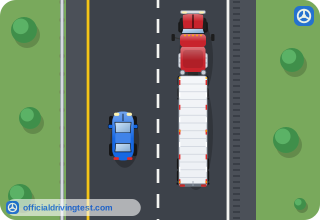
What does it mean if you cannot see a truck driver’s face in his side view mirror?
- He is about to turn
- He is yielding to you
- He will slow down
- He can’t see you
Show answer
Correct answer: He can’t see you
The manual says that if you can’t see the driver’s face in his side view mirror, he can’t see you.
Source: Connecticut Driver's Manual (Revised March 2023), page 19 · Open this page in the manual (Manual page 19)
-
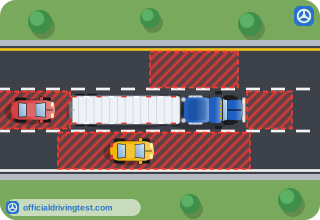
Why are the side No-Zones of trucks, tractor-trailers, buses and RVs dangerous?
- These vehicles must make wide turns
- These vehicles often drift into the next lane on straight roads
- These vehicles have no side mirrors at all
- These vehicles always travel faster than cars
Show answer
Correct answer: These vehicles must make wide turns
The side No-Zones are dangerous because these vehicles must make wide turns.
Source: Connecticut Driver's Manual (Revised March 2023), page 19 · Open this page in the manual (Manual page 19)
-
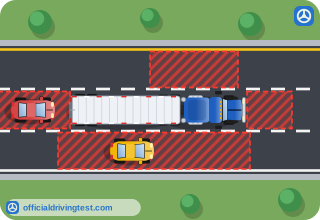
When you drive directly behind a truck, what can you not see?
- The brake lights of the truck itself
- The vehicles traveling behind you
- What is happening in traffic ahead of the truck
- The road signs on the right side of the road
Show answer
Correct answer: What is happening in traffic ahead of the truck
In the rear No-Zone you can’t see what’s happening in traffic ahead of the truck.
Source: Connecticut Driver's Manual (Revised March 2023), page 19 · Open this page in the manual (Manual page 19)
-
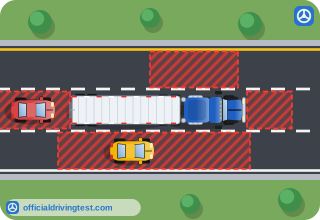
What can happen if you are in the rear No-Zone of a truck and it brakes or stops suddenly?
- The truck driver will have time to see you and warn you
- You have no place to go and could crash into its rear end
- You will have time to pass it on either side
- Its brake lights will give you more room than other vehicles
Show answer
Correct answer: You have no place to go and could crash into its rear end
If the truck brakes or stops suddenly while you are in its rear No-Zone, you have no place to go and could crash into it.
Source: Connecticut Driver's Manual (Revised March 2023), page 19 · Open this page in the manual (Manual page 19)
-
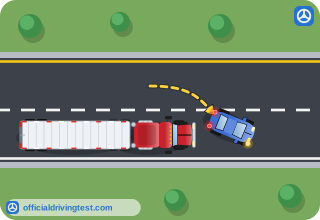
What could happen if you cut in front of a truck, bus or RV too soon after passing it?
- The truck driver will see you more easily in his mirrors
- The truck will automatically slow down to give you space
- You will be ticketed under the No-Zone rules
- You could be rear-ended by the truck
Show answer
Correct answer: You could be rear-ended by the truck
Cutting in front too soon after passing could get you rear-ended by the truck, bus or RV.
Source: Connecticut Driver's Manual (Revised March 2023), page 19 · Open this page in the manual (Manual page 19)
-
How long may a truck and its tow vehicle be, according to the manual?
- As long as 40 feet
- As long as 90 feet
- As long as 65 feet
- As long as 120 feet
Show answer
Correct answer: As long as 65 feet
The manual says a truck and its tow vehicle may be as long as 65 feet.
Source: Connecticut Driver's Manual (Revised March 2023), page 19 · Open this page in the manual (Manual page 19)