Connecticut: Sharing the road — Part 1 Practice Test
Bicyclists, motorcycles, large trucks and their No-Zones, buses, horses and other road users. — Part 1
Independent educational site · not affiliated with any government agency or DMV
Ready? Test yourself
- Instant feedback with an explanation
- Every answer cites its source in the manual
- Your best score is saved on this device
Questions are original and based on the official manual "Connecticut Driver's Manual" (Revised March 2023), Connecticut Department of Motor Vehicles (DMV).
All 31 questions in this practice test
Take the test above first, then use this list to study. Tap “Show answer” to see the correct answer and explanation.
Show the questions and answersHide the questions
-
According to the manual, what does sharing the road mean?
- Getting there first, whatever it takes
- Getting along, not getting ahead
- Making sure you are never delayed
- Letting faster vehicles go first
Show answer
Correct answer: Getting along, not getting ahead
The manual says sharing the road means “getting along, not getting ahead.”
Source: Connecticut Driver's Manual (Revised March 2023), page 16 · Open this page in the manual (Manual page 16)
-
What does Connecticut's Vulnerable User's Law provide?
- A permanent ban on driving in any area where pedestrians and bicyclists are present on the road
- A requirement that all vulnerable users wear bright clothing and carry lights at night
- Lower fines for drivers who cause a crash while sharing the road with a bicyclist
- Higher penalties when a driver fails to use reasonable care and seriously injures or kills a vulnerable user
Show answer
Correct answer: Higher penalties when a driver fails to use reasonable care and seriously injures or kills a vulnerable user
The law provides higher penalties for drivers who fail to exercise reasonable care and cause the serious injury or death of a vulnerable user.
Source: Connecticut Driver's Manual (Revised March 2023), page 16 · Open this page in the manual (Manual page 16)
-
Which of these is a vulnerable user under Connecticut's Vulnerable User's Law?
- A wheelchair user
- A passenger car driver
- A school bus driver
- A taxi driver
Show answer
Correct answer: A wheelchair user
Vulnerable users include pedestrians, bicyclists, wheelchair users, people riding or driving an animal, highway workers, garbage trucks, tank vehicles, mail vehicles and express delivery carriers.
Source: Connecticut Driver's Manual (Revised March 2023), page 16 · Open this page in the manual (Manual page 16)
-
How much distance must drivers allow when passing a vulnerable user?
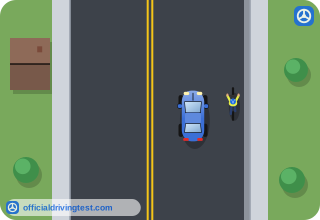
- Six feet
- Ten feet
- Three feet
- Five feet
Show answer
Correct answer: Three feet
The manual states that drivers must allow for three feet of distance when passing vulnerable users.
Source: Connecticut Driver's Manual (Revised March 2023), page 16 · Open this page in the manual (Manual page 16)
-
How does the manual say bicyclists are treated when they use roadways?
- As vehicles that follow the same rules as motorized vehicles
- As pedestrians who must stay off the roadway entirely
- As a separate group that has its own traffic rules
- As guests of the road who must yield to all motorists
Show answer
Correct answer: As vehicles that follow the same rules as motorized vehicles
Bicyclists are considered vehicles on roadways and are expected to follow the same rules of the road as motorized vehicles.
Source: Connecticut Driver's Manual (Revised March 2023), page 17 · Open this page in the manual (Manual page 17)
-
What does it mean when a bicyclist “takes the travel lane” on a lane too narrow for cars and bikes to drive side by side?
- The bicyclist rides on the sidewalk beside the lane
- The bicyclist stops until all the cars have passed
- The bicyclist drives in or near the center of the lane
- The bicyclist rides on the left edge of the roadway
Show answer
Correct answer: The bicyclist drives in or near the center of the lane
When a lane is too narrow for cars and bikes side by side, the bicyclist “takes the travel lane,” which means driving in or near the center of the lane.
Source: Connecticut Driver's Manual (Revised March 2023), page 17 · Open this page in the manual (Manual page 17)
-
According to the manual, what should you not be surprised to see a bicyclist do when turning?
- Make the turn from the shoulder
- Use the left lane
- Dismount and walk across the lanes
- Wait for a signal from the driver behind
Show answer
Correct answer: Use the left lane
The manual says you should not be surprised to see a bicyclist using the left lane when turning.
Source: Connecticut Driver's Manual (Revised March 2023), page 17 · Open this page in the manual (Manual page 17)
-
If you see an unskilled bicyclist, what should you be ready for?
- A steady, predictable line
- A stop at every intersection
- A hand signal before every move
- Any sudden movements
Show answer
Correct answer: Any sudden movements
An unskilled bicyclist may swerve unpredictably, so the manual says to be ready for any sudden movements.
Source: Connecticut Driver's Manual (Revised March 2023), page 17 · Open this page in the manual (Manual page 17)
-
Which behavior does the manual describe for a skillful bicyclist?
- Rides predictably and holds a steady line
- Swerves unpredictably between lanes
- Ignores traffic signs and signals
- Rides without a light at night
Show answer
Correct answer: Rides predictably and holds a steady line
A skillful bicyclist rides predictably and holds a steady line; the other behaviors describe an unskilled bicyclist.
Source: Connecticut Driver's Manual (Revised March 2023), page 17 · Open this page in the manual (Manual page 17)
-
On which part of the roadway are bicyclists required to ride?
- On the left side, facing oncoming traffic
- In the center of the lane at all times
- On the right, as far right as they deem safe
- On the sidewalk whenever one is available
Show answer
Correct answer: On the right, as far right as they deem safe
Bicyclists are required to ride on the right side of the roadway, as far to the right as they deem safe.
Source: Connecticut Driver's Manual (Revised March 2023), page 17 · Open this page in the manual (Manual page 17)
-
When may a bicyclist ride in the left-hand edge of a right turn lane?
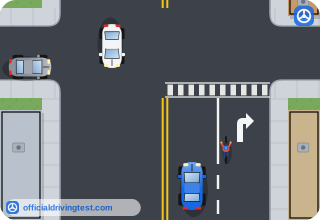
- When the lane is empty of traffic
- When proceeding straight
- When making a right turn
- When a driver waves the bicyclist ahead
Show answer
Correct answer: When proceeding straight
Bicyclists may ride in the left-hand edge of a right turn lane if they are proceeding straight.
Source: Connecticut Driver's Manual (Revised March 2023), page 17 · Open this page in the manual (Manual page 17)
-
Under what age must a bicyclist wear a helmet?
- Under 12 years of age
- Under 14 years of age
- Under 18 years of age
- Under 16 years of age
Show answer
Correct answer: Under 16 years of age
Bicyclists under 16 are required to wear a helmet; those 16 or older should consider wearing one as a safety precaution.
Source: Connecticut Driver's Manual (Revised March 2023), page 17 · Open this page in the manual (Manual page 17)
-
Which of these should all bicyclists do, according to the manual?
- Use required lights and reflectors
- Avoid hand signals when traffic is heavy
- Wear dark clothing when riding at night
- Ride only on sidewalks near schools
Show answer
Correct answer: Use required lights and reflectors
All bicyclists should wear brightly colored clothing, use required lights and reflectors, and keep the bicycle in good repair.
Source: Connecticut Driver's Manual (Revised March 2023), page 17 · Open this page in the manual (Manual page 17)
-
As a bicyclist, whom are you required to yield to?
- Motorcycles
- Larger vehicles
- Pedestrians
- Other bicyclists
Show answer
Correct answer: Pedestrians
The manual states that bicyclists are required to yield to pedestrians.
Source: Connecticut Driver's Manual (Revised March 2023), page 17 · Open this page in the manual (Manual page 17)
-
What happens to the fine when a driver fails to yield the right-of-way to a bicyclist?
- It is cut in half for a first offense
- It is the same as for any other vehicle
- It is doubled
- It is waived if no one was hurt
Show answer
Correct answer: It is doubled
The manual says fines are doubled for failure to yield right-of-way to a bicyclist.
Source: Connecticut Driver's Manual (Revised March 2023), page 17 · Open this page in the manual (Manual page 17)
-
What is the minimum distance to leave between your vehicle and a bicycle when you pass it?
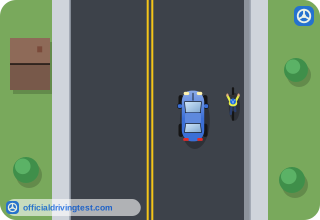
- One foot
- Three feet
- Five feet
- Six feet
Show answer
Correct answer: Three feet
The manual says to pass only when you can give a minimum of three feet between your vehicle and the bicycle.
Source: Connecticut Driver's Manual (Revised March 2023), page 17 · Open this page in the manual (Manual page 17)
-
What should you avoid doing right after you have passed a bicyclist?
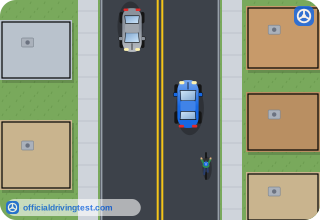
- Checking your mirror
- Staying in your lane
- Keeping a steady speed
- Turning right immediately
Show answer
Correct answer: Turning right immediately
After passing a bicyclist, do not slow down or stop quickly or turn right immediately, because a motor vehicle's brakes are more powerful than a bicycle's and you could cause a crash.
Source: Connecticut Driver's Manual (Revised March 2023), page 17 · Open this page in the manual (Manual page 17)
-
When may you sound your horn close to a bicyclist?
- Only if you have good cause to warn the bicyclist
- Whenever the bicyclist rides in the travel lane
- Any time you want to alert your presence
- Whenever the bicyclist is not on the right side
Show answer
Correct answer: Only if you have good cause to warn the bicyclist
The manual says not to sound your horn close to bicyclists unless you have good cause, because it may startle them and cause them to steer into your path and crash.
Source: Connecticut Driver's Manual (Revised March 2023), page 17 · Open this page in the manual (Manual page 17)
-
What is one good reason for a bicyclist to be riding in the travel lane?
- To keep faster cars from passing
- The bike lane is closed to bicycles at night
- Roadway hazards not visible to motorists
- Bicyclists must stay in the center at all times
Show answer
Correct answer: Roadway hazards not visible to motorists
The manual notes there may be a good reason for a bicyclist to ride in the travel lane, such as roadway hazards not visible to motorists.
Source: Connecticut Driver's Manual (Revised March 2023), page 17 · Open this page in the manual (Manual page 17)
-
Why should you be especially careful when you see children riding bikes on the sidewalk?
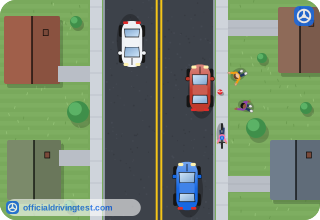
- They are required to stop at every driveway
- They always ride in the direction of traffic
- They are not allowed to ride near driveways
- They may come onto the road
Show answer
Correct answer: They may come onto the road
The manual warns that children riding bikes on the sidewalk may come onto the road.
Source: Connecticut Driver's Manual (Revised March 2023), page 17 · Open this page in the manual (Manual page 17)
-
What should you never do when you turn near a bicyclist?
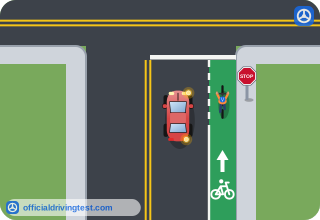
- Turn sharply in front of the bicyclist
- Signal before the turn
- Slow down before the turn
- Check your mirrors before the turn
Show answer
Correct answer: Turn sharply in front of the bicyclist
The manual says never to turn sharply in front of a bicyclist and not to force a bicyclist off the road.
Source: Connecticut Driver's Manual (Revised March 2023), page 17 · Open this page in the manual (Manual page 17)
-
Although bicyclists are required to ride in the direction of traffic, where should you look for them?
- Only on the right side of the road
- Only in bike lanes
- Anywhere on the road
- Only on the shoulder
Show answer
Correct answer: Anywhere on the road
The manual says to look for bicyclists riding anywhere on the roadway even though they are required to ride in the direction of traffic.
Source: Connecticut Driver's Manual (Revised March 2023), page 17 · Open this page in the manual (Manual page 17)
-
Why should you be particularly careful around bicyclists when the road is wet or covered with sand or gravel?
- Bicyclists must stop and wait until the road dries
- Bicycles cannot brake as quickly or turn as sharply
- Bicycle tires cannot be seen in wet weather
- Bicyclists are not allowed to use hand signals
Show answer
Correct answer: Bicycles cannot brake as quickly or turn as sharply
Like motor vehicles, bicycles cannot brake as quickly or turn as sharply under these conditions, and the conditions affect bicycles much more than vehicles.
Source: Connecticut Driver's Manual (Revised March 2023), page 17 · Open this page in the manual (Manual page 17)
-
When may bicyclists use the full travel lane?
- Whenever no car is directly behind them
- Only during daylight hours on wide roads
- Only when riding in a group of two or more
- When the shoulder or bike lane is unsafe
Show answer
Correct answer: When the shoulder or bike lane is unsafe
Bicyclists may use the full travel lane where the shoulder or bike lane is unsafe due to conditions such as wet roads, sand or gravel.
Source: Connecticut Driver's Manual (Revised March 2023), page 17 · Open this page in the manual (Manual page 17)
-
What can you look for when a bicyclist cannot signal because both hands must stay on the handlebars?
- Standing up on the pedals before the turn
- Ringing a bell to warn nearby drivers
- Turning the head or looking over the shoulder
- Pedaling faster to get ahead of traffic
Show answer
Correct answer: Turning the head or looking over the shoulder
The manual says to look for other clues of a bicyclist's intent, like turning their head or looking over their shoulder before changing lane position.
Source: Connecticut Driver's Manual (Revised March 2023), page 17 · Open this page in the manual (Manual page 17)
-
When may you stop, park or drive on a designated bicycle path or lane?
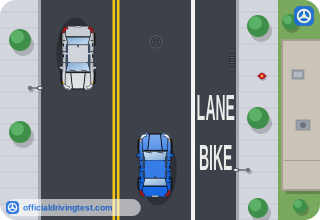
- When traffic in the other lanes is heavy
- When no bicyclists are in sight
- When you are making a delivery
- When entering or leaving an alley or driveway
Show answer
Correct answer: When entering or leaving an alley or driveway
The manual allows it only when entering or leaving an alley or driveway, performing official duties, directed by a police officer, or in an emergency.
Source: Connecticut Driver's Manual (Revised March 2023), page 17 · Open this page in the manual (Manual page 17)
-
When you approach a turn, may you drive in the bicycle lane?
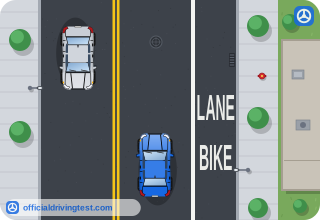
- No, you may turn across it but may not drive in it
- Yes, if no bicyclist is in sight at the time
- Yes, as long as you signal before entering
- Yes, for up to one block before the turn
Show answer
Correct answer: No, you may turn across it but may not drive in it
The manual says you may turn across a bicycle lane but may not drive in the bicycle lane when approaching a turn.
Source: Connecticut Driver's Manual (Revised March 2023), page 17 · Open this page in the manual (Manual page 17)
-
When you are parked on the street, what should you check before you open your vehicle door?
- Only the front of your vehicle
- Only the curb side
- The sides and rear for bicyclists
- Nothing, if your vehicle is legally parked
Show answer
Correct answer: The sides and rear for bicyclists
When parked on the street, check to the sides and rear for bicyclists before you open your vehicle door.
Source: Connecticut Driver's Manual (Revised March 2023), page 17 · Open this page in the manual (Manual page 17)
-
Where should you be especially cautious about bicyclists when backing?
- On long rural highways at night
- Near schools or residential areas
- On freeway shoulders and ramps
- In heavy fast-moving traffic
Show answer
Correct answer: Near schools or residential areas
You should check for bicyclists in your path before backing, especially near schools or residential areas where bicyclists may be present.
Source: Connecticut Driver's Manual (Revised March 2023), page 17 · Open this page in the manual (Manual page 17)
-
What rights and responsibilities do motorcyclists have?
- Fewer rights on multi-lane roads
- The same as other drivers
- Right-of-way at all intersections
- Responsibilities only when carrying a passenger
Show answer
Correct answer: The same as other drivers
The manual says motorcyclists have the same rights and responsibilities as other drivers.
Source: Connecticut Driver's Manual (Revised March 2023), page 18 · Open this page in the manual (Manual page 18)
-
How much of a traffic lane do motorcycle operators have the right to use?
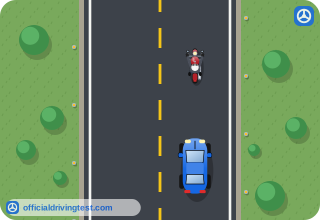
- Only the right half
- Only the left half
- Only the center third
- The complete traffic lane
Show answer
Correct answer: The complete traffic lane
Motorcycle operators have the right to use a complete traffic lane.
Source: Connecticut Driver's Manual (Revised March 2023), page 18 · Open this page in the manual (Manual page 18)