Connecticut: Seat belts and child safety Practice Test
The Connecticut seat belt law and the child restraint rules by age and weight.
Independent educational site · not affiliated with any government agency or DMV
Ready? Test yourself
- Instant feedback with an explanation
- Every answer cites its source in the manual
- Your best score is saved on this device
Questions are original and based on the official manual "Connecticut Driver's Manual" (Revised March 2023), Connecticut Department of Motor Vehicles (DMV).
All 27 questions in this practice test
Take the test above first, then use this list to study. Tap “Show answer” to see the correct answer and explanation.
Show the questions and answersHide the questions
-
According to the manual, what is the simplest way to prevent car crash deaths and serious injuries?
- Drive only in daylight
- Keep the radio off
- Avoid weekend driving
- Buckle up
Show answer
Correct answer: Buckle up
The manual says the simplest way to prevent car crash deaths and serious injuries is to buckle up.
Source: Connecticut Driver's Manual (Revised March 2023), page 4 · Open this page in the manual (Manual page 4)
-
Learner's permit holders and 16- and 17-year-old drivers may NOT transport more passengers than what?
- The number of seats in the front row
- The number of seatbelts in the vehicle
- Three passengers
- The number of immediate family members
Show answer
Correct answer: The number of seatbelts in the vehicle
The manual bars these drivers from transporting more passengers than the number of seatbelts in the vehicle.
Source: Connecticut Driver's Manual (Revised March 2023), page 8 · Open this page in the manual (Manual page 8)
-
Before you drive away, what does the manual say you should always do about safety belts?
- Fasten yours only if you plan to drive on a highway or at night
- Fasten yours and make sure passengers use belts or child restraints
- Fasten yours once the vehicle is moving
- Make sure only the front-seat passengers use belts or child seats
Show answer
Correct answer: Fasten yours and make sure passengers use belts or child restraints
The manual says to fasten your safety belt and make sure all passengers are using safety belts or child restraints before driving away.
Source: Connecticut Driver's Manual (Revised March 2023), page 12 · Open this page in the manual (Manual page 12)
-
Under Connecticut’s seat belt law, what is illegal?
- To drive with a safety belt on a short trip
- To wear a safety belt while you are pregnant
- To ride in the back seat without wearing a head restraint
- To drive or to be a passenger without wearing a safety belt
Show answer
Correct answer: To drive or to be a passenger without wearing a safety belt
The manual says that in Connecticut it is illegal to drive or to be a passenger without wearing a safety belt.
Source: Connecticut Driver's Manual (Revised March 2023), page 12 · Open this page in the manual (Manual page 12)
-
If either the driver or a passenger fails to wear a seat belt, what can happen?
- Only the driver could be cited for the violation and fined $75
- Only the passenger could be cited for it and fined $75
- Each could be given a warning but would never be fined
- Each could be cited for a seat belt violation and fined $75
Show answer
Correct answer: Each could be cited for a seat belt violation and fined $75
The manual says that each could be cited for a seat belt violation and fined $75.
Source: Connecticut Driver's Manual (Revised March 2023), page 12 · Open this page in the manual (Manual page 12)
-
Your vehicle has a two-part seat belt system. What should you wear?
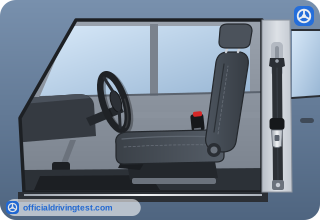
- The shoulder belt only
- Both the lap belt and the shoulder belt
- The lap belt only
- Whichever part is more comfortable
Show answer
Correct answer: Both the lap belt and the shoulder belt
The manual says to wear both the lap belt and the shoulder belt, since wearing either part alone greatly reduces your protection.
Source: Connecticut Driver's Manual (Revised March 2023), page 12 · Open this page in the manual (Manual page 12)
-
Your vehicle has an automatic shoulder belt. What else should you do?
- Nothing, because the shoulder belt is enough
- Tuck the shoulder belt behind your back
- Buckle your lap belt as well
- Unbuckle it on short trips
Show answer
Correct answer: Buckle your lap belt as well
The manual says to buckle the lap belt as well, otherwise you could slide out of the belt and be hurt or killed in a collision.
Source: Connecticut Driver's Manual (Revised March 2023), page 12 · Open this page in the manual (Manual page 12)
-
Besides protecting you from injury, how do safety belts help the driver?
- They help you keep control of the vehicle
- They shorten your stopping distance
- They make the brakes work better
- They reduce the glare from other headlights
Show answer
Correct answer: They help you keep control of the vehicle
The manual says safety belts help you keep control of the vehicle, since you cannot steer if you are not behind the wheel.
Source: Connecticut Driver's Manual (Revised March 2023), page 12 · Open this page in the manual (Manual page 12)
-
Does state law require you to wear a safety belt if your vehicle is equipped with airbags?
- Yes, safety belts must be worn even if the vehicle has airbags
- No, airbags replace the need for safety belts
- Only the driver must wear one when airbags are present
- Only passengers in the back seat must wear one
Show answer
Correct answer: Yes, safety belts must be worn even if the vehicle has airbags
The manual says state law requires safety belts to be worn even if the vehicle is equipped with airbags.
Source: Connecticut Driver's Manual (Revised March 2023), page 12 · Open this page in the manual (Manual page 12)
-
In which situations does the manual say airbags do not protect you?
- Hitting the steering wheel in a crash
- Hitting the dashboard in a crash
- A hit from the side or rear, or a rollover
- Something hitting the windshield
Show answer
Correct answer: A hit from the side or rear, or a rollover
The manual says airbags protect against hitting the steering wheel, dashboard or windshield, but not if you are hit from the side or rear or the vehicle rolls over.
Source: Connecticut Driver's Manual (Revised March 2023), page 12 · Open this page in the manual (Manual page 12)
-
Under state law, children under what age must be secured in a proper child restraint and safety system while riding in a vehicle?
- 12
- 16
- 8
- 10
Show answer
Correct answer: 16
The manual says state law requires children under 16 to be secured in proper child restraint and safety systems.
Source: Connecticut Driver's Manual (Revised March 2023), page 12 · Open this page in the manual (Manual page 12)
-
What restraint does the table require for a child under age 2, or weighing less than 30 pounds regardless of age?
- A forward-facing child restraint with a 5-point harness or a booster seat
- A booster seat only
- A booster seat or a seat belt
- A rear-facing-only car seat or rear-facing convertible seat with a 5-point harness
Show answer
Correct answer: A rear-facing-only car seat or rear-facing convertible seat with a 5-point harness
The table requires a rear-facing-only car seat or a rear-facing convertible seat with a 5-point harness for this group.
Source: Connecticut Driver's Manual (Revised March 2023), page 12 · Open this page in the manual (Manual page 12)
-
What restraint does the table require for a child age 2 to 5, or weighing less than 40 pounds regardless of age?
- A booster seat only
- A booster seat or a seat belt
- A booster seat with a lap and shoulder belt, no harness needed
- A rear- or forward-facing child restraint with a 5-point harness
Show answer
Correct answer: A rear- or forward-facing child restraint with a 5-point harness
The table requires a rear- or forward-facing child restraint with a 5-point harness for this group.
Source: Connecticut Driver's Manual (Revised March 2023), page 12 · Open this page in the manual (Manual page 12)
-
What restraint does the table list for a child age 5 to 8, or weighing between 40 and 60 pounds?
- A rear-facing convertible seat
- A 5-point harness or a booster seat
- A seat belt only
- A booster seat or a seat belt
Show answer
Correct answer: A 5-point harness or a booster seat
The table lists a 5-point harness or a booster seat for this group.
Source: Connecticut Driver's Manual (Revised March 2023), page 12 · Open this page in the manual (Manual page 12)
-
What restraint does the table list for a child age 8 or older who weighs 60 pounds or more?
- A 5-point harness only
- A rear-facing child restraint
- A booster seat or a seat belt
- A forward-facing seat with a 5-point harness only
Show answer
Correct answer: A booster seat or a seat belt
The table lists a booster seat or a seat belt for this group.
Source: Connecticut Driver's Manual (Revised March 2023), page 12 · Open this page in the manual (Manual page 12)
-
A child is less than two years old but weighs more than 30 pounds, so the child falls in two different categories. Which requirement applies?
- The more restrictive one, a rear-facing car seat
- The less restrictive one, a forward-facing seat
- The one for the child’s weight only
- Either one, whichever the parent chooses
Show answer
Correct answer: The more restrictive one, a rear-facing car seat
The manual says the more restrictive requirement applies, which in this example is a rear-facing car seat.
Source: Connecticut Driver's Manual (Revised March 2023), page 12 · Open this page in the manual (Manual page 12)
-
What does the law prohibit about a rear-facing child restraint system?
- Placing it in the back seat of a vehicle with a functional side airbag
- Using it for a child under 2
- Placing it in the front seat of a vehicle with a functional passenger airbag
- Using it with a five-point harness
Show answer
Correct answer: Placing it in the front seat of a vehicle with a functional passenger airbag
The manual says the law prohibits placing a rear-facing child restraint in the front seat of a vehicle with a functional passenger side airbag.
Source: Connecticut Driver's Manual (Revised March 2023), page 12 · Open this page in the manual (Manual page 12)
-
In addition to the child restraint laws, every driver must make sure that any passenger of what age is wearing a seat safety belt?
- Between 7 and 16 years old
- Between 4 and 12 years old
- Under 7 years old only
- Between 10 and 18 years old
Show answer
Correct answer: Between 7 and 16 years old
The manual says ALL drivers are obligated to ensure that any passenger between 7 and 16 years old is wearing a safety belt.
Source: Connecticut Driver's Manual (Revised March 2023), page 13 · Open this page in the manual (Manual page 13)
-
If a passenger is not wearing a seat belt, who could be cited for a violation?
- Only the passenger who is unbelted
- Only the driver of the vehicle
- Both the driver and the passenger
- Only the registered owner of the vehicle
Show answer
Correct answer: Both the driver and the passenger
If either the driver or the passengers fail to wear the seat belt, each could be cited.
Source: Connecticut Driver's Manual (Revised March 2023), page 13 · Open this page in the manual (Manual page 13)
-
According to the manual, how long does it take to undo a safety belt?
- About five seconds
- Less than a second
- About ten seconds
- Up to thirty seconds
Show answer
Correct answer: Less than a second
The manual answers the myth that belts trap you: it takes less than a second to undo a safety belt.
Source: Connecticut Driver's Manual (Revised March 2023), page 13 · Open this page in the manual (Manual page 13)
-
If a vehicle catches fire or sinks in deep water, how can a safety belt help you?
- It will keep the vehicle from sinking
- It will release itself automatically
- It will protect you from the fire
- It may keep you from being knocked out
Show answer
Correct answer: It may keep you from being knocked out
The manual says a safety belt may keep you from being knocked out, and your chance to escape is better if you are conscious.
Source: Connecticut Driver's Manual (Revised March 2023), page 13 · Open this page in the manual (Manual page 13)
-
Over half of all traffic deaths happen within how far of home?
- 25 miles
- 5 miles
- 10 miles
- 100 miles
Show answer
Correct answer: 25 miles
The manual states that over half of all traffic deaths happen within 25 miles of home.
Source: Connecticut Driver's Manual (Revised March 2023), page 13 · Open this page in the manual (Manual page 13)
-
Compared with being thrown clear of the vehicle in a crash, your chances of not being killed are:
- Much better if you are thrown clear of the vehicle
- About the same either way
- Much better if you stay inside the vehicle
- Better only when the crash is at high speed
Show answer
Correct answer: Much better if you stay inside the vehicle
The manual says your chances of not being killed are much better if you stay inside the vehicle.
Source: Connecticut Driver's Manual (Revised March 2023), page 13 · Open this page in the manual (Manual page 13)
-
When a vehicle is struck from the side, which way does everything not fastened down, including the passengers, slide?
- Away from the point of crash
- Toward the point of crash
- Toward the rear of the vehicle
- Toward the front of the vehicle
Show answer
Correct answer: Toward the point of crash
The manual says unfastened passengers and objects slide toward the point of crash, not away from it.
Source: Connecticut Driver's Manual (Revised March 2023), page 13 · Open this page in the manual (Manual page 13)
-
At 25 mph, the force of a head-on crash is the same as doing what?
- Driving a car into a parked vehicle at 5 mph
- Falling from a bed onto the floor
- Jumping from a curb onto the street
- Pedaling a bicycle full-speed into a brick wall
Show answer
Correct answer: Pedaling a bicycle full-speed into a brick wall
The manual compares a 25 mph head-on crash to pedaling a bicycle full-speed into a brick wall, so no one can brace for the impact.
Source: Connecticut Driver's Manual (Revised March 2023), page 13 · Open this page in the manual (Manual page 13)
-
What is the most important thing you can do to lessen injuries from a crash you cannot avoid?
- Turn off the ignition
- Hold the steering wheel loosely
- Open the windows
- Use your lap and shoulder belts
Show answer
Correct answer: Use your lap and shoulder belts
The manual says the most important thing you can do is to use your lap and shoulder belts.
Source: Connecticut Driver's Manual (Revised March 2023), page 41 · Open this page in the manual (Manual page 41)
-
If your vehicle is hit from the side, what helps keep you behind the wheel?
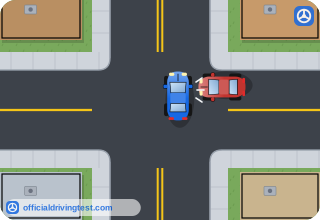
- Your front and side airbags
- Your seat and head restraint
- Your grip on the steering wheel
- Your lap and shoulder belts
Show answer
Correct answer: Your lap and shoulder belts
The manual says front airbags will not help in a side hit, and lap and shoulder belts are needed to keep you behind the wheel.
Source: Connecticut Driver's Manual (Revised March 2023), page 41 · Open this page in the manual (Manual page 41)