Connecticut: Right-of-way and turning — Part 5 Practice Test
Questions in this part include: “A driver overtaking a vehicle traveling in the same direction must do what?” · “How is each road approaching a roundabout marked?”
Independent educational site · not affiliated with any government agency or DMV
Ready? Test yourself
- Instant feedback with an explanation
- Every answer cites its source in the manual
- Your best score is saved on this device
Questions are original and based on the official manual "Connecticut Driver's Manual" (Revised March 2023), Connecticut Department of Motor Vehicles (DMV).
All 18 questions in this practice test
Take the test above first, then use this list to study. Tap “Show answer” to see the correct answer and explanation.
Show the questions and answersHide the questions
-
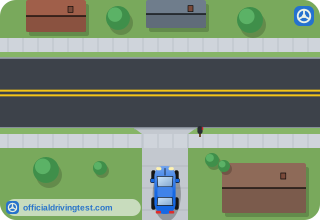
What must drivers entering a road from a driveway, alley or roadside do?
- Yield only to vehicles coming from the left
- Yield to vehicles already on the main road
- Enter quickly so that they do not block the driveway
- Sound the horn and then enter the road
Show answer
Correct answer: Yield to vehicles already on the main road
Vehicles already on the main road have the right-of-way.
Source: Connecticut Driver's Manual (Revised March 2023), page 37 · Open this page in the manual (Manual page 37)
-
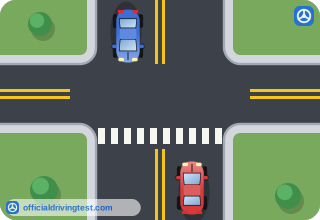
When may drivers enter an intersection?
- Whenever the light is green, even if traffic ahead is stopped
- Whenever no pedestrian is in the crosswalk
- Only when they intend to turn
- Only when they can get through it without having to stop
Show answer
Correct answer: Only when they can get through it without having to stop
The manual says to wait until traffic ahead clears so you do not block the intersection.
Source: Connecticut Driver's Manual (Revised March 2023), page 37 · Open this page in the manual (Manual page 37)
-
A driver overtaking a vehicle traveling in the same direction must do what?
- Yield to that vehicle, even if it is slowing or coming to a stop
- Sound the horn and continue to pass it without stopping
- Get ahead of it quickly before it comes to a stop
- Yield only if the vehicle has its turn signal turned on
Show answer
Correct answer: Yield to that vehicle, even if it is slowing or coming to a stop
The overtaking driver must yield to the vehicle being overtaken.
Source: Connecticut Driver's Manual (Revised March 2023), page 37 · Open this page in the manual (Manual page 37)
-
When are drivers required to yield the right-of-way to a bus traveling in the same direction?
- Only when the bus has passengers on board
- Only when the bus is in the right lane
- When the bus appropriately signals
- Never, because buses must yield to cars
Show answer
Correct answer: When the bus appropriately signals
Drivers must yield to a same-direction bus that signals appropriately.
Source: Connecticut Driver's Manual (Revised March 2023), page 37 · Open this page in the manual (Manual page 37)
-
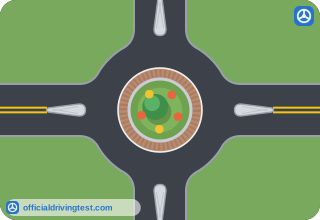
What is a roundabout?
- A road that loops back to the place where it first started
- A parking lot area that is built around a circular island
- A road that has only one lane and is shaped like a circle
- An intersection controlled by a circular island in the center
Show answer
Correct answer: An intersection controlled by a circular island in the center
A roundabout is an intersection controlled by a circular island in the center.
Source: Connecticut Driver's Manual (Revised March 2023), page 37 · Open this page in the manual (Manual page 37)
-
How many lanes may a roundabout have?
- Only a single lane
- One lane or two lanes
- Always exactly two lanes
- Up to four lanes
Show answer
Correct answer: One lane or two lanes
A roundabout may have one lane or two lanes.
Source: Connecticut Driver's Manual (Revised March 2023), page 37 · Open this page in the manual (Manual page 37)
-
In a roundabout, who must yield the right-of-way?
- Circulating traffic must yield to entering traffic
- The larger vehicle must yield to the smaller one
- Entering traffic must yield to circulating traffic
- The vehicle that arrives last must always stop
Show answer
Correct answer: Entering traffic must yield to circulating traffic
Entering traffic yields to traffic already circulating.
Source: Connecticut Driver's Manual (Revised March 2023), page 37 · Open this page in the manual (Manual page 37)
-
How is each road approaching a roundabout marked?
- With a yield sign, and possibly yield line markings on the pavement
- With a stop sign and a solid stop line painted on the pavement
- With a traffic signal that is placed on each road approaching it
- With a no-passing sign and a double yellow line on the pavement
Show answer
Correct answer: With a yield sign, and possibly yield line markings on the pavement
Each approach has a yield sign and may also have yield lines painted on the pavement.
Source: Connecticut Driver's Manual (Revised March 2023), page 37 · Open this page in the manual (Manual page 37)
-
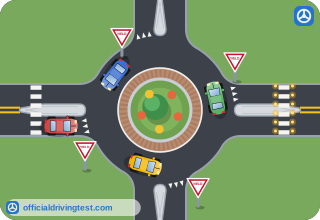
What should you do when approaching a roundabout?
- Speed up to enter before other vehicles
- Slow down
- Stop at its entrance every time
- Move toward the center of the road
Show answer
Correct answer: Slow down
The manual says to slow down when approaching a roundabout.
Source: Connecticut Driver's Manual (Revised March 2023), page 37 · Open this page in the manual (Manual page 37)
-
If there is more than one lane as you approach a roundabout, how do you choose the proper lane?
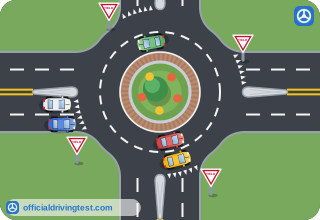
- Always use the left lane so that you can get around much faster
- Always use the right lane to stay out of the way of others
- Use the lane that has the fewest vehicles in it at that moment
- Follow the posted signs and lane-use controls for your intended movement
Show answer
Correct answer: Follow the posted signs and lane-use controls for your intended movement
The posted signs and lane-use controls show the proper lane.
Source: Connecticut Driver's Manual (Revised March 2023), page 37 · Open this page in the manual (Manual page 37)
-
Should you stop within a roundabout to allow traffic to enter from another leg?
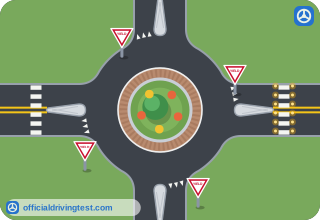
- Yes, whenever the entering vehicle is a large truck or a bus
- Yes, whenever you are driving in the outer lane of it
- No, do not stop within the roundabout to allow traffic to enter
- Yes, if you turn on your hazard lights before you stop
Show answer
Correct answer: No, do not stop within the roundabout to allow traffic to enter
The manual says not to stop within the roundabout for entering traffic.
Source: Connecticut Driver's Manual (Revised March 2023), page 37 · Open this page in the manual (Manual page 37)
-
What must you do before you make a U-turn?
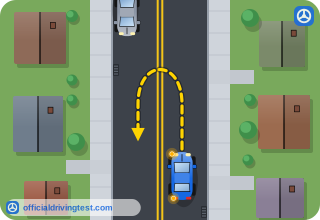
- Check for signs prohibiting them
- Sound your horn twice
- Turn on your hazard lights
- Move to the right lane of the road
Show answer
Correct answer: Check for signs prohibiting them
U-turns are not legal everywhere, so check for signs that prohibit them.
Source: Connecticut Driver's Manual (Revised March 2023), page 37 · Open this page in the manual (Manual page 37)
-
When making a U-turn, which lane should you proceed into?
- The left lane that is closest to the center of the road
- The outside or right hand lane traveling in the opposite direction
- Any lane that happens to be open when you complete it
- The lane that has the fewest vehicles in it at that time
Show answer
Correct answer: The outside or right hand lane traveling in the opposite direction
After the U-turn you proceed into the outside or right hand lane in the opposite direction.
Source: Connecticut Driver's Manual (Revised March 2023), page 37 · Open this page in the manual (Manual page 37)
-
What is the correct procedure when making a U-turn?
- Give a left turn signal, stop, and check for approaching traffic
- Give a right turn signal and then turn in one motion
- Sound your horn and begin to turn at once without stopping
- Slow down and turn without stopping or checking traffic
Show answer
Correct answer: Give a left turn signal, stop, and check for approaching traffic
The procedure is a left turn signal, a stop, and a check for approaching traffic.
Source: Connecticut Driver's Manual (Revised March 2023), page 37 · Open this page in the manual (Manual page 37)
-
What must you do before turning right on a red light?
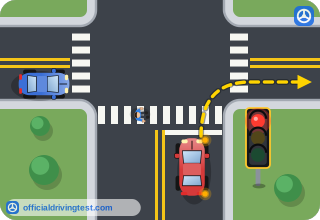
- Slow down and turn if no pedestrians are in the crosswalk, whatever the signs say
- Wait for the light to turn yellow before making the turn
- Stop only if other vehicles are present, then turn when the way is clear
- Stop fully and check that no traffic is oncoming and no sign prohibits the turn
Show answer
Correct answer: Stop fully and check that no traffic is oncoming and no sign prohibits the turn
You may turn right on red after a full stop and checking for oncoming traffic and for a sign prohibiting the turn.
Source: Connecticut Driver's Manual (Revised March 2023), page 45 · Open this page in the manual (Manual page 45)
-
What does a steady green traffic light mean when you are turning left?
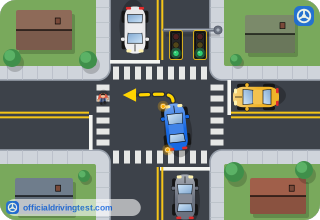
- You may turn, but only when it is safe to do so
- You must wait for a green arrow before you may turn
- You have the right-of-way over all oncoming traffic
- You may turn only after the light turns yellow
Show answer
Correct answer: You may turn, but only when it is safe to do so
With a steady green light you may turn left only when it is safe to do so.
Source: Connecticut Driver's Manual (Revised March 2023), page 45 · Open this page in the manual (Manual page 45)
-
If you are turning right on a green light, whom must you yield to?
- Vehicles behind you
- Bicyclists only
- Pedestrians crossing the street
- Nobody, because you have a green light
Show answer
Correct answer: Pedestrians crossing the street
When turning right on green you must yield to pedestrians crossing the street.
Source: Connecticut Driver's Manual (Revised March 2023), page 45 · Open this page in the manual (Manual page 45)
-
What does a green arrow signal mean?
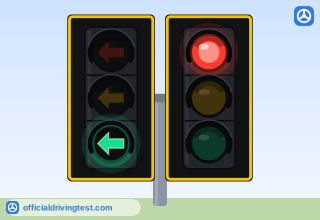
- You must yield to oncoming traffic before turning
- You may only go straight through the intersection
- You must stop and wait for the arrow to go out
- You can safely turn in the direction of the arrow
Show answer
Correct answer: You can safely turn in the direction of the arrow
A green arrow means you can safely turn in the direction of the arrow, with no oncoming or crossing traffic.
Source: Connecticut Driver's Manual (Revised March 2023), page 45 · Open this page in the manual (Manual page 45)