Connecticut: Right-of-way and turning — Part 3 Practice Test
Questions in this part include: “Where is it dangerous to pass because vehicles are likely to enter or cross the road?” · “After you complete a turn, when may you change to another lane if you need to?”
Independent educational site · not affiliated with any government agency or DMV
Ready? Test yourself
- Instant feedback with an explanation
- Every answer cites its source in the manual
- Your best score is saved on this device
Questions are original and based on the official manual "Connecticut Driver's Manual" (Revised March 2023), Connecticut Department of Motor Vehicles (DMV).
All 19 questions in this practice test
Take the test above first, then use this list to study. Tap “Show answer” to see the correct answer and explanation.
Show the questions and answersHide the questions
-
How does the speed of an oncoming vehicle that is far away usually look to you?
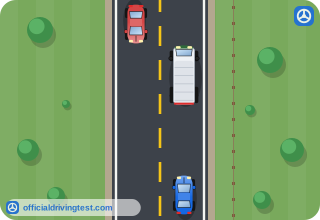
- Faster than it really is
- Slower than it really is
- Exactly as fast as it really is
- Faster at night and slower by day
Show answer
Correct answer: Slower than it really is
Oncoming vehicles at that distance do not seem to be coming as fast as they really are.
Source: Connecticut Driver's Manual (Revised March 2023), page 23 · Open this page in the manual (Manual page 23)
-
If you can actually see a distant oncoming vehicle coming closer, what does that mean for passing?
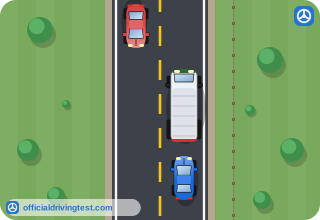
- It is far enough away that passing is safe
- You should speed up and pass quickly
- You should flash your headlights and pass
- It may be too close for you to pass
Show answer
Correct answer: It may be too close for you to pass
A vehicle that is far away appears to be standing still, so if you can see it coming closer it may be too close for you to pass.
Source: Connecticut Driver's Manual (Revised March 2023), page 23 · Open this page in the manual (Manual page 23)
-
If you are not sure there is enough space to pass, what should you do?
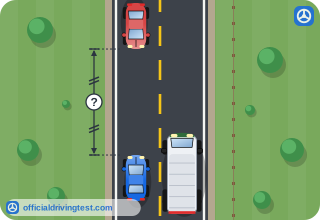
- Wait to pass until you are sure there is enough space
- Pass quickly and hope other drivers make room
- Pass on the shoulder
- Sound your horn and begin to pass
Show answer
Correct answer: Wait to pass until you are sure there is enough space
The manual says to wait to pass until you are sure that there is enough space.
Source: Connecticut Driver's Manual (Revised March 2023), page 23 · Open this page in the manual (Manual page 23)
-
After passing a vehicle, when is it safe to return to the driving lane?
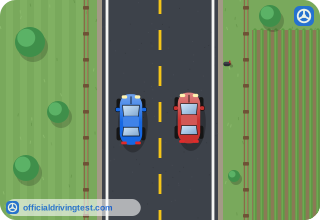
- As soon as you are even with its rear bumper
- As soon as one of its headlights is visible
- Both its headlights show in your rear-view mirror
- When it has disappeared from your mirror
Show answer
Correct answer: Both its headlights show in your rear-view mirror
Seeing both headlights of the vehicle you just passed in your rear-view mirror shows it is safe to return to the driving lane.
Source: Connecticut Driver's Manual (Revised March 2023), page 23 · Open this page in the manual (Manual page 23)
-
When you pass, what should you NOT count on?
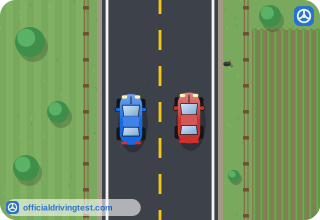
- Having a clear view of the road ahead
- Other drivers making room for you
- Having your headlights turned on
- Having a signal to warn other drivers
Show answer
Correct answer: Other drivers making room for you
The manual says not to pass unless you have space to return to the lane and not to count on other drivers to make room for you.
Source: Connecticut Driver's Manual (Revised March 2023), page 23 · Open this page in the manual (Manual page 23)
-
What do signs or lane markings that show a no passing zone tell you?
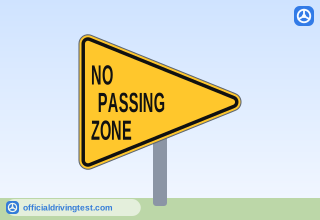
- The road ahead is closed to all traffic
- The speed limit is lower ahead
- Vehicles ahead are slower than you
- You cannot see far enough ahead to pass
Show answer
Correct answer: You cannot see far enough ahead to pass
No passing zone signs or markings tell you that you cannot see far enough ahead to pass.
Source: Connecticut Driver's Manual (Revised March 2023), page 23 · Open this page in the manual (Manual page 23)
-
Where is it dangerous to pass because vehicles are likely to enter or cross the road?
- Intersections, railroad crossings and shopping center entrances
- Long, straight highway stretches with no side roads or driveways
- Any road that has a paved shoulder beside it
- Roads that have only two lanes in total
Show answer
Correct answer: Intersections, railroad crossings and shopping center entrances
The manual names intersections, railroad crossings and shopping center entrances as places where passing is dangerous.
Source: Connecticut Driver's Manual (Revised March 2023), page 23 · Open this page in the manual (Manual page 23)
-
What does the manual say about passing on the shoulder?
- You may pass on a paved shoulder if no one is behind you
- You may pass on the shoulder only on highways
- Never pass on the shoulder, whether it is paved or not
- You may pass on the shoulder only at night
Show answer
Correct answer: Never pass on the shoulder, whether it is paved or not
Other drivers will never expect you on the shoulder and may pull off the road without looking.
Source: Connecticut Driver's Manual (Revised March 2023), page 23 · Open this page in the manual (Manual page 23)
-
On a multi-lane road, which lane is intended for passing slower vehicles?
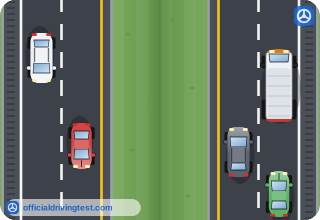
- The right-most lane
- The left-most lane
- The middle lane only
- Whichever lane is empty
Show answer
Correct answer: The left-most lane
The left-most lane is intended for passing slower vehicles.
Source: Connecticut Driver's Manual (Revised March 2023), page 23 · Open this page in the manual (Manual page 23)
-
Why is passing on the right on a multi-lane road risky?
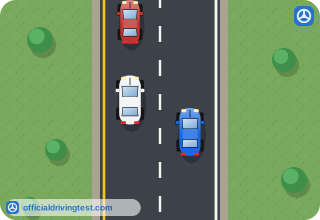
- The right lane is always reserved for trucks and buses
- Passing on the right is prohibited by every sign
- Right-lane vehicles are required to stop when passed
- Other drivers may not see you and may change lanes suddenly
Show answer
Correct answer: Other drivers may not see you and may change lanes suddenly
The other driver may have difficulty seeing you and might suddenly change lanes in front of you.
Source: Connecticut Driver's Manual (Revised March 2023), page 23 · Open this page in the manual (Manual page 23)
-
When your direction of travel has fewer than three lanes, which lane does Connecticut law require you to use?
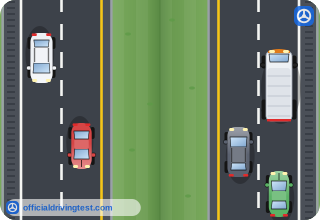
- The right lane, except when passing
- The left lane, except when exiting
- Any lane you choose
- The center lane at all times
Show answer
Correct answer: The right lane, except when passing
Connecticut law requires you to drive in the right lane, except when passing, when your direction of travel is less than three lanes.
Source: Connecticut Driver's Manual (Revised March 2023), page 23 · Open this page in the manual (Manual page 23)
-
On a multi-lane road, when may you move into the left lane even if you are not passing?
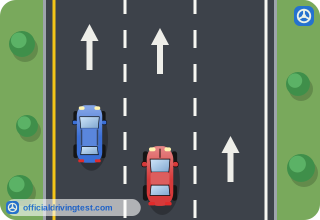
- When you want to drive faster than the traffic around you
- When the right lane has a bicycle in it
- When you must turn left or exit on the left
- Any time the left lane happens to be clear
Show answer
Correct answer: When you must turn left or exit on the left
If you need to make a left turn or exit the highway on the left, you may move into the left lane, safely and with a signal.
Source: Connecticut Driver's Manual (Revised March 2023), page 23 · Open this page in the manual (Manual page 23)
-
Where no signs or lane markings control turning, which lane should you turn from and into?
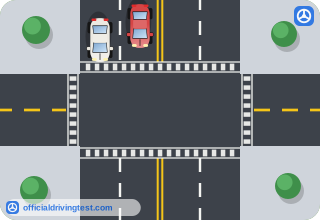
- From the center lane of the road, into the lane farthest from where you came from
- From the lane nearest your direction, into the lane nearest where you came from
- From any lane at all, into the left-most lane on the new road
- From the lane farthest from your direction, into the closest lane
Show answer
Correct answer: From the lane nearest your direction, into the lane nearest where you came from
Turning this way means you cross the fewest lanes of traffic.
Source: Connecticut Driver's Manual (Revised March 2023), page 23 · Open this page in the manual (Manual page 23)
-
When making a turn, how should you go from one lane to the other?
- By moving wide into the next lane first, then correcting
- By crossing lane lines to reach the farthest lane
- By stopping in the middle to check traffic
- As directly as possible, without crossing lane lines
Show answer
Correct answer: As directly as possible, without crossing lane lines
The manual says to go from one lane to the other as directly as possible without crossing lane lines or interfering with traffic.
Source: Connecticut Driver's Manual (Revised March 2023), page 23 · Open this page in the manual (Manual page 23)
-
After you complete a turn, when may you change to another lane if you need to?
- Once it is safe, after looking and signaling
- Immediately, before you look at traffic
- Only after you have driven another mile
- Only after another driver honks at you
Show answer
Correct answer: Once it is safe, after looking and signaling
After the turn is complete and once it is safe, you can change lanes, always looking and signaling before changing lanes.
Source: Connecticut Driver's Manual (Revised March 2023), page 23 · Open this page in the manual (Manual page 23)
-
What should you avoid when making a right turn?
- Turning from the lane closest to the curb
- Signaling before the turn
- Swinging wide to the left before making the turn
- Staying in your lane during the turn
Show answer
Correct answer: Swinging wide to the left before making the turn
If you swing wide, the driver behind may think you are changing lanes or turning left and may try to pass you on the right.
Source: Connecticut Driver's Manual (Revised March 2023), page 24 · Open this page in the manual (Manual page 24)
-
Why should you not swing wide as you complete a right turn?
- Your tires will wear faster on the curb side
- Drivers in the far lane will not expect you there
- Right turns must always be made sharply
- The curb lane is closed to turning vehicles
Show answer
Correct answer: Drivers in the far lane will not expect you there
If you swing wide as you complete the turn, drivers who are in the far lane will not expect to see you there.
Source: Connecticut Driver's Manual (Revised March 2023), page 24 · Open this page in the manual (Manual page 24)
-
What should you avoid when making a left turn?
- Leaving room for oncoming vehicles to turn left in front of you
- Giving a signal well before you begin the left turn
- Looking over your shoulder before you begin to turn
- Cutting the corner so sharply you hit someone approaching from the left
Show answer
Correct answer: Cutting the corner so sharply you hit someone approaching from the left
The manual says to avoid cutting the corner so sharply that you run into someone approaching from the left.
Source: Connecticut Driver's Manual (Revised March 2023), page 24 · Open this page in the manual (Manual page 24)
-
When you make a left turn, what room should you leave?
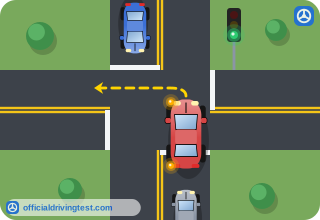
- Room for oncoming vehicles to turn left in front of you
- Room for vehicles behind you to pass on the left
- Room for pedestrians to cross in front of the vehicle behind
- No room is needed beyond your own lane
Show answer
Correct answer: Room for oncoming vehicles to turn left in front of you
While not cutting the corner, be sure to leave room for oncoming vehicles to turn left in front of you.
Source: Connecticut Driver's Manual (Revised March 2023), page 24 · Open this page in the manual (Manual page 24)