Connecticut: Right-of-way and turning — Part 2 Practice Test
Questions in this part include: “Which of these counts as changing lanes?” · “As a general rule, how many vehicles should you pass at one time?”
Independent educational site · not affiliated with any government agency or DMV
Ready? Test yourself
- Instant feedback with an explanation
- Every answer cites its source in the manual
- Your best score is saved on this device
Questions are original and based on the official manual "Connecticut Driver's Manual" (Revised March 2023), Connecticut Department of Motor Vehicles (DMV).
All 19 questions in this practice test
Take the test above first, then use this list to study. Tap “Show answer” to see the correct answer and explanation.
Show the questions and answersHide the questions
-
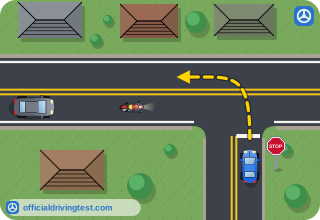
Before turning left, how should you look for motorcycles?
- Looking only in your mirrors and behind you
- Listening carefully for the sound of an engine
- Looking only at the traffic directly behind your vehicle
- Looking carefully to the front and sides of your vehicle
Show answer
Correct answer: Looking carefully to the front and sides of your vehicle
Before turning left, be alert for motorcycles by looking carefully to the front and sides of your vehicle.
Source: Connecticut Driver's Manual (Revised March 2023), page 18 · Open this page in the manual (Manual page 18)
-
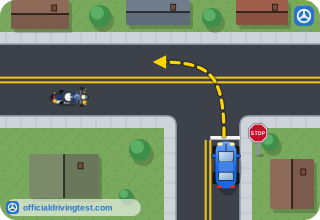
A motorcycle ahead has its turn signal flashing. When should you pull out in front of it?
- As soon as you see the signal flashing
- Not until you see it actually begin to turn
- After counting two seconds
- When the motorcyclist waves you ahead
Show answer
Correct answer: Not until you see it actually begin to turn
Do not pull out in front of a motorcycle until you see that it is actually beginning to turn.
Source: Connecticut Driver's Manual (Revised March 2023), page 18 · Open this page in the manual (Manual page 18)
-
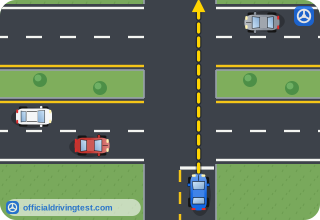
When is stopping halfway across traffic safe?
- Whenever the other lanes of traffic look busy to you
- Only when a median divider is large enough for your vehicle
- Only when you have a green light at the intersection
- Whenever you are driving a small vehicle such as a car
Show answer
Correct answer: Only when a median divider is large enough for your vehicle
The manual says it is safe only when the median divider is large enough for your vehicle.
Source: Connecticut Driver's Manual (Revised March 2023), page 21 · Open this page in the manual (Manual page 21)
-
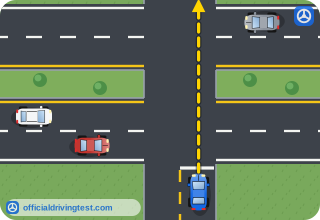
What must you not do when you stop in a divider while crossing traffic?
- Use your turn signal while you are waiting there
- Wait for a gap in the next lane of traffic
- Leave part of your vehicle sticking into traffic
- Check for pedestrians in the crosswalk ahead of you
Show answer
Correct answer: Leave part of your vehicle sticking into traffic
The manual says not to stop in a divider where part of your vehicle is sticking into traffic.
Source: Connecticut Driver's Manual (Revised March 2023), page 21 · Open this page in the manual (Manual page 21)
-
You have a green light, but vehicles are blocking your way across the intersection. What should you do?
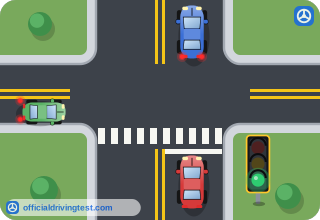
- Start across and wait in the middle
- Do not start across the intersection
- Sound your horn until traffic clears
- Drive around the blocking vehicles
Show answer
Correct answer: Do not start across the intersection
The manual says not to start across the intersection if vehicles are blocking your way, even with a green light.
Source: Connecticut Driver's Manual (Revised March 2023), page 21 · Open this page in the manual (Manual page 21)
-
What can happen if you are caught in an intersection when the light changes to red?
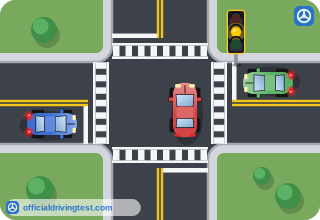
- You are allowed to wait until the light is green again
- You get the right of way over crossing traffic
- Nothing, because you entered on green
- You block other traffic and can get a ticket
Show answer
Correct answer: You block other traffic and can get a ticket
The manual says you will block other traffic and can get a ticket for blocking an intersection.
Source: Connecticut Driver's Manual (Revised March 2023), page 21 · Open this page in the manual (Manual page 21)
-
An approaching vehicle has a turn signal on. What should you do before you turn?
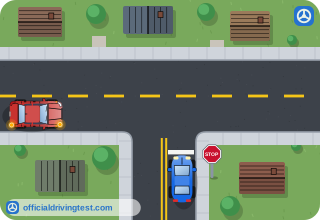
- Wait until the other driver actually starts to turn
- Turn right away, since that driver is turning too
- Assume the other driver will give you enough space
- Flash your headlights once and then start your turn
Show answer
Correct answer: Wait until the other driver actually starts to turn
The manual says never to assume another driver will share space; wait until the driver actually starts to turn.
Source: Connecticut Driver's Manual (Revised March 2023), page 21 · Open this page in the manual (Manual page 21)
-
Why should you not assume an approaching vehicle will turn because its signal is on?
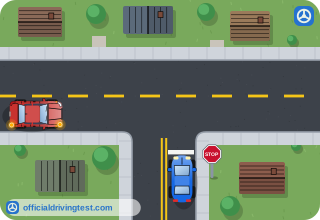
- Turn signals only work on vehicles that have two headlights
- The signal shows only the speed of the approaching vehicle
- The driver may turn later or may have forgotten a prior signal
- The driver is required to turn at the next corner ahead
Show answer
Correct answer: The driver may turn later or may have forgotten a prior signal
The manual says the driver may plan to turn after passing you or may have forgotten to turn the signal off.
Source: Connecticut Driver's Manual (Revised March 2023), page 21 · Open this page in the manual (Manual page 21)
-
Which of these counts as changing lanes?
- Slowing down while staying inside your own lane
- Stopping at a red light in the same lane you used
- Entering the roadway from the curb or shoulder
- Turning on your headlights before you drive away at dusk
Show answer
Correct answer: Entering the roadway from the curb or shoulder
Changing lanes includes moving from one lane to another, merging from an entrance ramp, and entering the roadway from the curb or shoulder.
Source: Connecticut Driver's Manual (Revised March 2023), page 23 · Open this page in the manual (Manual page 23)
-
Before you change lanes, which traffic must you check for?
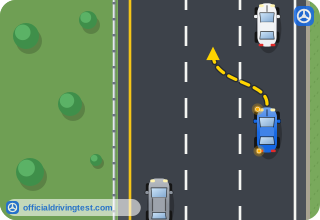
- Only traffic in front of your vehicle
- Traffic to the side of and behind your vehicle
- Only traffic in the lane you are leaving
- Only oncoming traffic
Show answer
Correct answer: Traffic to the side of and behind your vehicle
You must check for traffic to the side of and behind your vehicle before you change lanes.
Source: Connecticut Driver's Manual (Revised March 2023), page 23 · Open this page in the manual (Manual page 23)
-
What are "blind spots" when you drive?
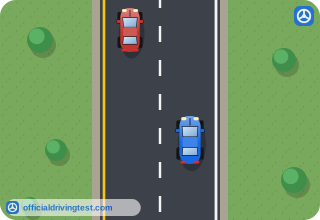
- Places on the road where a no passing zone begins
- Areas directly in front of your hood and bumper
- Parts of the road hidden from view by darkness
- Areas near the rear corners you cannot see in mirrors
Show answer
Correct answer: Areas near the rear corners you cannot see in mirrors
The manual calls the areas near the rear corners of your vehicle blind spots because you cannot see them through your mirrors.
Source: Connecticut Driver's Manual (Revised March 2023), page 23 · Open this page in the manual (Manual page 23)
-
How must you check your blind spot before changing lanes?
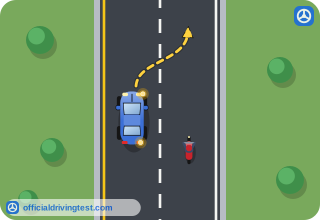
- Turn your head and look over your shoulder
- Look only in the rear-view mirror
- Look only in both side mirrors
- Sound your horn and wait for a reply
Show answer
Correct answer: Turn your head and look over your shoulder
You must turn your head and look to see vehicles in your blind spot.
Source: Connecticut Driver's Manual (Revised March 2023), page 23 · Open this page in the manual (Manual page 23)
-
When you check traffic before a lane change, how long may you take your eyes off the road ahead?
- Up to 5 seconds
- Up to 10 seconds
- No more than an instant
- As long as the lane looks clear
Show answer
Correct answer: No more than an instant
Do not take your eyes off the road ahead for more than an instant, because traffic ahead could stop suddenly.
Source: Connecticut Driver's Manual (Revised March 2023), page 23 · Open this page in the manual (Manual page 23)
-
When should you check over your shoulder for traffic in your blind spot?
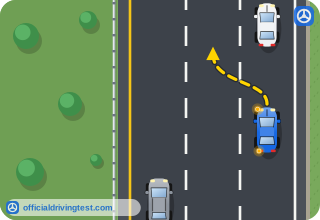
- Only after you have entered the new lane
- Just before you change lanes
- Only when you are parked
- Several minutes before you plan to move
Show answer
Correct answer: Just before you change lanes
The manual says to check over your shoulder for traffic in your blind spot just before you change lanes.
Source: Connecticut Driver's Manual (Revised March 2023), page 23 · Open this page in the manual (Manual page 23)
-
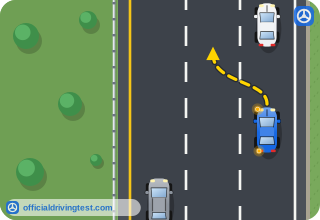
Why should you check the far lane before changing lanes?
- Vehicles in the far lane always have the right-of-way
- The far lane is always the passing lane on the road
- You must signal to drivers in the far lane first
- Someone there may be planning to move into your target lane
Show answer
Correct answer: Someone there may be planning to move into your target lane
Another driver in the far lane may be planning to move into the same lane that you want to enter.
Source: Connecticut Driver's Manual (Revised March 2023), page 23 · Open this page in the manual (Manual page 23)
-
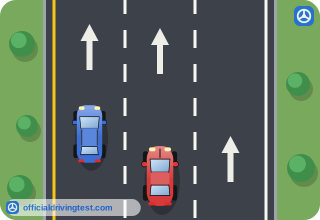
If you want to change several lanes, how should you do it?
- One lane at a time
- Wait until all lanes are clear, then cross them at once
- Cross all lanes quickly with your horn sounding
- Use the far lane first and then work back
Show answer
Correct answer: One lane at a time
It is safest and easiest to merge one lane at a time, like taking stairs one step at a time.
Source: Connecticut Driver's Manual (Revised March 2023), page 23 · Open this page in the manual (Manual page 23)
-
As a general rule, how many vehicles should you pass at one time?
- Two vehicles
- Three vehicles
- One vehicle
- As many as the road markings allow
Show answer
Correct answer: One vehicle
The manual says not to count on having time to pass several vehicles at once; as a general rule, pass only one vehicle at a time.
Source: Connecticut Driver's Manual (Revised March 2023), page 23 · Open this page in the manual (Manual page 23)
-
Which of these may cause you to lose your space for passing?
- A long straight road with no other traffic
- A narrow bridge or reduced lane width
- Traffic far behind you on the road
- A wide, paved shoulder beside your lane
Show answer
Correct answer: A narrow bridge or reduced lane width
The manual lists people or bicyclists near the road, a narrow bridge or reduced lane width, and ice, a pothole or an object on the road.
Source: Connecticut Driver's Manual (Revised March 2023), page 23 · Open this page in the manual (Manual page 23)
-
At 55 mph, how much clear distance do you need to pass safely, counting the oncoming vehicle's travel?
- About 400 feet
- About 800 feet
- Over 1600 feet
- About 3,200 feet
Show answer
Correct answer: Over 1600 feet
You travel over 800 feet and so does the oncoming vehicle, so you need over 1600 feet (about one-third of a mile).
Source: Connecticut Driver's Manual (Revised March 2023), page 23 · Open this page in the manual (Manual page 23)