Connecticut: Right-of-way and turning — Part 1 Practice Test
Questions in this part include: “Every time you make a turn during the road test, what should you be aware of and what should you adjust?” · “Before you start to move through an intersection, why should you look across it?”
Independent educational site · not affiliated with any government agency or DMV
Ready? Test yourself
- Instant feedback with an explanation
- Every answer cites its source in the manual
- Your best score is saved on this device
Questions are original and based on the official manual "Connecticut Driver's Manual" (Revised March 2023), Connecticut Department of Motor Vehicles (DMV).
All 19 questions in this practice test
Take the test above first, then use this list to study. Tap “Show answer” to see the correct answer and explanation.
Show the questions and answersHide the questions
-
Every time you make a turn during the road test, what should you be aware of and what should you adjust?
- Only other vehicles; your following distance
- Only road signs; your lane position
- Weather conditions; your headlights
- Other traffic and pedestrians; your speed
Show answer
Correct answer: Other traffic and pedestrians; your speed
You should be aware of other traffic and pedestrians at every turn, and your speed should also be adjusted for the turn.
Source: Connecticut Driver's Manual (Revised March 2023), page 7 · Open this page in the manual (Manual page 7)
-
According to the manual, what is an intersection?
- Any place where traffic merges or crosses
- Only a place where two paved roads meet at a traffic light
- Only a crossing marked by painted crosswalk lines
- Only a place controlled by a stop sign or a stop light
Show answer
Correct answer: Any place where traffic merges or crosses
The manual defines an intersection as any place where traffic merges or crosses, including cross streets, side streets, driveways and parking lot entrances.
Source: Connecticut Driver's Manual (Revised March 2023), page 15 · Open this page in the manual (Manual page 15)
-
When you are stopped at an intersection, what should you do just before you start moving?
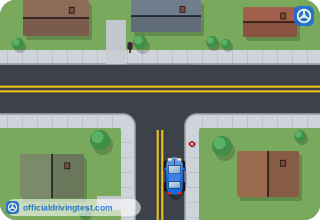
- Look only straight ahead
- Look only at the traffic light
- Look both left and right
- Tap the horn to warn cross traffic
Show answer
Correct answer: Look both left and right
The manual says that when stopped, you look both left and right just before you start moving.
Source: Connecticut Driver's Manual (Revised March 2023), page 15 · Open this page in the manual (Manual page 15)
-
Before you start to move through an intersection, why should you look across it?
- To make sure no police officer is waiting on the far side of the intersection
- To make sure the path is clear all the way through, so you will not block it if you must stop
- To make sure that the traffic light on the far side is the same color as yours
- To decide whether you can speed up to get through before the light changes
Show answer
Correct answer: To make sure the path is clear all the way through, so you will not block it if you must stop
You look across the intersection to be sure the path is clear all the way through and that you will not block it if you have to stop.
Source: Connecticut Driver's Manual (Revised March 2023), page 15 · Open this page in the manual (Manual page 15)
-
Before you turn left across traffic, what must you remember about oncoming traffic?
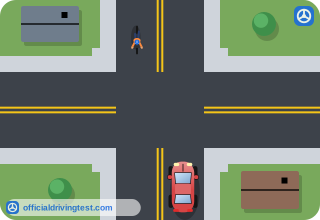
- It must yield to you if you signaled first
- Bicycles must yield to you but cars do not
- It has the right-of-way only when it has a green light
- It always has the right-of-way, including bicycles
Show answer
Correct answer: It always has the right-of-way, including bicycles
The manual states that oncoming traffic, including bicycles, always has the right-of-way when you turn left.
Source: Connecticut Driver's Manual (Revised March 2023), page 15 · Open this page in the manual (Manual page 15)
-
Before turning left, what should you check on the street onto which you are turning?
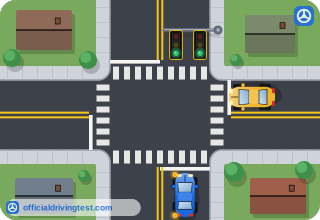
- That the street has a posted speed limit sign
- That the street has no parked cars on the far side
- That no vehicles, bicycles or pedestrians are in your path
- That the street has a marked bicycle lane
Show answer
Correct answer: That no vehicles, bicycles or pedestrians are in your path
You check that nothing is in your path on the street you are entering, otherwise you would be stuck in the path of oncoming traffic.
Source: Connecticut Driver's Manual (Revised March 2023), page 15 · Open this page in the manual (Manual page 15)
-
Just before you turn left, what should you do?
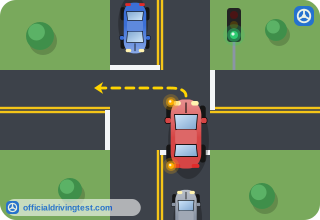
- Tap your horn to warn oncoming traffic
- Look one more time in the direction of oncoming traffic
- Check your mirrors for traffic behind you
- Stop and wait for oncoming drivers to wave you through
Show answer
Correct answer: Look one more time in the direction of oncoming traffic
The manual says to look one more time in the direction of oncoming traffic before you turn.
Source: Connecticut Driver's Manual (Revised March 2023), page 15 · Open this page in the manual (Manual page 15)
-
Before turning right, which of these must you make sure of?
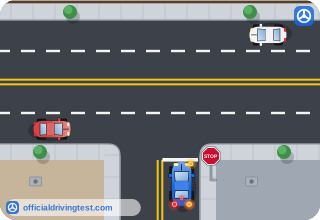
- No traffic is approaching from your right and no vehicle is stopped behind your vehicle
- No other vehicle has parked within one block of the corner where you will turn
- No traffic light is visible on the street onto which you will be turning
- No traffic is approaching from your left and no oncoming traffic is turning into your path
Show answer
Correct answer: No traffic is approaching from your left and no oncoming traffic is turning into your path
Before a right turn you make sure that no traffic approaches from your left and no oncoming traffic turns into your path.
Source: Connecticut Driver's Manual (Revised March 2023), page 15 · Open this page in the manual (Manual page 15)
-
Which of these is a rule for beginning a right turn?
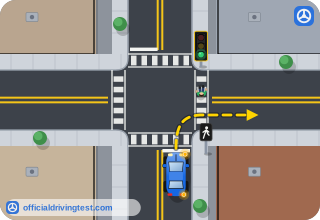
- Check for pedestrians crossing where you will be turning
- Turn first, then look for pedestrians
- Sound the horn so pedestrians clear the crossing
- Check only for vehicles, since pedestrians must yield to turning drivers
Show answer
Correct answer: Check for pedestrians crossing where you will be turning
Do not begin your turn without checking for pedestrians crossing where you will be turning.
Source: Connecticut Driver's Manual (Revised March 2023), page 15 · Open this page in the manual (Manual page 15)
-
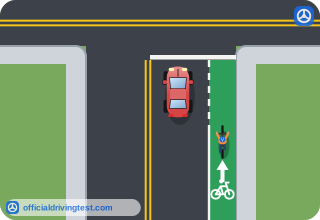
How soon after passing a bicycle may you turn right?
- Right away, if you have signaled
- Not immediately after passing it
- Right away, if the bicycle is in a bike lane
- Right away, if the bicycle is going slower than you
Show answer
Correct answer: Not immediately after passing it
The manual says not to turn immediately after passing a bicycle.
Source: Connecticut Driver's Manual (Revised March 2023), page 15 · Open this page in the manual (Manual page 15)
-
Why is it especially important to look left and right just after a light has turned green?
- People on the cross street are most likely to hurry through before their light turns red
- Vehicles waiting behind you tend to sound their horns and pull around you
- Pedestrians on the cross street always have a walk signal when your light turns green
- Cross-street drivers usually wait several seconds after their own light turns red
Show answer
Correct answer: People on the cross street are most likely to hurry through before their light turns red
Just after the light turns green is when people on the cross street are most likely to hurry through the intersection before the light changes to red.
Source: Connecticut Driver's Manual (Revised March 2023), page 15 · Open this page in the manual (Manual page 15)
-
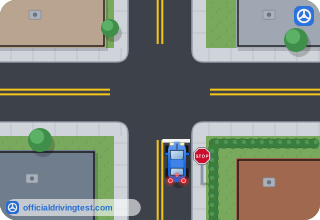
If you are stopped and your view of a cross street is blocked, what should you do?
- Sound your horn and then go
- Wait until another driver waves you ahead
- Stay stopped until the blockage disappears
- Edge forward slowly until you can see
Show answer
Correct answer: Edge forward slowly until you can see
You edge forward slowly until you can see the cross street.
Source: Connecticut Driver's Manual (Revised March 2023), page 15 · Open this page in the manual (Manual page 15)
-
Why does moving forward slowly help when your view of a cross street is blocked?
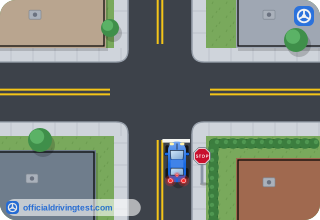
- Crossing drivers can see the front of your vehicle before you can see them
- It tells crossing drivers that you are about to turn left at the intersection
- It gives you time to check your mirrors for traffic behind you
- It lets pedestrians know that you plan to stop completely
Show answer
Correct answer: Crossing drivers can see the front of your vehicle before you can see them
Crossing drivers see the front of your vehicle first, which gives them a chance to slow down and warn you if necessary.
Source: Connecticut Driver's Manual (Revised March 2023), page 15 · Open this page in the manual (Manual page 15)
-
What does the manual say about entering an intersection during heavy traffic?
- Enter whenever your light is green, even if you may have to stop inside it
- Enter only if you can drive through without using your turn signal
- Do not enter unless there is room on the far side for your vehicle
- Enter only if no pedestrians are waiting at the crosswalk
Show answer
Correct answer: Do not enter unless there is room on the far side for your vehicle
Drivers may not enter an intersection unless there is enough space on the opposite side; entering without it is known as blocking the box or causing gridlock.
Source: Connecticut Driver's Manual (Revised March 2023), page 15 · Open this page in the manual (Manual page 15)
-
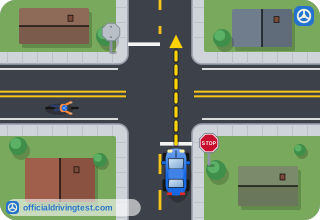
At an intersection, how must a driver treat a bicyclist?
- Go first because bicyclists are slower than cars
- Yield as you would for pedestrians and other vehicles
- Expect the bicyclist to wait until you have passed
- Honk to tell the bicyclist to stop
Show answer
Correct answer: Yield as you would for pedestrians and other vehicles
Drivers must yield to bicyclists in intersections as they would for pedestrians and other vehicles.
Source: Connecticut Driver's Manual (Revised March 2023), page 17 · Open this page in the manual (Manual page 17)
-
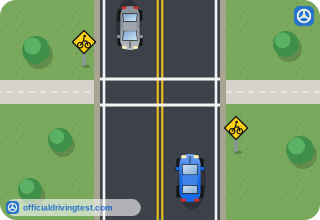
When a bicycle path or bike lane intersects a road, who must yield the right-of-way?
- The bicyclist must yield to the driver
- The one traveling more slowly must yield
- The vehicle on the left must yield
- The driver must yield to the bicyclist
Show answer
Correct answer: The driver must yield to the bicyclist
A driver must yield the right-of-way to a bicyclist when a bicycle path or bike lane intersects a road.
Source: Connecticut Driver's Manual (Revised March 2023), page 17 · Open this page in the manual (Manual page 17)
-
Before you turn across a bicycle lane or a sidewalk, what must you do?
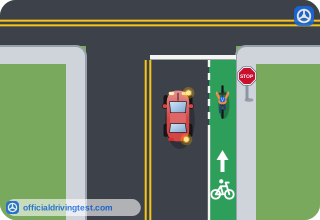
- Yield to bicyclists and persons on the sidewalk
- Honk to warn bicyclists that you are turning
- Move into the bicycle lane before you turn
- Slow down but keep moving through the lane
Show answer
Correct answer: Yield to bicyclists and persons on the sidewalk
You must yield to bicyclists in a bicycle lane or persons on a sidewalk before you turn across the lane or sidewalk.
Source: Connecticut Driver's Manual (Revised March 2023), page 17 · Open this page in the manual (Manual page 17)
-
When making turns, what should you watch carefully for?
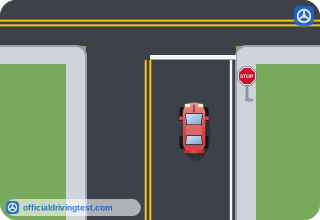
- Only pedestrians in front of you
- Bicyclists entering your lane
- Only vehicles behind you
- Only signals on the far side
Show answer
Correct answer: Bicyclists entering your lane
The manual says to watch carefully for bicyclists entering your lane when making turns.
Source: Connecticut Driver's Manual (Revised March 2023), page 17 · Open this page in the manual (Manual page 17)
-
A bicyclist is beside you and you are about to turn right. What should you do?
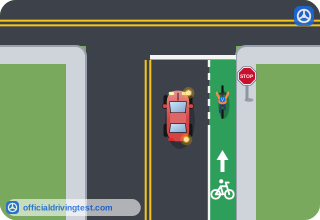
- Pass the bicyclist quickly and then make your turn
- Slow down and let the cyclist clear the intersection
- Turn in front of the bicyclist with your signal on
- Sound your horn and then make your turn
Show answer
Correct answer: Slow down and let the cyclist clear the intersection
If you are about to make a right turn, you must not pass a bicyclist immediately before the turn; slow down and let the cyclist clear the intersection.
Source: Connecticut Driver's Manual (Revised March 2023), page 17 · Open this page in the manual (Manual page 17)