Connecticut: Railroad crossings Practice Test
Railroad crossing signs, signals and gates, and how to cross the tracks safely.
Independent educational site · not affiliated with any government agency or DMV
Ready? Test yourself
- Instant feedback with an explanation
- Every answer cites its source in the manual
- Your best score is saved on this device
Questions are original and based on the official manual "Connecticut Driver's Manual" (Revised March 2023), Connecticut Department of Motor Vehicles (DMV).
All 23 questions in this practice test
Take the test above first, then use this list to study. Tap “Show answer” to see the correct answer and explanation.
Show the questions and answersHide the questions
-
As you approach any railroad crossing, what should you do?
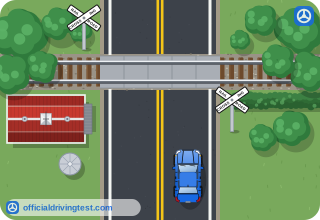
- Slow down and look up and down the tracks for any train
- Keep your speed and listen for a train horn to decide whether to stop
- Stop only when you actually see a train or warning lights at the crossing
- Shift to a lower gear and cross as quickly as you safely can
Show answer
Correct answer: Slow down and look up and down the tracks for any train
The manual says to slow down and look up and down the tracks to make sure that no trains are coming.
Source: Connecticut Driver's Manual (Revised March 2023), page 15 · Open this page in the manual (Manual page 15)
-
According to the manual, what is one of the leading causes of fatalities at railroad crossings?
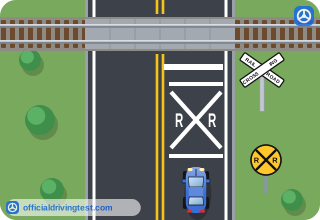
- Stopping too close to the tracks
- Driving too slowly across the tracks
- Assuming that a train is not coming
- Parking too near the crossing
Show answer
Correct answer: Assuming that a train is not coming
Even if you have never seen a train at a crossing, do not assume none are coming; that assumption is a leading cause of fatalities.
Source: Connecticut Driver's Manual (Revised March 2023), page 15 · Open this page in the manual (Manual page 15)
-
What must you check on the far side of a railroad crossing before you cross?
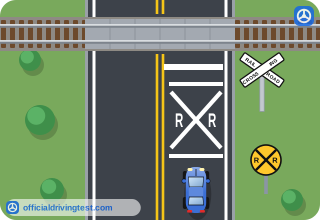
- That the pavement is dry and free of ice
- That there is room there for your vehicle
- That a flagger has waved you across
- That the road beyond has a higher speed limit
Show answer
Correct answer: That there is room there for your vehicle
Make sure there is room for your vehicle on the far side before you cross the tracks.
Source: Connecticut Driver's Manual (Revised March 2023), page 15 · Open this page in the manual (Manual page 15)
-
At a railroad crossing with more than one track, when should you start to cross after a train passes?
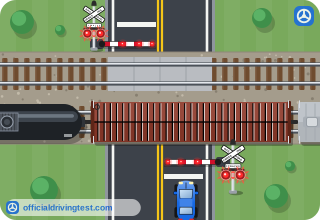
- As soon as the last railcar has passed you
- As soon as the driver behind you honks
- After counting to ten once the train has passed
- Once the passing train is well down the track
Show answer
Correct answer: Once the passing train is well down the track
The train that just passed may hide another one that is approaching, so wait until it is well down the track.
Source: Connecticut Driver's Manual (Revised March 2023), page 15 · Open this page in the manual (Manual page 15)
-
Some trucks are required by law to stop at railroad crossings. What should you do when one stops and no train is approaching?
- Pass the stopped truck on the left to avoid being delayed
- Honk to tell the driver to cross the tracks right away
- Drive around the stopped truck on the shoulder to save time
- Be alert and let the truck driver stop and resume travel safely
Show answer
Correct answer: Be alert and let the truck driver stop and resume travel safely
You should be alert and allow the truck driver to stop and to resume travel safely if no train is approaching.
Source: Connecticut Driver's Manual (Revised March 2023), page 20 · Open this page in the manual (Manual page 20)
-
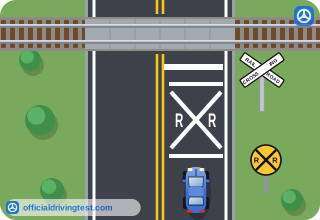
When you cross railroad tracks, what must you make sure of?
- That you can cross the tracks at full highway speed
- That you have shifted into a lower gear before crossing
- That you can cross without having to stop on the tracks
- That all other vehicles have crossed ahead of you first
Show answer
Correct answer: That you can cross without having to stop on the tracks
The manual says to make sure you can cross without stopping on the tracks.
Source: Connecticut Driver's Manual (Revised March 2023), page 21 · Open this page in the manual (Manual page 21)
-
Which vehicles does the manual say are required to stop at railroad crossings, so you should leave extra room behind them?
- Taxis, delivery vans, pickup trucks and passenger cars in general
- Pickup trucks, sport utility vehicles and small passenger cars
- Transit buses, school buses and vehicles carrying hazardous materials
- Motorcycles, bicycles and mopeds traveling in the right lane
Show answer
Correct answer: Transit buses, school buses and vehicles carrying hazardous materials
The manual names transit buses, school buses and vehicles carrying hazardous materials.
Source: Connecticut Driver's Manual (Revised March 2023), page 21 · Open this page in the manual (Manual page 21)
-
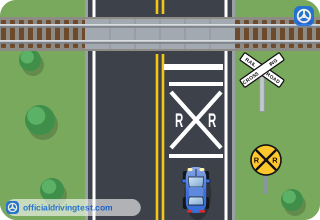
Why slow down at some railroad crossings?
- Trains always cross at low speed
- The crossing signs are hard to read
- Some crossings are bumpy
- The road narrows at the tracks
Show answer
Correct answer: Some crossings are bumpy
The manual says some crossings are bumpy, so you need to slow down to cross safely.
Source: Connecticut Driver's Manual (Revised March 2023), page 22 · Open this page in the manual (Manual page 22)
-
What should you not do if there is a railroad grade crossing ahead?
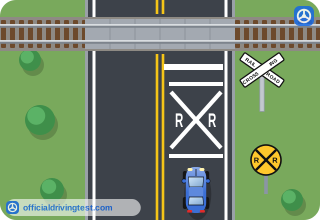
- Pass another vehicle
- Slow down
- Look for trains
- Check for room to cross
Show answer
Correct answer: Pass another vehicle
The manual says not to pass if there is a railroad grade crossing ahead.
Source: Connecticut Driver's Manual (Revised March 2023), page 22 · Open this page in the manual (Manual page 22)
-
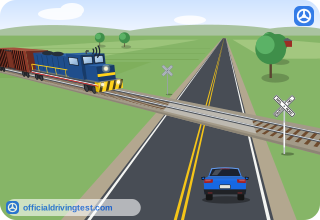
Who must yield the right-of-way to trains crossing the roadway?
- The train, if it is slowing down
- The driver who is closer to the tracks
- Only drivers of large vehicles
- You, the driver
Show answer
Correct answer: You, the driver
The manual says you must yield the right-of-way to trains crossing the roadway.
Source: Connecticut Driver's Manual (Revised March 2023), page 37 · Open this page in the manual (Manual page 37)
-
What should you do when you see a circular railroad crossing sign?
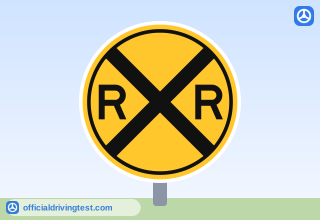
- Speed up to cross before a train comes
- Slow down, look and listen for trains
- Honk your horn and proceed
- Stop only if a train is in sight
Show answer
Correct answer: Slow down, look and listen for trains
At a railroad crossing sign, slow down, look and listen for trains.
Source: Connecticut Driver's Manual (Revised March 2023), page 46 · Open this page in the manual (Manual page 46)
-
What should you never try to do at a railroad crossing?
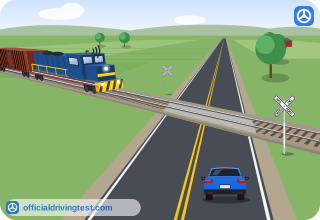
- Beat a train across the tracks
- Wait for a train to pass
- Look both ways before crossing
- Cross at a slow, steady speed
Show answer
Correct answer: Beat a train across the tracks
The manual says never try to beat a train across the tracks.
Source: Connecticut Driver's Manual (Revised March 2023), page 51 · Open this page in the manual (Manual page 51)
-
If there is not room for your vehicle on the far side of a railroad crossing and you would have to stop on the tracks, what should you do?
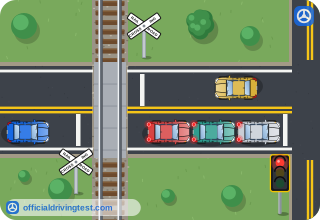
- Cross quickly and stop as soon as you are past the tracks
- Stop on the tracks and wait for the traffic ahead to move
- Wait until there is room on the far side before you start to cross
- Stop on the tracks and turn on your hazard lights until clear
Show answer
Correct answer: Wait until there is room on the far side before you start to cross
The manual says never start to cross if you would have to stop on the tracks; wait until there is room on the far side.
Source: Connecticut Driver's Manual (Revised March 2023), page 51 · Open this page in the manual (Manual page 51)
-
Why does the manual say it is wise not to shift gears when crossing railroad tracks?
- You might lose your brakes
- You might stall
- You might damage the rails
- You might trigger the gates
Show answer
Correct answer: You might stall
The manual says it is wise not to shift gears when crossing railroad tracks because you might stall.
Source: Connecticut Driver's Manual (Revised March 2023), page 51 · Open this page in the manual (Manual page 51)
-
Which statement about trains does the manual give?
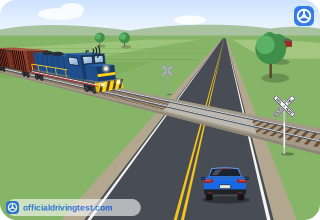
- They are small and are moving slower than they seem to be
- They always sound a horn long before they reach the crossing
- They can stop quickly if the driver sees you on the tracks
- They are large and may be moving faster than they seem to be
Show answer
Correct answer: They are large and may be moving faster than they seem to be
The manual says to remember that trains are large and may be moving faster than they seem to be.
Source: Connecticut Driver's Manual (Revised March 2023), page 51 · Open this page in the manual (Manual page 51)
-
What is the purpose of a blue Emergency Notification System sign at a highway-rail grade crossing?
- It gives a telephone number to report problems or emergencies
- It warns drivers that a train is coming down the line
- It tells drivers to stop at the crossing until it is clear
- It marks the speed limit that applies at the crossing
Show answer
Correct answer: It gives a telephone number to report problems or emergencies
The manual says the blue sign provides a 24/7/365 telephone number to report problems or emergencies at railroad locations.
Source: Connecticut Driver's Manual (Revised March 2023), page 51 · Open this page in the manual (Manual page 51)
-
A round yellow sign with a black “X” and the letters “RR” is placed where?
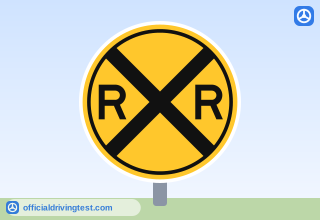
- At the railroad crossing itself, beside the tracks
- At the start of a work zone
- Along the road before you get to a railroad crossing
- At the exit of a divided highway
Show answer
Correct answer: Along the road before you get to a railroad crossing
The manual says this round yellow Railroad Crossing sign is placed along the road before you get to a railroad crossing.
Source: Connecticut Driver's Manual (Revised March 2023), page 52 · Open this page in the manual (Manual page 52)
-
A white, X-shaped “Railroad Crossing” sign has the same meaning as which sign?
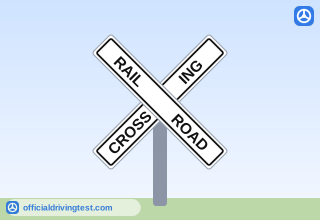
- Stop
- Yield
- Detour
- Do Not Enter
Show answer
Correct answer: Yield
The manual says the crossbuck has the same meaning as a Yield sign, so you must yield to crossing trains.
Source: Connecticut Driver's Manual (Revised March 2023), page 52 · Open this page in the manual (Manual page 52)
-
Where is the white, X-shaped crossbuck sign located?
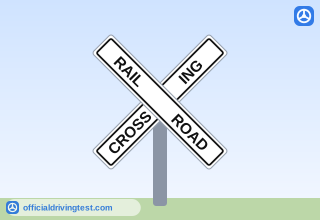
- Along the road well before the crossing
- Only beside the freeway
- Only at crossings with gates
- At the railroad crossing
Show answer
Correct answer: At the railroad crossing
The manual says the crossbuck is located at the railroad crossing.
Source: Connecticut Driver's Manual (Revised March 2023), page 52 · Open this page in the manual (Manual page 52)
-
At a crossing with flashing lights and a gate, when must you stop?
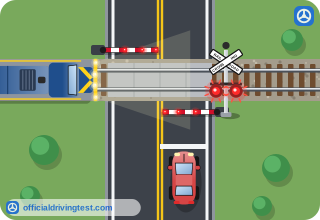
- When the lights begin to flash and before the gate lowers
- Only after the gate is fully lowered
- Only when you see the train
- Only if the lights flash for more than a few seconds
Show answer
Correct answer: When the lights begin to flash and before the gate lowers
The manual says to stop when the lights begin to flash and before the gate lowers.
Source: Connecticut Driver's Manual (Revised March 2023), page 52 · Open this page in the manual (Manual page 52)
-
At a crossing with flashing lights and a gate, how long must you remain stopped?
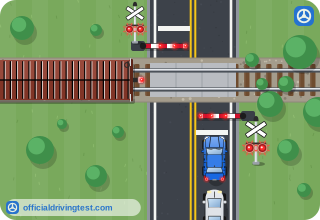
- Until you can no longer see the train
- Until the gates are raised, even if the lights still flash
- Until the gates are raised and the lights stop flashing
- Until the first vehicle in the opposite lane moves
Show answer
Correct answer: Until the gates are raised and the lights stop flashing
The manual says to remain stopped until the gates are raised and the lights stop flashing.
Source: Connecticut Driver's Manual (Revised March 2023), page 52 · Open this page in the manual (Manual page 52)
-
What must you not attempt to do at a lowered railroad gate?
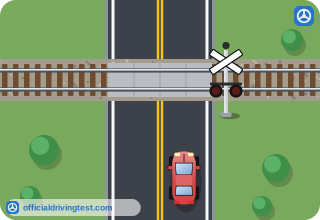
- Wait for the train to pass
- Drive around the lowered gate
- Stop behind the stop line
- Turn off your engine
Show answer
Correct answer: Drive around the lowered gate
The manual says not to attempt to drive around the lowered gate.
Source: Connecticut Driver's Manual (Revised March 2023), page 52 · Open this page in the manual (Manual page 52)
-
When may pedestrians not cross railroad tracks?
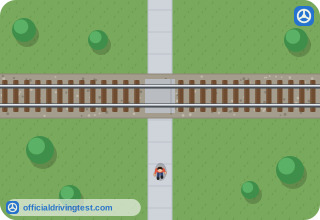
- Only after dark, when trains are harder to see from the road
- Only when there are no gates or flashing lights at the crossing
- Only when a train is already visible to them and very close
- When warned of a train by a signal, crossing gates, flagman or officer
Show answer
Correct answer: When warned of a train by a signal, crossing gates, flagman or officer
The manual says pedestrians may not cross railroad tracks when warned of a train by an automatic signal, crossing gates, flagman or law enforcement officer.
Source: Connecticut Driver's Manual (Revised March 2023), page 52 · Open this page in the manual (Manual page 52)