Connecticut: Pedestrians Practice Test
Yielding to people on foot, crosswalks, blind pedestrians and children near the road.
Independent educational site · not affiliated with any government agency or DMV
Ready? Test yourself
- Instant feedback with an explanation
- Every answer cites its source in the manual
- Your best score is saved on this device
Questions are original and based on the official manual "Connecticut Driver's Manual" (Revised March 2023), Connecticut Department of Motor Vehicles (DMV).
All 29 questions in this practice test
Take the test above first, then use this list to study. Tap “Show answer” to see the correct answer and explanation.
Show the questions and answersHide the questions
-
When is there a good chance that someone will cross or enter the road?
- Only on roads that have painted crosswalks and traffic lights
- Whenever there is a lot of activity along the roadside
- Only during school hours on weekdays, when buses are loading
- Only on roads that have no sidewalks along either side
Show answer
Correct answer: Whenever there is a lot of activity along the roadside
A lot of activity along the roadside, such as near shopping centers, parking lots or playgrounds, makes it likely someone will cross or enter the road.
Source: Connecticut Driver's Manual (Revised March 2023), page 15 · Open this page in the manual (Manual page 15)
-
Which pedestrians are the most frequent victims in auto-pedestrian collisions?
- Children, the elderly and disabled pedestrians
- Adults who cross at unmarked crosswalks
- Pedestrians who walk at night along highways
- Pedestrians who ignore walk signals
Show answer
Correct answer: Children, the elderly and disabled pedestrians
Drivers should be especially alert for children, the elderly and disabled pedestrians, who are the most frequent victims in auto-pedestrian collisions.
Source: Connecticut Driver's Manual (Revised March 2023), page 16 · Open this page in the manual (Manual page 16)
-
Why should drivers be especially alert for elderly and disabled pedestrians?
- They usually walk against traffic signals to save time
- They often step off the curb without looking in either direction
- They may have poor vision and hearing and may move slowly
- They may not use crosswalks and can enter the road anywhere
Show answer
Correct answer: They may have poor vision and hearing and may move slowly
Elderly and disabled pedestrians may have poor vision and hearing and may move slowly.
Source: Connecticut Driver's Manual (Revised March 2023), page 16 · Open this page in the manual (Manual page 16)
-
Generally, who has the right of way in crosswalks?
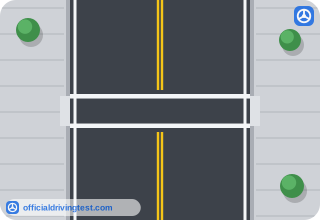
- Vehicle drivers
- Pedestrians
- Bicyclists
- Whoever arrives first
Show answer
Correct answer: Pedestrians
The manual says that, generally, pedestrians have the right of way in crosswalks.
Source: Connecticut Driver's Manual (Revised March 2023), page 16 · Open this page in the manual (Manual page 16)
-
Where is there a crosswalk, even if it is not marked by painted lines?
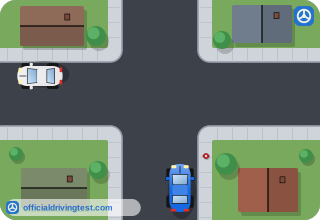
- Only at intersections with traffic lights
- Only near schools and playgrounds
- Only where a sign shows a pedestrian
- At every intersection
Show answer
Correct answer: At every intersection
There is a crosswalk at every intersection, even when no painted lines mark it.
Source: Connecticut Driver's Manual (Revised March 2023), page 16 · Open this page in the manual (Manual page 16)
-
How can you tell where an unmarked crosswalk is?
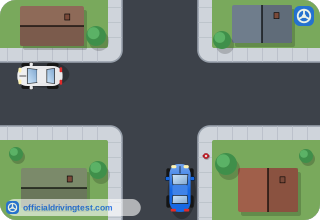
- Assume it is located halfway along the block between two intersections
- Assume it is wherever the last painted crosswalk on the street ends
- Imagine the sidewalk or shoulder at the corner extending across the road
- Look for the spot where the crossing guard usually stands
Show answer
Correct answer: Imagine the sidewalk or shoulder at the corner extending across the road
Imagine the sidewalk or shoulder at the corner extending across the road to meet the sidewalk or shoulder on the other side.
Source: Connecticut Driver's Manual (Revised March 2023), page 16 · Open this page in the manual (Manual page 16)
-
When must a driver slow or stop and grant the right-of-way to a pedestrian at a crosswalk?
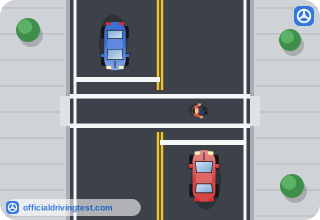
- Only when the crosswalk is marked with painted lines
- When the pedestrian is within any portion of the crosswalk
- Only when the pedestrian has a walk signal showing
- Only when the pedestrian is in the lane the driver is using
Show answer
Correct answer: When the pedestrian is within any portion of the crosswalk
The driver must slow or stop for a pedestrian at a marked or unmarked crosswalk when the pedestrian is within any portion of it.
Source: Connecticut Driver's Manual (Revised March 2023), page 16 · Open this page in the manual (Manual page 16)
-
A pedestrian steps to the curb at the entrance to a crosswalk. What shows the intent to cross that requires you to grant the right-of-way?
- Looking both ways before the signal changes
- Pointing at the far side of the street
- Standing still at the curb watching the signal
- Raising a hand and arm toward oncoming traffic
Show answer
Correct answer: Raising a hand and arm toward oncoming traffic
A pedestrian who steps to the curb and raises a hand and arm toward oncoming traffic indicates intent to cross.
Source: Connecticut Driver's Manual (Revised March 2023), page 16 · Open this page in the manual (Manual page 16)
-
Which of these shows a pedestrian's intent to cross when moved into a crosswalk's entrance?
- Any body part or extension of a body part, such as a cane or stroller
- Only the pedestrian's whole body, never a cane or stroller
- Only a raised hand and arm toward oncoming traffic
- Only a wheelchair, since canes and strollers do not count
Show answer
Correct answer: Any body part or extension of a body part, such as a cane or stroller
Moving any body part or extension of one, including a wheelchair, cane, stroller or leashed dog, into the entrance indicates intent to cross.
Source: Connecticut Driver's Manual (Revised March 2023), page 16 · Open this page in the manual (Manual page 16)
-
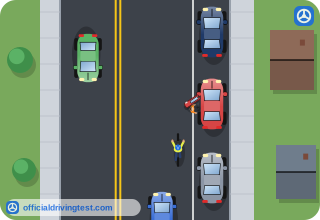
When must you not open a vehicle door?
- If any other vehicle is parked within one car length of your door
- If it hits or gets in the way of a pedestrian, bicyclist or other moving traffic
- If a pedestrian or bicyclist is within sight at any distance
- If the driver of the vehicle behind you has not yet stopped completely
Show answer
Correct answer: If it hits or gets in the way of a pedestrian, bicyclist or other moving traffic
Do not open a vehicle door if it hits or gets in the way of a pedestrian, bicyclist or other moving traffic.
Source: Connecticut Driver's Manual (Revised March 2023), page 16 · Open this page in the manual (Manual page 16)
-
Why should drivers take extra care to look out for children?
- They usually cross only at marked crosswalks and obey every signal
- They stay on sidewalks and are easy to see from far away
- They always travel in groups led by an adult crossing guard
- They are often the least predictable pedestrians and the most difficult to see
Show answer
Correct answer: They are often the least predictable pedestrians and the most difficult to see
Children are often the least predictable pedestrians and the most difficult to see.
Source: Connecticut Driver's Manual (Revised March 2023), page 16 · Open this page in the manual (Manual page 16)
-
Near which places should you take extra care to look out for children?
- Schools, bus stops, playgrounds, parks and ice cream trucks
- Highway ramps, toll plazas and rest areas
- Freight yards, loading docks and car washes
- Hospitals, public libraries, office parks and train stations
Show answer
Correct answer: Schools, bus stops, playgrounds, parks and ice cream trucks
The manual names schools, bus stops, playgrounds, parks and ice cream trucks as places to take extra care for children.
Source: Connecticut Driver's Manual (Revised March 2023), page 16 · Open this page in the manual (Manual page 16)
-
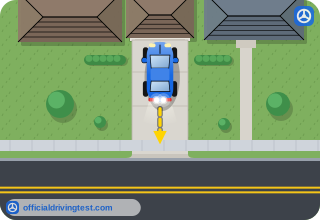
Why should you be extra watchful when backing in or out of a driveway?
- Other drivers rarely check their mirrors there
- The pavement is usually slick near driveways
- Children may run behind or be playing behind your vehicle
- Parked cars on the street hide oncoming traffic from view
Show answer
Correct answer: Children may run behind or be playing behind your vehicle
Children may run behind or be playing behind your vehicle when you back in or out of a driveway.
Source: Connecticut Driver's Manual (Revised March 2023), page 16 · Open this page in the manual (Manual page 16)
-
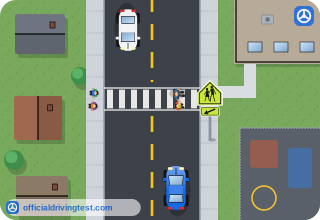
What does the manual say about when children are present in a school zone?
- Children are present only during school hours
- Children are present only on weekday mornings
- Children are present only when the flashing lights operate
- School hours are not the only time children are present
Show answer
Correct answer: School hours are not the only time children are present
Drivers must be alert in a school zone at all times, because school hours are not the only time children are present.
Source: Connecticut Driver's Manual (Revised March 2023), page 16 · Open this page in the manual (Manual page 16)
-
What should you follow to know that you are approaching a school or a school crossing?
- The signs or flashing lights
- Only the school bell
- The crossing guard's whistle
- The school bus schedule
Show answer
Correct answer: The signs or flashing lights
The manual says to follow the signs or flashing lights that warn you that you are approaching a school or school crossing.
Source: Connecticut Driver's Manual (Revised March 2023), page 16 · Open this page in the manual (Manual page 16)
-
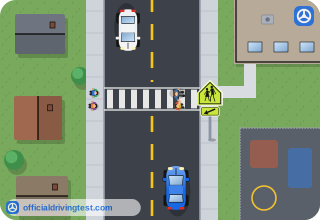
What must you do about speed in a school zone?
- Drive at the regular limit when no children are visible
- Drive at the regular limit if the road ahead looks clear
- Obey the slower posted speed limit or be subject to fines
- Slow down only when a crossing guard is present
Show answer
Correct answer: Obey the slower posted speed limit or be subject to fines
You must obey the slower posted speed limit in school zones or be subject to fines.
Source: Connecticut Driver's Manual (Revised March 2023), page 16 · Open this page in the manual (Manual page 16)
-
What must you do when students are crossing in a school zone or a crossing guard signals you to do so?
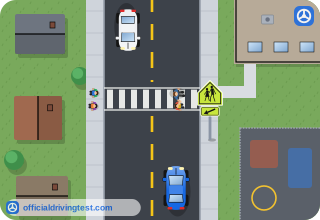
- Slow down and sound your horn
- Stop and yield to the students
- Proceed if the students are on the far side of the road
- Stop only if the students are in your lane
Show answer
Correct answer: Stop and yield to the students
The manual says to stop and yield to students who are crossing or if a crossing guard signals you to do so.
Source: Connecticut Driver's Manual (Revised March 2023), page 16 · Open this page in the manual (Manual page 16)
-
To which pedestrian must you give the right-of-way?
- One carrying a white cane, with or without a colored tip
- Only a pedestrian whose white cane has a red or colored tip
- Only a pedestrian using a guide dog, not one carrying a cane
- Only a pedestrian who is already in the middle of the road
Show answer
Correct answer: One carrying a white cane, with or without a colored tip
You must give the right-of-way to a pedestrian with a guide dog or who is carrying a white cane, with or without a colored tip.
Source: Connecticut Driver's Manual (Revised March 2023), page 16 · Open this page in the manual (Manual page 16)
-
A pedestrian with a white cane or guide dog is attempting to cross the road. What must you do?
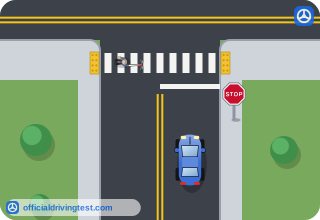
- Slow down and sound your horn
- Slow down and drive around them
- Stop and stay stopped
- Stop only if no other vehicles are around
Show answer
Correct answer: Stop and stay stopped
You must stop and stay stopped if the person is attempting to cross or is in the process of crossing the road.
Source: Connecticut Driver's Manual (Revised March 2023), page 16 · Open this page in the manual (Manual page 16)
-
At a regulated intersection, how long must you remain stopped for a blind pedestrian who is crossing, even if you have a green light?
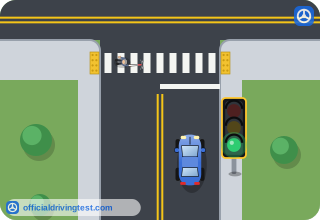
- Until your light turns yellow
- Until the pedestrian is out of the road
- Until your light has been green for a few seconds
- Until the pedestrian waves you ahead
Show answer
Correct answer: Until the pedestrian is out of the road
At regulated intersections you remain stopped until the pedestrian is out of the road, even if you have a green light.
Source: Connecticut Driver's Manual (Revised March 2023), page 16 · Open this page in the manual (Manual page 16)
-
What should you do when you share the road with pedestrians, bicycles and children?
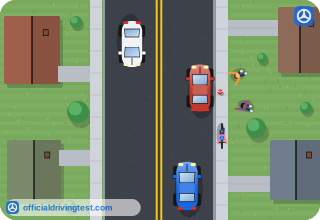
- Give extra space, as they can move into your path without warning
- Honk your horn so that they know that you are passing by
- Drive faster to pass them more quickly and get out of the way
- Stay close behind them in the same lane until it is clear
Show answer
Correct answer: Give extra space, as they can move into your path without warning
The manual says to give extra space, especially to children, as they can move into your path quickly.
Source: Connecticut Driver's Manual (Revised March 2023), page 22 · Open this page in the manual (Manual page 22)
-
What should you always be alert for near schools, playgrounds and residential streets?
- Children crossing or running or riding into the street
- Heavy trucks that stop suddenly in the road ahead
- Drivers entering the road from a toll plaza ahead
- Vehicles traveling at very high speeds on the road
Show answer
Correct answer: Children crossing or running or riding into the street
The manual says there are often children in these areas.
Source: Connecticut Driver's Manual (Revised March 2023), page 22 · Open this page in the manual (Manual page 22)
-
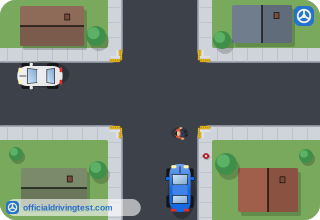
When must drivers yield the right-of-way to pedestrians in a marked or unmarked crosswalk?
- Only when the pedestrian signal shows walk
- At all times
- Only when a pedestrian has already entered your lane
- Only inside school zones
Show answer
Correct answer: At all times
Drivers must yield at all times to pedestrians in marked or unmarked crosswalks.
Source: Connecticut Driver's Manual (Revised March 2023), page 36 · Open this page in the manual (Manual page 36)
-
Where a bicycle path crosses the roadway, to whom must drivers yield the right-of-way?
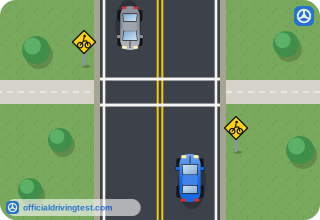
- Bicyclists and pedestrians
- Pedestrians only
- Bicyclists only
- Neither one, if the driver arrived first
Show answer
Correct answer: Bicyclists and pedestrians
Drivers must yield to both bicyclists and pedestrians at a bicycle path crossing.
Source: Connecticut Driver's Manual (Revised March 2023), page 36 · Open this page in the manual (Manual page 36)
-
Which pedestrians have absolute right-of-way?
- Pedestrians who are crossing the street at a green light
- Pedestrians who are walking in a group across the street
- Pedestrians using a guide dog or carrying a white cane
- Pedestrians who are wearing bright clothing at night time
Show answer
Correct answer: Pedestrians using a guide dog or carrying a white cane
The manual gives absolute right-of-way to pedestrians with a guide dog or white cane.
Source: Connecticut Driver's Manual (Revised March 2023), page 36 · Open this page in the manual (Manual page 36)
-
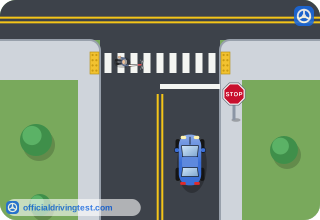
Why should you not use your horn at a pedestrian using a guide dog or carrying a white cane?
- It is illegal to sound a horn near a crosswalk
- It could confuse or frighten the pedestrian
- It could damage the guide dog's hearing
- It tells the pedestrian that you will go first
Show answer
Correct answer: It could confuse or frighten the pedestrian
The horn could confuse or frighten the pedestrian.
Source: Connecticut Driver's Manual (Revised March 2023), page 36 · Open this page in the manual (Manual page 36)
-
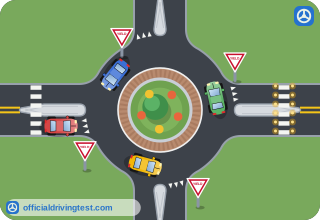
When you are exiting a roundabout, whom must you yield to?
- Only vehicles that are entering the roundabout
- Only bicyclists in the crosswalk
- Any pedestrians in the crosswalk on the exiting leg
- No one, because exiting traffic has the right-of-way
Show answer
Correct answer: Any pedestrians in the crosswalk on the exiting leg
You must yield to pedestrians in the crosswalk on the exiting leg.
Source: Connecticut Driver's Manual (Revised March 2023), page 37 · Open this page in the manual (Manual page 37)
-
Which pedestrians must you yield to at a crosswalk?
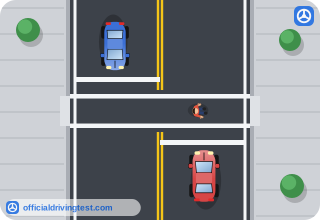
- Those in the crosswalk or about to enter it
- Only those already in the crosswalk
- Only those who have a walk signal
- Only those crossing in front of your vehicle
Show answer
Correct answer: Those in the crosswalk or about to enter it
You must yield to pedestrians in or about to enter a crosswalk.
Source: Connecticut Driver's Manual (Revised March 2023), page 44 · Open this page in the manual (Manual page 44)
-
Which statement about crosswalks is correct?
- All of them are marked with white lines
- Pedestrians may use them only at traffic signals
- Not all of them are marked
- Drivers need to watch for pedestrians only where lines are painted
Show answer
Correct answer: Not all of them are marked
Not all crosswalks are marked, so be alert for pedestrians when crossing intersections.
Source: Connecticut Driver's Manual (Revised March 2023), page 44 · Open this page in the manual (Manual page 44)