Connecticut: Pavement markings
Yellow and white lines, stop and yield lines, crosswalks, reserved and reversible lanes and the other markings in the Connecticut manual. Split into 2 shorter tests so you're not stuck in one long quiz.
Independent educational site · not affiliated with any government agency or DMV
All 38 Pavement markings questions with answers
Choose a part above to take a practice test, or study every question and answer here.
Show the questions and answersHide the questions
-
May you pass a bicyclist in a no-passing zone?
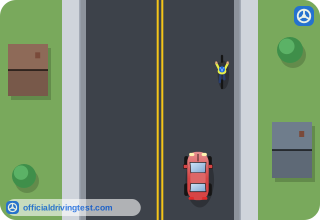
- Yes, if you can make the maneuver safely
- No, never in any no-passing zone
- Yes, but only after you sound your horn
- Yes, but only when the bicyclist signals you to pass
Show answer
Correct answer: Yes, if you can make the maneuver safely
The manual says you may pass slow moving vehicles, including bicyclists, in a no passing zone if you can make the maneuver safely.
Source: Connecticut Driver's Manual (Revised March 2023), page 17 · Open this page in the manual (Manual page 17)
-
State law permits passing slow moving traffic in no passing zones. What must you be sure of before you cross a double yellow line to pass?
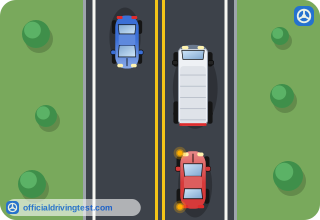
- The vehicle you pass has an orange triangle
- The road has a paved shoulder
- No one is behind you
- You can see far enough ahead to pass safely
Show answer
Correct answer: You can see far enough ahead to pass safely
You may cross a double yellow line in these instances, but you must make sure you can see far enough ahead to pass safely before attempting the maneuver.
Source: Connecticut Driver's Manual (Revised March 2023), page 18 · Open this page in the manual (Manual page 18)
-
Which of these does state law permit you to pass in a no passing zone?
- Parked or standing vehicles
- Vehicles stopped for a school bus
- Emergency vehicles with lights on
- A line of traffic stopped at a red light
Show answer
Correct answer: Parked or standing vehicles
State law permits passing slow moving traffic, pedestrians, parked or standing vehicles, animals, bicycles, mopeds and scooters in no passing zones.
Source: Connecticut Driver's Manual (Revised March 2023), page 18 · Open this page in the manual (Manual page 18)
-
What do edge lines show?
- Where the edge of the road is located
- Where passing is allowed
- Where you must yield to pedestrians
- Which lanes are reserved for buses
Show answer
Correct answer: Where the edge of the road is located
Edge lines are solid lines along the side of the road that show where the road edge is.
Source: Connecticut Driver's Manual (Revised March 2023), page 43 · Open this page in the manual (Manual page 43)
-
Which edge line is used on the right edge of the roadway?
- Solid yellow line
- Dashed white line
- Solid white line
- Dashed yellow line
Show answer
Correct answer: Solid white line
Solid white lines are used on the right of the roadway edge.
Source: Connecticut Driver's Manual (Revised March 2023), page 43 · Open this page in the manual (Manual page 43)
-
Where are solid yellow edge lines used?
- On the right edge of every roadway
- On the left edge of divided streets or roadways
- Between lanes moving in the same direction
- At the location of a mid-block crosswalk
Show answer
Correct answer: On the left edge of divided streets or roadways
Solid yellow edge lines mark the left edge of divided streets or roadways.
Source: Connecticut Driver's Manual (Revised March 2023), page 43 · Open this page in the manual (Manual page 43)
-
What are lane lines?
- Yellow lines that separate lanes of traffic moving in opposite directions
- Solid lines along the side of the road showing its edge
- Lines marking where drivers must yield at a crosswalk
- White lines that separate multiple lanes traveling in the same direction
Show answer
Correct answer: White lines that separate multiple lanes traveling in the same direction
Lane lines are white lines that separate lanes traveling in the same direction.
Source: Connecticut Driver's Manual (Revised March 2023), page 43 · Open this page in the manual (Manual page 43)
-
What does a dashed white line between lanes moving in the same direction mean?
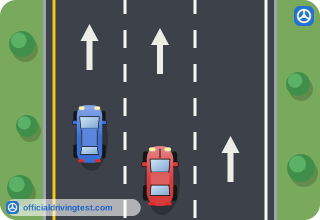
- You may cross it to change lanes if it is safe to do so
- Traffic moves in opposite directions on each side of the line
- Lane changes are prohibited
- You must stop before crossing it
Show answer
Correct answer: You may cross it to change lanes if it is safe to do so
A dashed white lane line lets you change lanes when it is safe.
Source: Connecticut Driver's Manual (Revised March 2023), page 43 · Open this page in the manual (Manual page 43)
-
What does a solid white line between lanes of traffic moving in the same direction indicate?
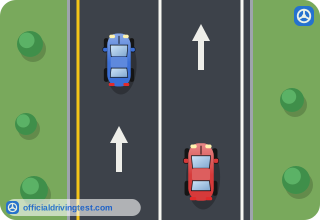
- Change lanes freely whenever the lane beside you is clear of traffic
- Expect traffic to approach from the opposite direction
- Stay in your lane unless a special situation requires you to change lanes
- Stop before crossing the line to change lanes
Show answer
Correct answer: Stay in your lane unless a special situation requires you to change lanes
A solid white lane line means you should stay in your lane unless a special situation requires a lane change.
Source: Connecticut Driver's Manual (Revised March 2023), page 43 · Open this page in the manual (Manual page 43)
-
What do center lines separate?
- Lanes of traffic moving in the same direction
- Lanes of traffic moving in opposite directions
- The roadway from the shoulder
- The bicycle lane from the travel lane
Show answer
Correct answer: Lanes of traffic moving in opposite directions
Center lines are yellow lines that separate lanes of traffic moving in opposite directions.
Source: Connecticut Driver's Manual (Revised March 2023), page 43 · Open this page in the manual (Manual page 43)
-
What does a dashed yellow center line mean?
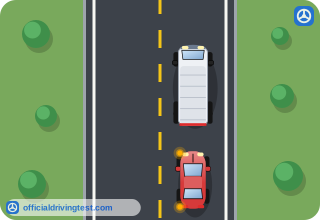
- Traffic moves in the same direction and you may not pass
- Traffic moves in opposite directions and passing is prohibited
- Traffic moves in one direction and lane changes are allowed
- Traffic moves in opposite directions and passing is allowed
Show answer
Correct answer: Traffic moves in opposite directions and passing is allowed
Dashed yellow lines separate single lanes of opposing traffic, and passing is allowed.
Source: Connecticut Driver's Manual (Revised March 2023), page 43 · Open this page in the manual (Manual page 43)
-
Yield lines are used at which kind of location?
- A mid-block crosswalk
- A shared center lane
- A reversible lane
- A fire lane
Show answer
Correct answer: A mid-block crosswalk
Yield lines are used where drivers are required to yield, such as a mid-block crosswalk.
Source: Connecticut Driver's Manual (Revised March 2023), page 43 · Open this page in the manual (Manual page 43)
-
A dashed yellow line runs alongside a solid yellow line in the center of the road. On which side do these lines permit passing?
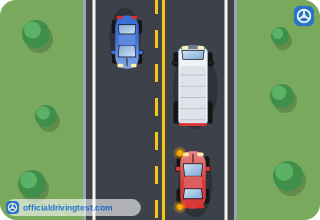
- On the side of the solid line
- On both sides of the lines
- On the side of the broken line
- On neither side of the lines
Show answer
Correct answer: On the side of the broken line
Passing is permitted on the side of the broken line, but not on the side of the solid line.
Source: Connecticut Driver's Manual (Revised March 2023), page 44 · Open this page in the manual (Manual page 44)
-
Which of these is a reason a driver may cross solid yellow lines?
- To make a U-turn at any point along the roadway, even on a curve
- To make a left turn to or from an alley, private road, driveway, or street
- To stop at the roadway edge and let passengers out
- To change lanes on a road with several lanes in one direction
Show answer
Correct answer: To make a left turn to or from an alley, private road, driveway, or street
Solid yellow lines may be crossed to make a left turn to or from an alley, private road, driveway, or street.
Source: Connecticut Driver's Manual (Revised March 2023), page 44 · Open this page in the manual (Manual page 44)
-
When you are required to stop because of a sign or signal, where must you stop?
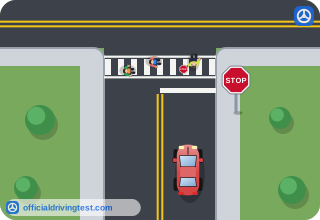
- With your front wheels on the stop line
- Past the stop line, in the crosswalk
- Beyond the stop line, so you can see cross traffic
- Before your vehicle reaches the stop line
Show answer
Correct answer: Before your vehicle reaches the stop line
You must stop before your vehicle reaches the stop line.
Source: Connecticut Driver's Manual (Revised March 2023), page 44 · Open this page in the manual (Manual page 44)
-
How are reserved lanes marked?
- Solid red lines painted along both edges of the lane
- Signs saying the lane is reserved, often with a white diamond
- A double solid white line and an overhead flashing arrow
- Green paint covering the whole lane surface
Show answer
Correct answer: Signs saying the lane is reserved, often with a white diamond
Reserved lanes are marked by signs stating the lane is reserved for special use and often have a white diamond.
Source: Connecticut Driver's Manual (Revised March 2023), page 44 · Open this page in the manual (Manual page 44)
-
What does a lane marked “Transit” or “bus” mean?
- The lane is for vehicles with more than one person in them
- The lane is for left turns only
- The lane is reserved for bicycles
- The lane is for bus use only
Show answer
Correct answer: The lane is for bus use only
A “transit” or “bus” lane is for bus use only.
Source: Connecticut Driver's Manual (Revised March 2023), page 44 · Open this page in the manual (Manual page 44)
-
What does a lane marked “Bicycle” mean?
- The lane is reserved for bicycles
- The lane is for bus use only
- The lane is shared with all vehicles
- The lane is for vehicles with more than one person in them
Show answer
Correct answer: The lane is reserved for bicycles
A “bicycle” lane is reserved for bicycles.
Source: Connecticut Driver's Manual (Revised March 2023), page 44 · Open this page in the manual (Manual page 44)
-
What does “HOV” stand for?
- Heavy Occupancy Vehicles
- Highway Operating Vehicles
- High Occupancy Vehicles
- High Output Vehicles
Show answer
Correct answer: High Occupancy Vehicles
HOV stands for High Occupancy Vehicles.
Source: Connecticut Driver's Manual (Revised March 2023), page 44 · Open this page in the manual (Manual page 44)
-
A diamond-shaped marker on a lane indicates the lane is reserved for which vehicles?
- Vehicles towing trailers or campers
- Vehicles with more than one person in them
- Vehicles turning left or making U-turns
- Vehicles carrying commercial cargo
Show answer
Correct answer: Vehicles with more than one person in them
A diamond-shaped marker indicates lanes reserved for vehicles with more than one person in them (HOV lanes).
Source: Connecticut Driver's Manual (Revised March 2023), page 44 · Open this page in the manual (Manual page 44)
-
What do signs at an HOV lane tell you?
- How fast vehicles in the lane may travel
- What hours the lane is open to buses
- Which vehicle types may not use the lane
- How many people must be in the vehicle
Show answer
Correct answer: How many people must be in the vehicle
Signs are posted that say how many people must be in the vehicle.
Source: Connecticut Driver's Manual (Revised March 2023), page 44 · Open this page in the manual (Manual page 44)
-
What is a shared center lane reserved for?
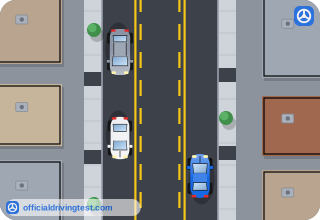
- Left turns, or U-turns where permitted, from both directions
- Passing slower vehicles traveling in either direction
- Vehicles traveling in one direction at certain times
- Right turns and merging by traffic from both directions
Show answer
Correct answer: Left turns, or U-turns where permitted, from both directions
Shared center lanes are reserved for left turns (or U-turns when permitted) and can be used by vehicles traveling in both directions.
Source: Connecticut Driver's Manual (Revised March 2023), page 44 · Open this page in the manual (Manual page 44)
-
How do the arrows on the pavement of a shared center lane appear?
- Straight arrows for each direction alternate
- Right-turn arrows all point toward the curb
- Left-turn arrows for each direction alternate
- Left-turn arrows all point the same way
Show answer
Correct answer: Left-turn arrows for each direction alternate
On a shared center lane, left-turn arrows for traffic in one direction alternate with arrows for traffic from the other direction.
Source: Connecticut Driver's Manual (Revised March 2023), page 44 · Open this page in the manual (Manual page 44)
-
How is a shared center lane marked on each side?
- By double solid white lines on both sides
- By solid yellow and dashed yellow lines
- By dashed white lines on each side only
- By double solid yellow lines on each side
Show answer
Correct answer: By solid yellow and dashed yellow lines
A shared center lane is marked on each side by solid yellow and dashed yellow lines.
Source: Connecticut Driver's Manual (Revised March 2023), page 44 · Open this page in the manual (Manual page 44)
-
In some areas, what does a shared center lane become during rush hours?
- A bus-only lane
- A bicycle lane
- An HOV lane
- A reversible lane
Show answer
Correct answer: A reversible lane
In some areas the shared center lane becomes a reversible lane during rush hours.
Source: Connecticut Driver's Manual (Revised March 2023), page 44 · Open this page in the manual (Manual page 44)
-
Before entering a shared center lane that may be in reversible use, what must you be sure of?
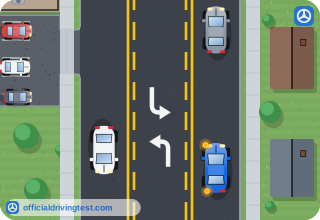
- That you can enter the lane and that it is safe
- That no bus is in the lane ahead
- That at least one other vehicle is already using the lane
- That another driver has entered the lane ahead of you
Show answer
Correct answer: That you can enter the lane and that it is safe
The manual says to be sure you can enter the lane and that it is safe before you do so.
Source: Connecticut Driver's Manual (Revised March 2023), page 44 · Open this page in the manual (Manual page 44)
-
What are reversible lanes designed to do?
- Carry only buses and bicycles during rush hours
- Allow left turns from both directions at all times
- Carry traffic one way at some times, the other way at others
- Let drivers pass on either side at any time
Show answer
Correct answer: Carry traffic one way at some times, the other way at others
Reversible lanes carry traffic in one direction at certain times and in the opposite direction at other times.
Source: Connecticut Driver's Manual (Revised March 2023), page 44 · Open this page in the manual (Manual page 44)
-
How are reversible lanes usually marked?
- Double solid white lines
- Double-dashed yellow lines
- A single solid yellow line
- A single dashed white line
Show answer
Correct answer: Double-dashed yellow lines
Reversible lanes are usually marked by double-dashed yellow lines.
Source: Connecticut Driver's Manual (Revised March 2023), page 44 · Open this page in the manual (Manual page 44)
-
Before you start driving in reversible lanes, what must you do?
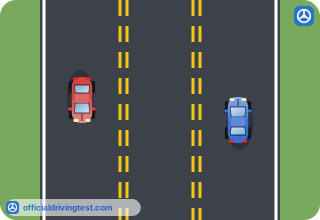
- Wait for a bus to enter ahead of you
- Move to the far left lane and match the speed of traffic
- Turn on your hazard lights
- Check which lanes you can use at that time
Show answer
Correct answer: Check which lanes you can use at that time
Before you drive in reversible lanes, check which lanes you can use at that time.
Source: Connecticut Driver's Manual (Revised March 2023), page 44 · Open this page in the manual (Manual page 44)
-
A green arrow shows above a reversible lane. What does it mean?
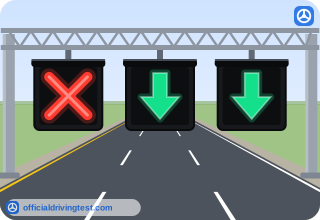
- You can use the lane beneath it
- You must turn left from that lane
- The lane is closed to all traffic
- The lane is for buses only
Show answer
Correct answer: You can use the lane beneath it
A green arrow means you can use the lane beneath it.
Source: Connecticut Driver's Manual (Revised March 2023), page 44 · Open this page in the manual (Manual page 44)
-
A red “X” shows above a reversible lane. What does it mean?
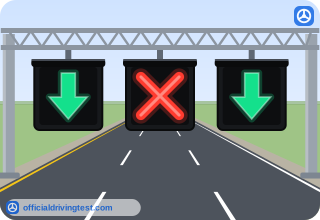
- You may use the lane only to turn
- You should move out of the lane as soon as it is safe
- You cannot use the lane
- You can use the lane beneath it
Show answer
Correct answer: You cannot use the lane
A red “X” means you cannot use the lane.
Source: Connecticut Driver's Manual (Revised March 2023), page 44 · Open this page in the manual (Manual page 44)
-
A flashing yellow “X” shows above a reversible lane. What does it mean?
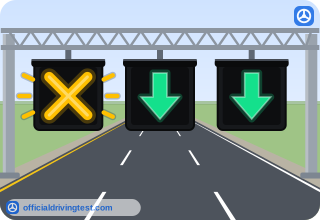
- The lane is closed to all traffic
- The lane is only for turning
- The lane is open to all traffic
- You must stop and wait for the signal to change
Show answer
Correct answer: The lane is only for turning
A flashing yellow “X” means the lane is only for turning.
Source: Connecticut Driver's Manual (Revised March 2023), page 44 · Open this page in the manual (Manual page 44)
-
A steady yellow “X” shows above a reversible lane. What does it mean?
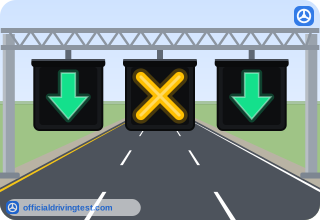
- The lane is only for turning, so signal and enter when it is clear
- The lane is reserved for buses until the signal changes again
- The lane is now open to traffic in both directions
- The use of the lane is changing, so move out of it as soon as it is safe
Show answer
Correct answer: The use of the lane is changing, so move out of it as soon as it is safe
A steady yellow “X” means the use of the lane is changing and you should move out of it as soon as it is safe to do so.
Source: Connecticut Driver's Manual (Revised March 2023), page 44 · Open this page in the manual (Manual page 44)
-
Yellow or white diagonal stripes on the road are used to mark what?
- Fixed obstructions
- Reserved bus lanes
- Areas where parking is allowed
- Pedestrian crosswalks
Show answer
Correct answer: Fixed obstructions
Yellow or white diagonal stripes mark fixed obstructions.
Source: Connecticut Driver's Manual (Revised March 2023), page 44 · Open this page in the manual (Manual page 44)
-
What are solid white or yellow lines sometimes used for?
- To mark the start of a school zone
- To show where buses must stop
- To channel traffic around a hazard
- To mark where drivers must yield
Show answer
Correct answer: To channel traffic around a hazard
Solid white or yellow lines are sometimes used to channel traffic around a hazard.
Source: Connecticut Driver's Manual (Revised March 2023), page 44 · Open this page in the manual (Manual page 44)
-
What does a double solid white line prohibit?
- Making right turns
- Lane changing
- Pedestrians crossing
- Entering the roadway from a driveway
Show answer
Correct answer: Lane changing
A double solid white line prohibits lane changing.
Source: Connecticut Driver's Manual (Revised March 2023), page 44 · Open this page in the manual (Manual page 44)
-
Who may designate curb markings, fire lanes and pavement markings as “No Parking” areas?
- Only the state DMV
- Vehicle owners
- Insurance companies
- Local authorities
Show answer
Correct answer: Local authorities
Local authorities may designate these markings as “No Parking” areas.
Source: Connecticut Driver's Manual (Revised March 2023), page 44 · Open this page in the manual (Manual page 44)
-
What does a bicycle symbol with two chevrons painted above it on the road mean?
- The lane is shared; vehicle or bicycle traffic may be in the lane
- The lane is reserved for bicycles and no other vehicles may enter it
- Bicycles must stop and yield to all vehicles before entering
- A bicycle parking area is just ahead on the road
Show answer
Correct answer: The lane is shared; vehicle or bicycle traffic may be in the lane
A bicycle sharrow indicates the lane is shared and warns you to watch for bicycles in the lane.
Source: Connecticut Driver's Manual (Revised March 2023), page 44 · Open this page in the manual (Manual page 44)