Connecticut: Parking rules Practice Test
Where you may not park, parking on hills, getting out of a parked vehicle and leaving it safely.
Independent educational site · not affiliated with any government agency or DMV
Ready? Test yourself
- Instant feedback with an explanation
- Every answer cites its source in the manual
- Your best score is saved on this device
Questions are original and based on the official manual "Connecticut Driver's Manual" (Revised March 2023), Connecticut Department of Motor Vehicles (DMV).
All 30 questions in this practice test
Take the test above first, then use this list to study. Tap “Show answer” to see the correct answer and explanation.
Show the questions and answersHide the questions
-
You want to parallel park and traffic is coming behind you. What should you do?
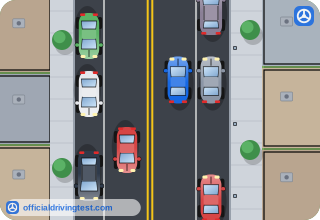
- Signal, pull next to the space and let following vehicles pass before you park
- Park as quickly as possible before the traffic behind you arrives
- Stop in the lane, sound your horn and wait for traffic to clear
- Back into the space immediately without using any signal at all
Show answer
Correct answer: Signal, pull next to the space and let following vehicles pass before you park
The manual says to signal, pull next to the space and allow following vehicles to pass before you park.
Source: Connecticut Driver's Manual (Revised March 2023), page 22 · Open this page in the manual (Manual page 22)
-
What does the manual say about the number of parking spaces your vehicle may take?
- Take two if your vehicle is large
- Do not take more than one
- Take two spaces only when the lot is empty
- Take two if the lines are faded
Show answer
Correct answer: Do not take more than one
The manual says not to take more than one parking space.
Source: Connecticut Driver's Manual (Revised March 2023), page 26 · Open this page in the manual (Manual page 26)
-
Which drivers does the manual say should not park in a handicapped parking space?
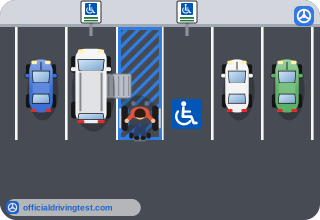
- Those who plan to stay longer than an hour
- Those driving a large vehicle
- Those traveling without a passenger
- Those who are not handicapped
Show answer
Correct answer: Those who are not handicapped
The manual says not to park in a handicapped parking space if you are not handicapped.
Source: Connecticut Driver's Manual (Revised March 2023), page 26 · Open this page in the manual (Manual page 26)
-
When you park next to another vehicle, what should you not allow your door to do?
- Strike an adjacent parked vehicle
- Open while the engine is still running
- Open on the curb side of the vehicle
- Touch the curb as you get out
Show answer
Correct answer: Strike an adjacent parked vehicle
The manual says not to allow your door to strike an adjacent parked vehicle.
Source: Connecticut Driver's Manual (Revised March 2023), page 26 · Open this page in the manual (Manual page 26)
-
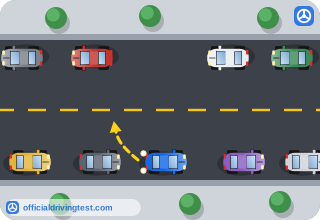
What does the “Parking” list say to do before backing up?
- Sound your horn twice
- Turn on your hazard lights
- Look before backing up
- Tap the brake pedal twice
Show answer
Correct answer: Look before backing up
The manual says to look before backing up.
Source: Connecticut Driver's Manual (Revised March 2023), page 26 · Open this page in the manual (Manual page 26)
-
How far from travel lanes should you park, and how visible should your vehicle be?
- As close to the travel lane as possible, and visible from behind only
- Far from any travel lane, and hidden from approaching traffic
- Far enough to avoid interfering with traffic, and visible from both directions
- Close to the center of the road, and visible from one direction
Show answer
Correct answer: Far enough to avoid interfering with traffic, and visible from both directions
The place must be far enough from travel lanes and visible to vehicles from either direction.
Source: Connecticut Driver's Manual (Revised March 2023), page 37 · Open this page in the manual (Manual page 37)
-
Where should you always park if possible?
- On the street next to the curb
- In a designated area
- In the first space you see
- On the shoulder of the road
Show answer
Correct answer: In a designated area
The manual says to always park in a designated area if possible.
Source: Connecticut Driver's Manual (Revised March 2023), page 37 · Open this page in the manual (Manual page 37)
-
What should you do with a vehicle that has a manual transmission when you park?
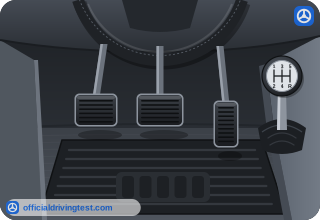
- Set the parking brake and leave it in neutral
- Leave the parking brake off and leave it in gear
- Leave it in reverse without the parking brake
- Set the parking brake and leave it in gear
Show answer
Correct answer: Set the parking brake and leave it in gear
You always set the parking brake and, with a manual transmission, leave the vehicle in gear.
Source: Connecticut Driver's Manual (Revised March 2023), page 37 · Open this page in the manual (Manual page 37)
-
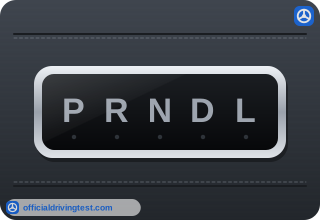
In what position should you leave a vehicle with an automatic transmission when you park?
- In neutral
- In drive
- In reverse
- In park
Show answer
Correct answer: In park
With an automatic transmission, you leave the vehicle in park.
Source: Connecticut Driver's Manual (Revised March 2023), page 37 · Open this page in the manual (Manual page 37)
-
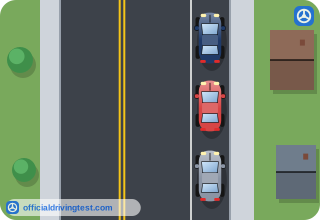
What should you do before you open the door of a parked vehicle?
- Sound the horn
- Check traffic
- Turn on the hazard lights
- Roll down the window
Show answer
Correct answer: Check traffic
The manual says to check traffic before you open the door.
Source: Connecticut Driver's Manual (Revised March 2023), page 37 · Open this page in the manual (Manual page 37)
-
Which side of a parked vehicle should you get out of if you can?
- The street side
- The driver's side only
- The curbside
- The side facing passing traffic
Show answer
Correct answer: The curbside
Get out on the curbside if you can; if you must use the street side, check traffic first.
Source: Connecticut Driver's Manual (Revised March 2023), page 37 · Open this page in the manual (Manual page 37)
-
What should you do with the ignition keys when you leave a parked vehicle?
- Never leave them in the vehicle
- Leave them in the ignition if you will be back soon
- Leave them on the seat so you can find them
- Leave them in the glove compartment
Show answer
Correct answer: Never leave them in the vehicle
The manual says never to leave the ignition keys in a parked vehicle.
Source: Connecticut Driver's Manual (Revised March 2023), page 37 · Open this page in the manual (Manual page 37)
-
If you must park on a roadway and there is a curb, how close to the curb should you park?
- About two feet away from it
- As close to it as you can
- Close enough to touch it with your tires
- About three feet away from it
Show answer
Correct answer: As close to it as you can
Park as far from traffic as possible and as close to the curb as you can.
Source: Connecticut Driver's Manual (Revised March 2023), page 37 · Open this page in the manual (Manual page 37)
-
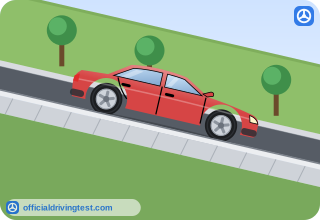
When you park on a hill, what should you do with your wheels?
- Keep them pointing straight ahead of the vehicle
- Turn them toward the center of the road
- Turn them only if you are facing downhill
- Turn them sharply towards the side of the road or curb
Show answer
Correct answer: Turn them sharply towards the side of the road or curb
On a hill you turn your wheels sharply towards the side of the road or the curb.
Source: Connecticut Driver's Manual (Revised March 2023), page 37 · Open this page in the manual (Manual page 37)
-
Why should you turn your wheels sharply towards the side of the road or curb when you park on a hill?
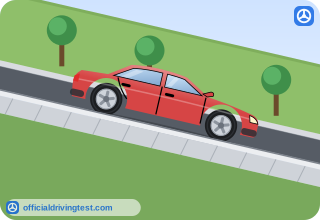
- If your vehicle starts to roll downhill, it will roll away from traffic
- It keeps the tires from wearing unevenly over a long time
- It makes the parking brake unnecessary when you park
- It keeps the vehicle from being towed away by a police officer
Show answer
Correct answer: If your vehicle starts to roll downhill, it will roll away from traffic
The turned wheels make a rolling vehicle roll away from traffic.
Source: Connecticut Driver's Manual (Revised March 2023), page 37 · Open this page in the manual (Manual page 37)
-
How are some parking restrictions indicated?
- By arrows painted on the pavement
- By the width of the street
- By colored curb markings
- By a yellow flashing light
Show answer
Correct answer: By colored curb markings
The manual says some parking restrictions are shown by colored curb markings.
Source: Connecticut Driver's Manual (Revised March 2023), page 37 · Open this page in the manual (Manual page 37)
-
Within how many feet of a stop sign may you not park?
- 10 feet
- 15 feet
- 25 feet
- 50 feet
Show answer
Correct answer: 25 feet
You may not park within 25 feet of a stop sign.
Source: Connecticut Driver's Manual (Revised March 2023), page 37 · Open this page in the manual (Manual page 37)
-
Within how many feet of a pedestrian safety zone may you not park?
- 25 feet
- 10 feet
- 15 feet
- 5 feet
Show answer
Correct answer: 25 feet
You may not park within 25 feet of a pedestrian safety zone.
Source: Connecticut Driver's Manual (Revised March 2023), page 37 · Open this page in the manual (Manual page 37)
-
Within how many feet of a fire hydrant may you not park?
- 5 feet
- 15 feet
- 20 feet
- 10 feet
Show answer
Correct answer: 10 feet
You may not park within 10 feet of a fire hydrant.
Source: Connecticut Driver's Manual (Revised March 2023), page 37 · Open this page in the manual (Manual page 37)
-
How far from the curb may you park?
- No more than two feet
- No more than one foot
- No more than three feet
- No more than four feet
Show answer
Correct answer: No more than one foot
Parking more than one foot from the curb is not allowed.
Source: Connecticut Driver's Manual (Revised March 2023), page 37 · Open this page in the manual (Manual page 37)
-
Which of these is a place where you may not park?
- On a bridge or overpass
- On a roadway as close to the curb as you can
- In a designated parking area
- On the right side of the street, within a foot of the curb
Show answer
Correct answer: On a bridge or overpass
The manual lists bridges, overpasses, tunnels and underpasses as no-parking places.
Source: Connecticut Driver's Manual (Revised March 2023), page 37 · Open this page in the manual (Manual page 37)
-
Which of these is a place where you may not park?
- In a designated parking area
- On a roadway as close to the curb as you can
- In a bike lane
- In a spot visible to vehicles from both directions
Show answer
Correct answer: In a bike lane
The manual lists a bike lane among the places where you may not park.
Source: Connecticut Driver's Manual (Revised March 2023), page 37 · Open this page in the manual (Manual page 37)
-
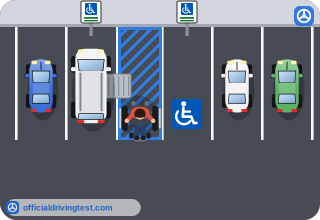
You may not park in a space marked for the handicapped unless you have what?
- A parking permit for that area
- A handicap license plate or placard
- A passenger who is over 65 years old
- A stay of five minutes or less
Show answer
Correct answer: A handicap license plate or placard
Handicapped spaces may be used only with a handicap license plate or placard.
Source: Connecticut Driver's Manual (Revised March 2023), page 37 · Open this page in the manual (Manual page 37)
-
What is double parking?
- Parking two vehicles in the same space
- Parking across two parking spaces
- Parking in the same space twice in one day
- Parking on the roadside of a parked vehicle
Show answer
Correct answer: Parking on the roadside of a parked vehicle
The manual defines double parking as parking on the roadside of a parked vehicle.
Source: Connecticut Driver's Manual (Revised March 2023), page 37 · Open this page in the manual (Manual page 37)
-
Which of these is a place where you may not park?
- Along a curb where no sign is posted
- In a designated parking area
- Beside the curb, within one foot of it
- On railroad tracks
Show answer
Correct answer: On railroad tracks
The manual lists railroad tracks among the places where you may not park.
Source: Connecticut Driver's Manual (Revised March 2023), page 37 · Open this page in the manual (Manual page 37)
-
When may you not park in a construction area?
- At any time, even if you do not block traffic
- If your vehicle will block traffic
- Only at night
- Only if the road is completely closed
Show answer
Correct answer: If your vehicle will block traffic
Parking in a construction area is prohibited if your vehicle will block traffic.
Source: Connecticut Driver's Manual (Revised March 2023), page 37 · Open this page in the manual (Manual page 37)
-
Which of these is a no-parking place?
- The curb beside a vacant lot with no sign posted
- A marked space in a public parking lot
- Blocking a driveway, alley, private road or lowered curb
- A spot beside the curb in a designated area
Show answer
Correct answer: Blocking a driveway, alley, private road or lowered curb
Blocking a driveway, alley, private road or lowered curb is not allowed.
Source: Connecticut Driver's Manual (Revised March 2023), page 37 · Open this page in the manual (Manual page 37)
-
Which of these is a place where you may not park?
- In an intersection
- In a designated parking area
- On a roadway, as far from traffic as possible
- Along a curb with no sign posted
Show answer
Correct answer: In an intersection
The manual lists an intersection among the places where you may not park.
Source: Connecticut Driver's Manual (Revised March 2023), page 37 · Open this page in the manual (Manual page 37)
-
Which of these is a place where you may not park?
- In a designated parking area
- On the wrong side of the street
- Beside the curb, within one foot of it
- On a roadway, as close to the curb as you can
Show answer
Correct answer: On the wrong side of the street
The manual lists the wrong side of the street among the places where you may not park.
Source: Connecticut Driver's Manual (Revised March 2023), page 37 · Open this page in the manual (Manual page 37)
-
Which of these is a place where you may not park?
- In a designated parking area
- Beside the curb, within one foot of it
- Along a curb with no sign posted
- On a crosswalk or sidewalk
Show answer
Correct answer: On a crosswalk or sidewalk
The manual lists a crosswalk or sidewalk among the places where you may not park.
Source: Connecticut Driver's Manual (Revised March 2023), page 37 · Open this page in the manual (Manual page 37)