Connecticut: Highway driving and merging Practice Test
Entering and leaving highways, merging, keeping pace with traffic and driving on the shoulder.
Independent educational site · not affiliated with any government agency or DMV
Ready? Test yourself
- Instant feedback with an explanation
- Every answer cites its source in the manual
- Your best score is saved on this device
Questions are original and based on the official manual "Connecticut Driver's Manual" (Revised March 2023), Connecticut Department of Motor Vehicles (DMV).
All 11 questions in this practice test
Take the test above first, then use this list to study. Tap “Show answer” to see the correct answer and explanation.
Show the questions and answersHide the questions
-
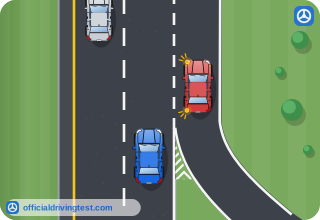
As you approach a highway entrance ramp, what should you do for the traffic entering the highway?
- Speed up so it cannot merge ahead of you
- Honk to warn it to wait on the ramp
- Allow it to merge safely
- Move onto the shoulder to let it pass
Show answer
Correct answer: Allow it to merge safely
If you are approaching the entrance ramp to a highway, you should allow entering traffic to merge safely.
Source: Connecticut Driver's Manual (Revised March 2023), page 20 · Open this page in the manual (Manual page 20)
-
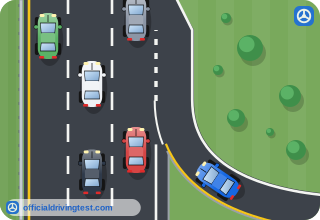
Which of these should you never do from an on-ramp?
- Check for an opening in the main flow of traffic
- Go all the way across several lanes of traffic
- Allow entering traffic to merge safely
- Look for a gap big enough to merge safely
Show answer
Correct answer: Go all the way across several lanes of traffic
The manual says never to go all the way across several lanes of traffic from an on-ramp.
Source: Connecticut Driver's Manual (Revised March 2023), page 20 · Open this page in the manual (Manual page 20)
-
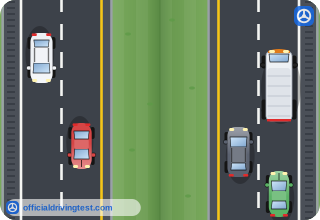
On a road with two or more lanes traveling in the same direction, which lane should you stay in except to pass?
- The right lane
- The left lane
- The center lane
- Any lane you choose
Show answer
Correct answer: The right lane
On such a road, except to pass, you should stay in the right lane.
Source: Connecticut Driver's Manual (Revised March 2023), page 20 · Open this page in the manual (Manual page 20)
-
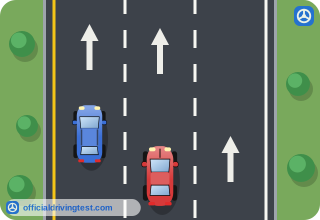
On a road with three or more lanes in the same direction, when should you use the center travel lane?
- When you are driving slower than other traffic
- When the right lane is closed to trucks
- When there is a lot of entering or exiting traffic
- When you are about to make a turn at the next light
Show answer
Correct answer: When there is a lot of entering or exiting traffic
On a road with three or more lanes, use the center travel lane if there is a lot of entering or exiting traffic.
Source: Connecticut Driver's Manual (Revised March 2023), page 20 · Open this page in the manual (Manual page 20)
-
When may you drive on the shoulder of the road?
- When traffic ahead is moving slowly
- Only when told to do so by officials
- When you need to pass a slow truck
- When you are looking for an exit
Show answer
Correct answer: Only when told to do so by officials
Unless told to do so by officials, you should never drive on the shoulder of the road.
Source: Connecticut Driver's Manual (Revised March 2023), page 20 · Open this page in the manual (Manual page 20)
-
When you enter into traffic, at what speed should you try to enter?
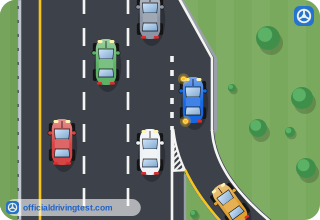
- The same speed that traffic is moving
- Slower than traffic so others can pass you
- Slightly above the speed of traffic
- At the minimum posted speed
Show answer
Correct answer: The same speed that traffic is moving
The manual says to try to enter at the same speed that traffic is moving.
Source: Connecticut Driver's Manual (Revised March 2023), page 20 · Open this page in the manual (Manual page 20)
-
Why should you not drive to the end of an entrance ramp and stop?
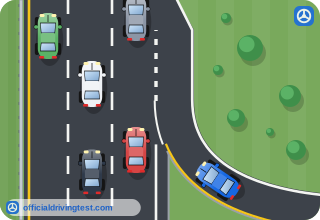
- Drivers behind you will expect you to stop and wait there
- Vehicles stopped at the end of a ramp are not allowed to merge
- You will not have enough room to get up to the speed of traffic
- The main road traffic must yield to a stopped vehicle
Show answer
Correct answer: You will not have enough room to get up to the speed of traffic
Stopping at the end of the ramp leaves too little room to reach the speed of traffic, and drivers behind will not expect you to stop.
Source: Connecticut Driver's Manual (Revised March 2023), page 20 · Open this page in the manual (Manual page 20)
-
If you must wait for space to enter a roadway from a ramp, what should you do?
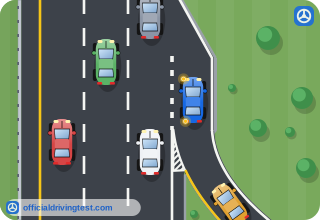
- Stop at the very end of the ramp until traffic clears completely
- Slow down on the ramp so you have room to speed up before merging
- Stay at ramp speed and move onto the shoulder to wait
- Speed up to the posted limit and force your way into traffic
Show answer
Correct answer: Slow down on the ramp so you have room to speed up before merging
Slowing down on the ramp leaves you some room to speed up before you merge onto the main road.
Source: Connecticut Driver's Manual (Revised March 2023), page 20 · Open this page in the manual (Manual page 20)
-
What does the manual say about the passing lane under “Lane Blocking”?
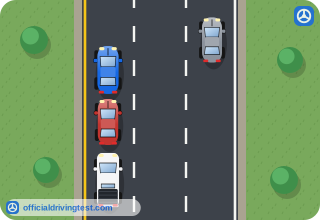
- Do not block it; yield right to passing vehicles
- Stay in it so that the traffic behind you keeps moving
- Use it for steady driving at the posted speed limit
- Stay in it unless the road ahead is crowded
Show answer
Correct answer: Do not block it; yield right to passing vehicles
The manual says not to block the passing lane, to stay out of the far left lane and to yield to the right for any vehicle that wants to pass.
Source: Connecticut Driver's Manual (Revised March 2023), page 26 · Open this page in the manual (Manual page 26)
-
When traffic permits, what should you do to allow vehicles to enter from the on-ramps?
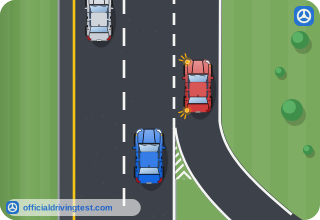
- Move into the far left lane and stay there
- Move out of the right-hand lane
- Speed up in the right-hand lane
- Sound your horn to warn merging drivers
Show answer
Correct answer: Move out of the right-hand lane
The manual says to move out of the right-hand lane of a multi-lane highway when traffic permits so vehicles can enter from the on-ramps.
Source: Connecticut Driver's Manual (Revised March 2023), page 26 · Open this page in the manual (Manual page 26)
-
Where must you never make a U-turn?
- On a road with only one lane
- At a stop sign
- In a residential area
- On an expressway
Show answer
Correct answer: On an expressway
The manual says never to make a U-turn on an expressway.
Source: Connecticut Driver's Manual (Revised March 2023), page 37 · Open this page in the manual (Manual page 37)