Connecticut: Emergency vehicles and work zones — Part 2 Practice Test
Questions in this part include: “How do police vehicles attempting to stop drivers signal them?” · “Where are traffic violations and traffic crimes charged against you decided?”
Independent educational site · not affiliated with any government agency or DMV
Ready? Test yourself
- Instant feedback with an explanation
- Every answer cites its source in the manual
- Your best score is saved on this device
Questions are original and based on the official manual "Connecticut Driver's Manual" (Revised March 2023), Connecticut Department of Motor Vehicles (DMV).
All 23 questions in this practice test
Take the test above first, then use this list to study. Tap “Show answer” to see the correct answer and explanation.
Show the questions and answersHide the questions
-
How do police vehicles attempting to stop drivers signal them?
- Flashing green lights or a steady white light only
- Flashing yellow and white lights, or only a horn blast
- Flashing blue or blue and red lights, or an audible signal
- A steady red light on the roof, with no sound or signal
Show answer
Correct answer: Flashing blue or blue and red lights, or an audible signal
Police use visual flashing blue or blue and red lights, or an audible signal.
Source: Connecticut Driver's Manual (Revised March 2023), page 35 · Open this page in the manual (Manual page 35)
-
When being stopped by a police vehicle, where do police recommend you stop?
- In the middle of the nearest intersection so you are seen
- Near the right-hand edge or curb, clear of any intersection
- In the left lane, so other traffic can pass on the right
- On the first bridge or overpass that you come to
Show answer
Correct answer: Near the right-hand edge or curb, clear of any intersection
Police recommend stopping near the right-hand edge or curb, clear of any intersection.
Source: Connecticut Driver's Manual (Revised March 2023), page 35 · Open this page in the manual (Manual page 35)
-
When being stopped by a police vehicle, what do police recommend about the movements of the driver and passengers?
- Reach quickly for your documents
- Move to the back seat
- Get out of the vehicle at once
- Limit them while stopping your vehicle
Show answer
Correct answer: Limit them while stopping your vehicle
Police recommend limiting the movements of the driver and passengers while stopping.
Source: Connecticut Driver's Manual (Revised March 2023), page 35 · Open this page in the manual (Manual page 35)
-
When being stopped by a police vehicle, where should the hands of the driver and the passengers be?
- Driver's hands on the wheel, passengers' in plain view
- Driver and passengers all with hands on the dashboard
- Driver's hands in pockets, passengers' hands raised
- Driver's hands out the window, passengers' on the seat
Show answer
Correct answer: Driver's hands on the wheel, passengers' in plain view
The driver keeps hands on the steering wheel and passengers keep hands in plain view.
Source: Connecticut Driver's Manual (Revised March 2023), page 35 · Open this page in the manual (Manual page 35)
-
When being stopped by a police vehicle, when should you obtain your driver license and vehicle registration?
- Before the officer approaches
- As soon as you stop the engine
- Only when requested
- While you are still pulling over
Show answer
Correct answer: Only when requested
Police recommend getting your license and registration only when requested.
Source: Connecticut Driver's Manual (Revised March 2023), page 35 · Open this page in the manual (Manual page 35)
-
When being stopped by a police vehicle, what do police recommend about the vehicle doors and where you stay?
- Open the doors and step out to meet the officer at once
- Keep doors closed and stay in the vehicle unless asked to get out
- Open the doors and wait outside the vehicle until asked
- Lock the doors and keep the windows rolled all the way up
Show answer
Correct answer: Keep doors closed and stay in the vehicle unless asked to get out
Keep doors closed and stay in the vehicle unless asked to get out.
Source: Connecticut Driver's Manual (Revised March 2023), page 35 · Open this page in the manual (Manual page 35)
-
If you are stopped by police at night, what do police recommend?
- Turn off all your lights to avoid glaring at the officer
- Leave only the parking lights on until you are told otherwise
- Flash the headlights at the officer to show you saw them
- Turn on the interior light before the officer approaches
Show answer
Correct answer: Turn on the interior light before the officer approaches
At night, turn on the interior light after stopping and before the officer approaches.
Source: Connecticut Driver's Manual (Revised March 2023), page 35 · Open this page in the manual (Manual page 35)
-
If enforcement action is taken against you that you disagree with, what should you do?
- Not argue with the officer at the scene
- Argue your case at the scene
- Refuse to sign anything and drive away
- Call the officer's supervisor on the spot
Show answer
Correct answer: Not argue with the officer at the scene
Do not argue with the officer at the scene.
Source: Connecticut Driver's Manual (Revised March 2023), page 35 · Open this page in the manual (Manual page 35)
-
Where are traffic violations and traffic crimes charged against you decided?
- At the roadside by the officer
- At the DMV counter
- In court
- By your insurance company
Show answer
Correct answer: In court
They are decided in court, not at the scene.
Source: Connecticut Driver's Manual (Revised March 2023), page 35 · Open this page in the manual (Manual page 35)
-
You must yield the right-of-way to an emergency vehicle that is using which of these?
- Only a yellow flashing light on the vehicle roof
- A regular horn used alone without any other warning
- A siren, an air horn, or a red or blue flashing light
- Only a siren, with no flashing lights of any color
Show answer
Correct answer: A siren, an air horn, or a red or blue flashing light
Police vehicles, fire engines, ambulances and other emergency vehicles using a siren, air horn or red or blue flashing light must be yielded to.
Source: Connecticut Driver's Manual (Revised March 2023), page 37 · Open this page in the manual (Manual page 37)
-
After you pull over for an emergency vehicle, how long must you remain stopped?
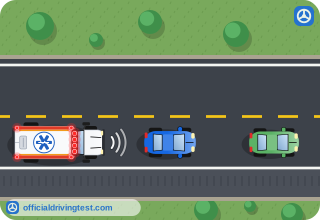
- Until you can no longer hear the siren, regardless of what an officer says
- For at least one full minute after the emergency vehicle has passed you
- Until the emergency vehicle is completely out of sight, no matter who directs you
- Until the vehicle has passed, unless a police officer or fire fighter directs otherwise
Show answer
Correct answer: Until the vehicle has passed, unless a police officer or fire fighter directs otherwise
Stay stopped until the emergency vehicle passes, unless an officer or fire fighter directs otherwise.
Source: Connecticut Driver's Manual (Revised March 2023), page 37 · Open this page in the manual (Manual page 37)
-
If you are in an intersection when an emergency vehicle approaches, what should you do?
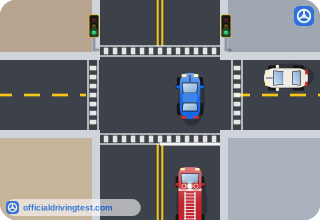
- Stop where you are, inside the intersection
- Drive through the intersection before you pull over
- Back up out of the intersection and stop
- Turn around and leave the intersection
Show answer
Correct answer: Drive through the intersection before you pull over
In an intersection you drive through it first and then pull over.
Source: Connecticut Driver's Manual (Revised March 2023), page 37 · Open this page in the manual (Manual page 37)
-
You must stop for a school bus with its red lights flashing in which of these places?
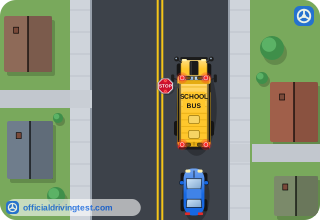
- On your side of the road, the opposite side, or at an intersection you are approaching
- Only when it is on your side of the road, but not at an intersection you approach
- Only on a road that has no median, whether the bus is on your side or not
- Only when children are visible outside the bus on your side of the road
Show answer
Correct answer: On your side of the road, the opposite side, or at an intersection you are approaching
You must stop for a stopped school bus with flashing red lights on either side of the road or at an intersection ahead.
Source: Connecticut Driver's Manual (Revised March 2023), page 37 · Open this page in the manual (Manual page 37)
-
When are you not required to stop for a school bus that is stopped with its red lights flashing?
- When the road has two lanes in each direction and the bus is on the other side
- When you are already very close to the bus and cannot stop in time safely
- When it is traveling towards you and a median or other physical barrier separates the roadway
- When the bus is stopped at an intersection that you are approaching
Show answer
Correct answer: When it is traveling towards you and a median or other physical barrier separates the roadway
A median or other physical barrier separating the roadway means oncoming drivers need not stop.
Source: Connecticut Driver's Manual (Revised March 2023), page 37 · Open this page in the manual (Manual page 37)
-
After a school bus's red lights have stopped flashing, when may you proceed?
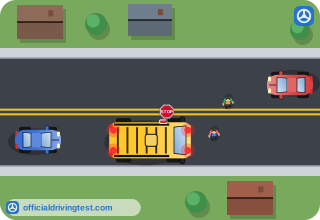
- As soon as the red lights stop flashing, if no children are in sight
- When the children have completely left the roadway and it is safe to proceed
- As soon as the bus begins to move away from the side of the road
- After you count to five slowly and look both ways for children
Show answer
Correct answer: When the children have completely left the roadway and it is safe to proceed
You must watch for children and wait until they have completely left the roadway and it is safe.
Source: Connecticut Driver's Manual (Revised March 2023), page 37 · Open this page in the manual (Manual page 37)
-
What do work area signs warn you of?
- A school zone with children nearby
- A railroad crossing a short way ahead
- A deer crossing area on the road ahead
- People working on or near the roadway
Show answer
Correct answer: People working on or near the roadway
The manual says work area signs warn you that people are working on or near the roadway.
Source: Connecticut Driver's Manual (Revised March 2023), page 51 · Open this page in the manual (Manual page 51)
-
Which of these warnings is included among work area signs?
- Slow moving construction equipment
- Rocks falling onto the roadway
- Wild deer crossing the road ahead
- School buses stopping ahead of you
Show answer
Correct answer: Slow moving construction equipment
The manual lists reduced speed, detours, slow moving construction equipment and poor or suddenly changing road surfaces.
Source: Connecticut Driver's Manual (Revised March 2023), page 51 · Open this page in the manual (Manual page 51)
-
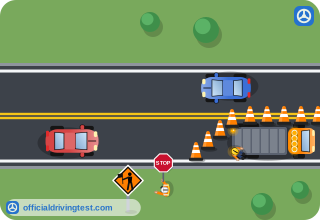
In a work area, a person with a sign or a flag may control traffic. What must you do?
- Obey them only if no police officer is present
- Obey them only when the road is closed
- Obey these persons
- Follow them only if you are in the left lane
Show answer
Correct answer: Obey these persons
The manual says you must obey a person with a sign or a flag who controls traffic in a work area.
Source: Connecticut Driver's Manual (Revised March 2023), page 51 · Open this page in the manual (Manual page 51)
-
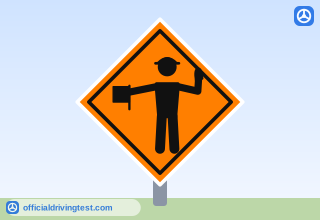
A diamond-shaped sign shows a figure holding a flag. What does it warn you of?
- A school crossing guard ahead
- A railroad crossing ahead
- A pedestrian crosswalk ahead
- A flag person ahead
Show answer
Correct answer: A flag person ahead
The manual says the Flag Person sign warns that there is a flag person ahead.
Source: Connecticut Driver's Manual (Revised March 2023), page 51 · Open this page in the manual (Manual page 51)
-
When you see a flag person ahead sign, what should you do about the flagger’s directions?
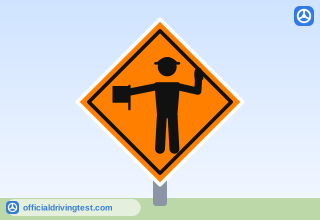
- Always follow them
- Follow them only if no other signs are posted
- Follow them only when workers are visible
- Treat them as advice only
Show answer
Correct answer: Always follow them
The manual says to always follow the flag person’s directions.
Source: Connecticut Driver's Manual (Revised March 2023), page 51 · Open this page in the manual (Manual page 51)
-
What do flaggers normally wear?
- Blue or white vests, or light gray shirts or jackets
- Red or pink vests, or black shirts or long jackets
- Orange or yellow vests, or yellow-green shirts or jackets
- Brown or tan shirts, or dark green vests or jackets
Show answer
Correct answer: Orange or yellow vests, or yellow-green shirts or jackets
The manual says flaggers normally wear orange or yellow vests, yellow-green shirts or jackets.
Source: Connecticut Driver's Manual (Revised March 2023), page 51 · Open this page in the manual (Manual page 51)
-
What do flaggers use to direct traffic through a work zone?
- Whistles and blue lights
- STOP/SLOW paddles and red flags
- Green flags and horns
- Hand-held radar and cones only
Show answer
Correct answer: STOP/SLOW paddles and red flags
The manual says flaggers use STOP/SLOW paddles and red flags to direct traffic.
Source: Connecticut Driver's Manual (Revised March 2023), page 51 · Open this page in the manual (Manual page 51)
-
Besides directing traffic through the work zone, what do flaggers let cross the road?
- Only pedestrians
- Only emergency vehicles
- Only vehicles from the side roads
- Workers or construction vehicles
Show answer
Correct answer: Workers or construction vehicles
The manual says flaggers also let workers or construction vehicles cross the road.
Source: Connecticut Driver's Manual (Revised March 2023), page 51 · Open this page in the manual (Manual page 51)