Connecticut: Emergency vehicles and work zones — Part 1 Practice Test
Questions in this part include: “What colors do all temporary signs in work zones have?” · “In a work zone, whose instructions must you follow in addition to the warning signs?”
Independent educational site · not affiliated with any government agency or DMV
Ready? Test yourself
- Instant feedback with an explanation
- Every answer cites its source in the manual
- Your best score is saved on this device
Questions are original and based on the official manual "Connecticut Driver's Manual" (Revised March 2023), Connecticut Department of Motor Vehicles (DMV).
All 24 questions in this practice test
Take the test above first, then use this list to study. Tap “Show answer” to see the correct answer and explanation.
Show the questions and answersHide the questions
-
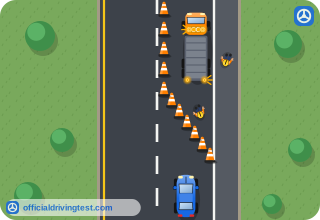
What is a work zone, according to the manual?
- Only a stretch of highway closed to all traffic
- Only an area where workers are present at that moment
- Any type of roadwork that may delay traffic conditions
- Only roadwork that lasts longer than one season
Show answer
Correct answer: Any type of roadwork that may delay traffic conditions
A work zone is any type of roadwork that may delay traffic conditions; it can be long or short term.
Source: Connecticut Driver's Manual (Revised March 2023), page 15 · Open this page in the manual (Manual page 15)
-
What colors do all temporary signs in work zones have?
- A yellow background with black letters or symbols
- An orange background with black letters or symbols
- A white background with red letters
- An orange background with white letters
Show answer
Correct answer: An orange background with black letters or symbols
All temporary signs in work zones have an orange background and black letters or symbols.
Source: Connecticut Driver's Manual (Revised March 2023), page 15 · Open this page in the manual (Manual page 15)
-
On a divided highway, where are temporary work zone signs found?
- Only on the right-hand side of the road
- Only on the left-hand side of the road
- Only in the median between lanes
- On both left and right sides of the road
Show answer
Correct answer: On both left and right sides of the road
Work zone signs are on the right side, or on both left and right sides when the roadway is a divided highway.
Source: Connecticut Driver's Manual (Revised March 2023), page 15 · Open this page in the manual (Manual page 15)
-
What should you do if a work zone has no reduced speed limit signs?
- Obey the normal posted speed limit
- Drive at the lowest speed your vehicle can safely hold
- Match the speed of the vehicle in front of you
- Use your own judgment since no limit applies
Show answer
Correct answer: Obey the normal posted speed limit
If there are no reduced speed limit signs, you should obey the normal posted speed limit.
Source: Connecticut Driver's Manual (Revised March 2023), page 15 · Open this page in the manual (Manual page 15)
-
A driver convicted of endangering a highway worker within a work zone in Connecticut could face fines of up to how much?
- $500
- $1,000
- $2,000
- $250
Show answer
Correct answer: $1,000
Connecticut drivers convicted of speeding, disobeying traffic control devices, using an improper lane or endangering a highway worker in a work zone could face fines of up to $1,000.
Source: Connecticut Driver's Manual (Revised March 2023), page 15 · Open this page in the manual (Manual page 15)
-
Besides fines, what else can happen to a driver convicted of disobeying traffic control devices in a work zone?
- The license is automatically suspended for a full year after the first offense
- The vehicle is impounded until all fines have been paid in full
- The driver must retake both the knowledge test and the road test
- Points can be assessed against the license and driver retraining may be required
Show answer
Correct answer: Points can be assessed against the license and driver retraining may be required
The manual says such a driver can be assessed points and may be required to complete the driver retraining program.
Source: Connecticut Driver's Manual (Revised March 2023), page 15 · Open this page in the manual (Manual page 15)
-
What happens to distracted driving fines for illegally using a hand-held cellphone while driving in a work zone?
- They are doubled
- They are tripled
- They are not changed
- They are waived once
Show answer
Correct answer: They are doubled
Distracted driving fines are doubled for anyone convicted of illegally using a hand-held cellphone or mobile electronic device in a work zone.
Source: Connecticut Driver's Manual (Revised March 2023), page 15 · Open this page in the manual (Manual page 15)
-
In a work zone, whose instructions must you follow in addition to the warning signs?
- The driver in front of you
- Your passengers
- Flaggers
- Tow truck operators
Show answer
Correct answer: Flaggers
The tips say to follow the instructions on the work zone warning signs and those given by flaggers.
Source: Connecticut Driver's Manual (Revised March 2023), page 15 · Open this page in the manual (Manual page 15)
-
When a work zone is long term or widespread, what does the manual say about its signs?
- You may ignore ones you have seen before
- They no longer apply after the first week
- Only the first sign must be obeyed
- Keep paying attention to them
Show answer
Correct answer: Keep paying attention to them
The manual warns drivers not to become oblivious to work zone signs when the work is long term or widespread.
Source: Connecticut Driver's Manual (Revised March 2023), page 15 · Open this page in the manual (Manual page 15)
-
What should you be aware of about traffic patterns in work zones?
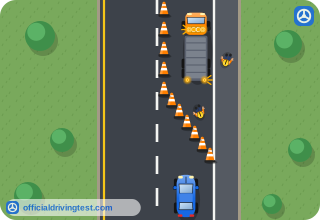
- They can change daily, including lane shifts or alternating lane closures
- They never change once the first warning sign has been posted by the crew
- They change only when the posted speed limit is lowered at night
- They are identical in every work zone on the same highway
Show answer
Correct answer: They can change daily, including lane shifts or alternating lane closures
Traffic patterns in work zones can change daily, including lane shifts or alternating lane closures.
Source: Connecticut Driver's Manual (Revised March 2023), page 15 · Open this page in the manual (Manual page 15)
-
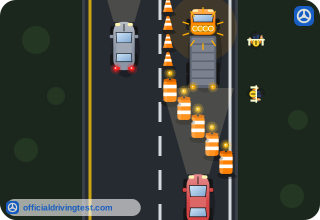
What does the manual say about driving through a work zone at night?
- Caution is needed only when workers are visible
- Use high beams to see the workers farther ahead
- Use extreme caution whether workers are present or not
- Speed up to clear the zone quickly
Show answer
Correct answer: Use extreme caution whether workers are present or not
The manual says to use extreme caution at night whether workers are present or not.
Source: Connecticut Driver's Manual (Revised March 2023), page 15 · Open this page in the manual (Manual page 15)
-
In a work zone, what should you check on the vehicles ahead of you to see what is happening on the road ahead?
- Their license plates
- Their tail and brake lights
- Their side mirrors
- Their hazard flashers only
Show answer
Correct answer: Their tail and brake lights
Checking the tail and brake lights of vehicles ahead tells you what is happening ahead so you can respond quickly.
Source: Connecticut Driver's Manual (Revised March 2023), page 16 · Open this page in the manual (Manual page 16)
-
When should you move to the appropriate lane as you approach a work zone?
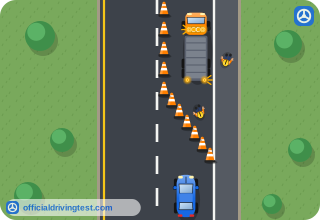
- At the first notice of the approaching work zone
- At the last moment, just before the lane ends
- Only when the driver ahead of you merges first
- Only after you reach the first traffic cone
Show answer
Correct answer: At the first notice of the approaching work zone
Motorists help maintain traffic flow and posted speeds by moving to the appropriate lane at first notice of a work zone.
Source: Connecticut Driver's Manual (Revised March 2023), page 16 · Open this page in the manual (Manual page 16)
-
When possible, how should you adjust your lane position in a work zone?
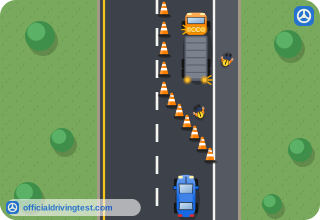
- Toward the side with workers so you can see them
- Toward the left edge of your lane at all times
- Away from the side with workers and equipment
- Onto the shoulder so other drivers can pass you
Show answer
Correct answer: Away from the side with workers and equipment
The manual says to adjust your lane position away from the side where workers and equipment are located when possible.
Source: Connecticut Driver's Manual (Revised March 2023), page 16 · Open this page in the manual (Manual page 16)
-
Near traffic barriers, trucks, construction equipment and workers, what should you do about your following distance?
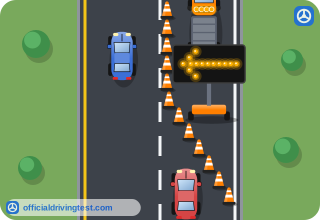
- Shorten it to keep traffic moving
- Increase it and do not tailgate
- Keep the same distance used on open highways
- Follow closely so no one cuts in front of you
Show answer
Correct answer: Increase it and do not tailgate
The manual tells drivers to increase their following distance and not to tailgate in work zones.
Source: Connecticut Driver's Manual (Revised March 2023), page 16 · Open this page in the manual (Manual page 16)
-
Which of these work operations does the manual give as an example of a mobile work zone?
- Bridge rebuilding
- Tunnel lighting repair
- Guardrail replacement
- Line painting
Show answer
Correct answer: Line painting
Line painting, road patching and mowing are named as mobile work zones.
Source: Connecticut Driver's Manual (Revised March 2023), page 16 · Open this page in the manual (Manual page 16)
-
If you do not see workers right after a work zone warning sign, until which sign should you keep observing the posted signs?
- The one that says “Resume Speed”
- The one that says “Workers Gone”
- The one that says “End Road Work”
- The last orange cone you pass
Show answer
Correct answer: The one that says “End Road Work”
Work zones can be mobile, so you keep observing the posted signs until you see the one that says “End Road Work.”
Source: Connecticut Driver's Manual (Revised March 2023), page 16 · Open this page in the manual (Manual page 16)
-
What does the manual suggest when you can avoid a work zone altogether?
- Drive through it at night
- Follow a truck through it
- Drive through it faster
- Use an alternate route
Show answer
Correct answer: Use an alternate route
The manual advises using alternate routes to avoid work zones when you can.
Source: Connecticut Driver's Manual (Revised March 2023), page 16 · Open this page in the manual (Manual page 16)
-
How does the manual say you should plan a trip that passes through a work zone?
- Expect delays, plan for them and leave early
- Plan to make up lost time by driving faster elsewhere
- Assume the road work will not affect your trip time
- Leave at your usual time and use your horn to hurry traffic
Show answer
Correct answer: Expect delays, plan for them and leave early
The tips say to expect delays, plan for them and leave early to reach your destination on time.
Source: Connecticut Driver's Manual (Revised March 2023), page 16 · Open this page in the manual (Manual page 16)
-
You must yield the right-of-way to emergency vehicles using what?
- Sirens or white and amber flashing lights only
- Only sirens, since lights do not require yielding
- Bells, whistles or green flashing lights
- Sirens, air horns or red or blue flashing lights
Show answer
Correct answer: Sirens, air horns or red or blue flashing lights
You must yield to police vehicles, fire engines, ambulances or other emergency vehicles using sirens, air horns or red or blue flashing lights.
Source: Connecticut Driver's Manual (Revised March 2023), page 16 · Open this page in the manual (Manual page 16)
-
When you see or hear an emergency vehicle approaching from any direction, what must you do?
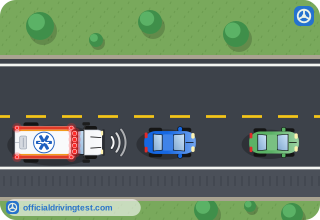
- Pull over to the right edge of the road, or as near as possible, and stop
- Pull over to the left edge of the road and stop until it passes
- Slow down and keep driving in your lane so it can pass you
- Stop wherever you are, even in an intersection, until it passes
Show answer
Correct answer: Pull over to the right edge of the road, or as near as possible, and stop
You must pull over to the right edge of the road, or as near to the right as possible, and stop your vehicle.
Source: Connecticut Driver's Manual (Revised March 2023), page 16 · Open this page in the manual (Manual page 16)
-
Under the Move Over Law, how must you adjust your speed when a vehicle is pulled over on a highway or road?
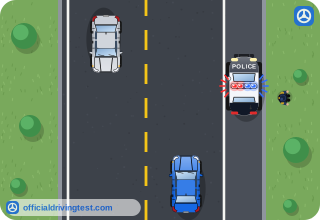
- Hold the posted limit exactly
- Speed up to pass it quickly
- Slow down below the posted limit
- Stop completely until it leaves
Show answer
Correct answer: Slow down below the posted limit
The Move Over Law requires drivers to slow down, below the posted speed limit.
Source: Connecticut Driver's Manual (Revised March 2023), page 16 · Open this page in the manual (Manual page 16)
-
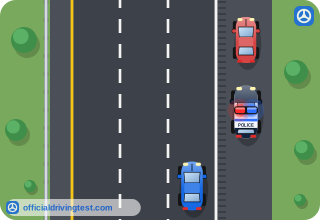
Under the Move Over Law, how many lanes must you move over when it is safe, if a vehicle is pulled over?
- Two lanes
- One lane
- Three lanes
- Into the shoulder
Show answer
Correct answer: One lane
Drivers must move their vehicle over one lane whenever it is safe to do so.
Source: Connecticut Driver's Manual (Revised March 2023), page 16 · Open this page in the manual (Manual page 16)
-
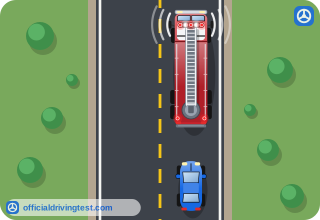
Why leave more room when following police vehicles, ambulances and fire trucks?
- They always stop at each intersection
- They need more room to operate
- They cannot use their brakes quickly
- They are not required to obey signals
Show answer
Correct answer: They need more room to operate
The manual says emergency vehicles need more room to operate.
Source: Connecticut Driver's Manual (Revised March 2023), page 21 · Open this page in the manual (Manual page 21)