Connecticut: Distracted driving and fitness — Part 1 Practice Test
Questions in this part include: “Which of these is named as a distracting activity that increases the risk of a serious crash for teens?” · “What results from an operator under age 18 being convicted of violating the cell phone law?”
Independent educational site · not affiliated with any government agency or DMV
Ready? Test yourself
- Instant feedback with an explanation
- Every answer cites its source in the manual
- Your best score is saved on this device
Questions are original and based on the official manual "Connecticut Driver's Manual" (Revised March 2023), Connecticut Department of Motor Vehicles (DMV).
All 21 questions in this practice test
Take the test above first, then use this list to study. Tap “Show answer” to see the correct answer and explanation.
Show the questions and answersHide the questions
-
Which of these is named as a distracting activity that increases the risk of a serious crash for teens?
- Unrestrained pets in the car
- Wearing a seat belt
- Driving with the windows closed
- Using the turn signal
Show answer
Correct answer: Unrestrained pets in the car
The manual lists talking, texting, dialing radio stations and unrestrained pets among distractions that raise crash risk.
Source: Connecticut Driver's Manual (Revised March 2023), page 4 · Open this page in the manual (Manual page 4)
-
May a driver use a hand-held cell phone while temporarily stopped because of traffic or at a traffic signal?
- No, state law also prohibits it
- Yes, because the vehicle is not moving
- Yes, but only at a red light
- Yes, but only for calls under one minute
Show answer
Correct answer: No, state law also prohibits it
State law prohibits hand-held use even when the vehicle is temporarily stopped because of traffic, road conditions or a traffic control sign or signal.
Source: Connecticut Driver's Manual (Revised March 2023), page 13 · Open this page in the manual (Manual page 13)
-
Where may you use a hand-held cell phone or mobile electronic device?
- In the left lane of a highway when traffic is light
- While moving slower than 25 mph on a local road
- Parked safely on the side or shoulder of a highway
- While stopped at a stop sign
Show answer
Correct answer: Parked safely on the side or shoulder of a highway
The manual allows use only if you are parked safely on the side or shoulder of a highway.
Source: Connecticut Driver's Manual (Revised March 2023), page 13 · Open this page in the manual (Manual page 13)
-
Under Connecticut's cell phone law, what kind of phone use is generally permitted for drivers 18 or older?
- Hand-held calls but not texting
- Hands-free accessories only
- Hand-held use with the speaker on
- Any use that keeps one hand on the wheel
Show answer
Correct answer: Hands-free accessories only
Drivers are permitted only to use hands-free mobile telephone accessories.
Source: Connecticut Driver's Manual (Revised March 2023), page 13 · Open this page in the manual (Manual page 13)
-
Apart from an emergency, what cell phone use is permitted for a driver who is 16 or 17 years old?
- Hands-free devices only
- Hand-held calls only, not texting
- Hand-held use when stopped in traffic
- None, not even a hands-free device
Show answer
Correct answer: None, not even a hands-free device
Drivers who are 16 or 17 may not use any type of cell phone or mobile electronic device, hands-free included.
Source: Connecticut Driver's Manual (Revised March 2023), page 13 · Open this page in the manual (Manual page 13)
-
Which of these does the manual say a "mobile electronic device" includes?
- A laptop computer
- A vehicle’s rearview mirror
- A tire pressure gauge
- A vehicle’s turn signal lever
Show answer
Correct answer: A laptop computer
The manual lists a laptop computer, personal digital assistant, and paging or text-messaging device.
Source: Connecticut Driver's Manual (Revised March 2023), page 13 · Open this page in the manual (Manual page 13)
-
Which situation allows a driver of any age to use a hand-held phone?
- A call to a family member to say you are running late
- A call to a friend while stopped at a red light
- An emergency call to the police or a hospital
- A call to your employer about a work schedule
Show answer
Correct answer: An emergency call to the police or a hospital
The exception is an emergency situation, such as contacting an emergency response operator, hospital, or police or fire department.
Source: Connecticut Driver's Manual (Revised March 2023), page 13 · Open this page in the manual (Manual page 13)
-
Which drivers aged 18 and older may use hand-held cell phones and electronic devices?
- Delivery drivers while they are working on the job
- Peace officers, firefighters and ambulance drivers
- Taxi drivers and bus drivers carrying passengers
- Licensed driving instructors giving a lesson
Show answer
Correct answer: Peace officers, firefighters and ambulance drivers
The manual names peace officers, firefighters and ambulance drivers aged 18 and older as exceptions.
Source: Connecticut Driver's Manual (Revised March 2023), page 13 · Open this page in the manual (Manual page 13)
-
What is a 16- or 17-year-old charged with for violating Connecticut’s cell phone law?
- A parking violation
- A written warning only
- A criminal misdemeanor
- A moving violation
Show answer
Correct answer: A moving violation
The manual says such a driver will be charged with a moving violation.
Source: Connecticut Driver's Manual (Revised March 2023), page 13 · Open this page in the manual (Manual page 13)
-
What results from an operator under age 18 being convicted of violating the cell phone law?
- A license suspension
- A warning letter only
- Loss of insurance coverage
- A mandatory driving lesson
Show answer
Correct answer: A license suspension
A conviction for an operator under 18 results in a license suspension.
Source: Connecticut Driver's Manual (Revised March 2023), page 13 · Open this page in the manual (Manual page 13)
-
A cell phone moving violation by a driver under 18 is counted for what purpose?
- Setting the length of the learner’s permit period
- Deciding whether the road test must be retaken
- Deciding if the operator retraining program is required
- Determining the driver’s insurance rate class
Show answer
Correct answer: Deciding if the operator retraining program is required
The manual says it is counted when determining if attendance is required in the operator retraining program.
Source: Connecticut Driver's Manual (Revised March 2023), page 13 · Open this page in the manual (Manual page 13)
-
Which of these is named as a distraction to avoid when driving through work zones?
- Checking your mirrors
- Changing the radio station
- Reading the warning signs
- Using the turn signal
Show answer
Correct answer: Changing the radio station
The manual lists cell phones, changing the radio station and applying make-up as distractions to avoid in work zones.
Source: Connecticut Driver's Manual (Revised March 2023), page 16 · Open this page in the manual (Manual page 16)
-
According to the manual, what is the single biggest contributor to crashes?
- Driving too slowly on busy roads
- Mechanical failure of the vehicle
- Failing to see what is happening
- Bad weather and slippery roads
Show answer
Correct answer: Failing to see what is happening
The manual states that the single biggest contributor to crashes is failing to see what is happening.
Source: Connecticut Driver's Manual (Revised March 2023), page 24 · Open this page in the manual (Manual page 24)
-
If you need to look at a map, what should you do?
- Glance at it at a red light only
- Pull safely off the road first
- Hold it at the top of the wheel
- Slow to 10 mph and look quickly
Show answer
Correct answer: Pull safely off the road first
The manual says not to take your eyes off the road for more than a few seconds and to pull safely off the road to look at a map.
Source: Connecticut Driver's Manual (Revised March 2023), page 24 · Open this page in the manual (Manual page 24)
-
Why should you not drive with head or earphones that cover or go into both ears?
- They can damage your hearing over a long time
- They block sunlight from reaching your eyes
- They are required only for commercial drivers
- They make it hard to hear emergency horns or sirens
Show answer
Correct answer: They make it hard to hear emergency horns or sirens
The manual says they are illegal in many states and make it too hard to hear emergency horns or sirens.
Source: Connecticut Driver's Manual (Revised March 2023), page 24 · Open this page in the manual (Manual page 24)
-
What is it called when you slow down just to look at a crash or someone getting a ticket?
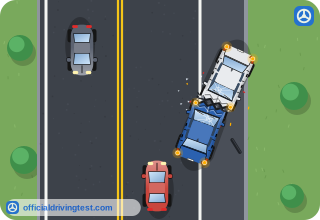
- Rubbernecking
- Tail drifting
- Lane gaping
- Road scanning
Show answer
Correct answer: Rubbernecking
The manual calls slowing down to look at roadside activity "rubbernecking", and it could cause a crash.
Source: Connecticut Driver's Manual (Revised March 2023), page 24 · Open this page in the manual (Manual page 24)
-
What else can rubbernecking do besides raising the risk of a crash?
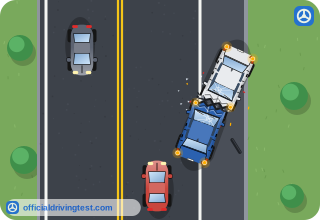
- Shorten stopping distance
- Improve traffic flow
- Increase congestion
- Lower the speed limit
Show answer
Correct answer: Increase congestion
The manual says rubbernecking can also increase congestion.
Source: Connecticut Driver's Manual (Revised March 2023), page 24 · Open this page in the manual (Manual page 24)
-
When you pass a crash or other roadside activity, what should you do?
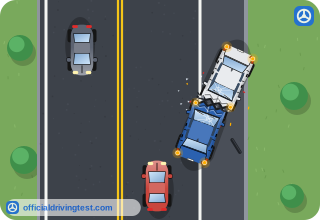
- Slow to a crawl so you can see what happened
- Keep your eyes on the road and get past it safely
- Stop on the shoulder and watch the activity
- Look at the scene first, then speed up
Show answer
Correct answer: Keep your eyes on the road and get past it safely
The manual says to keep your eyes on the road and get past the activity as quickly and safely as you can.
Source: Connecticut Driver's Manual (Revised March 2023), page 24 · Open this page in the manual (Manual page 24)
-
How does the manual define a distraction?
- Anything that takes your attention away from driving
- Any object that blocks your view of the road ahead
- Any task that needs both hands off the steering wheel
- Any sound inside the vehicle louder than the engine
Show answer
Correct answer: Anything that takes your attention away from driving
The manual defines a distraction as anything that takes your attention away from driving, and says distractions may occur anytime and anywhere.
Source: Connecticut Driver's Manual (Revised March 2023), page 27 · Open this page in the manual (Manual page 27)
-
Compared with taking your eyes off the road, how dangerous are mental activities that take your mind away from driving?
- Less dangerous, since your eyes stay on the road
- Only dangerous at speeds above 50 mph
- Just as dangerous
- Not dangerous if both hands are on the wheel
Show answer
Correct answer: Just as dangerous
The manual says taking your eyes off the road or hands off the wheel is risky, and mental activities that take your mind off driving are just as dangerous.
Source: Connecticut Driver's Manual (Revised March 2023), page 27 · Open this page in the manual (Manual page 27)
-
Why can a driver look straight at an object and still fail to see it?
- The windshield distorts objects close to the car
- The driver's mind is thinking of something else
- The eyes need several seconds to refocus each time
- Objects in front of the car are hidden by the hood
Show answer
Correct answer: The driver's mind is thinking of something else
The manual explains that your eyes can gaze at objects but fail to see them because your mind is thinking of something else.
Source: Connecticut Driver's Manual (Revised March 2023), page 27 · Open this page in the manual (Manual page 27)