Colorado: Speed and following distance — Part 4 Practice Test
Questions in this part include: “How far ahead of your vehicle should you look down the road?” · “Why should you look for other vehicles and pedestrians on both sides and beyond the curb?”
Independent educational site · not affiliated with any government agency or DMV
Ready? Test yourself
- Instant feedback with an explanation
- Every answer cites its source in the manual
- Your best score is saved on this device
Questions are original and based on the official manual "Colorado Driver Handbook" (DR 2337, January 2025), Colorado Division of Motor Vehicles (DMV).
All 16 questions in this practice test
Take the test above first, then use this list to study. Tap “Show answer” to see the correct answer and explanation.
Show the questions and answersHide the questions
-
How far ahead of your vehicle should you look down the road?
- At least 2 seconds
- At least 10 seconds
- At least 5 seconds
- At least 30 seconds
Show answer
Correct answer: At least 10 seconds
You should look down the road at least 10 seconds ahead of your vehicle.
Source: Colorado Driver Handbook (DR 2337, January 2025), page 18 · Open this page in the manual (Manual page 18)
-
On an open road, looking 10 seconds ahead of your vehicle means looking about how far?
- One block
- One mile
- 100 feet
- Half a mile
Show answer
Correct answer: Half a mile
The handbook gives half a mile for the open road.
Source: Colorado Driver Handbook (DR 2337, January 2025), page 18 · Open this page in the manual (Manual page 18)
-
In the city, looking 10 seconds ahead of your vehicle means looking about how far?
- One block
- Half a mile
- One mile
- Ten blocks
Show answer
Correct answer: One block
The handbook gives one block for the city.
Source: Colorado Driver Handbook (DR 2337, January 2025), page 18 · Open this page in the manual (Manual page 18)
-
Why should you look down the road at least 10 seconds ahead of your vehicle?
- To read the license plates of vehicles ahead
- To judge when a traffic signal will change colors
- To avoid last-minute braking or abrupt turns
- To find parking spaces earlier
Show answer
Correct answer: To avoid last-minute braking or abrupt turns
Looking ahead helps you avoid last-minute braking or the need to turn abruptly.
Source: Colorado Driver Handbook (DR 2337, January 2025), page 18 · Open this page in the manual (Manual page 18)
-
Looking well ahead and being ready to stop or change lanes helps you do which of these?
- Avoid using your mirrors
- Save on fuel
- Skip checking blind spots
- Drive faster than the posted limit
Show answer
Correct answer: Save on fuel
By looking well ahead you can drive more safely, save on fuel and help keep traffic moving at a steady pace.
Source: Colorado Driver Handbook (DR 2337, January 2025), page 18 · Open this page in the manual (Manual page 18)
-
Why should you look for other vehicles and pedestrians on both sides and beyond the curb?
- Curbs are always marked with warning colors
- It is the only way to know your lane position
- Signs giving directions are always at the curb
- Others might cross or enter your path at any time
Show answer
Correct answer: Others might cross or enter your path at any time
Other vehicles or pedestrians might cross or enter your path at any time.
Source: Colorado Driver Handbook (DR 2337, January 2025), page 18 · Open this page in the manual (Manual page 18)
-
How often must you check traffic behind you in your rear view mirror?
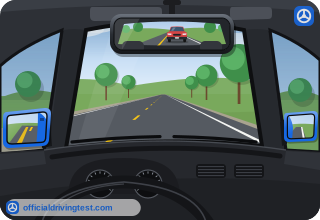
- Every 5 to 8 seconds
- Every 1 to 2 seconds
- Every 10 to 15 seconds
- Every 30 seconds
Show answer
Correct answer: Every 5 to 8 seconds
You must check traffic behind you in your rear view mirror every 5 to 8 seconds.
Source: Colorado Driver Handbook (DR 2337, January 2025), page 18 · Open this page in the manual (Manual page 18)
-
When should you check traffic behind you more often than every 5 to 8 seconds?
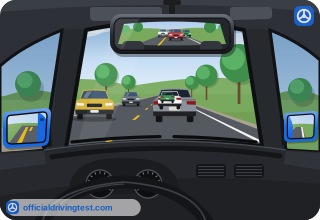
- When traffic is light
- On open rural roads
- When traffic is heavy
- When the road is dry
Show answer
Correct answer: When traffic is heavy
You need to check more often when traffic is heavy.
Source: Colorado Driver Handbook (DR 2337, January 2025), page 18 · Open this page in the manual (Manual page 18)
-
In which situation is it very important to look behind you?
- When you hold a steady speed on a flat road
- When you drive down a long or steep hill
- When you are parked with the engine off
- When you turn on your windshield wipers
Show answer
Correct answer: When you drive down a long or steep hill
It is very important to look behind you when you change lanes, slow down, back up, exit an intersection or drive down a long or steep hill.
Source: Colorado Driver Handbook (DR 2337, January 2025), page 18 · Open this page in the manual (Manual page 18)
-
What does following the vehicle in front of you too closely do?
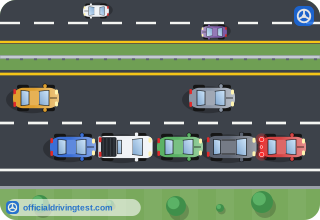
- Improves your view of traffic ahead
- Gives you extra time to react to hazards
- Saves fuel by reducing wind resistance
- Limits your view and your time to react
Show answer
Correct answer: Limits your view and your time to react
Following too closely limits your vision of the road and does not allow you enough time to react to avoid a crash.
Source: Colorado Driver Handbook (DR 2337, January 2025), page 18 · Open this page in the manual (Manual page 18)
-
Under normal conditions, which rule gauges the space to leave between your vehicle and the vehicle in front of you?
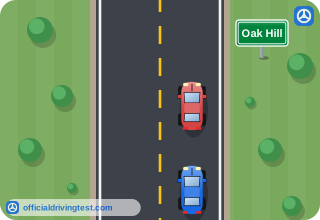
- Three-second rule
- Six-second rule
- Two-car-length rule
- Ten-second rule
Show answer
Correct answer: Three-second rule
Under normal conditions use the three-second rule to gauge the space between you and the vehicle ahead.
Source: Colorado Driver Handbook (DR 2337, January 2025), page 18 · Open this page in the manual (Manual page 18)
-
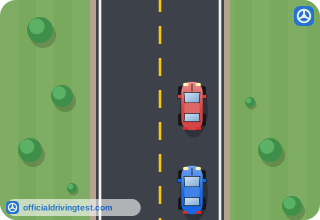
In the three-second rule, when do you begin counting?
- When the vehicle ahead brakes suddenly
- When your vehicle reaches the intersection
- When the vehicle ahead passes a reference point
- When the traffic signal turns green
Show answer
Correct answer: When the vehicle ahead passes a reference point
You watch the vehicle ahead; when it passes a reference point such as a mile marker, sign or telephone pole, you start counting.
Source: Colorado Driver Handbook (DR 2337, January 2025), page 18 · Open this page in the manual (Manual page 18)
-
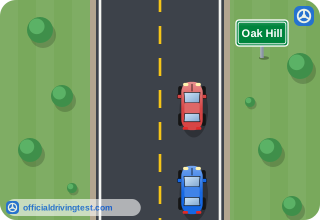
Using the three-second rule, you pass the reference point before you finish counting. What does that mean?
- You have the correct following distance
- You are following too closely
- You are following too far behind
- You should speed up
Show answer
Correct answer: You are following too closely
If you pass the reference point before you finish counting, you are following too closely.
Source: Colorado Driver Handbook (DR 2337, January 2025), page 18 · Open this page in the manual (Manual page 18)
-
According to the handbook, what happens when you travel much faster than traffic?
- It lets traffic flow more smoothly by keeping everyone moving
- It results in frequent passing, which increases the chance of a crash
- It lowers the number of passing situations on the road
- It causes back-ups and more passing situations behind you
Show answer
Correct answer: It results in frequent passing, which increases the chance of a crash
Traveling much faster than traffic results in frequent passing, increasing the opportunity for a crash.
Source: Colorado Driver Handbook (DR 2337, January 2025), page 19 · Open this page in the manual (Manual page 19)
-
What can result from driving considerably slower than other vehicles?
- Smoother traffic with fewer lane changes by other drivers
- Lower risk of a crash because you have more time to react
- Less need for others to pass you on the road
- Back-ups and more passing situations that compromise safety
Show answer
Correct answer: Back-ups and more passing situations that compromise safety
Driving considerably slower increases unpredictability and compromises safety by causing back-ups and more passing situations.
Source: Colorado Driver Handbook (DR 2337, January 2025), page 19 · Open this page in the manual (Manual page 19)
-
Which of these is listed in the handbook as a place that requires slower speeds and increased attention?
- Toll plazas
- Long, straight rural highways
- Wide freeway shoulders
- Empty parking lots at night
Show answer
Correct answer: Toll plazas
The handbook's list of slow zones includes shopping centers, schools, parks and playgrounds, residential streets, rush hour traffic, narrow bridges, toll plazas and rail crossings.
Source: Colorado Driver Handbook (DR 2337, January 2025), page 19 · Open this page in the manual (Manual page 19)