Colorado: Speed and following distance — Part 2 Practice Test
Questions in this part include: “What is stopping distance?” · “What could happen if you brake too quickly?”
Independent educational site · not affiliated with any government agency or DMV
Ready? Test yourself
- Instant feedback with an explanation
- Every answer cites its source in the manual
- Your best score is saved on this device
Questions are original and based on the official manual "Colorado Driver Handbook" (DR 2337, January 2025), Colorado Division of Motor Vehicles (DMV).
All 16 questions in this practice test
Take the test above first, then use this list to study. Tap “Show answer” to see the correct answer and explanation.
Show the questions and answersHide the questions
-
What is stopping distance?
- The distance your vehicle travels after you press the brake pedal
- The distance your vehicle needs to stop after the brakes lock
- The distance traveled from when you realize you must stop until you stop
- The distance between you and the vehicle ahead of you
Show answer
Correct answer: The distance traveled from when you realize you must stop until you stop
Stopping distance runs from the moment you realize you must stop until the vehicle stops.
Source: Colorado Driver Handbook (DR 2337, January 2025), page 12 · Open this page in the manual (Manual page 12)
-
Which of these factors affects your stopping distance?
- The color of your vehicle and its paint finish
- The time it takes you to recognize you need to stop
- The number on your vehicle's license plate
- The brand name printed on your tires
Show answer
Correct answer: The time it takes you to recognize you need to stop
Stopping distance depends on speed, recognition time, reaction time and the time the brakes take to slow and stop the vehicle.
Source: Colorado Driver Handbook (DR 2337, January 2025), page 12 · Open this page in the manual (Manual page 12)
-
How does giving yourself space behind other motorists help you?
- It lets you drive faster than the posted limit
- It means you never need to check your mirrors
- It shortens the time your brakes need to stop the vehicle
- You can assess well ahead when you will need to stop
Show answer
Correct answer: You can assess well ahead when you will need to stop
Space lets you judge early when you must stop; slowing down or changing lanes may let you avoid stopping or stop more gradually.
Source: Colorado Driver Handbook (DR 2337, January 2025), page 12 · Open this page in the manual (Manual page 12)
-
What is stopping suddenly often the result of?
- A driver who was not paying attention or trailing too closely
- A driver who was driving well below the posted speed limit
- A driver who was using a turn signal before slowing
- A driver who was in the right-hand lane of the road
Show answer
Correct answer: A driver who was not paying attention or trailing too closely
The handbook says sudden stops are often the result of a driver who was not paying attention or was following too closely.
Source: Colorado Driver Handbook (DR 2337, January 2025), page 12 · Open this page in the manual (Manual page 12)
-
What could happen if you brake too quickly?
- Your vehicle's brakes would reset themselves
- Your stopping distance would be zero
- You could skid or lose control of your vehicle
- Your tires would grip the road better
Show answer
Correct answer: You could skid or lose control of your vehicle
Braking too quickly could cause a skid, a loss of control or a crash with the vehicle behind.
Source: Colorado Driver Handbook (DR 2337, January 2025), page 12 · Open this page in the manual (Manual page 12)
-
According to the National Safety Council, in about how many feet can a lightweight passenger car traveling 55 mph stop?
- About 100 feet
- About 200 feet
- About 300 feet
- About 400 feet
Show answer
Correct answer: About 200 feet
The handbook cites the National Safety Council: a lightweight passenger car at 55 mph can stop in about 200 feet.
Source: Colorado Driver Handbook (DR 2337, January 2025), page 12 · Open this page in the manual (Manual page 12)
-
In the handbook's chart of approximate stopping distances at 55 MPH, what distance is shown for the bus?
- 200 feet
- 300 feet
- 5280 feet
- 230 feet
Show answer
Correct answer: 230 feet
The chart shows 230 feet for the bus at 55 MPH under ideal conditions.
Source: Colorado Driver Handbook (DR 2337, January 2025), page 12 · Open this page in the manual (Manual page 12)
-
In the handbook's chart of approximate stopping distances at 55 MPH, what distance is shown for the large truck (tractor-trailer)?
- 300 feet
- 200 feet
- 230 feet
- 5280 feet
Show answer
Correct answer: 300 feet
The chart shows 300 feet for the large truck at 55 MPH under ideal conditions.
Source: Colorado Driver Handbook (DR 2337, January 2025), page 12 · Open this page in the manual (Manual page 12)
-
In the handbook's chart of approximate stopping distances at 55 MPH, what distance is shown for the train?
- 530 feet
- 2640 feet
- 5280 feet
- 1000 feet
Show answer
Correct answer: 5280 feet
The chart shows 5280 feet for the train; the line would be 53 inches long.
Source: Colorado Driver Handbook (DR 2337, January 2025), page 12 · Open this page in the manual (Manual page 12)
-
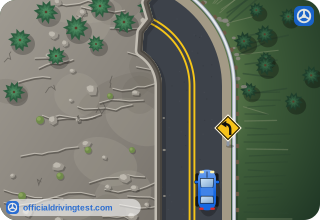
What should you be prepared to do when approaching a curve or hill that obscures your view of the road?
- Stop
- Pass the vehicle ahead
- Switch on your high beams
- Accelerate to the top
Show answer
Correct answer: Stop
Hills and curves can hide obstructions, so be prepared to stop.
Source: Colorado Driver Handbook (DR 2337, January 2025), page 16 · Open this page in the manual (Manual page 16)
-
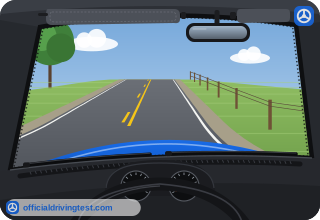
If you cannot see over the top of a hill, what should you do?
- Keep your speed and sound your horn as you reach the top
- Move to the center of the road so oncoming drivers see you
- Slow down until you crest the hill and can see the roadway
- Switch to your high beams and keep a steady speed uphill
Show answer
Correct answer: Slow down until you crest the hill and can see the roadway
Slow down to an appropriate speed until you crest the hill and regain sight of the roadway.
Source: Colorado Driver Handbook (DR 2337, January 2025), page 16 · Open this page in the manual (Manual page 16)
-
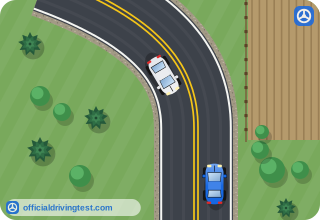
What can happen if you go through a curve too fast?
- Your brakes will lock and the engine will stall
- Your tires will not grip the road and the vehicle will skid
- Your headlights will point away from the road ahead
- Your steering wheel will lock in place
Show answer
Correct answer: Your tires will not grip the road and the vehicle will skid
The handbook says that at too high a speed your tires cannot grip the road and the vehicle will skid.
Source: Colorado Driver Handbook (DR 2337, January 2025), page 16 · Open this page in the manual (Manual page 16)
-
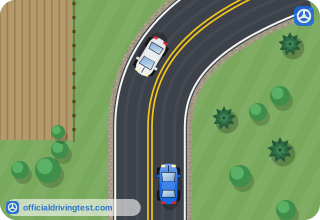
When in a curve should you begin to accelerate?
- As soon as you enter the curve
- Just before you enter the curve
- Only after you fully leave the curve
- After reaching the middle of the curve
Show answer
Correct answer: After reaching the middle of the curve
Begin your acceleration only after reaching the middle of the curve.
Source: Colorado Driver Handbook (DR 2337, January 2025), page 16 · Open this page in the manual (Manual page 16)
-
What should you do with your following distance when driving at night or on unfamiliar roads?
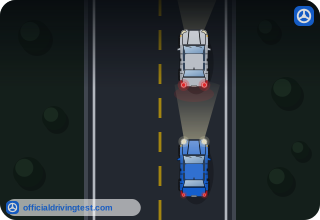
- Decrease it
- Increase it
- Keep it the same as in the daytime
- Shorten it so you can see the taillights better
Show answer
Correct answer: Increase it
The handbook says to increase your following distance at night or on unfamiliar roads.
Source: Colorado Driver Handbook (DR 2337, January 2025), page 16 · Open this page in the manual (Manual page 16)
-
What should you do in poorly lit areas where vehicles, pedestrians, bicyclists or animals might be traveling?
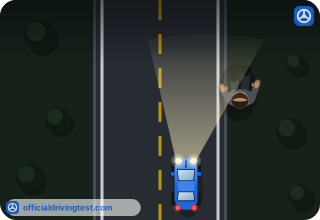
- Slow down and stay alert
- Speed up to pass through quickly
- Use only your parking lights to avoid glare
- Stop and wait for daylight
Show answer
Correct answer: Slow down and stay alert
The handbook says to slow down and stay alert in poorly lit areas.
Source: Colorado Driver Handbook (DR 2337, January 2025), page 16 · Open this page in the manual (Manual page 16)
-
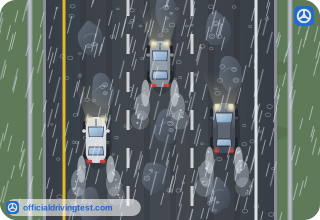
In rain, fog, ice, high winds or dust, what are the two most important actions you can take?
- Turn on your hazard lights and keep to the center lane
- Slow your speed and increase your following distance
- Use cruise control and keep up with traffic
- Switch to high beams and move to the left lane
Show answer
Correct answer: Slow your speed and increase your following distance
The two most important actions in inclement weather are to slow your speed and increase your following distance.
Source: Colorado Driver Handbook (DR 2337, January 2025), page 16 · Open this page in the manual (Manual page 16)