Colorado: Speed and following distance — Part 1 Practice Test
Questions in this part include: “Which is part of the drive test's speed control factor?” · “Unless otherwise posted, what is the speed limit on narrow, winding mountain highways and blind curves?”
Independent educational site · not affiliated with any government agency or DMV
Ready? Test yourself
- Instant feedback with an explanation
- Every answer cites its source in the manual
- Your best score is saved on this device
Questions are original and based on the official manual "Colorado Driver Handbook" (DR 2337, January 2025), Colorado Division of Motor Vehicles (DMV).
All 17 questions in this practice test
Take the test above first, then use this list to study. Tap “Show answer” to see the correct answer and explanation.
Show the questions and answersHide the questions
-
Which is part of the drive test's speed control factor?
- Maintaining a steady speed during a lane change
- Speeding up while changing lanes
- Slowing sharply before every lane change
- Braking hard during turns to stay in control
Show answer
Correct answer: Maintaining a steady speed during a lane change
Speed control includes maintaining a steady speed during a lane change.
Source: Colorado Driver Handbook (DR 2337, January 2025), page 2 · Open this page in the manual (Manual page 2)
-
At what speed should you approach an intersection on the drive test, according to speed control?
- A speed that lets you come to a complete stop before every turn you make
- A speed slightly above the limit so that you clear the intersection quickly
- A speed that lets you make the turn without stopping or braking during the turn
- A speed that lets you brake firmly once you are in the middle of the turn
Show answer
Correct answer: A speed that lets you make the turn without stopping or braking during the turn
You should approach an intersection at a speed that allows the turn to be made without stopping or braking during the turn.
Source: Colorado Driver Handbook (DR 2337, January 2025), page 2 · Open this page in the manual (Manual page 2)
-
How can you tell on the drive test that you are at an adequate distance from the vehicle in front of you when stopped?
- You can see the bumper of that vehicle in your mirror
- You can see the license plate of that vehicle clearly
- You can see about one car length of pavement ahead
- You can see the rear wheels of that vehicle touching the ground
Show answer
Correct answer: You can see the rear wheels of that vehicle touching the ground
If you can see the rear wheels touching the ground of the vehicle in front of you, you are at an adequate distance.
Source: Colorado Driver Handbook (DR 2337, January 2025), page 2 · Open this page in the manual (Manual page 2)
-
According to the handbook, what is the greatest factor influencing the severity of a crash?
- Weather
- Driver age
- Vehicle size
- Speed
Show answer
Correct answer: Speed
The handbook states that speed is the greatest factor influencing the severity of a crash.
Source: Colorado Driver Handbook (DR 2337, January 2025), page 12 · Open this page in the manual (Manual page 12)
-
What do speed limit signs show?
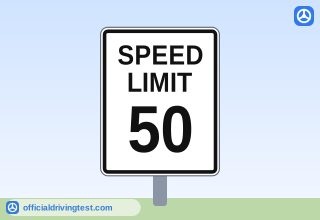
- The maximum speed allowed in ideal conditions
- The speed you should always drive
- The average speed of traffic
- The minimum speed allowed in ideal conditions
Show answer
Correct answer: The maximum speed allowed in ideal conditions
Speed limit signs show the maximum speed allowed in ideal conditions.
Source: Colorado Driver Handbook (DR 2337, January 2025), page 12 · Open this page in the manual (Manual page 12)
-
What is the rule on driving slower than a posted minimum speed limit, such as on a freeway?
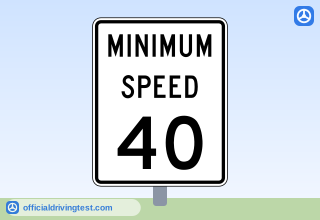
- It is allowed in the right lane only, at any time of day
- It is allowed whenever you turn on your hazard lights
- It is a traffic violation, unless due to road or weather
- It is allowed at night when the road has no other traffic
Show answer
Correct answer: It is a traffic violation, unless due to road or weather
Driving slower than the minimum speed limit is a traffic violation, unless due to road or weather conditions.
Source: Colorado Driver Handbook (DR 2337, January 2025), page 12 · Open this page in the manual (Manual page 12)
-
In which of these conditions does the handbook say it is important to slow down?
- On a freeway with no other vehicles near
- During poor weather
- When driving on a dry road in the daytime
- When no pedestrians are nearby
Show answer
Correct answer: During poor weather
The handbook lists poor weather and the presence of railroad tracks, pedestrians, bicyclists, animals and school buses.
Source: Colorado Driver Handbook (DR 2337, January 2025), page 12 · Open this page in the manual (Manual page 12)
-
What can driving much slower than the posted speed in normal conditions do?
- It makes a crash less likely in every situation
- It reduces your stopping distance to almost zero
- It gives other drivers time to rest and relax
- It can affect traffic flow and create unsafe situations
Show answer
Correct answer: It can affect traffic flow and create unsafe situations
Driving much slower than the posted speed in normal conditions can affect traffic flow and create unsafe situations.
Source: Colorado Driver Handbook (DR 2337, January 2025), page 12 · Open this page in the manual (Manual page 12)
-
What does the handbook say about the posted speed limit and reduced speed zones?
- It may be necessary to reduce speed regardless of the posted limit
- Reduced speed zones apply only at night
- The posted limit is always safe, so you never need to slow down
- Reduced limits apply only in school zones
Show answer
Correct answer: It may be necessary to reduce speed regardless of the posted limit
Regardless of the posted limit it may be necessary to reduce speed, and signs show when a reduced speed limit is in effect.
Source: Colorado Driver Handbook (DR 2337, January 2025), page 12 · Open this page in the manual (Manual page 12)
-
Unless otherwise posted, what is the speed limit on narrow, winding mountain highways and blind curves?
- 15 mph
- 25 mph
- 20 mph
- 30 mph
Show answer
Correct answer: 20 mph
Colorado's speed limit on narrow, winding mountain highways and blind curves is 20 mph unless otherwise posted.
Source: Colorado Driver Handbook (DR 2337, January 2025), page 12 · Open this page in the manual (Manual page 12)
-
Unless otherwise posted, what is the speed limit in any business district?
- 20 mph
- 25 mph
- 30 mph
- 35 mph
Show answer
Correct answer: 25 mph
The handbook lists 25 mph in any business district.
Source: Colorado Driver Handbook (DR 2337, January 2025), page 12 · Open this page in the manual (Manual page 12)
-
Unless otherwise posted, what is the speed limit in any residence district?
- 20 mph
- 25 mph
- 35 mph
- 30 mph
Show answer
Correct answer: 30 mph
The handbook lists 30 mph in any residence district.
Source: Colorado Driver Handbook (DR 2337, January 2025), page 12 · Open this page in the manual (Manual page 12)
-
Unless otherwise posted, what is the speed limit on open mountain highways?
- 40 mph
- 30 mph
- 35 mph
- 45 mph
Show answer
Correct answer: 40 mph
The handbook lists 40 mph on open mountain highways.
Source: Colorado Driver Handbook (DR 2337, January 2025), page 12 · Open this page in the manual (Manual page 12)
-
Unless otherwise posted, what is the speed limit for vehicles in the business of hauling trash?
- 35 mph
- 40 mph
- 45 mph
- 55 mph
Show answer
Correct answer: 45 mph
The handbook lists 45 mph for vehicles in the business of hauling trash.
Source: Colorado Driver Handbook (DR 2337, January 2025), page 12 · Open this page in the manual (Manual page 12)
-
Unless otherwise posted, what is the speed limit on urban interstates and highways?
- 45 mph
- 55 mph
- 50 mph
- 65 mph
Show answer
Correct answer: 55 mph
The handbook lists 55 mph on urban interstate and highways.
Source: Colorado Driver Handbook (DR 2337, January 2025), page 12 · Open this page in the manual (Manual page 12)
-
Unless otherwise posted, what is the speed limit range on designated rural interstates and highways?
- 55 to 65 mph
- 55 to 70 mph
- 70 to 80 mph
- 65 to 75 mph
Show answer
Correct answer: 65 to 75 mph
The handbook lists 65-75 mph on designated rural interstate and highways.
Source: Colorado Driver Handbook (DR 2337, January 2025), page 12 · Open this page in the manual (Manual page 12)
-
What may cities or towns do about speed limits in their jurisdictions?
- Adopt lower speed limits by ordinance
- Raise the speed limits above the state limits
- Remove the speed limits on local roads
- Adopt speed limits only on freeways
Show answer
Correct answer: Adopt lower speed limits by ordinance
The handbook says cities or towns may by ordinance adopt lower speed limits.
Source: Colorado Driver Handbook (DR 2337, January 2025), page 12 · Open this page in the manual (Manual page 12)