Colorado: Sharing the road — Part 5 Practice Test
Questions in this part include: “On a multi-lane, one-way street, where can a bicyclist ride?” · “What is the "Dutch Reach" way of opening your vehicle door?”
Independent educational site · not affiliated with any government agency or DMV
Ready? Test yourself
- Instant feedback with an explanation
- Every answer cites its source in the manual
- Your best score is saved on this device
Questions are original and based on the official manual "Colorado Driver Handbook" (DR 2337, January 2025), Colorado Division of Motor Vehicles (DMV).
All 17 questions in this practice test
Take the test above first, then use this list to study. Tap “Show answer” to see the correct answer and explanation.
Show the questions and answersHide the questions
-
On a multi-lane, one-way street, where can a bicyclist ride?
- Only on the right side of the roadway
- On the right or left side of the roadway
- Only on the left side of the roadway
- Only in the center lane
Show answer
Correct answer: On the right or left side of the roadway
The manual says a bicyclist can ride on the right or left side of the roadway on a multi-lane, one-way street.
Source: Colorado Driver Handbook (DR 2337, January 2025), page 23 · Open this page in the manual (Manual page 23)
-
What does the handbook say about forcing a bicyclist off the road?
- It constitutes aggressive driving and has legal consequences
- It is legal if the bicyclist is not in a bike lane
- It is a parking violation
- It is permitted when the bicyclist rides side by side with another
Show answer
Correct answer: It constitutes aggressive driving and has legal consequences
The manual states that forcing a bicyclist off the road constitutes aggressive driving and has legal consequences.
Source: Colorado Driver Handbook (DR 2337, January 2025), page 23 · Open this page in the manual (Manual page 23)
-
A law passed in 2022 lets bicyclists treat stop signs as yield signs and stop lights as stop signs, when the intersection is clear and the bicyclist already has the right-of-way. What is the minimum age?
- 12
- 14
- 15
- 18
Show answer
Correct answer: 15
The manual says the 2022 law applies to bicyclists ages 15 and older.
Source: Colorado Driver Handbook (DR 2337, January 2025), page 23 · Open this page in the manual (Manual page 23)
-
Under the 2022 law, how may bicyclists ages 15 and older treat a stop light when the intersection is clear and they already have the right-of-way?
- As a yield sign
- As a stop sign
- As a green light
- As a flashing yellow light
Show answer
Correct answer: As a stop sign
The manual says such bicyclists may treat stop lights as stop signs, and stop signs as yield signs.
Source: Colorado Driver Handbook (DR 2337, January 2025), page 23 · Open this page in the manual (Manual page 23)
-
The handbook advises leaving more than three feet of passing distance in which situations?
- When driving a small car on a city street at low speed
- Only when the bicyclist is wearing dark clothing at night
- Only when it is raining heavily or the road is icy
- When driving larger vehicles or in rural or windy conditions
Show answer
Correct answer: When driving larger vehicles or in rural or windy conditions
The manual advises more than three feet in these conditions to avoid dangerous wind blasts.
Source: Colorado Driver Handbook (DR 2337, January 2025), page 23 · Open this page in the manual (Manual page 23)
-
Why should you not turn sharply, slow down or stop abruptly in front of a bicyclist?
- A motor vehicle's brakes are more powerful than a bicycle's
- A bicycle's brakes are more powerful than a motor vehicle's
- Bicyclists cannot see the brake lights of vehicles ahead
- Bicyclists never slow down once they begin riding
Show answer
Correct answer: A motor vehicle's brakes are more powerful than a bicycle's
The manual says a motor vehicle's brakes are more powerful than a bicycle's and you could cause a crash.
Source: Colorado Driver Handbook (DR 2337, January 2025), page 23 · Open this page in the manual (Manual page 23)
-
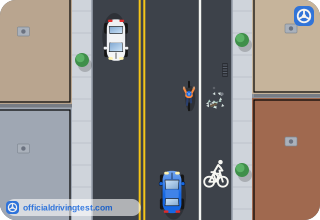
Why should you be particularly careful around bicyclists when the roadway is wet or covered with debris?
- Bicyclists are required to stop riding in such conditions
- Bicyclists are not allowed on wet roads or roads with debris
- They affect people on bicycles much more than people in vehicles
- Motor vehicles are affected more than bicycles by these things
Show answer
Correct answer: They affect people on bicycles much more than people in vehicles
The manual says wet or debris-covered roads affect people on bicycles much more than people in vehicles.
Source: Colorado Driver Handbook (DR 2337, January 2025), page 23 · Open this page in the manual (Manual page 23)
-
What is the "Dutch Reach" way of opening your vehicle door?
- Opening it with the hand that is closest to the door itself
- Opening it with the hand closest to the center of the vehicle
- Honking your horn twice before you open your door at all
- Opening it a few inches and waiting for traffic to pass
Show answer
Correct answer: Opening it with the hand closest to the center of the vehicle
The manual describes the Dutch Reach as using the hand closest to the center of the vehicle to open your door.
Source: Colorado Driver Handbook (DR 2337, January 2025), page 23 · Open this page in the manual (Manual page 23)
-
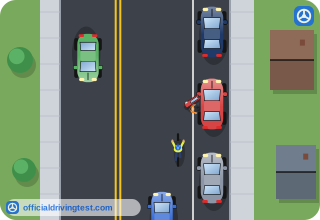
When parked on the street, what should you do before you open your vehicle door?
- Sound your horn
- Turn on your hazard lights
- Wait for a bicyclist to pass in front of you
- Check to the sides and rear for bicyclists
Show answer
Correct answer: Check to the sides and rear for bicyclists
The manual says to check to the sides and rear for bicyclists before opening your door.
Source: Colorado Driver Handbook (DR 2337, January 2025), page 23 · Open this page in the manual (Manual page 23)
-
Before backing up, changing lanes or turning, what should you check for?
- Bicyclists in your path and blind spots
- Only vehicles in the mirror
- Only pedestrians in the crosswalk
- Only bike lane signs
Show answer
Correct answer: Bicyclists in your path and blind spots
The manual says to check for bicyclists in your path and blind spots before backing up, changing lanes or turning.
Source: Colorado Driver Handbook (DR 2337, January 2025), page 23 · Open this page in the manual (Manual page 23)
-
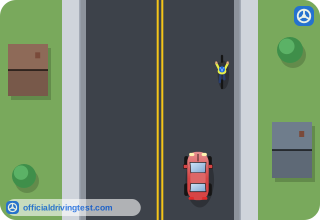
When should you sound your horn close to bicyclists?
- Only if there is an immediate risk of a crash
- Always, to warn them you are passing
- Whenever you approach them from behind
- Whenever they ride in the center of the lane
Show answer
Correct answer: Only if there is an immediate risk of a crash
The manual says to avoid sounding your horn close to bicyclists unless there is an immediate risk of a crash, because it may startle them.
Source: Colorado Driver Handbook (DR 2337, January 2025), page 23 · Open this page in the manual (Manual page 23)
-
If a bicyclist is not giving a hand signal, what else can show the bicyclist's intent?
- Ringing a bell or sounding a small horn as they ride
- Turning their head or looking over their shoulder
- Pedaling faster just before they change lane position
- Moving to the far left edge of the road at once
Show answer
Correct answer: Turning their head or looking over their shoulder
The manual tells drivers to look for clues such as turning the head or looking over the shoulder before the bicyclist changes lane position.
Source: Colorado Driver Handbook (DR 2337, January 2025), page 23 · Open this page in the manual (Manual page 23)
-
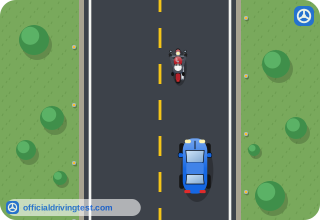
What rights and responsibilities do motorcyclists have on the road?
- Fewer rights than other drivers
- The same as other drivers
- Rights only in designated motorcycle lanes
- No responsibility to follow traffic signals
Show answer
Correct answer: The same as other drivers
The handbook states that motorcyclists have the same rights and responsibilities as other drivers.
Source: Colorado Driver Handbook (DR 2337, January 2025), page 23 · Open this page in the manual (Manual page 23)
-
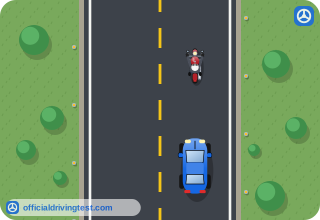
How much of a lane is a motorcyclist entitled to?
- Half of the lane width, on the left side
- Only the left third of the lane, when it is wide
- Only the part of the lane not needed by cars
- The same full lane width as other vehicles
Show answer
Correct answer: The same full lane width as other vehicles
The manual says motorcyclists are entitled to the same full lane width as other vehicles.
Source: Colorado Driver Handbook (DR 2337, January 2025), page 23 · Open this page in the manual (Manual page 23)
-
Why do motorcyclists frequently move around in their lane?
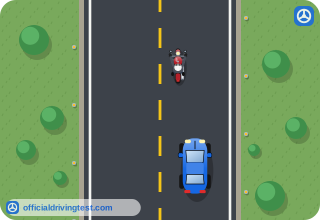
- To see, be seen and avoid road hazards
- Because they are not allowed to hold a position
- To pass cars in the same lane at any speed
- To save fuel
Show answer
Correct answer: To see, be seen and avoid road hazards
The manual explains that motorcyclists move in their lane so they can see, be seen and avoid road hazards.
Source: Colorado Driver Handbook (DR 2337, January 2025), page 23 · Open this page in the manual (Manual page 23)
-
What can unexpectedly move a motorcycle out of its lane?
- Light rain
- Bright headlights
- Strong winds
- Painted lane markings
Show answer
Correct answer: Strong winds
The manual says strong winds can unexpectedly move a motorcycle out of its lane.
Source: Colorado Driver Handbook (DR 2337, January 2025), page 23 · Open this page in the manual (Manual page 23)
-
What must be true for a two-wheeled motorcycle to lane filter past another vehicle in the same lane?
- Only the vehicle ahead is stopped and the adjacent lanes are moving
- The adjacent lanes are empty and the motorcycle uses a bike lane
- The motorcycle is traveling at 25 miles per hour or slower in free traffic
- Vehicles ahead and in adjacent lanes are stopped, with room to pass safely
Show answer
Correct answer: Vehicles ahead and in adjacent lanes are stopped, with room to pass safely
The manual lists these conditions for a two-wheeled motorcycle passing another motor vehicle in the same lane.
Source: Colorado Driver Handbook (DR 2337, January 2025), page 23 · Open this page in the manual (Manual page 23)